

Last Updated on 01/06/2025 by Chris Gampat
Late last year, we announced new changes to our reviews system. This is on top of all the other testing that we’ve done for years and called on the industry for. As it is, we’re constantly revamping our system of camera reviews. Today, we’re beginning the start of calling out what we believe to be falsehoods in the photography world. And this one has to do with a false statement about wet weather.
It’s 2025, and I’ve gotten very sick of misinformation amongst YouTubers, Influencers, etc., acting like they’re experts at something. I’ve held back on calling out other outlets for a while, but I’m starting to not care anymore. Fro got his stardom from calling out Ken Rockwell, though in the long run, I think we can say that both Ken and Jared were equally correct. A person can shoot RAW and also shoot JPEG and be perfecty fine. So, this article directly calls out Digital Camera World in a piece they published on December 23, 2024. In this article, they claimed that they’ve done the tests and that only one camera brand is great for wet-weather photography.
They’re wrong. As the editor-in-chief of a publication that conducts extensive weather resistance testing on the cameras and lenses we test, I can say this with full qualifications.
Table of Contents
Why You Should Trust Us
The Phoblographer has been around for 15 years in the photography industry. Alongside folks like Steve Huff, we were the first photography publication to take camera testing truly out of the lab and into the field. Our philosophy since the start has been that when you photograph a bride at her wedding, she won’t want to look at her pores at 100%. Trust me, I tried to sell it to brides that way; it didn’t work. So, instead, real photographers care more about what the camera can really do in the wild.
Over a decade ago, we started talking to camera manufacturers about their durability statements. Sometimes they say things like moisture resistant, dust resistant, splash proof, etc. But they never assign specific claims to these. They also don’t mean the same thing as waterproof: which to them, means that you can’t submerge the camera in water.
A few years ago, we were recognized by Lensrentals for our work in the weather-resistance category of camera testing. It’s a very eye-opening episode, and everything that we spoke of pretty much stands today years later.
Further, the Phoblographer’s reviewers are required to hold the manufacturers to their claims when it comes to weather resistance. We’re also required to provide images as proof that there’s rainfall, a trip to the beach, snow, etc.
Here are 27 photographs of the abuse that we’ve given to cameras and lenses as proof. You can even click on the images and see the entire filename in the URL to see more of what we’re talking about.


(
So really, we’re not playing around when it comes to stating what cameras are best for wet weather because we’ve done the tests for years.
More importantly, we’re a small staff of people who are both journalists and photographers. Because we’re a small staff, information gets transmitted easier amongst us and there are more people who are really versatile and can claim to be experts. We’ve got the work to show it off.
A Disclaimer
After doing these tests for years, the camera manufacturers refused to give clarifications about how durable their camera gear is. To that end, it’s not covered in your warranty. I asked many other publications to start pressing them, notably DPReview. But all of my pleas fell on seemingly deaf ears.
So I took matters into my own hands. A few years ago, the Phoblographer also launched the Photography Care Program; it’s a direct attempt to cover your camera gear and photography business just in case something gets destroyed. And better yet, it’s designed for amateur and professional photographers. If you camera gets wrecked due to rain or dust, your warranty won’t cover it. But the Photography Care Program will.
I AM NOT TELLING YOU TO BUY THE INSURANCE, BUT INSTEAD, I’M BEING DIRECT AND TRANSPARENT WITH YOU BECAUSE GOOD JOURNALISM DOES THAT.
If you want to buy it, then please know that the Phoblographer receives a referral fee for every person who follows through and signs up.
Leica Provides IP Durability on Their Cameras
And now, to finally talk about the cameras. Digital Camera World says that OM System is the only brand that provides the real deal when it comes to weather resistance. And I’m quoting the article here:
There’s only one mirrorless camera manufacturer which actually specifies a proper ingress protection (IP) rating for its high-end cameras, and that’s OM System. The OM-1 Mark II and OM5 are certified IP53, and OM System states they’re also built to work in temperatures down to -10°C.
‘IP53’ The first digit in an IP rating indicates solid particle (dust, in this case) resistance, while the second digit marks the degree of liquid protection. A solid particle resistance rating of 5 means a camera is protected against dust ingress to the extent that while dust may enter the camera, it shouldn’t “interfere with the safe operation of the equipment.” A liquid ingress protection rating of 3 certifies that the camera can resist “water falling as a spray at any angle up to 60°” for at least five minutes, and at a rate of 10 liters per minute. Consequently, the OM-1 Mark II and OM5 shouldn’t be harmed by typical rainfall, so you can confidently use them for wet-weather wildlife photography.
So there you have it: while any flagship mirrorless camera should be safe to use in the rain, only OM System actually guarantees this with a measurable protection rating.
Digital Camera World
But they’re wrong, Leica does this too; and they have for many years now. While cameras like the OM System OM1 provide IP53 durability, many Leica cameras also provide IP durability standards. For the record, we didn’t review the OM1 Mk II because to us, it seemed like just a firmware update.
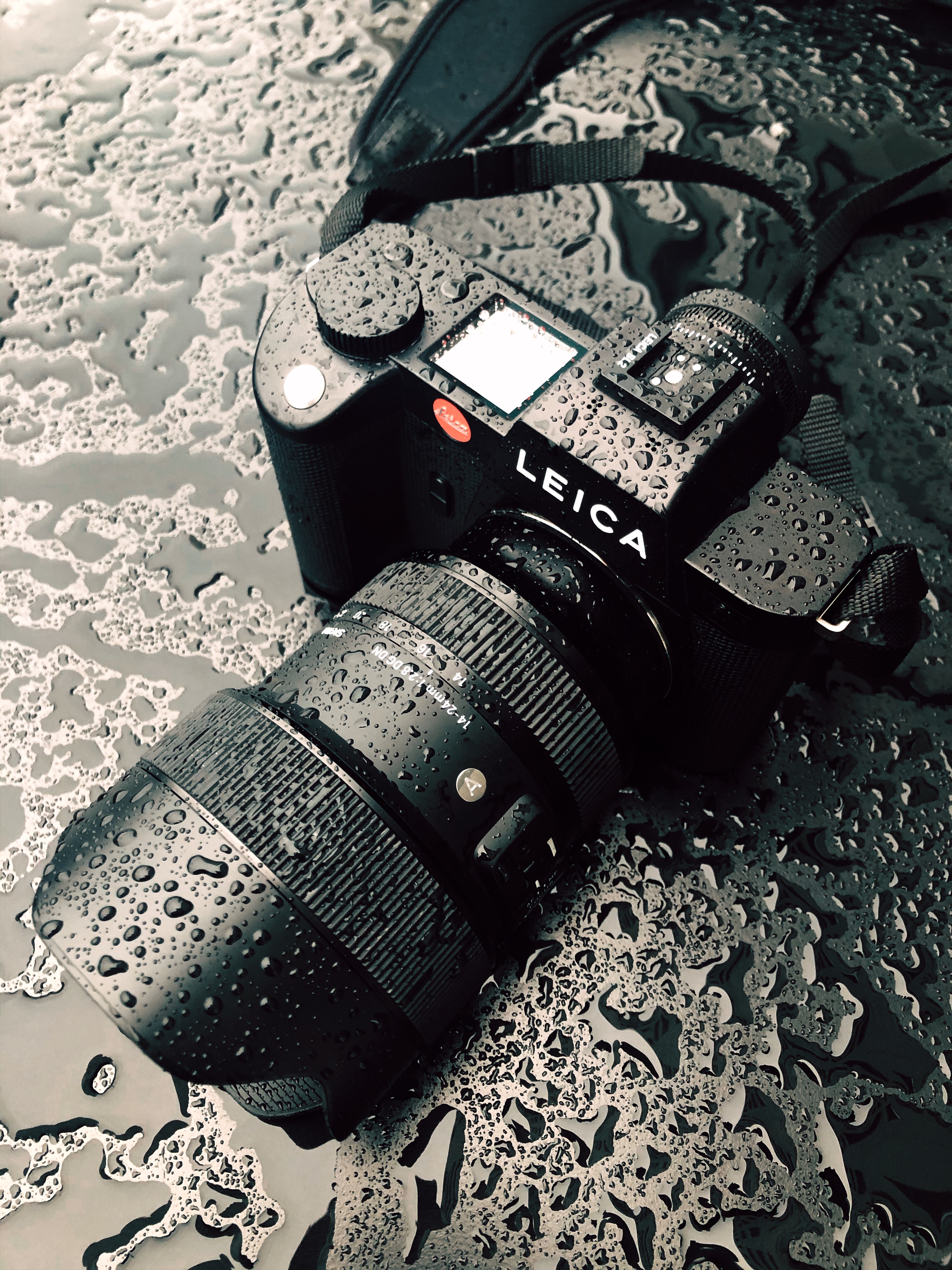
On the other hand, the Leica SL series of cameras have IP durability, but Leica doesn’t go as far as putting the same rating on their lenses — even though they claim to have similar durability. Leica goes as far as stating that their products have IP54 durability. For clarity, the 5 refers to dust resistance, specifically, “Ingress of dust is not entirely prevented, but it must not enter in sufficient quantity to interfere with the safe operation of the equipment,” according to the Wiki page.
The 4 refers to water resistance, and specifically, they refer the the splashing of water. They state, “Water splashing against the enclosure from any direction shall have no harmful effect, utilizing either: a) an oscillating fixture, or b) A spray nozzle with no shield. Test a) is conducted for 10 minutes. b) is conducted (without shield) for 5 minutes minimum.”
In contrast, OM System uses 3, which refers to spraying water. Specifically, it states, “Water falling as a spray at any angle up to 60° from the vertical shall have no harmful effect, utilizing either: a) an oscillating fixture, or b) a spray nozzle with a counterbalanced shield. Test a) is conducted for 5 minutes, then repeated with the specimen rotated horizontally by 90° for the second 5-minute test. Test b) is conducted (with a shield in place) for 5 minutes minimum.”
And here’s a list of Leica cameras with an IP54 durability rating, along with links to the reviews that we’ve done:
- Leica SL2s: A camera I bought personally and have used for many years with great effect.
- Leica SL3: This thing is a tank
- Leica SL2: one of the OGs. We absolutely abused this camera in the winter
I can only imagine that Leica’s SL system is going to stay as durable or get even more so in the future. The Leica M cameras don’t have the same rating, but they’ve survived some crazy things since the days of Robert Capa.
For the record, the Leica Q2 is rated at IP52, which is below what the camera company formerly known as Olympus rates. That also means that the Leica Q2 Monochrom is similar. However, the Leica Q3 and Q3 43 are rated to IP53 IP52, which is the same as OM System.
Editor’s Correction: Leica sent us the below
Please note that the following Leica cameras are IP52 rated: Leica Q2, Leica Q2 Monochrom, Leica Q3 & Leica Q3 43.
Please note that the following Leica cameras are IP54 rated: Leica SL2, Leica SL2-S, Leica SL3.
E
But What About Canon, Nikon, and Sony?
Let me start this section by saying this: if you’re a serious photographer that’s serious about finding gainful employment with your photographs, you’re probably not using APS-C or 4/3 system cameras to make still images unless you’ve been using the camera that you have for a while now. Smaller sensors aren’t as capable as bigger sensors, and all the technology in the higher end cameras are arguably better suited to the full frame cameras anyway.
So what about Canon, Nikon, and Sony?
Well, for years, Sony’s weather resistance hasn’t been that great until the Sony a1 came around. Only then did the durability majorly increase for pretty much every point on the camera except for the hot shoe. More specifically, we’ve only found this to be true for the Sony a1, Sony a9 III, and the Sony a1 II. The Sony a7 series and below don’t have the same durability at all.
Canon and Nikon, however, are much better at this. To clarify that statement, none of their cameras have ever given us error messages in the rain when used with solid weather-resistant lenses. By that, we mean the brand’s highest-end lenses and anything that Tamron makes. We’d know: we’ve tested more Canon RF, Nikon Z, and Tamron lenses than any other outlet in the field. We’ve even got our own guides to these lenses.
So what’s the truth? Leica can stand up to all of these cameras when it comes to durability. Further, the Leica L mount has great lens options available from both Leica and Panasonic Lumix. If you can handle Sigma’s weight and intermittent clunkiness when it comes to autofocus, then you’ve also got more options to choose from providing that the brand says that they’re weather resistant.
Get rid of the ads!
Did you enjoy reading this article as much as we enjoyed writing it? There's a way to support us and our reporting, getting ad-free navigation and more as a bonus. Subscribe to us for less than a coffee per month —just $3.99— or take advantage of our yearly subscription with a hefty discount for only $25.- An ad-free experience
- A free mystery box for Lightroom or Capture One
- All the books in our store
- 20% discount on Capture One
- 30% discount on Imalume Photo Theft Protection
- 20% off Herbs and Kettle Tea Company.
- 20% off your order from MPIX printing services.
- 5% off Viltrox Products via their eCommerce store.
- 10% off all film developing, printing and scanning services from Blue Moon Camera and Machine
- 15% off 7Artisans products: The lens and accessory maker is offering a sweet discount for Phoblographer's readers.