


“If you can’t afford a Leica, this is the one to get.” Those are the words of the Sony Rep that demoed the NEX-7 to me. The other day, I finally got my hands on the extremely coveted Sony NEX-7 (or NEX7 and NEX 7). Though the reviews have already started to come out, I’m still waiting for my units to give them a full run through. However, this camera seemed extremely impressive during the brief time I spent with it as did the 24mm f1.8 lens.
Note that these were pre-production models though.
Tech Specs
| Lens Compatibility | Sony E-mount lens, (Sony A-mount lenses when used with LA-EA1 or LA-EA2 lens adaptor) |
| Camera Type | Sony E-mount interchangeable lens digital camera |
| Imaging Sensor | |
| Imaging Sensor | Exmor™ APS HD CMOS sensor (23.5 X 15.6mm) |
| Processor | BIONZ™ image processor |
| Anti Dust | Charge protection coating on Low-Pass Filter and electromagnetic vibration mechanism |
| Pixel Gross | Approx. 24.7 megapixels |
| Effective Picture Resolution | Approx. 24.3 megapixels |
| Focal Length Conversion Factor | 1.5x |
| Color Filter System | RGB primary color filters |
| Recording | |
| Media Type | Memory Stick PRO Duo™/Pro-HG Duo™/PRO-HG HX Duo™ media SD, SDHC and SDXC memory card |
| Color Space | sRGB, AdobeRGB |
| Still Image Mode | JPEG (Standard, Fine), RAW, RAW+JPEG |
| Still Image Size 16:9 | L size: 6000 x 3376 (20M) M size: 4240 x 2400 (10M) S size: 3008 x1688 (5.1M) |
| Still Image Size 3:2 | L size: 6000 x 4000 (24M) M size: 4240 x 2832 (12M) S size: 3008 x 2000 (6M) |
| Panorama Still Image Size | Horizontal Wide: 12,416 x 1,856 (23M) Horizontal Std.: 8,192 x 1,856 (15M) Vertical Wide: 2,160 x 5,536 (12M) Vertical Std.: 2,160 x 3,872 (8.4M) 3D Sweep Panorama: Horizontal Wide: 7152 X 1080 (7.7M) Horizontal Std.: 4912 X 1080 (5.3M) 16:9: 1920 X 1080 (2.1M) |
| Video Format | AVCHD / MP4 (MPEG-4 AVC (H.264)) |
| Video Mode | AVCHD: PS – 1920 x 1080/60p@28Mbps FX – 1920 x 1080/60i@24Mbps FH – 1920 x 1080/60i@17Mbps FX – 1920 x 1080/24p@24Mbps FH – 1920 x 1080/24p@17Mbps MP4: HD – 1440 x 1080/ 30p@12Mbps VGA – 640 x 480/ 30p@3Mbps |
| Video Signal | NTSC color, EIA standards |
| Audio Format | Dolby Digital (AC-3) / MPEG-4 AAC-LC |
| Microphone/Speaker | Built-in stereo microphone; Built-in, monaural speaker |
| Still Image File Format | JPEG (DCF Ver. 2.0, Exif Ver.2.3, MPF Baseline compliant), RAW (Sony ARW 2.3format), 3D MPO (MPF Extended compliant) |
| Optics/Lens | |
| Lens Mount Type | Sony E-mount |
| Viewfinder | |
| Type | 0.50″ XGA OLED EVF (Electronic viewfinder) (2,359k dots) |
| Diopter Adjustment | -4.0m-1 to +1.0m-1 |
| Field of View | Approx. 100% |
| Magnification | 1.09x (with 50mm lens at infinity, -1m-1 ) |
| LCD Display | |
| LCD Type | 3.0” TFT Xtra Fine™ LCD (921,600 pixels) w/TruBlack™ technology |
| Angle Adjustment | Up: Approx. 90 degrees, Down: Approx. 45 degrees |
| Brightness Control | Auto, Manual (5 steps between -2 to +2), Sunny Weather |
| Coverage | 100% |
| Live View | Yes, (Constant AF Live View) |
| Real-time image adjustment display | Yes(On/Off) |
| Histogram | Yes (On/off) |
| Peaking | Yes (MF only, Level setting: High/Mid/Low/Off), (Color: White/Red/Yellow) |
| Grid Display | Yes (On/off) |
| Customization | Brightness: Auto, Manual, Sunny Weather; Display Color: Black, White, Blue, Pink |
| Focus Control | |
| Focus System | Contrast AF |
| Focus Points | 25 points |
| AF Modes | Single-shot AF(AF-S), Continuous AF(AF-C) selectable, Direct Manual Focus (DMF), Manual Focus |
| Focus Area | Multi Point AF (25 points), Center Weighted AF, Flexible Spot AF |
| Focus Sensitivity | 0 EV to +20 EV (at ISO100 conversion with F2.8 lens) |
| Manual Focus Assist | Yes MF assist(5.9x, 11.7x) |
| Focus Features | Predictive Focus Control, Focus Lock |
| AF Illuminator | Built-in LED, Range: approx. 18″ – 9′ (0.5m-3m) |
| Exposure System | |
| Picture Effect(s) | 11 types (15 variations): Posterization (Color, B/W), Pop Color, Retro Photo, Partial Color (R,G,B,Y), High Contrast Monochrome, Toy Camera, Soft High-key, Soft Focus, HDR Painting, Rich-tone Monochrome, Miniature |
| Auto Exposure Lock | Yes (AE Lock with focus lock) |
| Color Temperature | 2500 – 9900 k with 15-step each Magenta/Green compensation (G7 to M7), Amber/Blue (A7 to B7) |
| Creative Style | Standard, Vivid, Neutral, Clear, Deep, Light, Portrait , Landscape, Sunset, Night Scene, Autumn leaves, Black & White, Sepia (Contrast (-3 to +3steps), Saturation(-3 to +3steps), Sharpness(-3 to +3steps)) |
| D-Range Optimizer | Yes: (Auto, Level, Off) |
| Exposure Bracketing | Yes: (3 Continuous) |
| Exposure Compensation | +/-5.0 EV(1/3EV steps) |
| Exposure Settings | iAUTO, Program AE (P), Aperture priority (A), Shutter priority (S), Manual (M), Sweep Panorama (2D), 3D Sweep Panorama, Anti Motion Blur, Scene Selection |
| ISO | Auto (ISO 100-16000), Selectable (ISO 100 to 1600) |
| Metering | Advanced 1200-zone evaluative metering |
| Metering Modes | Multi-segment, Center-weighted, Spot |
| Metering Sensitivity | 0EV-20EV, (at ISO 100 equivalent w/ f/2.8 lens) |
| Noise Reduction | Long Exposure NR: (On/Off, available at shutter speeds longer than 1 second) High ISO NR: (High/Normal/Low) |
| Scene Mode(s) | Portrait, Landscape, Macro, Sports action, Sunset, Night portrait, Night View, Handheld Twilight |
| White Balance Mode | Auto,Daylight, Shade, Cloudy, Incandescent, Fluorescent, Flash, Setting the color temperature, Color Filter, Custom |
| Drive System | |
| Continuous Shooting Speed | Continuous (Variable) Speed Priority (up to 10fps) |
| Drive Mode | Single-shot, Continuous, Speed Priority, Self-timer, Continuous Self-timer, Bracketing |
| Self-timer | 2-sec. or 10-sec. delay, (single, continuous 3 or 5 frames) |
| Shutter Speeds | 1/4000 to 30 seconds, bulb |
| Shutter Type | Electronically-controlled, vertical-traverse, focal-plane shutter |
| Flash | |
| Flash Compensation | ±3.0 EV (in 1/3 EV steps) |
| Flash Coverage | FOV coverage up to 18 mm (in the focal length) |
| Flash Metering System | Pre-flash TTL |
| Flash Modes | Auto, Fill-flash, Slow Sync., Rear Sync., Hi-speed sync., Wireless (with external flash), Off |
| Flash Type | Built-in, Pop-up Auto |
| Guide Number | 6 (in meters at ISO100) |
| Recycling Time | Approx. 4 sec. |
| Advanced Features | |
| Face Detection | On/On (Regist. Faces)/Off |
| Smile Shutter™ technology | Smile shutter (selectable from 3 steps) |
| Auto High Dynamic Range | Yes, (Auto Exposure Difference, Exposure difference Level (1-6 EV at 1.0 EV step), off) |
| Sweep Panorama | Horizontal (Wide/Standard), Vertical, and 3D Panorama |
| Interface | |
| BRAVIA® Sync™ | Yes, via HDMI with compatible BRAVIA HDTV |
| DVDirect | Yes, via USB |
| HD Output | HDMI® (TypeC mini) |
| Memory Card Slot | Dual compatibility slot: Memory Stick PRO Duo™/Pro-HG Duo™/PRO-HG HX Duo™ media – SD, SDHC and SDXC memory card |
| PhotoTV HD | Yes, with BRAVIA Sync™ enabled HDTV and HDMI® cable |
| USB Port(s) | USB2.0 Hi-speed (mass-storage, MTP) |
| Weights and Measurements | |
| Dimensions (Approx.) | Approx. 4-3/4 × 2-3/4 × 1-11/16″ (119.9 x 66.9 x 42.8mm) (W/H/D) excluding protrusions |
| Weight (Approx.) | Approx. 10.3 oz (291g) (excl battery & media) |
| Power | |
| Battery Type | InfoLITHIUM® NP-FW50 (7.2V) |
| Number of Still Images | Approx. 430 images (CIPA standard) |
| Software | |
| Supplied Software | PMB (Picture Motion Browser) v5.2; Image Data Converter SR v3.2; Image Data Lightbox SR v2.2 |
| Operating System Compatibility | Windows XP SP3 (32-bit), Windows Vista SP2, Windows 7 SP1; Mac OS X (v10.3-v10.6), PMB is not compatible with Mac OS. Camera (via USB), Image Data Converter, and Image Data Lightbox software are compatible with Mac OS. |
Ergonomics
The top of the Sony NEX-7 features the proprietary Sony hot shoe, the on/off switch, two settings dials and another button. Following the trend of having clean and stylish looks to cameras these days, the NEX 7 seems to make its own mark on the community as if it were Fashion Week for Cameras.

The back LCD screen is curious in that it flips up, but I really wish that it had a touch screen like the EP3. However, it’s nice to use when shooting from the hip; although sometimes it may think that your eye is near the viewfinder.
The back also features the pop-up flash button, playback button, a button/switch for AF/MF and Auto Exposure locking, two programmable buttons like the other NEX models, and the back dial. In manual mode, the dial operates as ISO control with the two top ones operating Aperture and Shutter speed. In aperture mode, it still controls the ISO. Sony’s initiative to do this pleases me, as ISO is the other major control in digital photography.
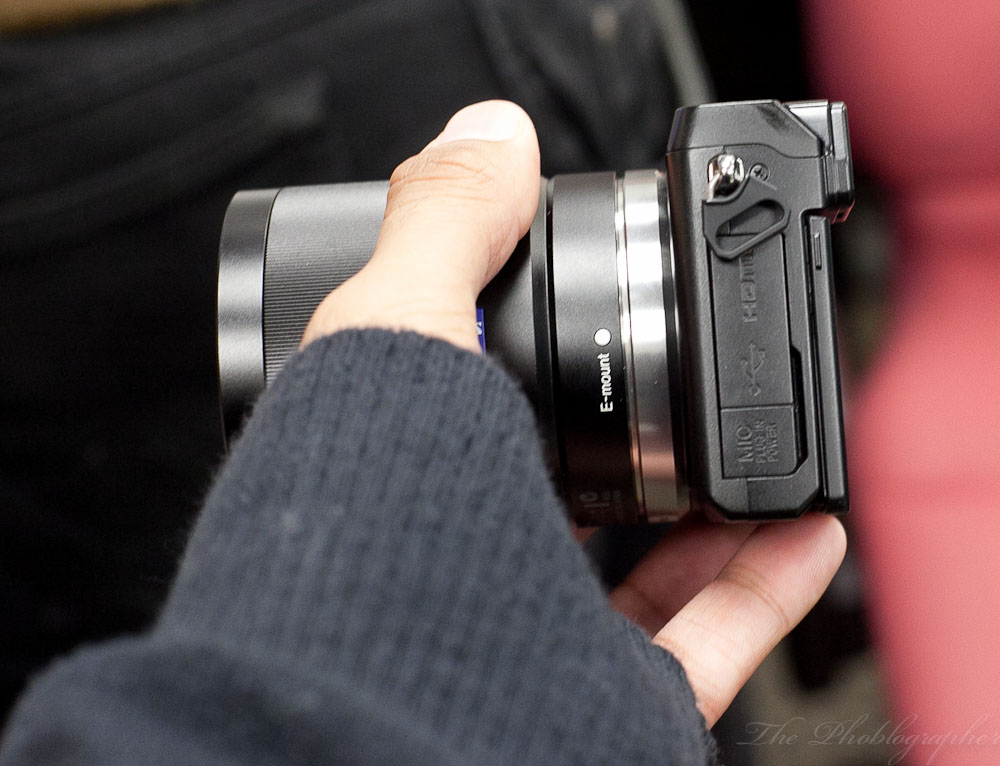
The side of the camera features the standard ports, nothing extremely special here.
Amazingly, the 24mm f1.8 is surprisingly light. It looks heavy in the photos, and it isn’t terribly large. It is much like a Leica lens in size. Still though, I yearn for smaller pancake lenses; especially for street photography.
Build Quality
When the rep said that this camera could replace your Leica, I was intrigued. The build quality is nothing like the M9 at all and I don’t even think that it’s on par with the EP3’s toughness. However, it still does feel very solid and may be just a bit below the EP3. If anything, it’s more like the Ricoh GXR.
Ease of Use
For the street photographer that wants to shoot in full manual mode, this is the camera to get. The dials are in all the right places, the viewfinder is big and beautiful, and LCD screen can flip up for shooting from the hip, and you’ve got a pop-up flash to shoot like Bruce Gilden.
The menu is still the NEX system’s menu, but now that there are more buttons, you don’t need to dig through them to find what you need.
Indeed, this camera is going to win awards. And I’m eagerly awaiting mine to come in for review. I couldn’t put a card in because it was a pre-production model, but the images with the 24mm lens were sharp and the bokeh was decent but nothing to get too excited about.
Please Support The Phoblographer
We love to bring you guys the latest and greatest news and gear related stuff. However, we can’t keep doing that unless we have your continued support. If you would like to purchase any of the items mentioned, please do so by clicking our links first and then purchasing the items as we then get a small portion of the sale to help run the website.
Get rid of the ads!
Did you enjoy reading this article as much as we enjoyed writing it? There's a way to support us and our reporting, getting ad-free navigation and more as a bonus. Subscribe to us for less than a coffee per month —just $3.99— or take advantage of our yearly subscription with a hefty discount for only $25.- An ad-free experience
- A free mystery box for Lightroom or Capture One
- All the books in our store
- 20% discount on Capture One
- 30% discount on Imalume Photo Theft Protection
- 20% off Herbs and Kettle Tea Company.