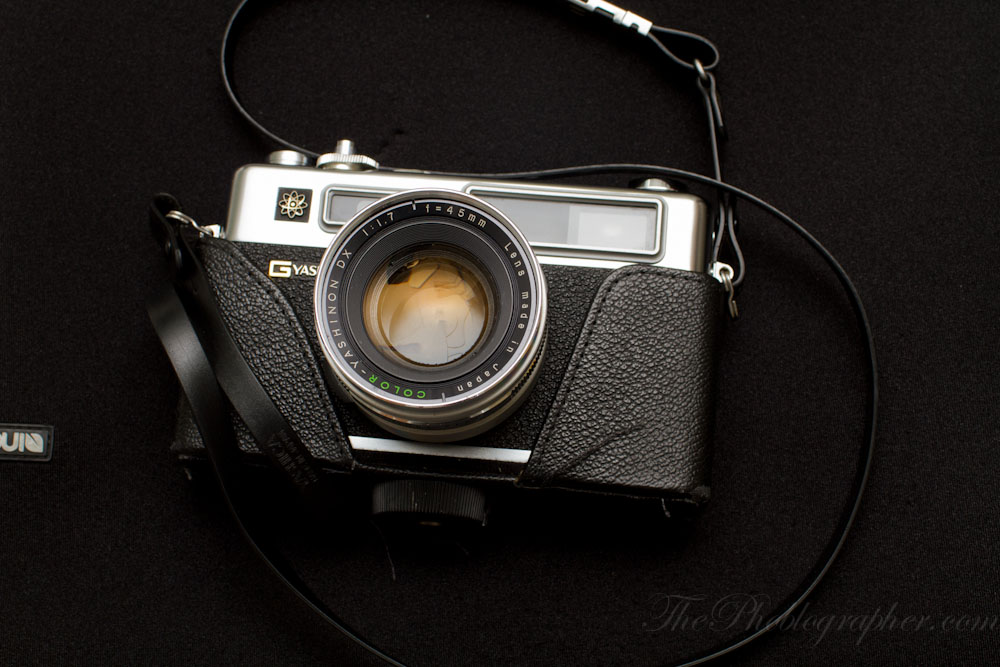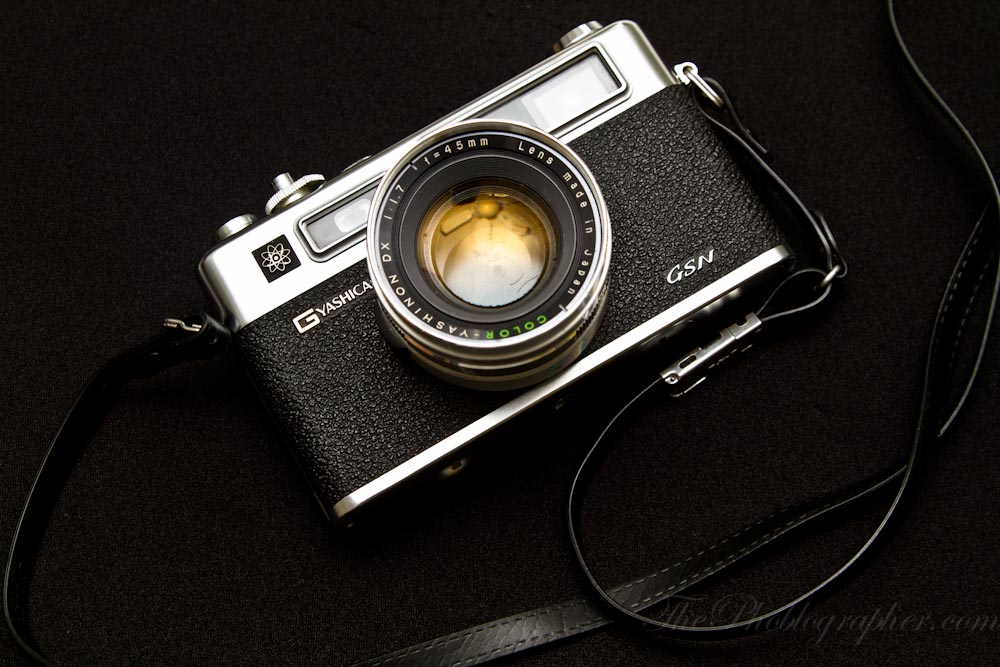
Review: Yashica Electro 35 GSN (The Poor Man’s Rangefinder)

by Chris Gampat on 07/26/2011

The Yashica Electro 35 GSN is a rangefinder camera that I personally purchased and that has been a dear love of mine since for street photography. After testing the Leica M9, M7 and the Fuji X100 (though the last is not a rangefinder), there were a number of reasons why I made the purchase. Besides the affordable cost combined with sharp lens, wonderful metering, and ease of use, the camera is built to last. But is it for everyone?

Tech Specs

  • From 1973 Yashica Camera Co., Japan
  • Film type 35mm (up to ISO 1000)
  • Weight 24.6oz (697.4g) sans battery
  • Lens Color Yashinon DX 45mm f1.7 (Color was just a marketing term)
  • Filter size 55mm threaded, 57mm slip-on
  • Focal range 2.6′ to infinity
  • Shutter Copal Elec (Leaf)
  • Shutter speeds B, 1/30, 30s-1/500 aperture priority (1/500 ONLY sans battery)
  • Viewfinder coupled rangefinder with auto parallax correction
  • Exposure meter lens mounted CdS, over/under lights in viewfinder. Other rangefinders had the meter on the lens for more accurate readings.
  • Battery originally PX32 5.6 Mercury, will accept 6v 28A or 4LR44 via an adapter from the Yashica Guy
  • Hotshoe
  • Self-timer
  • Battery check lamp
  • Fast-action wind lever

Ergonomics

The Yashica Electro 35 GSN isn’t an extremely small camera. In fact, my Olympus EP2 and the Fuji X100 are much smaller. However, the camera houses the equivalent of a full frame sensor: 35mm film! Yes, this is a film camera. The front of the camera is plain and simple. There is a lens, the rangefinder, the meter and nuclear symbol.

When you look at the top of the camera, you’ll see some serious business going on. One has the film advance lever with the film counter next to that. Then there is the shutter release. To lock it, one just needs to turn the dial to the locking position. This essentially turns the camera off in some ways. The shutter button is threaded to accept wired releases. Next to that is the ASA/ISO setting. This is by far one of the best ways I’ve seen it presented. Not only is it easy to access, but difficult to change and therefore throw off the camera’s metering.

Next to that are the Over and Slow lights. You’ll see this in the viewfinder, but that will tell you when the camera is overexposing or you’ll be shooting at a slow shutter speed. To compensate for these accordingly, you’ll need to adjust the F-stop until you reach a balance. In fact, the camera is Aperture priority only unless you switch to the bulb setting.

Next to the lights you have the hot shoe and the film rewind lever.

On the lens you have the apertures, the focus (with distance scale for hyperfocal length shooting) and some extra settings such as auto shutter, bulb or high speed flash sync.

How to Use One

First off, note that there is a major quirk to loading the film. In most cameras when you load the film, it wraps around the advance spool in a clockwise fashion. In the GSN, it goes counter clockwise with the advance still pushing it clockwise. This helps to protect your film if the back opens up, though not by much.

Focusing works exactly like a Leica or Voigtlander Bessa rangefinder. If you want to see how that works, check this out.

When you’ve taken a photo, you just need to advance the film. When you’re all out of film, you pop the button in on the bottom of the camera and rewind the film in the direction that the film rewind tells you. After you’re all done, just pop the back open, take the film out and reload.

A quick word before I go on: there is no advance lock. So if you advance the film once, and then advanced it again without firing, it will advance the film and you will have lost an area of film that you could have shot on.

Most photographers that use this camera will most likely keep it stopped down as the manual focusing will mean that you’ll need to take extra time to get the photo. To take the maximum advantage of this camera, you’re best off stopping it down when outside and often being aware of how far you’re focusing out at all times. When you see a scene that you love, just get right up to it and snap it.

Metering
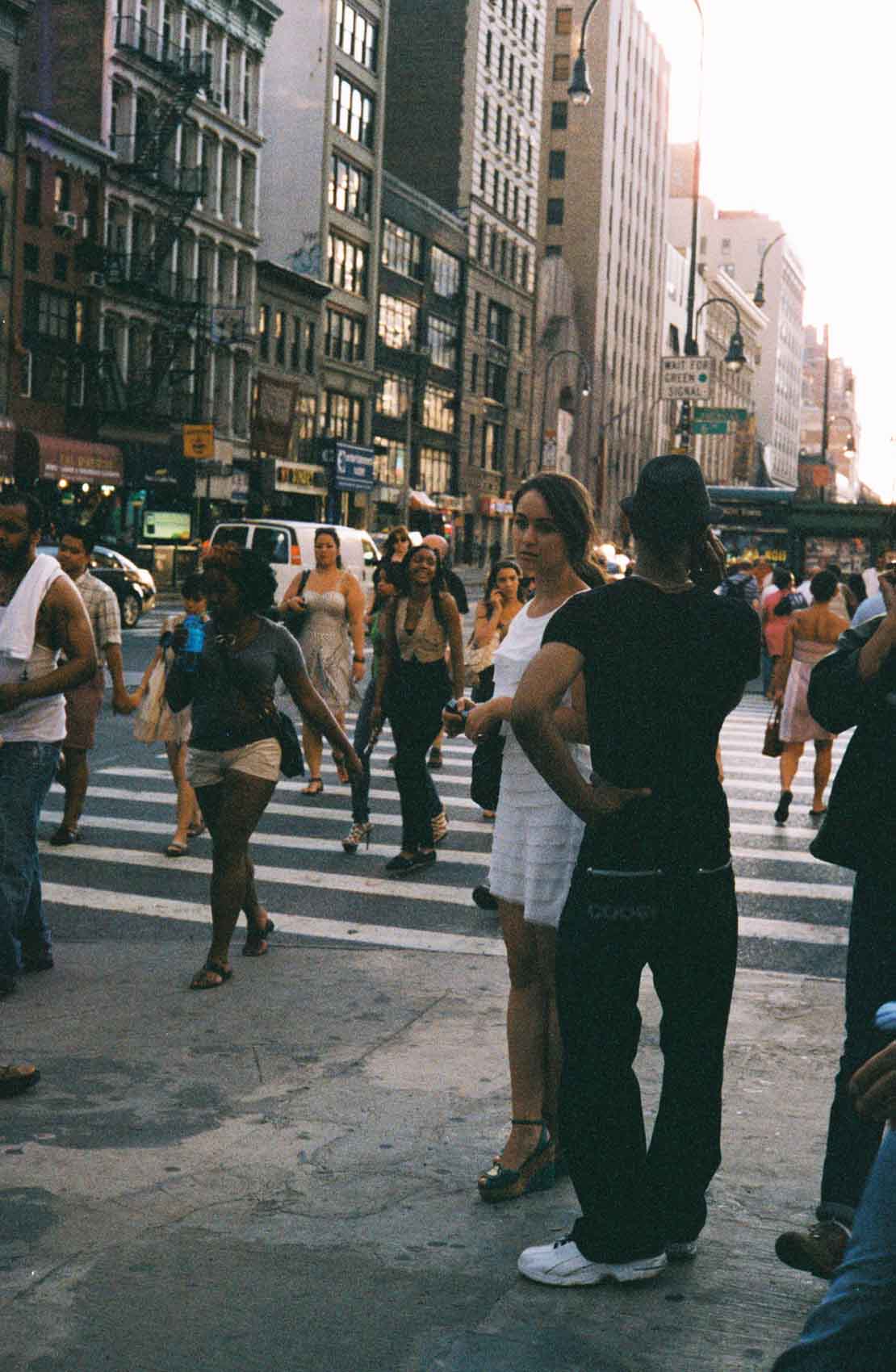
If you don’t want to pay attention to the camera’s meter, consider the Sunny 16 rule. However, I’ve seen from my film prints that the metering is actually quite good and very accurate. However, there is a problem. I really wish that there were an exposure lock function so that I could focus on one part, meter for the other part, recompose, and get a better exposure.

In the scene above, I had to focus on the woman in the dress and then recompose my image. To focus on her, I had to put the circle in the middle of the viewfinder over her. The problem is that when I recomposed, I was no longer metering for her but for another area. That’s a huge bummer because this image could have been much better.
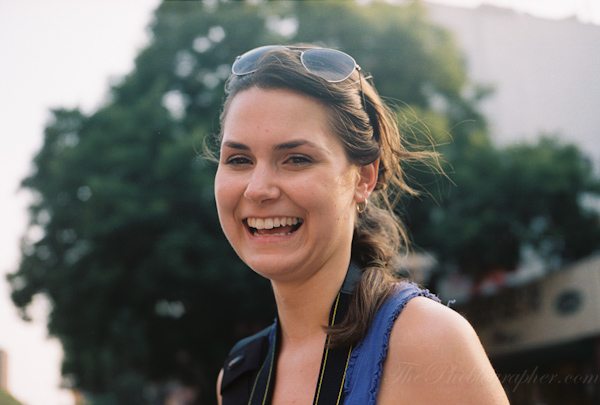
At other times when you meter for what’s in the center, you’ll often have perfectly exposed photos. Kodak Porta 400 VCis a wonderful film and has a great look to it if you expose your subject correctly.

Metering in low light when centering your subject is also very accurate.

Image Quality

For the most part, this lens is very sharp and when stopped down, only good things can be said about it.

In the photo above, the lens wasn’t stopped down as much and was probably open to f1.7. The lens can be softer then. But in addition, try to hold still especially if the meter is telling you that the exposure will be slow (as it did in the photo above.)

Most of the time though, you’ll often be very impressed by the image quality when combined with good film. This photo was once again taken with Portra.
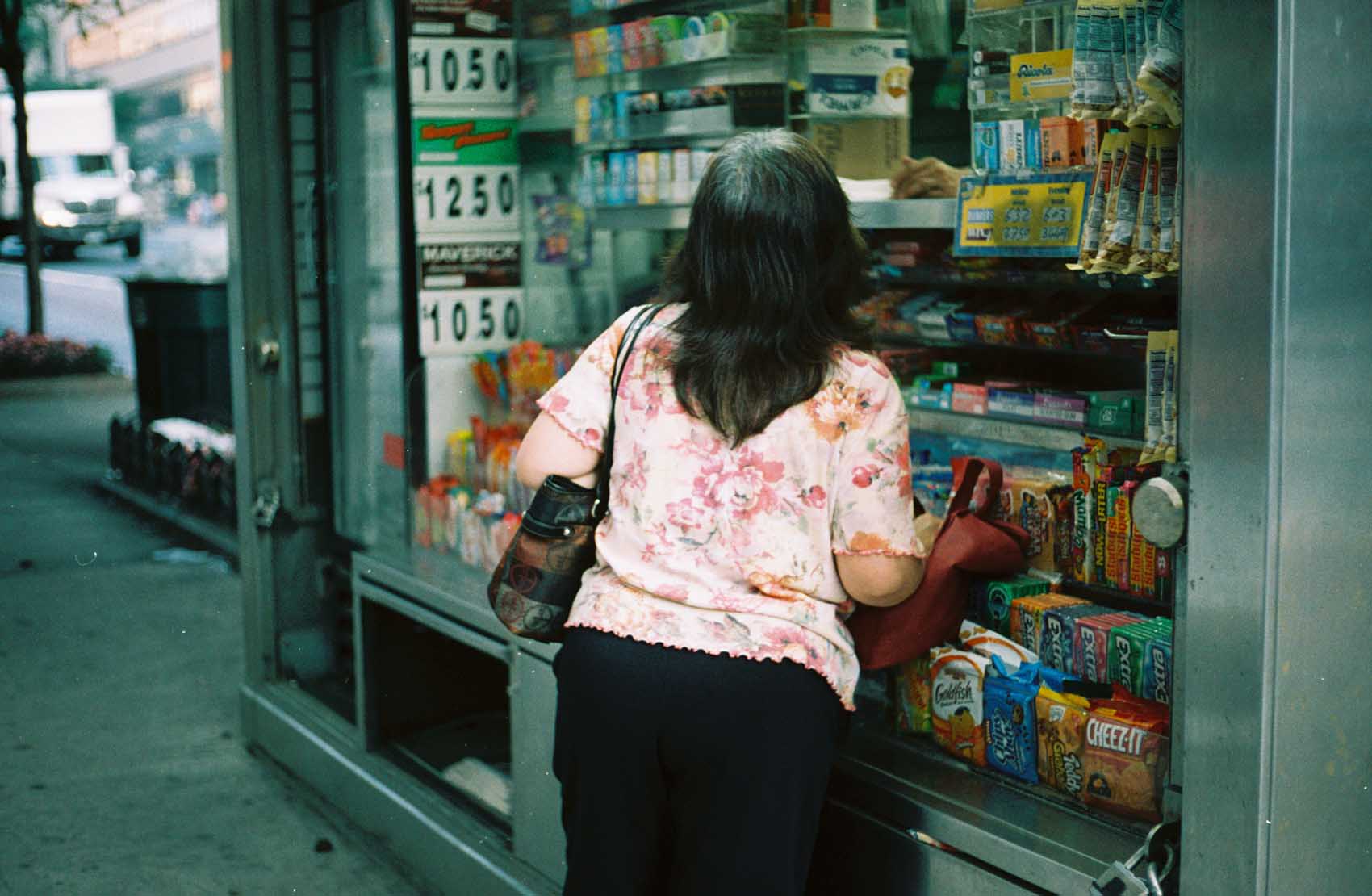
This photo was taken with expired Kodak Gold 100 (5 years.) However, the image quality still looks quite good. That’s partially a testament to how good the Yashica’s lens is.

The bokeh of this lens is okay. I wish it were creamier, but everything that is out of focus is still pleasing and not harsh at all.

When you use Lomography 800 filmyou’ll need to remember that this isn’t digital and that film grain will be there. Said graininess may take away from the sharpness of the images. In my eyes at least, I felt that the lower ISO films were plenty sharper.

However. 800 film will be essential for bars with low light. You’ll still also need to shoot wide open, which will add to your image’s softness. With that said, I wish that the Yashica’s lens were even faster.

Conclusions

So is the Yashica perfect? No, but it’s still very close to it. Called by many to be one of the best film rangefinders ever made, the Yashica Electro 35 GSN is easy to use, delivers sharp images, is portable, tough, and quite attractive looking. In terms of image quality, it can deliver some very good images if you choose the right film. I would not suggest using it with chromes because of the fact that you really need to nail your metering on that part. For those, you’re best off shooting full manual and this camera doesn’t have that.

For the street photographer that wants a rangefinder but that doesn’t want to dish out the money on a Leica, you’ll be in luck. The Online Photographer stated that one should spend an entire year shooting with one film, one camera and one lens. If you were to do that project, I’d recommend this camera. The 45mm focal length can handle nearly anything and the lens can also deliver some very stellar images.

However, if you’ve become spoiled by the more manual settings of a DSLR like exposure lock, you’ll be yearning for those features to help you create better photos.

But can you really complain for the price? I’d deem you crazy if you did.

Please Support The Phoblographer

We love to bring you guys the latest and greatest news and gear related stuff. However, we can’t keep doing that unless we have your continued support. If you would like to purchase any of the items mentioned, please do so by clicking our links first and then purchasing the items as we then get a small portion of the sale to help run the website.

  • http://twitter.com/Hit_TP Brenaman Jarmin Luiz

    I had the nicest of luck when I discovered that my father owned a GSN. Before this, my mother had kept the camera very nicely hidden from my conscience in their wardrobe before we moved house. When I stumbled upon this, I immediately took the camera and sent it to the camera repair shop to have it primed and updated (mercury batteries are illegal nowadays).

    I’m in Kuala Lumpur, studying for a degree. I think this will be very fine to take street shots during my free time.

    • Anonymous

      Hi,

      Glad that you like the GSN. What films are you using?

      Chris Gampat,
      Editor in Chief
      The Phoblographer

      • http://twitter.com/Hit_TP Brenaman Jarmin Luiz

        I tested my initial photographs on a Elite Chrome Extra Color 100 film (http://www.kodak.com/eknec/PageQuerier.jhtml?pq-path=1095&pq-locale=en_US&_requestid=30097). The ISO isn’t my cup of tea. Kodak is no longer manufacturing film, and nobody has the know-how to process slide films nowadays (at least in South-east Asia).

        What film do you recommend?

        • Anonymous

          You want color or black and white? If you want something like the Elite
          Chrome, consider Ektachrome. I’m smitten with Fuji 800N Professional right
          now though.

          -Chris Gampat
          Editor in Chief, ThePhoBlographer.com
          Twitter.com/ChrisGampat

  • Tomek Świeściak

    Yes, it is very good rangefinder camera. But there is this so called ‘Pad od Death’ thing. I had two GSN’s. Both are broken now, and I am not the only one with this problem.
    Still, it is one of my favorite camera!

  • http://photography.efixmedia.de efix

    Of course. You had to come up with this article the day my 35 GT gave up one me. How very considerate of you!
    I’m not really sure whether I should get another one — it seems to be a common thing with these that they die unexpectedly, as Tomek reports above. But then, what would be a viable alternative?

    • Anonymous

      Canonet QL 17 or Olympus 35RC

      Man did I feel bad for you when I read that article.

      -Chris Gampat
      Editor in Chief, ThePhoBlographer.com
      Twitter.com/ChrisGampat

      • http://photography.efixmedia.de efix

        Thanks for your suggestions! The QL17 and 35RC both are shutter priority if I recall correctly, which I don’t reall care for. Looks like it’s got to be another Electro 35. eBay, here I come … :-)

        • Anonymous

          Leica CL? Full manual!

          -Chris Gampat
          Editor in Chief, ThePhoBlographer.com
          Twitter.com/ChrisGampat

          • http://photography.efixmedia.de efix

            Absolutely, preferrably paired with a Nokton 40/1.4. However, right now my budget won’t allow that. But it’s on my list of cameras to get some time, together with the M2 :-)

            • Tomek Świeściak

              Yes, Leica CL is very good choice. I have one (got it really cheap) with broken meter, and I use it with external voigtlander light meter and nokton 40/1.4. But, hey, those cameras have 30+ years old! The problem with all this cameras is that you never know when it is going to die! ;)

              efix, try Konica C35 automatic… I enjoy it very much!

  • Christopher

    did you scan the film yourself into the  pc, have it put on dvd and retouch the images at all? I was wondering what would be the best way to go about uploading my pics to my Flickr or Facebook account for the best quality?

  • Larry C.

    http://www.yashica-guy.com/ I have been shooting with Yashica Electro’s since they were new. For those interested in details about the Electro 35 series you only need to select Yashica Guys web page for details. For starters the “G” series was an upgrade where the electronic contact points were finished in gold for better conductivity. The electronic shutter provided an infinite range of shutter speeds between a full 30-seconds, and 1/500 sec. as required (1/132 sec., etc.) and with a tripod take photos by candle light without a flash!

    Regards,

    Larry C.

  • http://twitter.com/scarynige Nigel Megitt

    Thanks for this review – reminded me about the old Yashica Electro 35 GX I bought 2nd hand about 20 years ago. Got it out, put new batteries in, got an old film out of the fridge and hey presto still seems to work. Worth noting that the original batteries are no longer made so you have to improvise, e.g. with tiny coins, tin foil and LR44 button cells. Going to go out and see what I can snap in London today…

  • Pingback: Review: Lomography La Sardina at The Phoblographer

  • http://www.galapinoyredux.com Cedric

    I have this in my dry box right now, loaned to me by my brother-in-law. Tried it to see if I was up to using a rangefinder camera, and I was apparently. And what I also like about the Yashica Electro is its focal length. Its close enough to what my eyes see, so I simply compose with my eyes then only bring the camera up to shoot.

  • Pingback: Field Review: Shooting at a Wedding With a Mamiya 7 II and Slow Film at The Phoblographer

  • http://jorgergonzalez.com Jorge

    I picked one up a few months ago on Ebay for 45 including shipping. I love it, it has become my favorite, always around my neck. Here are few images and a post that I wrote a while back. http://www.jorgergonzalez.com/2011/10/10/yashica-electro-35-gsn-wedding-photography-miami-florida/

    • Anonymous

      Good stuff my man!

      *-Chris Gampat*
      Editor in Chief, ThePhoBlographer.com
      Twitter.com/Phoblographer
      Facebook.com/ThePhoblographer
      The Phoblographer on Google +
      The Phoblographer on Tumblr

  • http://www.mikepadua.com/ Mike Padua

    Just picked up 3 of these at $40/piece, shipped (one GT, and two GSNs. I bought battery adapters from Yashica Guy and ALL the cameras worked beautifully–the only work they needed were light seal replacement. This is a great article, thank you.

  • ekeu

    great reviews..
    I want rangefinder camera too but still confused to choose among yashica, canonet ql17, ricoh gx1 and olympus xa..
    which one is better, have a sharp lense and cheapest?

    • ChrisGampat

      Ql17 is best, xa is cheapest

      - Chris Gampat
      Editor in Chief
      The Phoblographer

      • ekeu

        I see..
        thx for the recommend

  • amairphoto.com

    Great post! just ordered one of these for our upcoming vacation. Too many of my pics are just sitting on a hard drive at the office or home.

  • Lee

    Hi Chris, I finally got a Yashica GSN. I realized my Yashica might need to replace the light seal and I think it has the ‘death of pad’ too. Light seal is pretty easy to replace and I plan to do it myself. But do you know how much that ‘death of pad’ issue affect metering/shutter speed?

    • ChrisGampat

      Oh jeez man, I’ve got no idea…that sucks.

      Shoot me an email at chrisgampat[at]thephoblographer[dot]com and maybe I can help.

      *Chris Gampat*
      Editor in Chief

    • Felix Esser

      Lee, see here for a description of the issue and how it can be cured: http://www.yashica-guy.com/document/repair.html#nine
      Had the same problem with mine and had it fixed, wasn’t too expensive.

      • Lee

        Hi Felix, thanks for the link. I realized the problem when I saw this video: http://www.youtube.com/watch?v=r7jDS08KGbY
        mine has the same kind of sound, and found the yashica guy link as well. My GSN exposure, shutter seem to work fine but I have not run a roll through it. Where did you get it fixed? or is it DIY?

        • Felix Esser

          I do not recall that my 35GT made that particular sound. the POD problem may just have been coincidental to another problem. I had it fixed by a guy in England who is rather proficient in fixing old Yashicas. Shoot me an email to felixesser at thephoblographer dot com and I’ll forward you to him.

  • Pingback: New Old Camera « Word From The Doghouse

  • Namık AKSOY

    Hi Cris.l have one Yashica Elektro 35 GTN.Very clean.Thank you.

Previous post:

Next post: