

Sigma is one of those companies that sometimes seems to put the entire alphabet after the name of their lenses. By that we mean that a lot of shortcode is used. At least, they used to do this for many years. The company has had several changes with the move to mirrorless cameras, and they’ve needed to evolve with the changing technology. In 2014, we interviewed Sigma and many other manufacturers about the future of lenses. And they all agreed that the lifespan of lenses are going to get shorter. But with megapixel technology not majorly increasing, Sigma has had time to do things like build their own motors. In fact, they’re even considering bringing back an older design.
For this article, we talked with Sigma Marketing Associate Michael Dioguardi who provided answers to these questions and facilitated answers from Sigma Corporation directly.
The Longest Names Ever
Sigma realized over the years that the names were getting too long. “As the photographic landscape has progressed and mirrorless cameras have largely become the go-to tool for professional media production, Sigma has decided to drop the ‘DN’ designation from our lenses as we no longer see the necessity in specifying that our newest product developments are designed for mirrorless camera systems,” says Sigma Marketing Associate Michael Dioguardi to the Phoblographer in an email. “This is because Sigma is no longer developing products for DSLR cameras, instead focusing exclusively on producing mirrorless camera products. While the sudden change in naming conventions has been confusing for some, the shortening of the lens names have overall made them easier to understand, as ‘DG’ and ‘DC’ are now the only differentiating acronyms in our lens names.” So essentially, things have majorly changed due to how they cater their products.
Despite this, Sigma also has tons of their older DSLR lenses still listed on its website. These lenses have been discontinued — but there is still sufficient new and refurbished stock available for purchase, according to Mr. Dioguardi.

Several years ago, Phoblographer used a maintain a guide to all of Sigma’s prime lenses. And here’s some information from there:
APO (APOCHROMATIC)
To attain the highest quality images, the APO lens has been made using special low-dispersion (SLD) glass and is designed to minimize color aberration.
ASP (ASPHERICAL)
The aspherical lens complex allows freedom of design, improved performance, a reduced number of component lenses, and compact size.
OS (OPTICAL STABILIZER)
This function utilizes a built-in mechanism that compensates for camera shake. It dramatically expands photographic possibilities by alleviating camera movement when shooting handheld.
HSM (HYPER-SONIC MOTOR)
This lens uses a motor driven by ultrasonic waves to provide quiet, high-speed AF.
RF (REAR FOCUS)
This lens is equipped with a system that moves the rear lens group for high-speed, silent focusing.
IF (INNER FOCUS)
To ensure stability in focusing, this lens moves the inner lens or groups without changing the lens’ physical length.
CONV (APO TELECONVERTER EX)
This lens can be used with the APO Teleconverter EX. It can increase the focal length and will interface with the camera’s AE (automatic exposure) function.
EX (EX LENS)
The exterior of this lens is EX-finished to denote the superior build and optical quality and to enhance its appearance.
Additionally, there’s the DG, DN, and DC monikers. DG stands for Digital Grade and refers to full-frame lenses. DC is short for Digital Calculated, and works for smaller sensor lenses. DN on the other hand, is designed exclusively for mirrorless cameras.
For many years now, Sigma has stopped using monikers like APO. According to Sigma, the term is meaningless these days. “This is because, thanks to advancements in lens technology, most of our products—including lower-priced zoom lenses—now correct chromatic aberration more effectively than older prime lenses, rendering the designation meaningless beyond its literal meaning,” they tell us. Part of this could also be because Sigma maintains manufacturing and design departments in-house — which is what they tell us when we ask about how Sigma’s lenses are unique.
This statement hints at something the Phoblographer has been reporting on for years. For several years, we’ve known and reported that third party companies often make lenses for bigger manufacturers. This practice has been happening for a really, really long time. If you’ve ever gone to a used camera store and found lenses made by Sears, you should know that the store wasn’t making them.
Similarly, Sigma hasn’t made a rear focus lens in a while because they don’t work so well with the design of mirrorless cameras. However, they tell The Phoblographer that, “There’s a possibility we may adopt rear focusing in the future…” At the same time, Sigma is clear to say that inner focusing achieves the same result.
Sports, Art, and Contemporary
When Sigma launched their Global Vision program with a rebrand over a decade ago, the company divided their products up quite a bit. And sometimes it’s hard to differentiate the lenses. For example, why would a 24-70mm f2.8 be an Art lens?
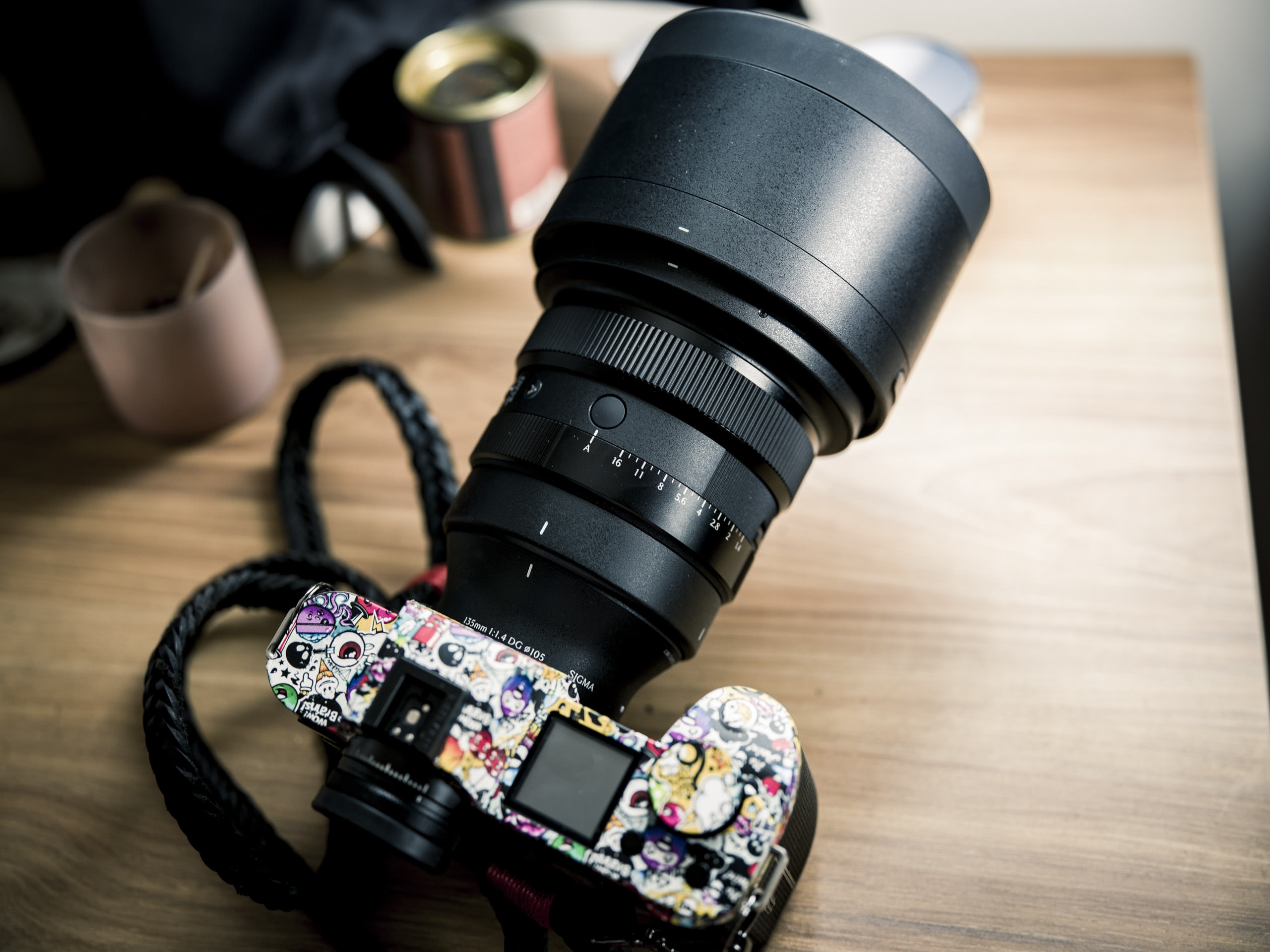
According to Mr. Dioguardi, the Art lineup is all about being the ultimate in “expressive potential.” These lenses have optical performance optomized above everything else and often have the widest apertures available. The longest focal length is their 135mm f1.4 Art.
With that said, there’s apparently no hard line separating Art and Sports. In fact, the Sports lineup is designed to have the same quality as the Art lineup. “Sigma’s Sports line of lenses provide optical quality on par with that of our Art line while prioritizing telephoto zoom ranges, optical stabilization, and rugged build quality,” says Mike. “These lenses always feature our strongest build quality and often include built-in OS support.”

These lenses no longer use things like the HSM motors — which Sigma utilized for many years. Some of the newer lenses have a basic stepping motor, but other designs in the Art and Sports lineup use the company’s new HLA motor tech. According to Sigma, this stands for “High-response Linear Actuator”. It’s proprietary dual-action focus motor tech that simultaneously moves two elements within the lens at once, providing extremely fast and accurate autofocus. This confirms that Sigma’s motors aren’t from another company at all — and it also explains a lot with their performance.
Where things kind of get different is with the Contemporary lineup. These are designed to be compact and often require far fewer materials to produce. For example, Sigma’s APS-C lenses are part of this lineup.
All of this makes a whole lot of sense when you consider just how large Sigma’s art lenses can be. “Generally speaking, a higher number of lens elements provides greater design flexibility, making it easier to achieve high image quality,” says Sigma Corporation, via Mike. “However, since image quality also depends on the focal length, aperture value, and other specifications, the number of elements does not directly correlate with image quality.” They continued to state that increasing the number of lens elements places a significant burden on the manufacturing process — so they try to keep the number down.
Making lenses is incredibly complex at this level. And Sigma is one of the best when it comes to providing some of the clearest image quality you can get. Yet still, I wonder how long photographers will crave only the clearest images and a vision that every single company has.