

Last Updated on 02/09/2026 by Chris Gampat
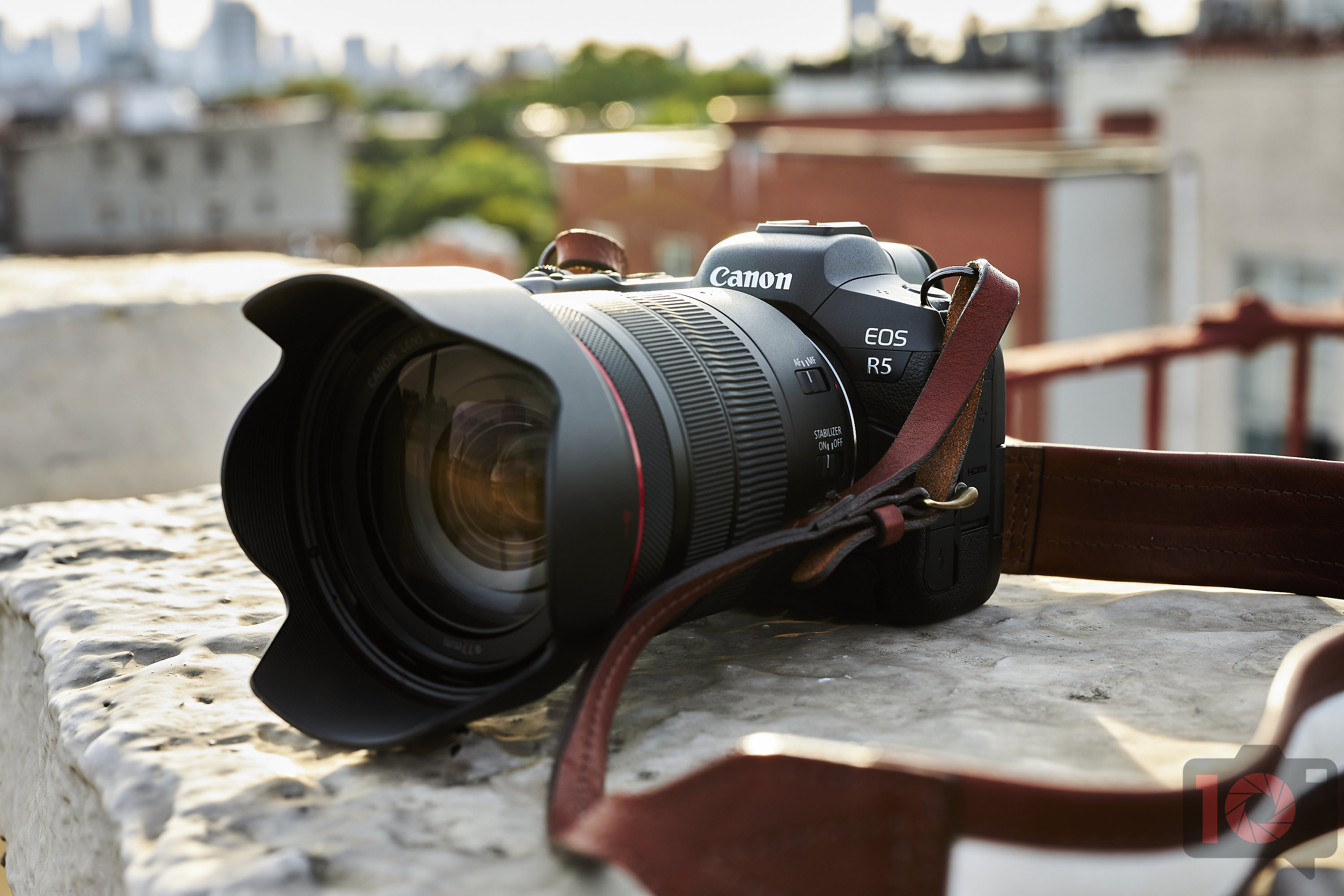
When Canon launched the R5, little did we know it would go on to win over millions of users. In some ways, it was the revival of the now iconic Canon 5D series, but in the mirrorless format. It was replaced with the Canon EOS R5 II, and it seems like it’s time to say farewell to the older camera.
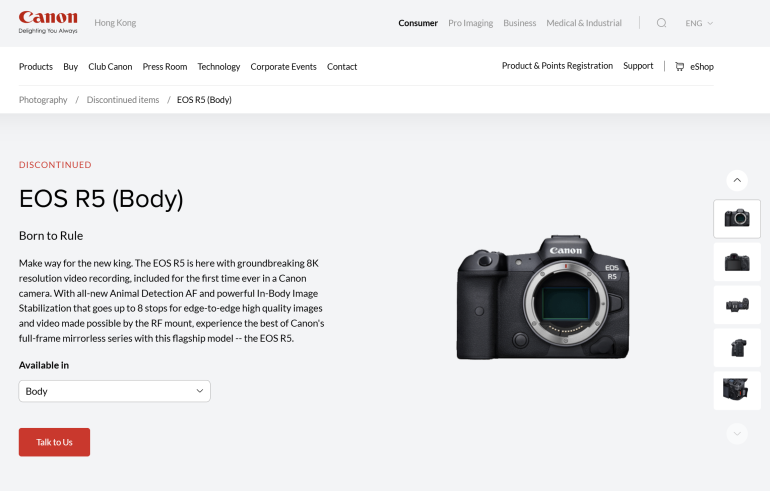
First reported by Asobinet, the Canon R5 appears on the ‘discontinued’ product list on Canon’s Hong Kong website. But if you look at Canon’s Japan website, there has been no mention of this.
The company has its manufacturing plants across various regions, including Hong Kong, Vietnam, China, Thailand, and the Philippines. So, with one of them listing the camera as ‘discontinued,’ there is a possibility that others may follow suit soon.
The Canon R5, as we said, is already 6 years old, and the company introduced its successor at the end of 2024. One reason, thus, for this move could be that Canon wants to focus its production elsewhere, especially after introducing the R6 III recently and the G7X Mk III’s special edition. There are also reports of the company introducing the R7 II soon, but there is no concrete date about when it may happen.
Either way, the Canon R5 was replaced by the R5 II, which offers features such as a new full-frame back-illuminated stacked sensor, Register People Priority, Eye Control AF, and pre-continuous shooting, among others. However, despite the variety of inclusions, the R5 II seemed too centred on video rather than photography, which irked our reviewers. The company has introduced an update that improves the autofocus quite a bit when focusing people of color. As we explained in our article:
In short, the latest firmware makes the R5 Mark II a more stable camera, but many of the initial issues we had with it remain. Canon (and every major manufacturer these days) has decided that “hybrid photography” is the only kind of photography that matters anymore, and this makes me sad and angry all at once.
If you look at the two, you’ll see the R5 scored higher in our tests because it not only delivered good images but also offered multiple exposure modes for RAW files, a good timelapse mode, and didn’t heat the way people were accusing it of doing.
The R5 was Canon trying to be different, but with the R5 II, they did not innovate the device as much as they should have for photography needs. This is one of the reasons people turn to Sony: it offers not just more features but also the ability to use third-party lenses.
It remains to be seen whether Canon Japan announces the discontinuation soon, or if Canon Hong Kong removes what they have posted.
Get rid of the ads!
Did you enjoy reading this article as much as we enjoyed writing it? There's a way to support us and our reporting, getting ad-free navigation and more as a bonus. Subscribe to us for less than a coffee per month —just $3.99— or take advantage of our yearly subscription with a hefty discount for only $25.- An ad-free experience
- A free mystery box for Lightroom or Capture One
- All the books in our store
- 20% discount on Capture One
- 30% discount on Imalume Photo Theft Protection
- 20% off Herbs and Kettle Tea Company.