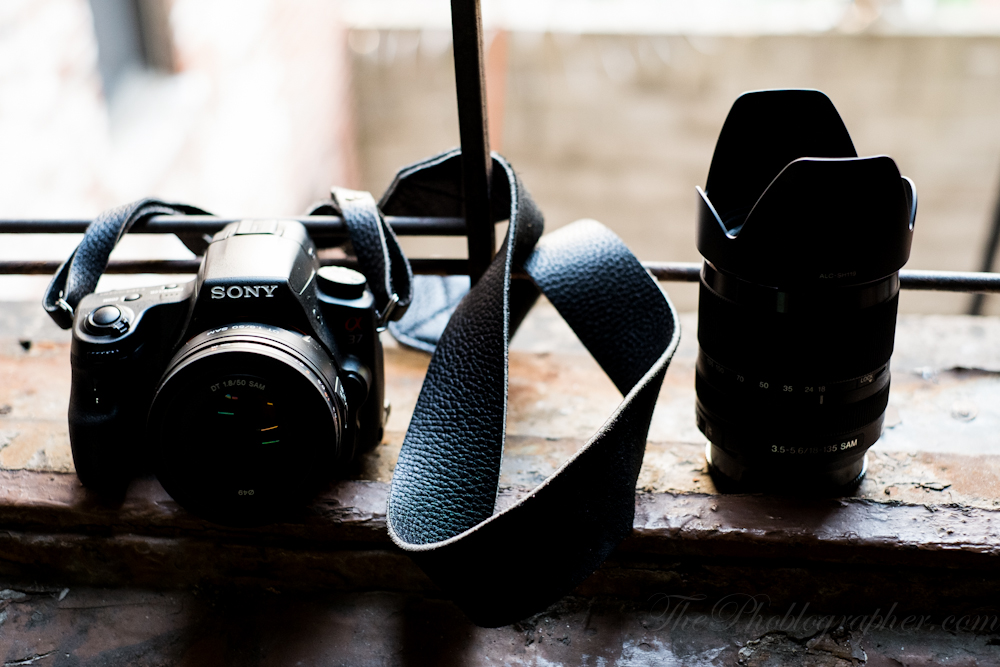
Review: Sony A37

by Chris Gampat on 07/05/2012

The Sony A37 is the company’s latest offering to the entry level crowd. Both Peter and I  had hands on time with the unit before it was even announced and in two totally different scenarios. The camera has stylistic differences from the likes of Canon and Nikon: the other two major players in this market segment. The A37 also continues Sony’s dedication to the SLT system; which removes the optical viewfinder for an electronic one and therefore also sticks with a translucent mirror.

Many Sony products are very favorably reviewed on this website. So is the A37 any different?

Tech Specs

Tech specs taken from the B&H Photo Video listing of the camera.

Imaging
Camera Type Digital SLR with Interchangeable lenses
Lens Mount Sony Alpha/ Minolta
Camera Format APS-C / (1.5x Crop Factor)
Resolution Effective Pixels: 16.1 Megapixels
Aspect Ratio 16:9
Sensor Type / Size CMOS, 23.4 x 15.6 mm
File Formats Still Images: JPEG, RAW
Movies: MPEG-4 AVC/H.264, Full HD 3D (MPEG-4 MVC Standard)
Memory Card Type Memory Stick Pro Duo
Memory Stick PRO HG-Duo
SD
SDHC
SDXC
Image Stabilization Mechanical
Focus Control
Focus Type Auto
Focus Mode Single-servo AF (S), Continuous-servo AF (C)
Autofocus Points 15
Viewfinder/Display
Viewfinder Type Electronic
Viewfinder Magnification Not Specified By Manufacturer
Diopter Adjustment Not Specified By Manufacturer
Display Screen 3″ Rear Screen Swivel Live Preview LCD (230000)
Screen Coverage 100%
Live View Yes
Exposure Control
ISO Sensitivity 100-12800 (Extended Mode: 100-16000)
Shutter Type: Electronic
Speed: 30 – 1/4000 sec
Metering Method Spot metering, Center-weighted average metering, Multi-zone metering
Exposure Modes Modes: Aperture Priority, Auto, Manual, Programmed Auto, Shutter Priority
Compensation: -2 EV to +2 EV (in 0.3 EV steps)
White Balance Modes Auto, Cloudy, Daylight, Flash, Fluorescent, Incandescent, Kelvin, Manual, Shade
Flash
Built-in Flash Not Specified By Manufacturer
Continuous Shooting Up to 5.5 fps 1
AV Recording
Video Recording Yes
Performance
Self Timer 2 sec, 10 sec
Connectivity HDMI C (Mini), USB 2.0
Software Requirements Windows: XP (SP3), Vista (SP2), 7
Mac: OS X 10.4 or later
Power
Battery Not Specified By Manufacturer
Physical
Dimensions (WxHxD) 4.9 x 3.6 x 3.3″ / 12.45 x 9.14 x 8.38 cm
Weight 14.6 oz / 414  g Camera body only
Kit Lens
Focal Length 18 – 55 mm
Comparable APS-C Focal Length: 27 – 82.5 mm
Aperture Maximum: f/3.5 – 5.6
Minimum: f/22 – 22
Minimum Focus Distance 9.84″ (24.99 cm)
Magnification 0.34x
Maximum Reproduction Ratio 1:2.94
Groups/Elements 7/8
Diaphragm Blades 7
Autofocus Yes
Image Stabilization No
Filter Thread Front: 55 mm
Dimensions (DxL) Approx. 2.75 x 2.75″ (6.99 x 6.99 cm)
Weight 7.41 oz (210 g)

Gear Used

Ergonomics

The Sony A37 is in some ways a very standard entry level DSLR in terms of ergonomics, and in others a bit different. For starters, the front the camera is very plain and only really characterized by the lens release, front dial for exposures, and an AF assist lamp.

For the entry level consumer, that means that there is also an emphasis on implied simplicity.

The top right of the camera above the smallish but comfortable grip sports some of the controls. Here is where the user will find the on/off switch, digital zoom functionality, and the option to go from electronic finder to LCD. Unfortunately, it doesn’t always work so well. Honestly, you’re better off ignoring it because it will ignore what you’ve told it to do after a while.

Just behind there are some more multi-function buttons. Here you’ll find the movie record button, zoom out/exposure control (for aperture or compensation), and the auto exposure lock button/zoom it during playback. Right by here is also the pop-up flash lock; that only works when the camera is on to begin with.
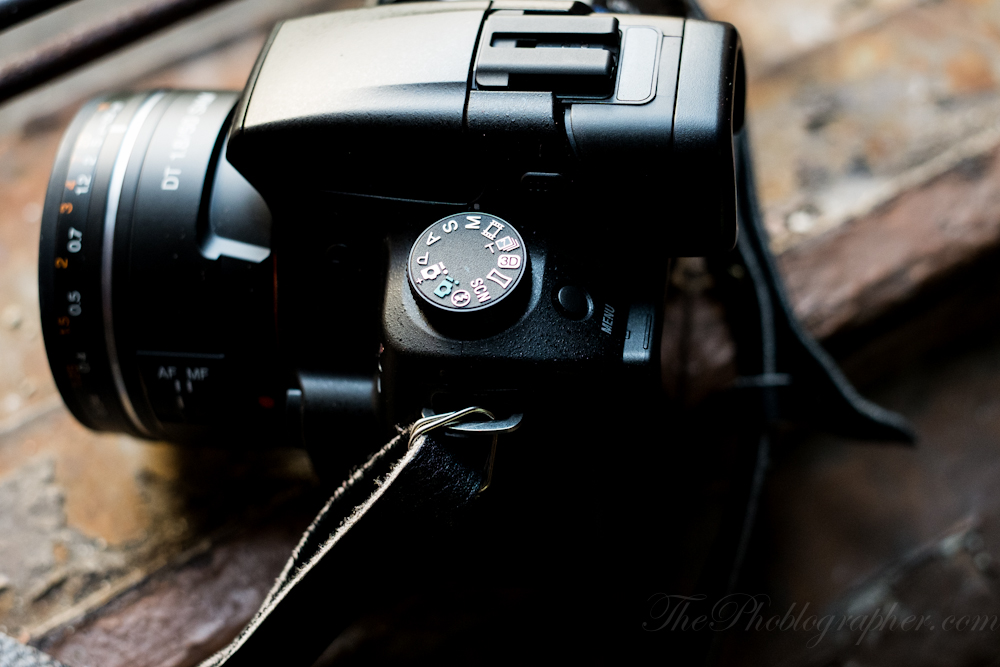
The top left is where the control dial and menu buttons are. The dial features a slew of different setting modes, and the good thing is that it often stayed in place and provided just enough resistance to ensure that it never was switch out of a setting that I originally wanted it to be in.

Near this is Sony’s proprietary hot shoe which sticks to the old Minolta standards.
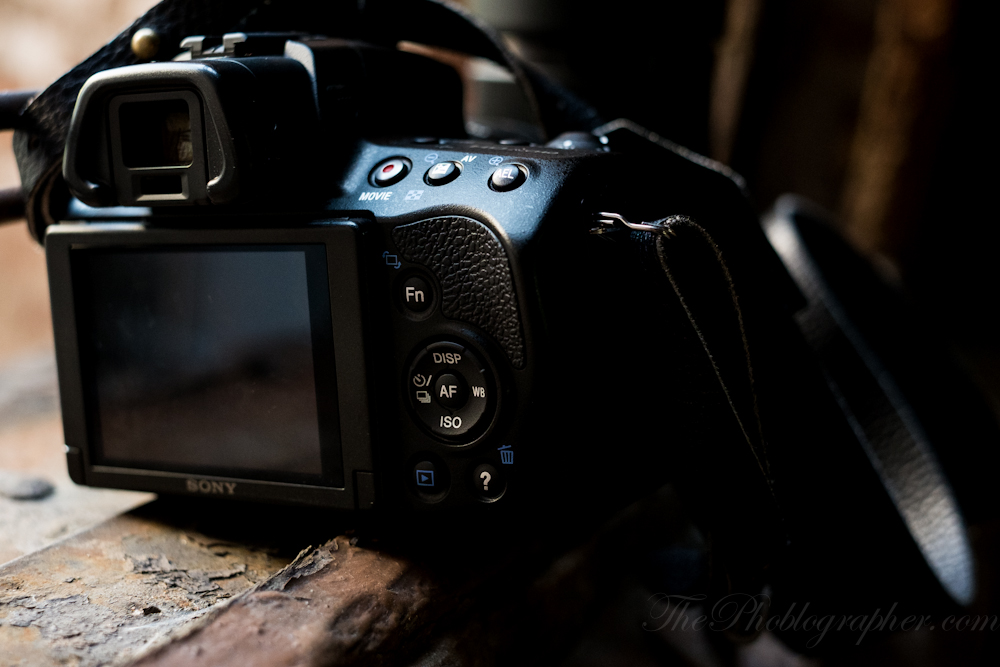
The back of the camera sports a couple of other goodies. The screen, first off, will tilt up and down for the user. Additionally, there is a multi-control area/button hub, a custom function button, playback button, and info/trash button. The recessed area for gripping feels really quite nice in practice.

Here is where the electronic viewfinder is also housed.

Autofocus

I’ve developed a bit of a love/hate relationship with the focusing system on this camera. Firstly, I used the very excellent Sony 50mm f1.8 almost exclusive for this review. The reasons for this are the excellent image quality, compact size, and if you’re going to get serious about your photography, this is the lens you’ll have to get if you’re tied to the Sony camera system.

We’ve given it high marks on our best budget lens list and in our list of great Sony lenses.

With this all said, the A37 is a speedy performer in terms of autofocusing and it utilizes the points available very well. My problem though is that the points are too much in the middle area of the image. Sony could have spread them out a bit more.

Additionally, the selection of a single focus point is a bit tedious. In order to do this, you’ll need to access the quick/function menu and choose the AF area selection. Then you’ll need to scroll through to the area you want, and fine tune it to what you actually want. Say you want to use the center point on the right area of the focusing points, that’s a bit time consuming and a photo opportunity can be gone.

Thankfully, I’m mostly a portrait shooter, and in that case this worked totally fine and I was able to keep my subjects very content while I fiddled a bit (unless I set it up beforehand.)

For consumers who want to move up and utilize all the functions of the camera, you may tire of this after a while. But for consumers that want to leave the focusing on full auto, the system has a fairly good and fairly smart focusing algorithm working for it. However, I still feel that the NEX system’s is better.

Image Quality

I used both the 18-135mm zoom lens that comes with the camera in a bundled package, but as stated earlier, far preferred using their 50mm f1.8. And to be honest with you, this lens really allows the camera to take the fullest advantage of what the sensor can do. The image quality right out of the camera is really pretty dark, good, and only requires slight tweaks to really improve upon the RAW files in post. However, I’d stress that for the best results that one should over-expose around 1/7th of a stop in order to get the fullest potential out of the files. Then you’ll need to work with them a tiny bit in post to get the best results you can.

Originally, all of my images were coming out super warm, and I didn’t figure out how to change this until my second day of use with the combination. It is a setting hidden in the menu, but once it is unlocked, you’ll see your images start to become much better. In fact, the sensor output seems to resemble Kodak Porta VC, and for this photog, I’m ecstatic about that!

Here are some more images shot with the A37 and other lenses:

High ISOs

Here’s where the review starts to get a tiny bit hairy. The High ISO performance on the A37 could be better, even with the faster prime lenses attached. I saw a bit too much smudging of noise and quite a bit of loss of detail. In fact, I would purposely only use prime lenses just to keep the ISO levels out of the nuclear area. Quite honestly, I even saw it start to degrade at ISO 800.

The Sony A37 was taken with me to performance art piece, and the focusing seemed to go in and out, but when it nailed it, it did so quickly. Like the Canon 5D Mk II, it is often best the focus on a contrasting area/point.


Ease of Use

To make the most use of the Sony A37, you’ll need to sit down and spend some time digging through the menus and getting everything set up just the way you like it before you even go out to shoot.

Once this is done, the only issue I really had was manual focusing point selection. Otherwise, I also recommend that this camera only shoot in aperture mode because pressing the EV button on the back can be a bit of a pain in manual mode due to ergonomic placement.

Something else that pissed me off a bit: even though it did wirelessly set off my other slave flashes, it didn’t sync with the shutter. That’s probably because of something going on with the camera because the flashes have synced with Canon, Nikon, Olympus and Pentax with no problems at all.

Metering

A Sunny 16 test showed us that the system tends to underexpose by 1/3rd of a stop. In real life use, we found it best to overexposed your images by 1/7th of a stop.

Conclusions

In the end, I overall have found the image quality of the A37 to be good enough for most users, but at the higher ISOs you’ll start to encounter some problems. The ergonomics could also have been designed a bit better, as they are behind a bit from Canon and Nikon and honestly very far behind Pentax’s K30 in terms of ergonomics. To take the best advantage of the camera, you’ll need to use primes and fast lenses in combination with keeping the ISO levels down.

Further, Sony’s higher end DSLRs are still probably a much more viable option and I’d recommend this camera to someone like my mom who very little technical knowledge and will set it to auto with the belief that every image she gets is wondrous. The experienced eye should look elsewhere.

Please Support The Phoblographer

We love to bring you guys the latest and greatest news and gear related stuff. However, we can’t keep doing that unless we have your continued support. If you would like to purchase any of the items mentioned, please do so by clicking our links first and then purchasing the items as we then get a small portion of the sale to help run the website.

  • Mike

    Thanks for the review!

    I’ve got two questions:
    1. Is the high ISO quality only bad in JPEGs or also in RAW? That’s probably the same sensor as in my NEX-5n so I curious what Sony messed up…
    2. How’s the EVF compared to the NEXes and A65 & A77? The LCD seems to be A.D 2005 it the EVF just as bad?

    Thanks,
    Mike

    • ChrisGampat

      Hey Mike,

      1. We only shoot RAW, so that’s it. I don’t think it’s the same sensor. The 5N’s was wonderful in low light.
      2. The A65 and A77′s viewfinder destroys this one. It reminds me of the old Panasonic G1.

      • Steve Long

        It’s the SLT…
        Performance from all of them is a little below the NEX platform using the same sensor

        • Norbert

          Thanks! And here’s the general point, why I will choose NEX over the SLT camera. :)

  • Pingback: Review: Sony A37 | shootplex

  • Alfmeister

    I’m sorry that you were disappointed with the results you achieved
    from this camera. The posted photos are both colorful and sharp. If you think
    that some aren’t as sharp as you would like then the tested lens 18-135 may be
    an issue. You can also adjust the in camera sharpening in the menu to achieve
    very sharp images.

    I would have liked to see a more complete review though with
    mention of the many features including the built in steady shot that allows you
    to use any lens, Sony or Minolta. You praise the Sony 50mm and rightly so but
    there is a bargain to be had by looking for a Minolta 50mm which were produced
    in large numbers.

    Also there wasn’t a mention of the Panorama feature, the
    stereo microphones for video recording or the external microphone jack. The
    1200 zone exposure metering and the 15 point auto focus are also included in
    this camera which beats the competition.

    In your conclusion you mention that the more expensive,
    larger and heavier Sony cameras are more ‘viable.’ How so? What makes them more
    viable? The A37 has the same 16mp sensor that is in the A57 and the new Nex F3.
    It also has the same processor that’s in the A77 which is the new 3rd
    generation Bionz processor. The viewfinder is excellent and is shared by the
    A57. The A65 and the A77 do have slightly better viewfinders and 24mp sensors
    but both of those improvements come with the trade offs of using a larger, heavier
    camera. You mention that you need to spend some time digging through the menus.
    This is true of every digital camera. All cameras are tools and it’s the
    photographer that makes the difference. With my decades of experience and the
    right lenses I can produce excellent images with this camera and as you say so
    can your Mom.

    To answer Mikes questions; the ISO is usable up to 3200 with
    very little noise. Even at the extreme limit of 16000 ISO the images are still
    usable. This may be a newer sensor than what is in the NEX 5n but the processor
    is certainly newer and capable of higher
    ISO images with low noise. The A65 and the A77 have more noise because they
    have the same APS-C sensor size but with more pixels. The EVF is the same one that
    is in the A57 which is excellent.

    • ChrisGampat

      I’m spoiled by the NEX 7′s and A77′s viewfinder, and their overall ergonomics are better as well. Plus once you’ve held the Pentax K30 and then hold an A37, there is absolutely no comparison. Heck, the Rebels suck compared to that thing.

      I barely used the zoom lens, I’m an all prime shooter. Our copy editor owns the 50mm, but he’s swamped with other things right now.

      I’m rooting for Sony, and their reps even know this. But this review is my fair opinion, and it could have been a better camera. Even so, I’d probably even just spring for an NEX F3 at this point.

      • Alfmeister

        Yes a $2000 camera has a better viewfinder than a $600 camera. But that doesn’t mean that the viewfinder on the A37/A57 is bad. It’s actually quite good. I’ve held all of the current crop of DSLR’s and to me the A37 is the best when it comes to ergonomics. Sony improved on the A33/35 by making the grip a little bit deeper. I’ve read Peter’s review which was both well written and much fairer. Time to put down that Canon D5 and realize that a $600 camera can take great photos with the right photographer at the helm.

        • Dude

          Alfmeister is correct. This reviewer takes shitty pics with every camera he uses, regardless the price or feature set. He should learn more about actually taking pictures instead of bragging about his use of film and knowledge of color theory. Maybe instead of reviewing cameras he should stick to reviewing camera bags. Oh, never mind, I believe he recently compared the feel of a leather bag to the touch of a woman’s skin. Like this goofy looking douche even knows what that’s like.

  • Dude

    To be honest (a phrase used constantly by this so called writer), the reason for the inconsistencies in the reviews between the various Sony products is simply the ineptitude of this author. In addition to his poor photography, he also dazzles us with his questionable judgement and truly abysmal sentence structure.

    I would also appreciate it if this reviewer would would stop attempting to use the Sunny 16 rule to evaluate a cameras metering. The Sunny 16 rule is a guideline to establish a starting point for the exposure. It is based on incident light, so adjustments need to be made depending on the subject of the photo. It is not able to determine an exact exposure, and definitely not able to rate a cameras metering accuracy to within 1/3 of a stop.

    • ChrisGampat

      You’ve obviously never shot film or went to photography class.

      • Dude

        Why would you remove my response to your comment? Obviously you realize I speak the truth and your fragile ego can’t handle it. Quite pathetic. Just remember, simply saying that you are are a photographer on a self edited blog does not actually make you one. Making money from links to B&H or Amazon does not mean you earn a living as a photographer.

  • Jumanji777

    I have read this review and the one of the D5100. You are arguably uncomfortable with cameras (DSLRS) costing less than $1000 for a body. You have made very good cameras seems like they were designed by not-smart people. Leave the sub-$1000 gems to Peter who knows how to appreciate them.

  • Matt

    The last photo posted in this review supposedly from this camera also appears in the linked article on budget Sony lenses written almost 12 months earlier. You me mention that changing a hidden setting prevented getting a warm colour cast in images, but then forget to actually tell anyone what this hidden setting is and what it should be changed to improve the situation? Also while the Sony’s are far from perfect I was completely underwhelmed by the K-30, which was a shame as it appeared to be an amazing mid range / entry level camera on paper.

    • lck

      Go to Fn – WB auto and press the directional wheel. A color chart will apear. Adjust for colder color pressing the diretional wheel to the left till parameters reach something about B2 or B3.
      You may also try to raise the sharpeness on the creative mode set ups using the cursor.

  • 1eyedManIsKing

    Not a single photo in this review is properly exposed, and most of them are oversaturated and contrast boosted to oblivion.
    Good stuff..

  • Lux

    This review is very shallow and does not describe may features of this camera. It has also some incorrectness in it. For example selection of af point. When one goes to fn menu and selects the autoficus submenu one can select one of three options: auto, group and single point. If group or single mode is selected once via the fn menu, then during taking pictures or recording movies one can easily swap between groups of af points or between single af points by pressing the af button (in the middle of quad directional wheel) and then by confirming the selection by pressing af button again. It works just like in rebels or any other camera, but better, because you can choose a group of af points (left T, a + in the centre or right T).
    When it comes to high isos, I think that 3200 is usable for prints 13 by 18 cm, maybe for A4 (letter) sized prints when viewed from longer distances.

    For the money it is one of the best cameras, and I do not really see a point in buying a canon or nikon.

    One more thing (or maybe two) – EVF and grip, both are far superior than canon T3i, T4i, and EVF is muuuch better than OVF in D5100.

    To sum up – amount of camera one gets for the money paid is unbeatable by canikon.

    I wish you nice picturetaking.

  • Katie-beth98

    My camera(this) has a self timer but it does not turn off could you tell me how to please thank you

    • ChrisGampat

      Go to the drive modes and switch it.

      *Chris Gampat*
      Chris Gampat Photography

  • Classiccamera

    The Fn button on the A37 is the best I have used. All the functions appear on the EVF in easy to read symbols and numbers. The placement of the buttons on the body is miles better than a Nikon D5100 especially the Fn button and I can make instant changes to nearly all settings while up at the eye .I use Konica Minolta lenses on my 37 and they give superb IQ. Above all its a superb camera at a bargain price that most review sites have either given it best buy or editors choice with 5 stars.

Previous post:

Next post: