

Street Photography Showdown: Leica M9-P vs Olympus EP3 vs Fuji X100

by Chris Gampat on 08/01/2011

We’ve reviewed the Leica M9-P (M9P or M-9P), Olympus EP3 (E-P3 or EP-3) and the Fuji X100 (Fujifilm X100) and put them through their paces. Now if you take a look at street photography forums and read questions from photographers, they will all express uncertainty about which camera would be best for them. After long, thorough and exhaustive testing, this is the comparison review; we hope our findings will answer the questions of street photographers and documentarians everywhere.

So which one is right for you and which one can be declared king of the streets? Let’s find out.

Ergonomics
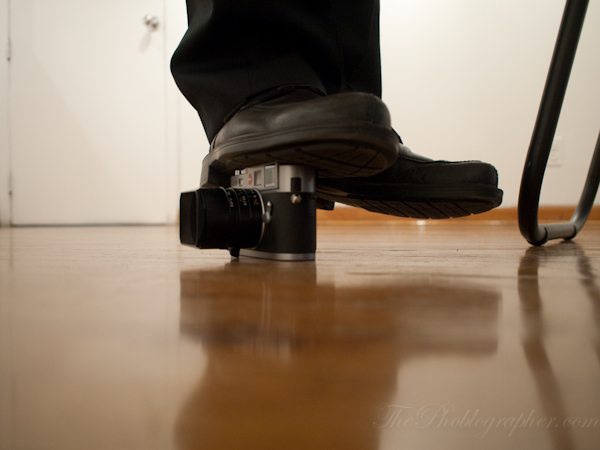
Would you stand on a Leica M9?


Leica M9-P: As the heaviest and sturdiest camera of the bunch, Leica will proudly tout that you can stand on their cameras and they will live to shoot another day (seen in the photo above with a Leica M9). With the least buttons of the bunch of cameras in this list, it isn’t necessarily the easiest to use. However, it must be stated that it allows the user to get to the important settings very quickly.

Fuji X100: When it comes to setting the exposure, the Fuji X100 totally rocks. When it comes to actually changing a setting like ISO or having to switch to Macro mode because you want to take a portrait of someone and be closer than three feet, it’s a bit of a workaround. Otherwise though, this camera is very easy to work with, and it is also the lightest camera of the bunch, at least in my hands.

Olympus EP3: The buttons and dials that you really need are in the right place. The most amazing thing about the EP3, however, is the touchscreen. The entire camera can be operated from this special piece of glass. It feels good in the hand and will feel like a constant companion to you.

Winner: Tie- Olympus EP3 for the total lack of fussing needed to be done with the camera and if you don’t mind using a touchscreen. And the Fuji X100 if you prefer a viewfinder.

Focusing

Leica M9-P: To focus the Leica, you’ll need to do things the old-school way—manually. Luckily, all Leica lenses have a distance meter that will help you to focus out if you’re not looking through the viewfinder. The way a rangefinder focuses is very precise though, and nothing terrible can be said about it at all. It’s just different.

Fuji X100: You’re usually best off using the center focusing area and recomposing with this camera. The focusing isn’t that snappy in low light either.

Olympus EP3: Olympus has totally revamped their focusing system with their new processor and their new line of MSC lenses. It is the fastest I’ve seen of any camera. Yet, it isn’t very smart in focusing by itself, so you’re best off just using the touchscreen.

Winner: Olympus EP3 for the superb focusing system. They have taken flak for years and they’ve now gotten their act together.

Ease of Use

Summer Love

Leica M9-P: Accessing the settings you want and need is very quick and easy to do.

Fuji X100: You’ll have to develop a workflow that works best for you in terms of accessing your ISO settings, different focusing settings, film modes, etc.

Olympus EP3: Almost everything you’ll need is accessible via a button or through the touchscreen.

Winner: Leica M9-P. I can do everything I need in the shortest amount of time.

Image Quality

Astia

Leica M9-P: The full frame sensor camera in this category can give the user some incredible photos, but in order to do so you’ll need to learn a new style of metering. As stated in my review, the images look like Chrome film and coupled with Leica lenses and the full frame sensor, you’ll get some really gorgeous bokeh.

Fuji X100: The camera comes with an APS-C sensor and the best dynamic range in this group will also give you excellent photos. I initially had trouble with the metering until it suddenly and magically started working perfectly. According to forums, this is actually more common than I thought, though I cannot explain it.

Olympus EP3: The EP3′s image quality is very good and I believe it indeed has the best image quality of any Four Thirds/Micro Four Thirds camera to date. In fact, I was amazed at how good the images were. It also delivers the most color depth of any camera in this group.

Winner: Fuji X100 for better dynamic range and color rendering. However, the M9-P and EP3 are close.

High ISOs

Leica M9-P: A full frame sensor should deliver the best high ISO output, right? Unfortunately, it does not here. In fact, the camera only goes up to ISO 2500.

Fuji X100: The Fuji X100′s high ISO output is around that of the Canon 5D Mk II.

Olympus EP3: Olympus has done a very good job with their high ISO noise control. However, it isn’t the best of this group. It is close to the Canon 7D.

Winner: Fuji X100. For a company that has been the butt of many jokes in the digital world since the death of the S5 Pro, they came roaring back with a vengeance. Damned good job, Fujifilm.

Metering

Leica M9-P: The worst part of the M9-P is the metering. Once you’ve got it figure out though, you’ll be smitten with the images the camera can produce. For a camera that appeals to film photographers and that doesn’t even follow the simple rules of Sunny 16, I’m shocked.

Fuji X100: Inconsistent, but when it works, it works very well.

Olympus EP3: Olympus hands down has the best metering of any camera system I’ve used except for Hassleblad.

Winner: Olympus EP3.

Stealth Factor

Leica M9-P: As the biggest and loudest camera of the bunch, many people will pass it off as just as film camera. Leica’s efforts to make the camera stealthier in terms of looks have paid off.

Fuji X100: As the quietest of the bunch, you often have to look through the viewfinder to have any idea of what you’re going to get. That may not always work. Nothing about it, however, is designed to intimidate the person you’re photographing.

Olympus EP3: Though it’s not the quietest, it is the smallest. Coupled with the fast focusing and touchscreen, the photographer can take their photo quickly and then move away like a fly on the wall.

Winner: Tie. All three cameras will help you to achieve your mission, but they need to be used differently. If you can work with their unique functionalities, you can do well. Get the M9-P if you don’t mind shooting from the hip. Get the Fuji X100 if you want the viewfinder. Get the EP3 if you want to get up close, shoot quickly, and move along.

Portability

Buried face in a book

Leica M9-P: This is the heaviest camera of the bunch, but wearing it around your torso all day or night won’t hurt you one bit. Given its size, you should make sure it fits well in your hands.

Fuji X100: As the middle of the cameras, it is super light, well-built, and can be tossed easily into your day bag. You won’t regret it.

Olympus EP3: As the smallest camera of the bunch, many would think that it is the most portable option.

Winner: EP3 and Fuji X100 tie for being the smallest and the lightest accordingly.

Conclusion

I’ve used all of these cameras for street photography over a long and exhausting period of time. The Fuji X100 was amazing, but so was the Olympus EP3 and the Leica M9-P. I miss all three cameras, though all of them had quirks.

The Leica M9-P is a wonderful camera that can take extraordinary images, is built well, and has access to those lovely Leica lenses. Yet, given its hefty price tag, I simply cannot justify the purchase. If I want a Leica, I’d be much more inclined to purchase a film version.

The Fuji X100 is also expensive, but nowhere as bad as the Leica. It is another beast that requires taming, and there are dozens of photographers that have done so and came back with stunning images. The firmware updates have solved many problems with the camera as well. The fact that no one can keep them in stock is a testament to how amazing that camera really is. This camera retaught me street photography.

The Olympus EP3 is a personal love of mine. Small, powerful, fast, and simple to use, the EP3 is a camera that I’d almost consider trading in my Canon 7D for. My problem is that I can’t justify the price to myself when I already own such amazing DSLR cameras and I have no problem shooting with some of the best films out there. Using it for street photography was a pure pleasure.

In the end however, I would choose the Olympus EP3 for the fact that it does the most at a more affordable price than the others. If you’re interested in any of these cameras, you can click these links to compare and contrast prices.

Fuji X100: B&H or Amazon or eBay

Olympus EP3: B&H or Amazon or eBay

Leica M9-P: B&H or Amazon or eBay

Please Support The Phoblographer

We love to bring you guys the latest and greatest news and gear related stuff. However, we can’t keep doing that unless we have your continued support. If you would like to purchase any of the items mentioned, please do so by clicking our links first and then purchasing the items as we then get a small portion of the sale to help run the website.

  • O Stahle

    You missed the point about the M9. It is the lenses that are the jewels and, further more, why do not everone buy a 20 dollar Timex etc. watch to tell the time? The feeling own owning a Leica M9 with Leica glass cannot be challenged by the Japanese brands.

    • Anonymous

      Leica’s lenses are worth every penny. But said feeling that you’re talking about won’t make you a better photographer, nor does it make the job easier.
      Chris Gampat,
      Editor in Chief
      The Phoblographer

    • http://twitter.com/JohnOlinda John Olinda

      Not all of us are CEOs or Magnum photographers, so that’s why we can pass on that special feeling in order to get a camera/lens kit that’s as good or better for a fraction of the price.

    • http://twitter.com/JohnOlinda John Olinda

      Not all of us are CEOs or Magnum photographers, so that’s why we can pass on that special feeling in order to get a camera/lens kit that’s as good or better for a fraction of the price.

    • joost

      it’s not the camera that makes the  picture, it’s the person behind it.
      I own the fuji X-100, Panasonic GF-1 with pancake 17mm, Epson R-D1s and Leica M6.
      And I’m considering of buying a Leica M9-p for my weddings.

      The fuji X-100 is a wonderful camera, good job in high iso, and in f2.0. This is the one that I always carry with me. Small, silent, fast. And therefor I hardly use the GF-1
      The Epson RD-1 has a more film look-a-like file, great for BW and I use this one with a leica 2.0/35 4th generation, 2.0/50mm and a voigtlander 1.9/28mm. For this one the metering is also poor, one has to photograph on the histogram.

      Photographing with the X-100 or RD-1s is like photographing the way I used to do for 10 years ago. Not using zoomlenses, only the 35mm and the zoom are my feet.

      Leica glass is indeed worth every penny ( or in  my case every euro )
      They keep their value, even if you have a lens which is 25 years old.

      You have to buy the camera that fits best for you, your kind of photography and your wallet.

      The forums I’m reading about the M9 – X-100 are always with pictures taken in available light.
      Why not showing some pictures of these camera’s when using (off-) camera flash ?
      I know that they have lenses and iso’s that makes it worthwhile photographing without is, but it’s sometimes
      not possible shooting without flash.

      • Anonymous

        I shot the x100 with a ring flash during the review, which you can see in the link.

        Can we see some wedding work please? Thanks.

        Chris Gampat,
        Editor in Chief
        The Phoblographer

        • Jon33

           Why don’t the camera manufacturers build a decent compact camera? Something like a rangefinder style, it must have manual and aperture and priority settings. All this at a reasonable price, and not a silly over inflated price. The cameras out at the moment are very poor indeed, with the exception of the fuji x100 this is a nice little camera, but very poor video. Also the price is crazy, it should be about £200 in price, there is no need to be asking £700 for it.

      • Anonymous

        I shot the x100 with a ring flash during the review, which you can see in the link.

        Can we see some wedding work please? Thanks.

        Chris Gampat,
        Editor in Chief
        The Phoblographer

      • http://gabrielelopezphoto.wordpress.com/ gabriele lopez, Italy

        I’ve had the opportunity to try all these cameras…I own an x100 and a ep1…a close friend has the m9.. I think all of these three cameras have a thing in common…you have to take the time to know them well. How to set them, how to use them, what to do and what to avoid. In every case they will fit your needs. I totally LOVE  my x100 but you have to live with one focal lenght (good for me) and the rest can be done with my Pen…the m9? a dream companion for my m4.
        I sold my reflex stuffs months ago, I work with these two cameras on a daily basis..

        Happy new year everyone!

  • Pingback: Street Photography Showdown: Leica M9-P vs Olympus EP3 vs Fuji X100 – The Phoblographer (blog) | The Photo Bargains

  • Sbcht3

    Someone looks like buying a camera for feeling of owning it. I’d rather buy a camera to take pictures. If Leica fits your needs (including feeling of owning) and can afford it, go for it. I just cannot afford >$10k for a camera and a lens and feeling of owning is not a factor.

  • GJ dK

    Why are you never talking about Sony NEX C3 and upcoming NEX 7? If image quality is one of your things and – maybe – you don’t like four-thirds then this is a good alternative in my opinion, especially if you don’t have the money for the beast X100.

    • Anonymous

      Because I’m currently reviewing the C3 and it wasn’t in my hands before…
      As for what’s coming from Sony, you’ll want to keep your eyes peeled.

      -Chris Gampat
      Editor in Chief, ThePhoBlographer.com
      Twitter.com/ChrisGampat

      • GJ dK

        Okay, I’m very curious. I use the X100 with pleasure. However, I sent it back this week, because aperture is broken. I’m thinking of buying the NEX C3 as a second camera, because of the interchangeable lenses. I don’t like the four-thirds format. I tend to crop every image then.

  • James Mansell Read

    I use a Panasonic LX3 much better than any of the above [well I would say that wouldn't I] I can set it to manual zone focus, no need to use a viewfinder [there isn't one] and I can print to A4 [US letter] and you wouldn’t know the difference to anything from the above. http://www.jasread.com/ link to download my eBook PDF of street photography on the page and pics on the site. Don’t spend loads of money on something you’ll be too frightened to take out.

  • Manuel Guerzoni

    The metering on the Leica is the most precise I have ever experienced.  Not sure how you figured it is not good.  Have you looked at your histograms?

    • http://www.facebook.com/chrisgampat Chris Gampat

      Yes I have. I’m judging by simple Sunny 16 rules. That’s what metering is based on.

    • http://twitter.com/patrickonaty Patrick Conaty

      I agree, the metering on the m9 is shit. It is easily thrown off by even just a small patch of white sky making it very easy to underexpose images. 

    • http://twitter.com/patrickonaty Patrick Conaty

      I agree, the metering on the m9 is shit. It is easily thrown off by even just a small patch of white sky making it very easy to underexpose images. 

  • Pingback: GF3 and PL 25/1.4 for street photography - Micro Four Thirds User Forum

  • Kalahun

    Why would shutter noise even be an issue on the street?  Must be a really quiet street. I use an M9 and I doubt anyone has ever heard it.

    • Anonymous

      Shutter noise isn’t an issue? Sure is. That sound will get people curious about what it is.

      -Chris Gampat
      Editor in Chief, ThePhoBlographer.com
      Twitter.com/ChrisGampat

    • Anonymous

      Shutter noise isn’t an issue? Sure is. That sound will get people curious about what it is.

      -Chris Gampat
      Editor in Chief, ThePhoBlographer.com
      Twitter.com/ChrisGampat

  • Kalahun

    Why would shutter noise even be an issue on the street?  Must be a really quiet street. I use an M9 and I doubt anyone has ever heard it.

  • Kalahun

    Why would shutter noise even be an issue on the street?  Must be a really quiet street. I use an M9 and I doubt anyone has ever heard it.

  • Steven

    I think you forgot o include the wonderful Lumix cameras. I’m using the G3 withe the Olympus 12mm lens and its an amazing street combo. Blazing fast auto focus like the EP3 yet it has an amazingly bright EVF which the Oly doesn’t. I had an X100 and it’s lowlight focusing capability was inconsistent at best and at time unusable. The M9 in this era of tremendous changes in camera development happening so quickly it is just way too expensive. Perhaps in the days of film when a camera would last decades it made sense but not today. The 12mm lens has a snap focus feature which allows you to easily set manual focusing and easily use zone focus with it’s depth of field scale. An awesome combo of lens and body for the street shooter. I think it’s time to rethink your article.

    • Anonymous

      I’m going to assume you didn’t read the reviews of the 12mm or EP3 that we did. With that said, we didn’t include the G3 because Panasonic is taking their sweet time getting us units for loan.

      Chris Gampat,
      Editor in Chief
      The Phoblographer

    • Anonymous

      I’m going to assume you didn’t read the reviews of the 12mm or EP3 that we did. With that said, we didn’t include the G3 because Panasonic is taking their sweet time getting us units for loan.

      Chris Gampat,
      Editor in Chief
      The Phoblographer

  • Pingback: Street photographer compares Leica M9, Olympus EP3, Fuji X100 | Leica Myth

  • Pingback: Which One? Sony NEX C3 vs Olympus EP3 at The Phoblographer

  • Nainnonyme

    Maybe if you did know how to use a classical rangefinder and the M-metering system, your judgement on the M9 would be different.
    Your tests and opinions should be backed with more objectivity and – above all – real facts.

    • Anonymous

      Sunny 16 is a general rule that works with photography.

      Take the images off the web and examine the EXIF data. The facts are all there. There is no favoritism or fanboyism. It’s all just cold, solid tests.
      -Chris Gampat
      Editor in Chief, ThePhoBlographer.com
      Twitter.com/ChrisGampat

    • Anonymous

      Sunny 16 is a general rule that works with photography.

      Take the images off the web and examine the EXIF data. The facts are all there. There is no favoritism or fanboyism. It’s all just cold, solid tests.
      -Chris Gampat
      Editor in Chief, ThePhoBlographer.com
      Twitter.com/ChrisGampat

  • Tony

    seriously.  this is the most pedantic review i’ve ever seen in my life.  perhaps you should actually learn to make photographs rather than running your mouth about cameras that are way over your head.

    • Anonymous

      You know, some insight from any expert would help? What do you have to say exactly?

      Chris Gampat,
      Editor in Chief
      The Phoblographer

  • Castiel

    This is absolutely insane by judging the M9-P like that
    I just think that you know nothing about the Street Photography
    No offensive but this post is a piece of junk

    • Anonymous

      Please explain. If you believe that the M9-P’s image quality has as much dynamic range as the others, please show me. Also, my metering judgement is based on how accurately the camera can meter based on old school metering methods.

      So essentially, meter a scene in your head without the camera helping you at all. And see if you can get it.

      • Sam

        You are an insult to street photography. Period.

        • Mike

          What exactly is this “street photography” of which you speak? Is it some kind of holy grail? People like you make me alternate between laughter and puking. You ruin photography.

  • Pingback: Using the Ricoh GXR and A12 Leica M Mount Module for Street Photography at The Phoblographer

  • Christian

    Comparing the M9 to the other two is the same as comparing a full-frame dslr to a medium format camera. Ergonomically the M9 and its siblings are almost the best in the business – extremely simple and efficient – with all the major controls where you need them. Also why they have changed very little over the years, ’cause the layout works and has been working for some time now. They (Leica’s) are also built to withstand years of rough use, the same cannot be said of the other two. In comparison they are toys.

    Rangefinder focussing was never meant to shoot sports with. That being said, photographers using them for a long time rarely miss shots and it is extremely accurate if used correctly. Also I highly doubt the Olympus being faster and more accurate than a Canon 1d mkIV or Nikon D3s – maybe faster than some cameras in its class but “fastest I’ve seen of any camera”? (and missing focus when left to its own devices rather misses the point in being fast.)

    I almost choked in reading your IQ comparison. The Leica surpasses the other two by miles with regard to anything to do with IQ, be it dynamic range, colour depth, colour graduation etc etc. Not only does it have a full frame sensor and all that entails, it also has no AA filter, thus your images are much much sharper if you want them to be than anything the other two can remotely capture. The AA filters on the other two rob them of resolution, you effectively get two thirds of the published resolution the manufacturer claim. The rest is lost due to the blurring effect of the AA filter. Another point to make is very little in-camera processing happens with the Leica, and if post processing is your thing, you can push the Leica images much further with few or no artifacts showing in the final image. There is also the subjective feeling the Leica images give you – the others simply look flat. Sensors on their own cannot produce an image – they are linked to the glass you put on them and Leica produce some of the best, contrast, colour rendition, sharpness etc are all in a different class to anything Fuji or Olympus currently produce. Scientific tests and real world shooting shows this with regards to IQ and lens quality. How you can come to a conclusion of the Olympus producing better quality images is beyond my understanding.

    The same goes for high ISO shooting – granted the Leica only goes to ISO 2500, however it produces a much more pleasing look with less artifacting and more detail than the other two. The Fuji’s high ISO output is also nowhere near that of a 5d mkII – period. There are scientific tests available with regards to sensor noise as well as real world examples and it just does not. Even subjectively I have not the slightest idea how you came to that conclusion. Objectively, mathematically and statistically there is no comparison.

    With regards to metering – if you only ever rely on what the camera tells you, you are missing the boat completely. Each and every camera’s metering system is different. The longer you live with it the more adept you become at using it. The Olympus and Fuji systems are up to par but the Olympus being better that anything but a Hasselblad? How do you come to this conclusion? Professional photographers all over the world must have been getting it completely wrong all these years spending their money on Canon and Nikon’s. Also what do you use when metering? Zone system? Light Meter? Years of actually being in the field and understanding exposure? Or is it a case of Auto and away we go? Seriously, do some research on the subject before writing about it. And this is without factoring in actual ISO and Aperture values into the equation. ISO 100 is not always ISO 100 on certain camera’s, with a little bit of research this information can be had and you can then base your exposures on this knowledge.

    The Leica is built like the proverbial tank, will probably outlast the photographer and produce images the other two can only dream about. They are usually passed along from generation to generation and still produce fantastic images. The other two end up either broken or being sold for nothing at the second hand shop on the corner after a year or two. This also why Leica’s demand such a steep asking price – you get what you pay for. Do you want a camera that will fit the “ah, I need to replace it, its two years old” consumer driven, use it and lose it lifestyle where you are looking for the latest and not always greatest toy or do you want a piece of craftsmenship that will last through all the trends and moods?

    • Mikael

      Leica glass is good, but their camera systems today are made for doctors and lawyers. With the same glass, the nex 5n delivers comparable images. I do think it is good to have a long lifespan on products, but with sensor technology changing so fast, I can not see how they will be able to compete without constant updates. Maybe by swapping just the internals?

      “The Fuji’s high ISO output is also nowhere near that of a 5d mkII – period. There are scientific tests available with regards to sensor noise as well as real world examples and it just does not. Even subjectively I have not the slightest idea how you came to that conclusion. Objectively, mathematically and statistically there is no comparison.”

      I think you are a bit negative and harsh on Chris.  You are not very scientific here yourself leaving out your sources.

  • Pballers

    LOL at all the leica fanboys getting their panties in a wade.

  • Pingback: A Fuji X100 Shooter’s Thoughts on the Leica M9 at The Phoblographer

  • Ethan

    Lens selection should have been factored in. For example, the EP3 has a nice and affordable crop of small primes. Leica, while expensive, has a large selection if the best lenses money can buy.

  • Jan

    Very cool group test. I love the impartiality that comes across. This review has created interest for me in the Oly. Although I met someone recently with an X100 and was greatly impressed by the build and OVF.

  • Jan

    geez sorry dude, i went to fave this post and i think i just gave it like minus 19 stars (?!) lol

  • Pingback: Olympus PEN EP 3 « Warna-warni

Previous post:

Next post: