How to Shoot Street Photography with a DSLR

by Chris Gampat on 07/25/2011

It’s no secret, I love small cameras for street photography. The Fuji X100 retaught me how to do it and the Olympus EP3 is perhaps a game changer in nailing the right shot. Before this, though, I used DSLRs: my Canon 7DDigital SLRs)and Canon 5D Mk IIDigital SLRs)to be exact. And when the smaller cameras had been sent back after the review was over, I needed something with better image quality. So I returned to my DSLR. But how exactly do you deal with something so large and so beastly? Here are a couple of tips.

Note: the majority of the images in this story were also shot with the Canon T3i which we found to be very good. Check out our full review and if you’re not sure if the camera is for you, take a look at this posting.

Pre-Selected Focusing Point

A good idea when shooting street photography is to use a pre-selected focusing point. Ideally, what you want to do is choose a point that would allow for the best composition possible and also allow you lots of leeway in the editing process. What I usually do is choose one of the furthest points on the left or right side of my viewfinder. When I find a subject I’m interesting in, I place said subject on that point in the viewfinder. Then I either recompose a bit or just shoot. This allows you to keep up the shooting pace and doesn’t slow you down when you know you have a great moment.

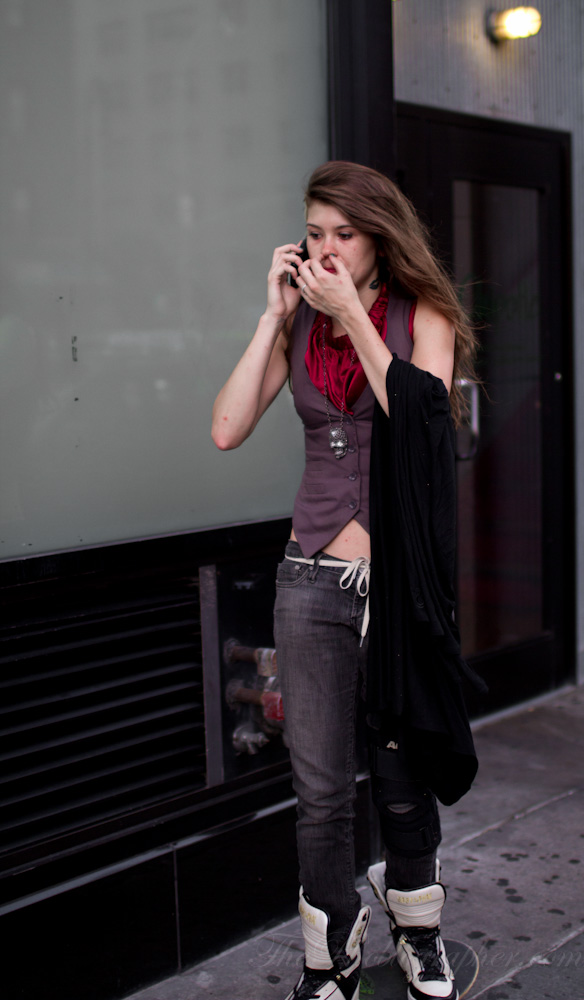
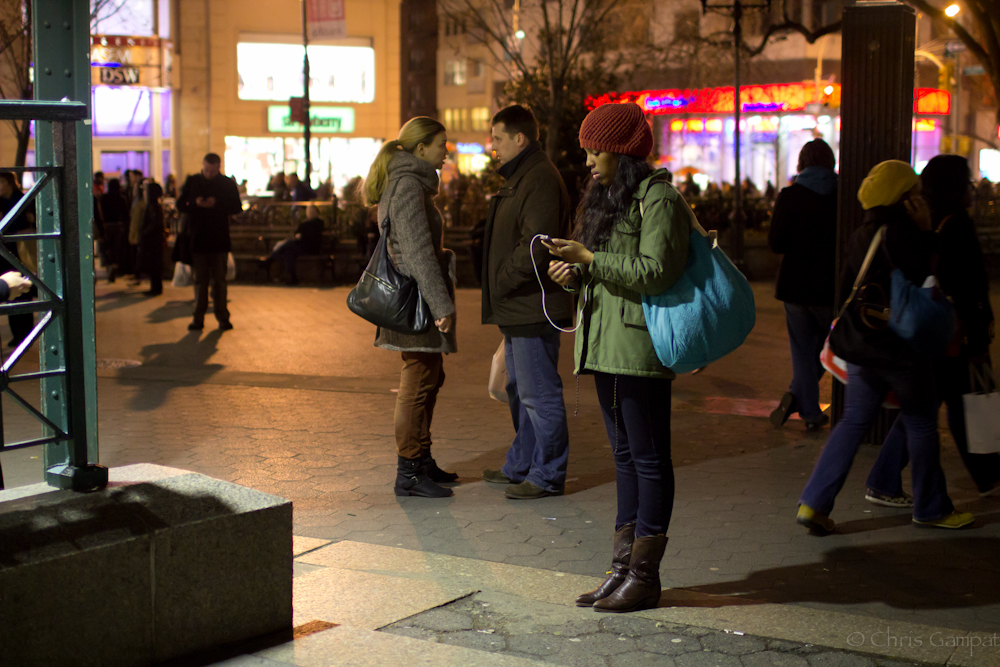
For the photo above, I used the right most focusing point, placed it on the girl’s face and shot. What attracted me to the moment was her style of dress, the shoes, the skateboard, and the fact that she’s on the phone at the same time. That takes some skill.

When Moving, Stop the Lens Down

Face it, you’re almost never going to nail a perfectly sharp photo with a lens wide open and while you’re on the move. A good idea is to stop the lens down to anywhere between f4-f8. When you’ve done that, consider either:

- Using the hyperfocal length scale on your lens to stay focused out to somewhere around maybe five feet away. Then when your subject is within five feet, just shoot.

- Stay in autofocus, and use the preselected point method that I talked about.

- Shoot from the hip (more on this later)

When Still, Open it Back Up
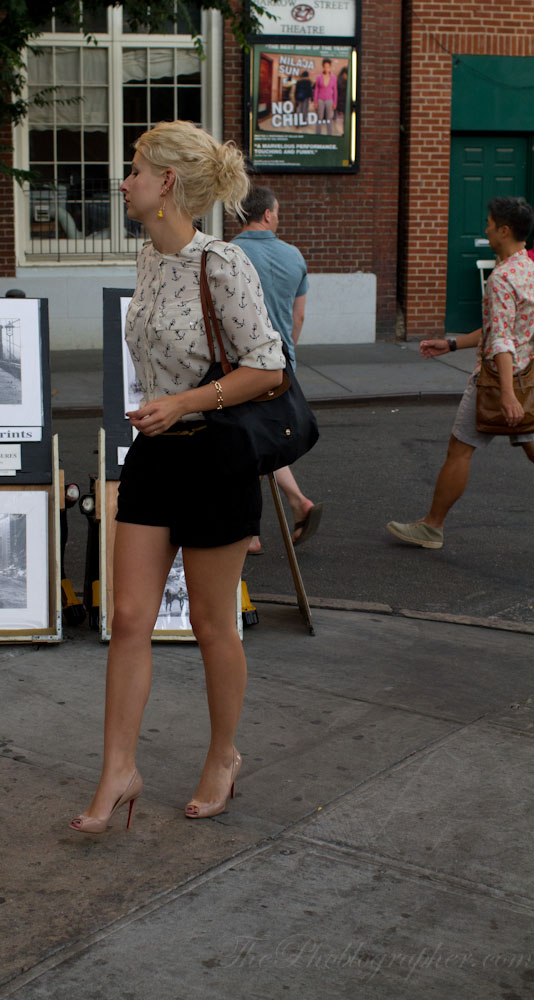
When you or your subject are still or moving slowly, you can open the aperture back up. If you act quickly, you should be able to get the shot. Part of this comes from using the pre-selected focusing point and having a vision in mind of the shot you want.

What also doesn’t hurt is firing off one or two shots.

Aperture Priority and Shoot Raw
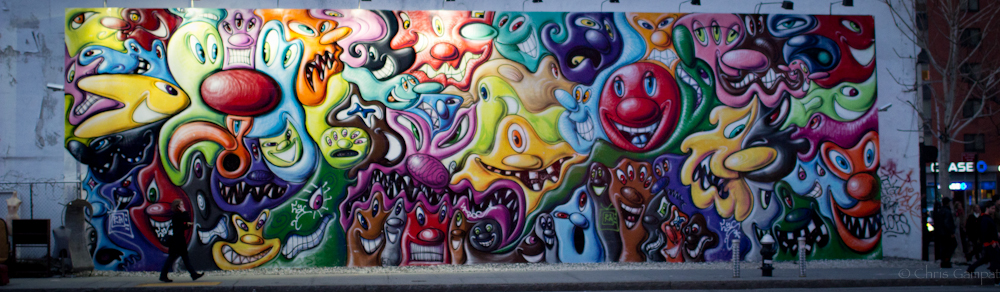
What I often do when shooting street photography is use Aperture priority and adjust my ISOs accordingly because the high ISO settings on the 7D and 5D Mk II are so good to begin with. This means that I fiddle with the settings much less and I’m often able to balance out the depth of field with a fast shutterspeed to capture the moment.

Shooting RAW allows me all the forgiveness in the world in the post-production stage because I can turn what some may call a mistake into something artistic and beautiful later on.

Don’t Be Afraid, You’re Not Shooting Someone with a Gun
The other day, someone came up to me and asked me how to get rid of their fears when they’re shooting with a big camera and getting in someone’s face.

I immediately put the camera to my eye, and said, “Give me all your money, or I’ll shoot you.”

Would shooting him kill him? Of course not.

Could I have robbed him with my camera? If I did, I would probably need extra insurance which would cost me more.

Could someone actually think that you’re threatening them when you point a camera at them? If you answer yes, you need to stop taking photos.

If you can’t get over your fear, close your eyes. When I first started shooting street photography, the people I was trying to photograph looked at me with an intense gaze as I was about to press the shutter button. In response, I would become frightened. Because I realized that the fear came from seeing this gaze, my procedure was to focus and compose very quickly then close my eyes and shoot the photo.

Just keep in mind that taking a photo of someone is harmless.

Smile
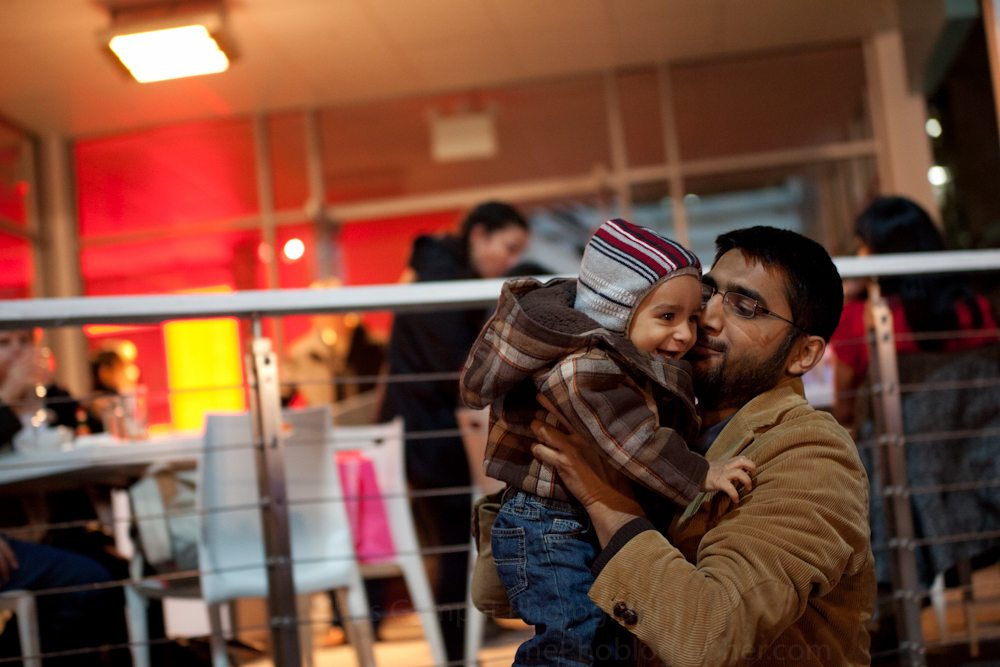
A way to disarm the angry person that you just photographed is by smiling at them and making eye contact after you’ve taken the shot. But this isn’t an ordinary smile: it needs to come from the heart. You need to fill yourself with genuine warmth and excitement and convey to them through body language that you don’t mean anyone any harm.

All of this first comes from your mentality. You need to believe in your own cause and convince yourself that you’re not harming anyone.

Use a 24mm, 35mm or 50mm Lens Equivalent
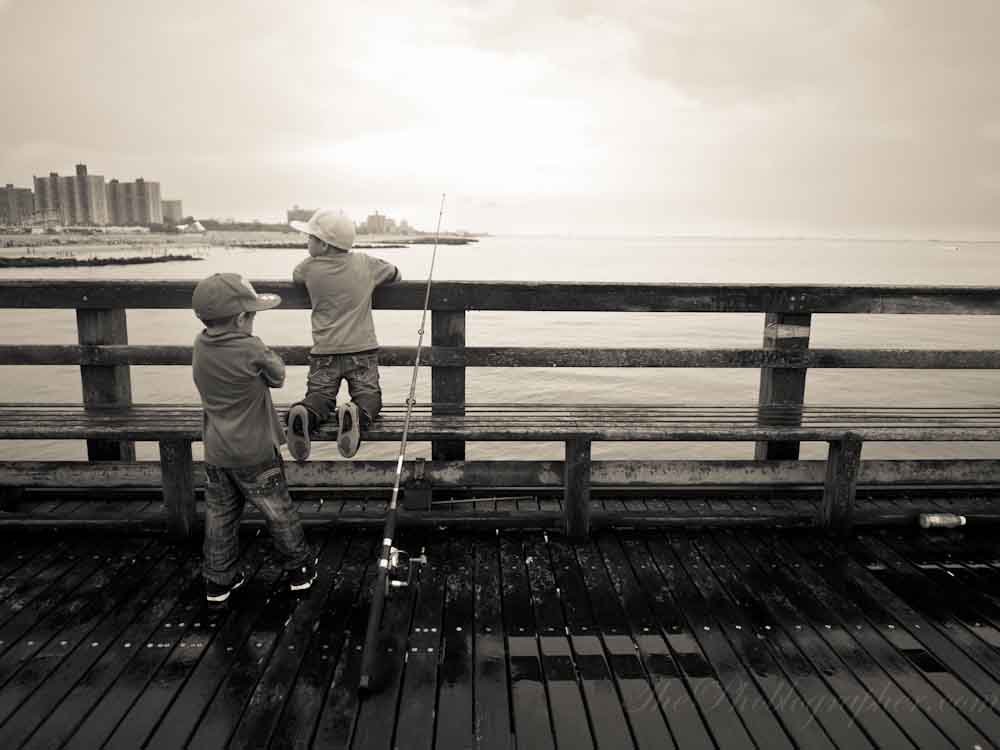
One day, we're going to catch Moby Dick...

The reason why I’m recommending these lenses is because they closely mimic what the human eye sees and allow you to capture the entire environment when shooting. Don’t want everything? Then just crop later on in post-production. But when you shoot with these focal lengths, you’ll make your viewers feel as if they’re there.

Combine that with shooting from perspectives and angles to inject your emotions and feelings into the image, and you’ll have an enthralled audience.

Don’t have these lenses? Consider our list of the Best Budget Lenses. My current favorites are the Canon EF 35mm f1.4L (review here) and Olympus 17mm f2.8.

Positive Reinforcement

It’s important to show genuine enthusiasm about your photos. When you nail one perfectly, use that excitement to nail another perfectly. Remember that the image won’t look just like it does on the LCD when you import it to your computer. With that in mind, you’ll need to develop your own style of editing to make the files work. Said files will work differently for each camera and RAW file format.

Shoot from the Hip

Try this:

- Sling your camera around your body.

- Pre-focus your lens to a certain area; this often works best with a smaller aperture.

- When someone is in range, press the shutter button on your camera while it is still slung down by your waist. You can get some very interesting results this way.

or

- If you camera has a tilting or flip-out LCD screen, you can hold the camera down by your waist and flip the LCD screen out to compose your images.

Please Support The Phoblographer

We love to bring you guys the latest and greatest news and gear related stuff. However, we can’t keep doing that unless we have your continued support. If you would like to purchase any of the items mentioned, please do so by clicking our links first and then purchasing the items as we then get a small portion of the sale to help run the website.

  • http://Quillcards.com David Bennett

    After failing many times to get the street photos that I wanted to take, I think for me it comes down to one thing – conquering fear.

    • Anonymous

      Why are you afraid exactly?

      Chris Gampat,
      Editor in Chief
      The Phoblographer

      • http://Quillcards.com David Bennett

        Sometimes I want to get closer – and I go through a little argument in my head about invading someone’s space, the reason I want to photograph them, whether they will mind, etc.

        • Anonymous

          That’s where you put your own needs first. So what if you take their
          picture. Are you harming anyone? No. What harm will taking someone’s photo
          do to them?

          Especially if you’re in public.

          Chris Gampat,
          Editor in Chief
          The Phoblographer

          • http://Quillcards.com David Bennett

            I like getting this out in the open, and it’s good to discuss it.

            I agree that taking a photo does no harm.. But publishing it may do. I wouldn’t like to see a photo of myself picking my nose surreptitiously, for example.Weegee photographed gangland slayings and Diane Arbus photographed circus freaks. Both were good photographers, but I don’t think I would feel comfortable knowing I had published a book of circus freaks. There’s an article about Diane Arbus in the Guardian today:http://www.guardian.co.uk/artanddesign/2011/jul/26/diane-arbus-photography-sideshow

            • Anonymous

              You’re going to think about that beforehand, most people usually do when
              they’re going through the images in Lightroom. Seriously, I’ll shoot over
              100 and maybe be happy with one.

              Chris Gampat,
              Editor in Chief
              The Phoblographer

      • Anonymous

        I can only speak for myself, but my fear is related to being confronted with why I take pictures on the street. I’m not good at handling such situations and easily get pushed into a corner where I look guilty as hell…  I can’t just say that I love photography, but are tired of taking pictures of the same sunset, the same lake or mountains…

        It’s much easier in the Summer when all the tourists are walking around with their cameras, though.

    • Anonymous

      I have the same issue David and for me it comes down to the fact that I don’t like people photographing me so I’m uncomfortable photographing others without permission. I’ve done it, sometimes with great success and sometimes have upset people. Either way I know how you feel. One suggestion – go on a photo walk with another photographer that isn’t scared of doing it and see if that helps you get over it.

      • http://Quillcards.com David Bennett

        Good idea. I’l try to follow up on that.

        Is this you? http://sander-martijn.com/

        • Anonymous

          Yes that’s me – you’ll also see my name as the author of some of the articles here.

        • Anonymous

          Yes that’s me – you’ll also see my name as the author of some of the articles here.

  • Pingback: How to Shoot Street Photography with a DSLR – The Phoblographer (blog) | The Photo Bargains

  • http://twitter.com/gservo The Servo

    Damn, now i have an itch to get to the city and shoot

    • Anonymous

      Do it!

  • pradeep

    wouldnt a model release be required if you take someone’s picture on the street and use it on a website or blog?

    • Anonymous

      Not if you’re in public.

      Chris Gampat,
      Editor in Chief
      The Phoblographer

      • Anonymous

        As Joseph said, if you want to use an image commercially you do need model release forms. This is why most advertising shots are posed. The other option is to request someone to sign it after you’ve gotten the shot but that’s risky. If you’re using it for personal noncommercial usage which probably includes artistic purposes you’re ok shooting anyone or anything you can see in public – except federal buildings (since 9/11 laws took effect).

    • Joseph

      only if you use it to advertise for something
      I think even for an exhibition you woudn’t need a model release or for any artistic use
      but you have to ask for local regulations

      • Anonymous

        So in NYC, there was an actual court case about this that I learned about in
        both photojournalism class and college. A man sued an artist exhibiting a
        street photo of him in an exhibit.

        The artist won because it was in public. Anything goes in public.

        -Chris Gampat
        Editor in Chief, ThePhoBlographer.com
        Twitter.com/ChrisGampat

  • Pingback: 206/365 Walking between rain showers | GServo's Photography & Art

  • Joseph

    Check out Scott Kelby’s A day with Jay Maisel series for more insight on how a pro approaches street photography.
    Very inspiring, and he doesn’t ask for model releases either.

  • Joseph

    Unfortunately I have seen much so called street photography that is quite bland because the photographer did not have the courage to go nearer or to go to a place where something worth photographing was happening.
    Even though Jay Maisel shoots with a tele lens you can still see good use of human interest, composition and color.
    If it’s not interesting after a while of looking at it, then you don’t really need to show it.
    It doesn’t always have to be people photos, look at the work of Ralph Gibson about light and shadow in high contrast b/w.

    • Millenium Dom

      I kind of agree with Joseph, this street photography is boring.  

      Do a google search of Sarah Moon, she is just great. Like staring at an expressionist painting. 

    • http://sthlmstreet.com/ Jimmy D

      Yeah – getting closer to your subjects really pays off in street photography. But “close” isn´t just about distance – it might as well be about establish some kind of connection between the view and the subject, don´t you think?

  • Pingback: 207/365 You want me to do what? Where? How? | GServo's Photography & Art

  • Pingback: 208/365 Another Early Morning in NYC | GServo's Photography & Art

  • Pingback: How to Shoot Street Photography with a DSLR at The Phoblographer « G11 – Photography Magazine

  • chuck

    On my D7000 the AF-C auto is fast enough to nail focus walking at a brisk pace even at f/2. I really don’t see the need for a small aperture unless your focus system can’t move fast enough. 
    I get a feeling about people when I’m making the decision to take their picture, if they look confrontational I have to judge whether or not it is worth the possibility of having to deal with an irate person getting in your face demanding you pay them or give them your camera. 

  • Morgan

    great article

  • Daniel T Lowe

    Hi, I’m an amateur photographer and shoot with a Nikon D90. I like your shoot from the hip idea and would like to add what I do. It’s more or less blind shooting, but I simply hold the camera at the hand grip and shoot on a vertical to tilted plain. This works really well in the downtown area of the city that I live in, especially working with shooting buildings. Granted, there is little control over focus and adjustment, so I just leave on the auto focus. ,Akers for some great and interesting shots. I usually snap two or three keepers this way and will practice it as my end of the shoot practice, walking home. Just my $.02. Thank you.

  • Pete

    Legal or not, I view street photography and the subsequent posting of unaware individuals’ pictures on the internet as an invasion of privacy.

    • http://www.facebook.com/ron.dowdell.1 Ron Dowdell

      The common assertion is that if you are in plain view on the street, or in many cases in plain view of the street, you should have no expectation of privacy.

  • Pingback: » URBAN/STREET/INDUSTRIAL PHOTOGRAPHY ASSIGNMENT Advanced Photography

  • Hipster

    Great article! I’m out and about in London this weekend to do a spot of street photography with my gorgeous Canon 7D, my 10-22mm, 30mm prime and the 70-300! Will be putting all advice into practice…

    All in preparation for the big apple in July :-)

  • Maddieraz

    Hi, I get confused when smaller aperture is mentioned, some folks mean smaller aperture number f4-f8 others mean smaller aperture (physically smaller f16). So when you say “Pre-focus your lens to a certain area; this often works best with a smaller aperture.” which do you mean?

  • http://twitter.com/TheresaZphotoz Theresa Z.

    Great article. I love the picture “One day, we’re going to catch Moby Dick”.

    Ask to take the picture, if it’s an individual person that you want to shoot, all they can say is no. = )

Previous post:

Next post: