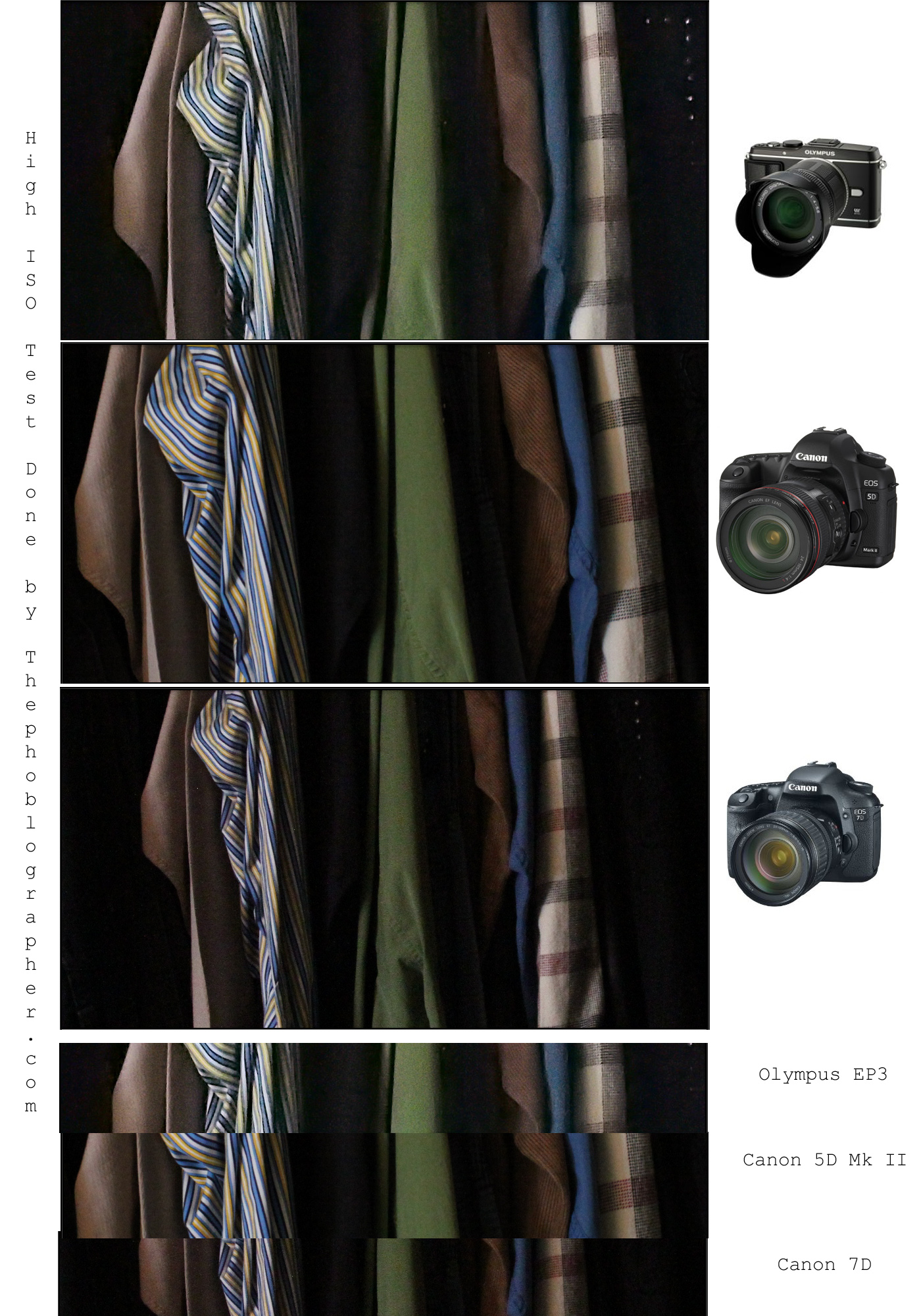
High ISO Test: Olympus EP3 vs Canon 5D Mk II vs 7D

by Chris Gampat on 07/09/2011

According to DXoMark, the Fuji X100 has an amazing sensor and it has been rated to be better than the Canon 5D Mk II and the 7D (correction: the 5D Mk II is still rated to be better). With the announcement of the Olympus EP3, I decided to put the camera against the two DSLRs myself. So how does the new internally developed sensor do against the mainstream giants?

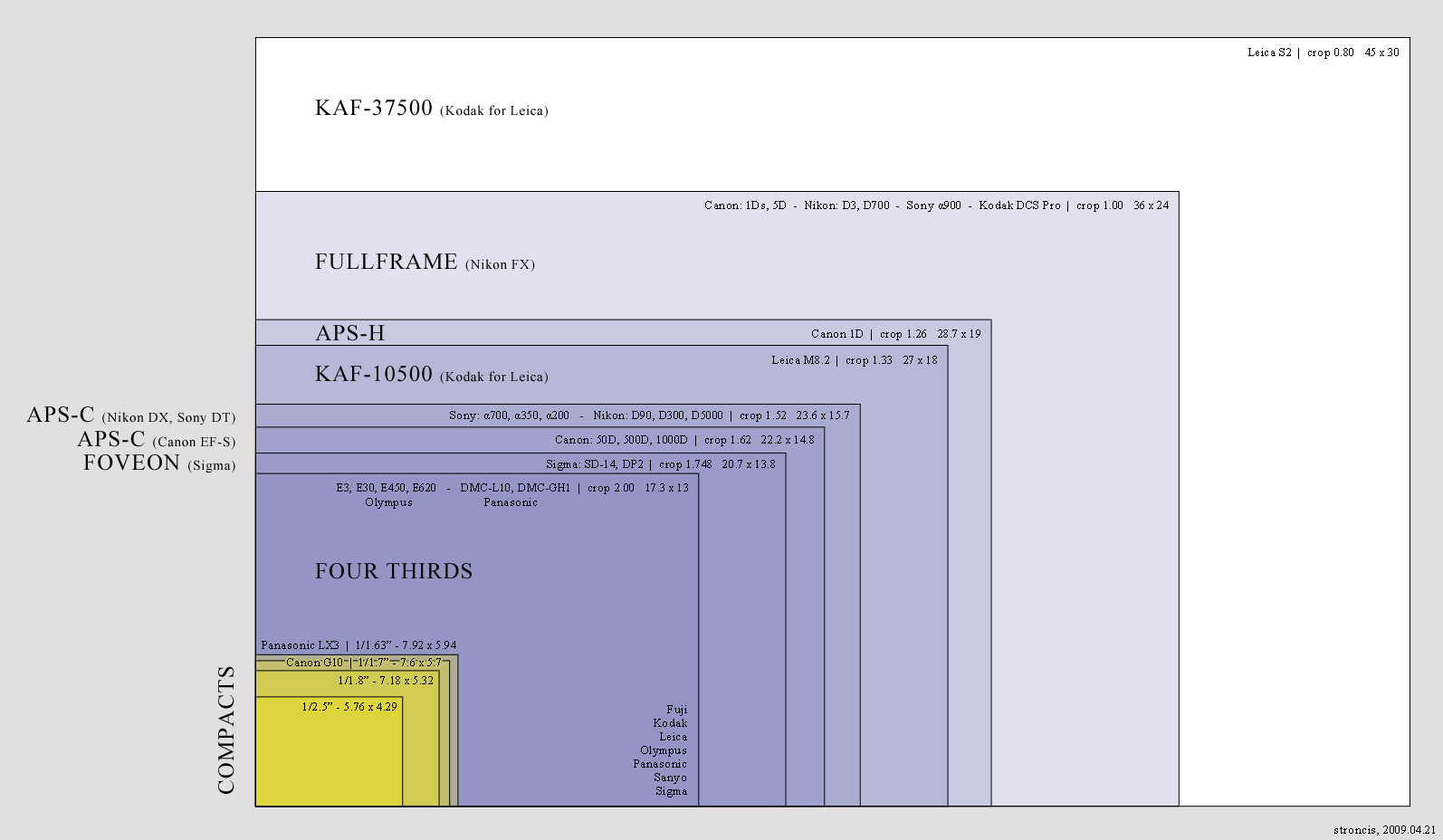
Disclaimer: Yes, we know the sensor are different sizes. Yes, we know that you’ll go over to other sites to look for this information anyway. Yes, we are trying to answer the question for you.

Test Conditions
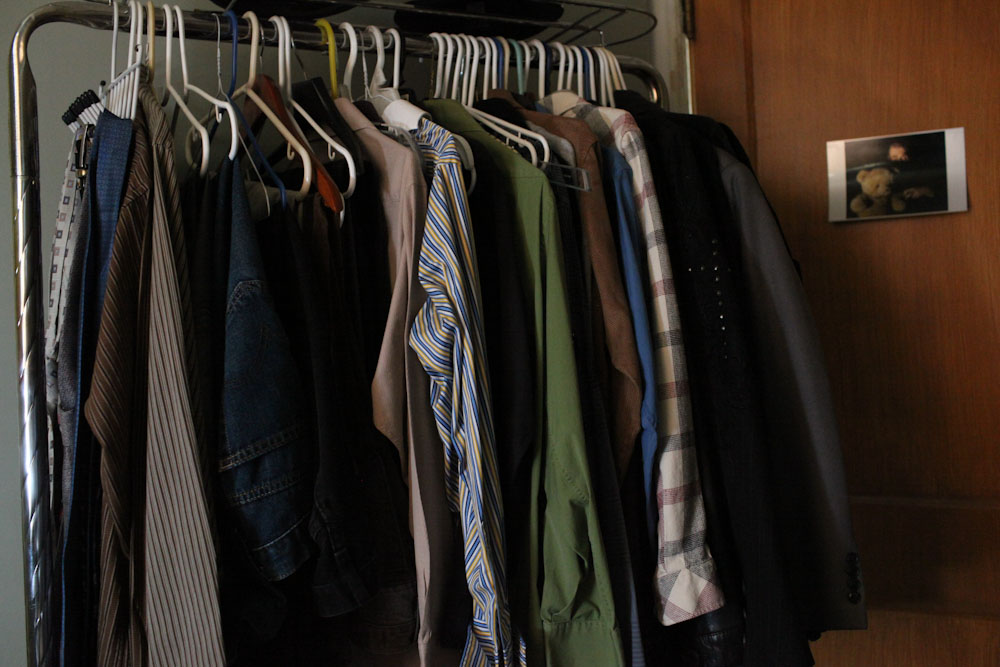
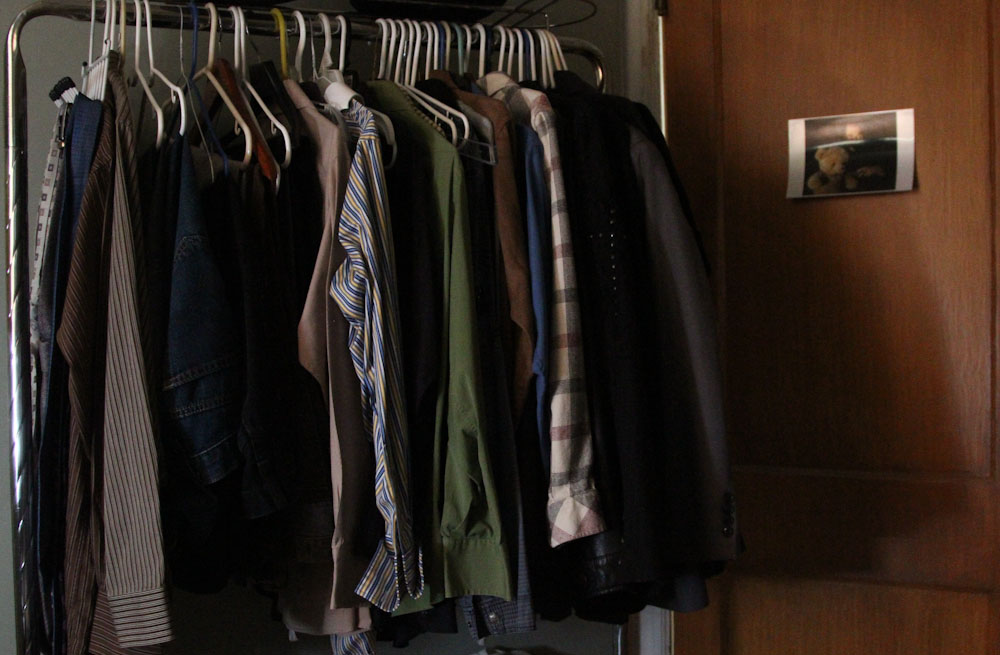
The cameras were all set to the 3:2 aspect ratio. After that, they were set to around the same size dimensions (around 2,000 pixels wide) and were shot in RAW + JPEG. The exposure metering was based upon what the EP3 stated was balanced for it based off of metering the center of the area. Each camera was set up to shoot as close to the same scene as possible. When imported into Lightroom 3, all of the histograms looked very similar.

Then 100% crops were done.

For this test, we will be testing the JPEGs. A RAW test will be conducted in a future posting.

Image Samples
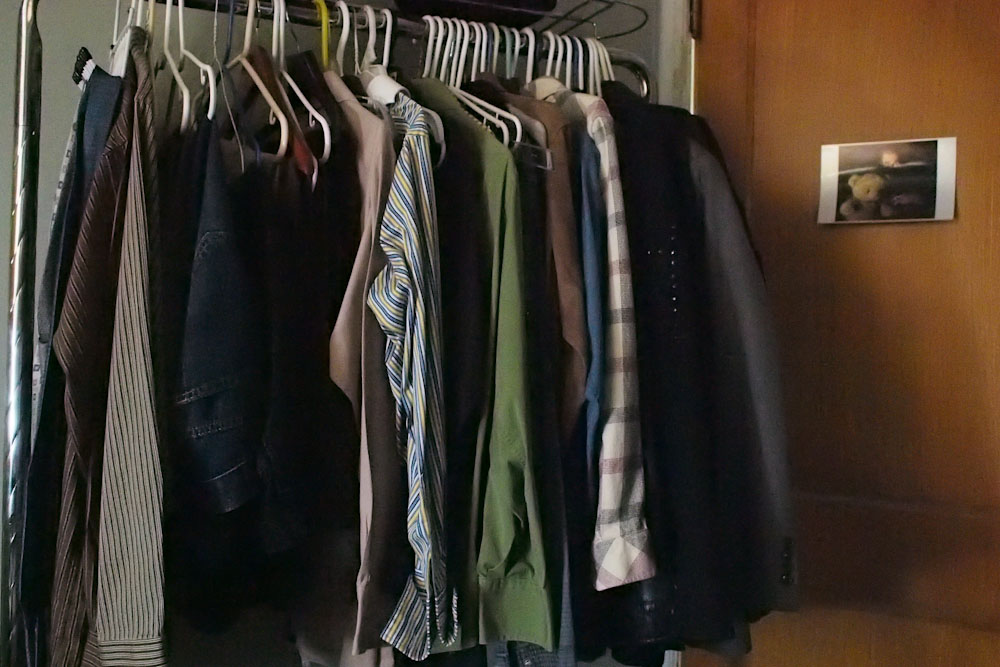
EP3 at 1/15th and f/4 iso 6400 (corrected)

5D Mk II 1/15th at F4 ISO 6400

7D 1/15th at F/4 at ISO 6400

Conclusions

Based on the image samples, the Canon 5D Mk II is still way ahead of the other two cameras. However, the EP3 is almost on par with the Canon 7D’s high ISO output results.

This must be exciting news for the company as they have struggled for years with getting better high ISO output results. Here’s a better look with the EP3 on the right and the 7D on the left.
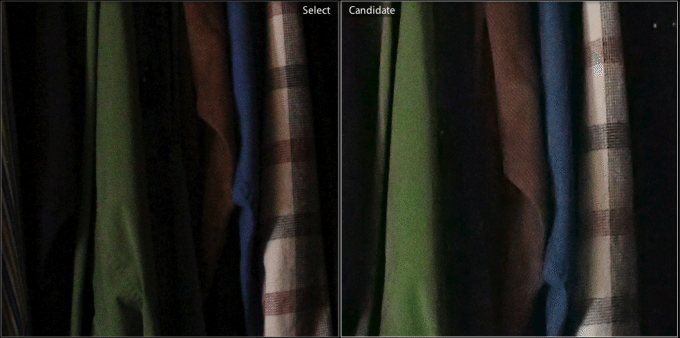
EP3 (right) vs 7D (left)

As you can see, in JPEG mode the image quality is starting to catch up to the Canon 7D. With this said, I can estimate that the noise levels may be on par with the old Nikon D300 (please note that this is not the D300s that I’m talking about.)
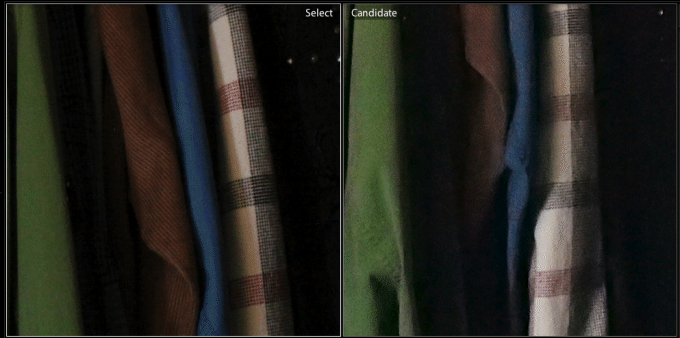
Canon 5D Mk II (left) with Olympus EP3 (right)

Now take a look at this, the 5D Mk II is still holding its ground very well even after all of these years at ISO 6400.

Overall, the new Olympus EP3 has been able to vastly improve the high ISO output and may finally creep up within the next iteration of the camera (or maybe even in RAW).

Thoughts? Comments? Let us know!

Update: the Olympus EP3 Raw File test has been added. We now see that the EP3 isn’t as good as the 7D in RAW, but still okay and workable.

Please Support the Phoblographer

We love to bring you guys the latest and greatest news and gear related stuff. However, we can’t keep doing that unless we have your continued support. If you would like to purchase any of the items mentioned, please do so by clicking our link and then purchasing the items as we then get a small portion of the sale to help run the website.


  • Pingback: CanonWatch | Blog | Review and Comparison

  • Anonymous

    Chris, your earlier statement about the Olympus EP3 being the best camera for the money may be understated.  Comparing the cost of the Canon 5D Mk II and the Canon 7D to the EP3, the EP3 is definitely the front-runner.  Thanks for all of your work!

  • Pingback: High ISO Test: Olympus EP3 vs Canon 5D Mk II vs 7D – The Phoblographer (blog)

  • Robert

    Great news for the M4/3 format. Panasonic G3 reviews often compare it to very well regarded larger sensor cameras. So with these latest generations, Olympus and Panasonic are putting to rest many of the negatives (real or imagined) about the format. 

  • Peroni -

    thanks for this test, however I cannot explain why the olympus pic had to be shot with a shutter speed of 1/5th  while the two Canons were at 1/15th to achieve a similar brightness?

    • Anonymous

      The Canon’s most likely absorb more light. Additionally, their metering is different. Oddly, their histograms are very similar.

      • http://pulse.yahoo.com/_NZOJ4HWBMUHYOYAKLLNTLKOTVQ A N

        Then that would seem to undermine this comparison imo. In order to capture a similar image you needed a longer exposure time, which can help to reduce noise. At least that’s what I’ve experienced with my camera at higher ISO settings. A stronger test of noise would be to compare with equalized shutter speeds or like at 1/200.

        • Chris Gampat

          No it doesn’t. Different cameras meter differently

        • Rudi Kdahlan

          AN, I think longer exposure will be more noise. That’s why shooting at night will be a problem with oly because it make it more exposure time. and people use high Iso to reduce exposure time shorter.

      • Peroni -

        Then Oly is “cheating” a bit here, they can call it ISO6400 but if it behaves like iso 2000 then the end result for the user is completely different that what this brief comparison might suggest.

        • Chris Gampat

          In my honest opinion, all cameras brands cheat. If I were to start mentioning names though, fan boys would rise up in arms.

      • GuestJames

        Has anyone though it ma be a typographic error? Perhaps is was at 1/15 and it was type wrong.

        • Chris Gampat

          It wasn’t. The cameras metered the scene differently. It was done this way because most users would meter the scene be balanced according to the cameras meter anyway.

        • Peroni -

          Chris would know if that was a typo, he wrote the article!!

          • Peearwood

            I’m with Piew98. If you look at the exif of the file, it’s clear that this image was shot with 1/15 s.

            • Peroni -

              You’re both right! Sorry I should have checked the exif first but was on my mobile.
              The knowledge of the autor of this article is to be questioned since he goes as far as saying this:  ”The Canon’s most likely absorb more light. Additionally, their metering is different. Oddly, their histograms are very similar.”

              • Anonymous

                Nope the knowledge isn’t to be questioned. Larger sensors absorb more light
                and that’s a stated fact. It’s why they often don’t need to shoot at higher
                ISOs when smaller sensor cameras need to.

                Go try it…seriously.
                -Chris Gampat
                Editor in Chief, ThePhoBlographer.com
                Twitter.com/ChrisGampat

              • Anonymous

                Nope the knowledge isn’t to be questioned. Larger sensors absorb more light
                and that’s a stated fact. It’s why they often don’t need to shoot at higher
                ISOs when smaller sensor cameras need to.

                Go try it…seriously.
                -Chris Gampat
                Editor in Chief, ThePhoBlographer.com
                Twitter.com/ChrisGampat

              • Anonymous

                Nope the knowledge isn’t to be questioned. Larger sensors absorb more light
                and that’s a stated fact. It’s why they often don’t need to shoot at higher
                ISOs when smaller sensor cameras need to.

                Go try it…seriously.
                -Chris Gampat
                Editor in Chief, ThePhoBlographer.com
                Twitter.com/ChrisGampat

            • Peroni -

              You’re both right! Sorry I should have checked the exif first but was on my mobile.
              The knowledge of the autor of this article is to be questioned since he goes as far as saying this:  ”The Canon’s most likely absorb more light. Additionally, their metering is different. Oddly, their histograms are very similar.”

            • Peroni -

              You’re both right! Sorry I should have checked the exif first but was on my mobile.
              The knowledge of the autor of this article is to be questioned since he goes as far as saying this:  ”The Canon’s most likely absorb more light. Additionally, their metering is different. Oddly, their histograms are very similar.”

      • Piew98

        The Oly is at 1/15 as per the exif, definately typo error… i also notice the setting was at manual mode, unless you forget what shutter speed you set.

  • Pingback: Reviews: Canon EOS 7D » Photo Video Online [en]

  • Pingback: Reviews: Olympus PEN E-P3 » Photo Video Online [en]

  • Pingback: Reviews: Canon EOS 5D Mark II » Photo Video Online [en]

  • Nalaxiao

    Good news for m43 but as noise technology improves for m43, it will improve as well for larger sensors which is good news for all camera brands and sizes. When the 7d gets updated, we should expect better high iso capabilities. The bar continually gets raised and we get better cameras. Thanks for the tests, I’m anxious to try out the ep3. I decided to hang on to the ep2 as it has it’s own niche for my shooting. I ‘ve told my wife it’s an inexpensive point and shoot!

    • Chris Gampat

      Ha. Expensive point and shoot

  • Pingback: 'E-P3 vs Canon 5D Mk II & Canon 7D' - Micro Four Thirds User Forum

  • Pingback: Next E-P3 and 45mm f/1.8 tests roundup (E-P3 almost on par with the Canon 7D) « b r e a k m e l o d y

  • Pingback: High ISO Test: Olympus E-P3 vs some serious competition | Foggy Fotos

  • Pingback: Mirrorless Rumors | Blog | Mirrorless news roundup!

  • Mmmkvista

    m43 iso performance is still unacceptable compare to DSLR especially to Nikon.

  • Csulestio

    Im sorry but EP3 has only deceivingly told itself to be a ‘great’ camera. yes it has the looks and incredible jpeg color rendering. however I cannot agree on olympus’ philosophy on high ISO tuning of the m4/3 sensor. This is what i meant by philosophy:

    I bought a GF1 back in 2009, choosing it over the EP1 ( I realised that were talking about EP3 here but if u notice the high iso results between ep1 and ep3 they have the same characteristics), only because of the AF difference (faster AF on GF1, thank goodness its corrected on EP3)

    I compared my GF1 to a bunch of olympus m4/3 enthusiasts to see where the same sensor can produce a different output. The result shows that panasonic has higher noise level but retains more detail. A different set up to the same  m4/3 sensor have produced this difference. Why? because they were tune up differently. a difference  in image philosophy. 
    The conlusion is that although Olympus has less noise in higher ISO output, it loses detail of the subject. Like the example above, the 7d has more detail than the ep3.

    So choosing between the two different philosphies; detail over noise or noise over detail? i got to go with detail over noise. 

     Im not pro panasonic, but i just want to point out that olympus got it wrong in cancelling so much detail in high ISOs. So mr gampat, instead of going overboard and testing ep3 against 5d and 7d id like to see the comparison with G3 see what i mean by this difference in philosophy that is deceivingly ‘great’ in all Olympus cameras.

    • Anonymous

      I think you need to see this:
      http://www.thephoblographer.com/2011/07/05/which-one-olympus-ep-3-vs-olympus-ep-2/

      As I’ve stated before, there was apparently a great variation in the units
      that were sent out when I compared mine to CNet’s (I used to work a floor
      below Lori) and Digtial Camera Review’s (where I write workshops).

      To be quite honest, I don’t know who to believe, but these were my tests.

      -Chris Gampat
      Editor in Chief, ThePhoBlographer.com
      Twitter.com/ChrisGampat

      • Csulestio

        Chris, thanks for the info, from your link above i can see that the iso performance is indeed better than the ep2. Maybe previously I have i assumed too early and looked at the wrong reviews, cause judging from your link it looks like the EP3 has indeed left its EP1 & EP2 philosophy of approach (the gradual total annihilation of details in high ISO). If indeed they have, then it will be a major boost. Because in the end of the day, everybody can do their own post processing which includes noise cancelling. Olympus need not embed this forcefully into its Jpeg processor.

  • Pingback: Which One: Olympus VF-3 or VF-2? at The Phoblographer

  • guest

    EP3 jpg looked fine here because it applied heavy noise reduction, and thus created a pretty heavy “oil painting” file. Just check out the shirt with yellow/white/blue stripes, it all got mushy.  Just IMHO.

    • Anonymous

      Hey,

      Actually, I set the noise reduction to standard. I do that with all my cameras. So that means that even then it’s high?

  • Pingback: High ISO Noise Test: Olympus EP2 vs Canon 5D Mk II vs Leica M9-P at The Phoblographer

  • Pingback: Mirrorless Rumors | Blog | Mirrorless news (Ricoh firmware, Paper Leica and more).

  • Pingback: Mirrorless news (Ricoh firmware, Paper Leica and more). « b r e a k m e l o d y

  • Pingback: E-P3 Images on par with what?

  • Pingback: Any Guess about Canon's EVIL? - Page 11 - Micro Four Thirds User Forum

  • http://twitter.com/Grakus_Art Grakus Art

    Thanks for this test. I hear the GX1 improves alot over the Ep3. So using some fast primes should improve alot over the  above images. Im still in two minds wether to sacrifice image quality for  a more compact camera.

    • Anonymous

      Depends on how good of an editor you are in the software.

      *-Chris Gampat*
      Editor in Chief, ThePhoBlographer.com
      Twitter.com/Phoblographer
      Facebook.com/ThePhoblographer
      The Phoblographer on Google +
      The Phoblographer on Tumblr

Previous post:

Next post: