


Wildlife photography is one of the most challenging genres of the medium. It requires one to be patient, but also quick when the moments call. Close-up Photographer of the Year, which has been providing a platform for many emerging wildlife photographers, has now unveiled the winners of its new challenge: Death & Decay. Here is a quick look at the winners and finalists, and how a Nikon camera managed to help the photographer win the award.
All the images are used with permission of the Close-up Photographer of the Year.
Since 2018, the Close-up Photographer of the Year has been at the forefront of awarding photographers who document wildlife up close, or using macro lenses. As part of their growing platform, the award has now unveiled the CUPOTY challenge, a themed competition that allows photographers to further showcase their work.
This time, the theme was Death and Decay, the winner of which was Willem Kruger from South Africa, whose image Hyena Portrait Zebra won the challenge. “Willem’s image stops you in your tracks,” said Tracy Calder, Co-founder of CUPOTY. “The direct eye contact, the graphic zebra stripes against the hyena’s fur, the unflinching honesty of the scene – it’s a powerful reminder that death is the end of one story and the beginning of another.”
The winner was chosen from hundreds of entries, which was judged by David Maitland, Georgina Steytler, Jamie Hall and CUPOTY co-founder Tracy Calder. William’s photograph beat the other 18 finalists to receive £300, and also will be featured in the CUPOTY ebook of 2026.
Here’s a quick look at the gear of the photographers:
- Nikon Z6
- Nikon Z8
- Nikon Z9
- Nikon D300s
- Nikon D750
- Canon EOS 6D
- Canon EOS R5
- Canon EOS M50 Mark II
- Canon EOS 5D Mark IV
- Canon EOS-1D Mark IV
- Sony A1
- OM System OM-D E-M1 Mark II
- Olympus OM-D E-M1 Mark III
- Olympus OM-D E-M1X
- Hasselblad 203 FE
Lenses
- Nikkor 600mm f4 ED AF-S VR
- Nikon 10.5mm Fisheye
- Nikon 70-200mm f4G
- Nikon Z 50mm Macro
- Nikon 8-15mm Fisheye
- Canon 70-200mm f2.8L USM
- Canon EF 100mm f2.8L Macro IS USM
- Canon EF 600mm f4L IS II USM
- Canon EF 17-40mm f4L USM
- Sony FE 24-70mm f4
- OM System 60mm Macro
- M.Zuiko Digital ED 90mm f3.5 Macro IS + MC-20 2x Teleconverter
- M.Zuiko 60mm Macro
- Hasselblad 50mm
Overall, there are 6 Canon cameras, 5 Nikon offerings, 3 OM System models, and one from Sony and Hasselblad each. Similarly, there are 8 full frame cameras, 3 Micro Four Thirds, 2 APS-C, one APS-H, and one medium format. The range is quite diverse for the challenge, which is rarely seen in a photo competition. Moreover, while Nikon won the main challenge, they are still behind Canon when it comes to being the first choice.
Willem Kruger | Winner
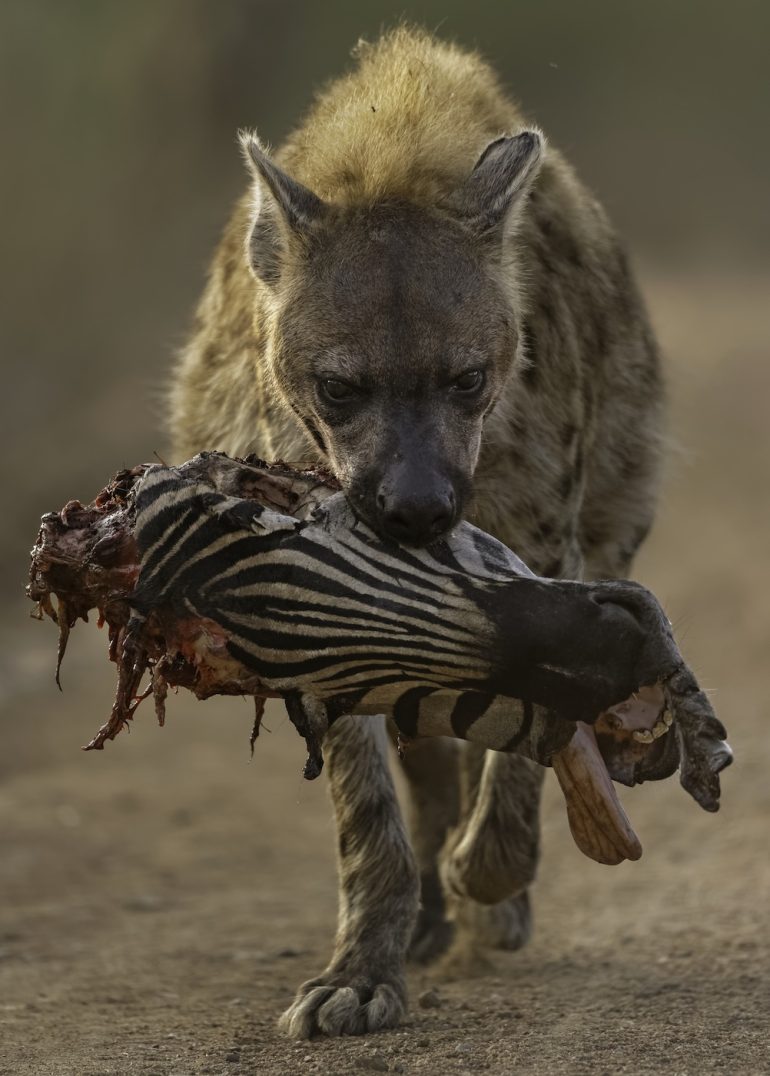
Early one morning during a game drive in Kruger National Park, South Africa, William and his wife saw three spotted hyenas walking along the road. One was carrying the head of a zebra, presumably from a nearby lion kill, and was heading straight towards us. The couple parked at the roadside as the hyena approached and walked past our vehicle. They followed for a while, hoping it would lead them to the den. After a short distance, the hyena left the road and melted into the bush. In nature, almost nothing goes to waste – even hyenas have a family to feed, and they do it with remarkable commitment.’
Camera: Nikon Z6
Lens: Nikkor 600mm f/4 ED AF-S VR
ISO: 800
Aperture: f/4
Shutter speed: 1/2000sec
Accessories: Gimpro head on Gimpro window mount attached to vehicle
Juan Jesus Gonzalez Ahumada | Second Place
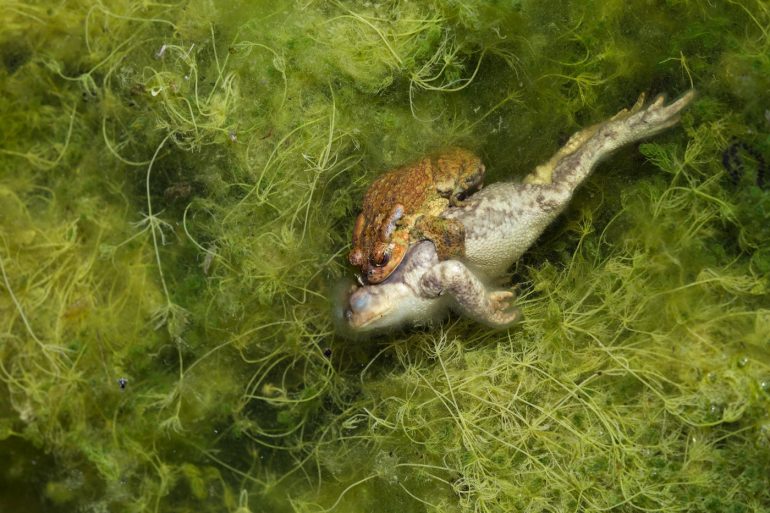
When the breeding season arrives, common toads congregate in ponds to mate. Often, several males court a single female, and sometimes she can die from suffocation, unable to surface for air amidst the throng of males surrounding her. In this case, several males had courted the female unsuccessfully and when tragedy struck, they all abandoned the scene. Only he remained, embracing her body – his true love.
Camera: Canon EOS 6D
Lens: Canon 70–200mm f/2.8L USM
ISO: 200
Aperture: f/6.3
Shutter speed: 1/640sec
Accessories: None
Gaël Modrak | Third Place
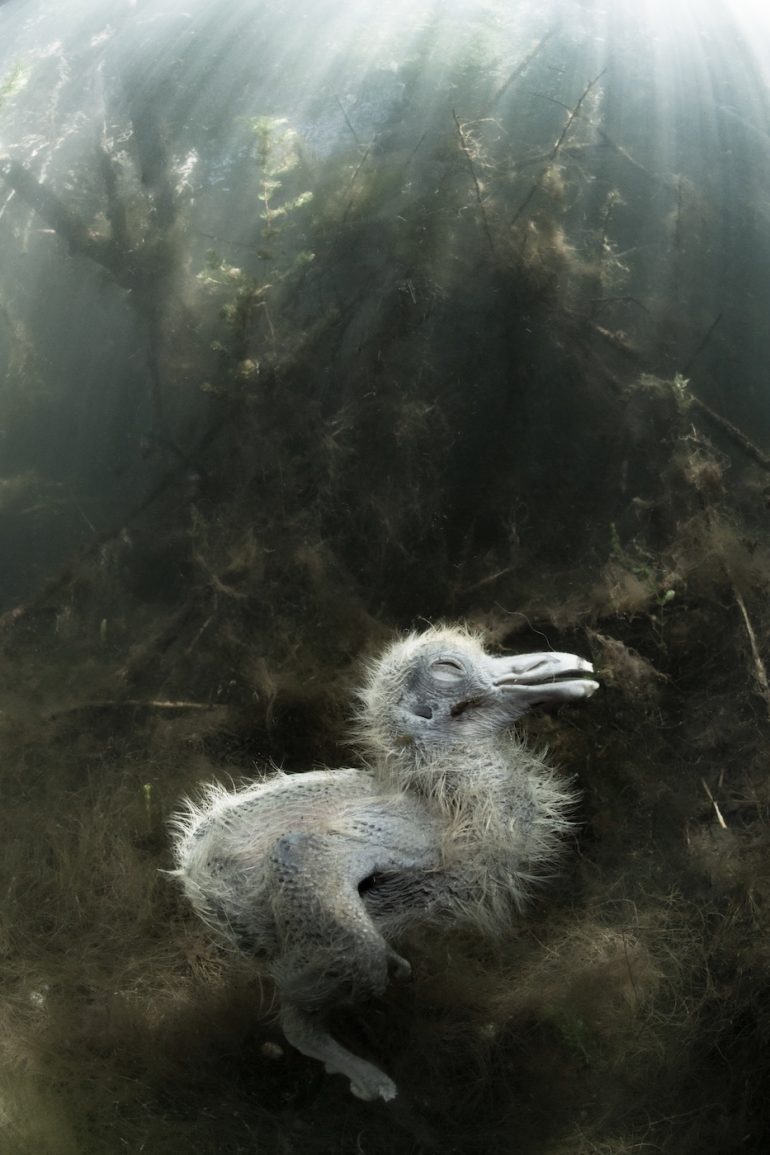
Gaël and his friends were diving in a pond near Paris, and he was searching for interesting subjects in this rather barren setting when he discovered the body of a waterfowl chick lying on the bottom. The scene, though macabre, inspired the photographer. Gaël switched to my wide-angle lens to capture the somber atmosphere, positioning himself to incorporate rays of light filtering down through the murky water, lending a mystical, almost reverential quality to the image.
Camera: Nikon D300s
Lens: Nikon 10.5mm fisheye
ISO: 640
Aperture: f/13
Shutter speed: 1/60sec
Accessories: Hugyfot underwater housing, two Ikelite underwater strobes
Finalists
G Ramaprasad
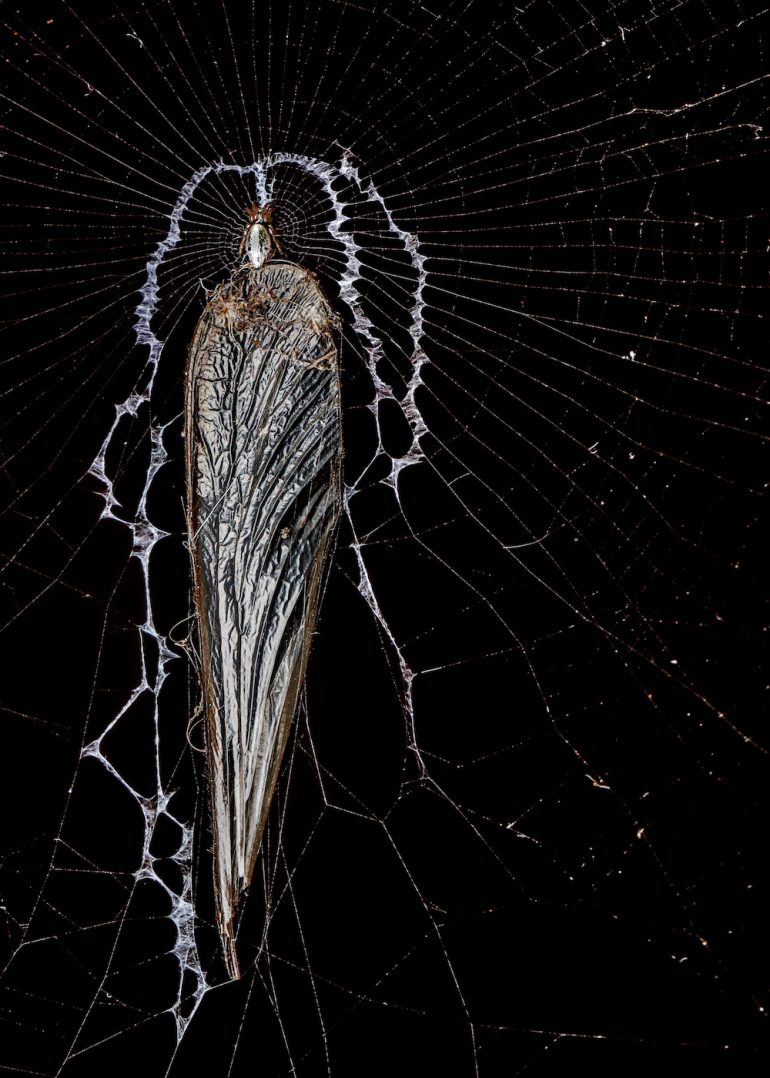
During a dry summer afternoon, while exploring his backyard in search of interesting insects to photograph, Ramprasad came across a fascinating trashline orb weaver spider. These spiders have always captivated him with their intricate and uniquely designed webs. This particular encounter was especially striking – the spider had incorporated the delicate wing of a fly into its web, almost as if it were a trophy from a recent hunt. The scene felt like a natural work of art, showcasing both beauty and predation in perfect harmony.
Camera: Canon EOS M50 Mark II
Lens: Canon EF 100mm f/2.8L Macro IS USM
ISO: 200
Aperture: f/10
Shutter speed: 1/200sec
Accessories: Godox TT520II flash with Radiant diffuser
Alex Pansier
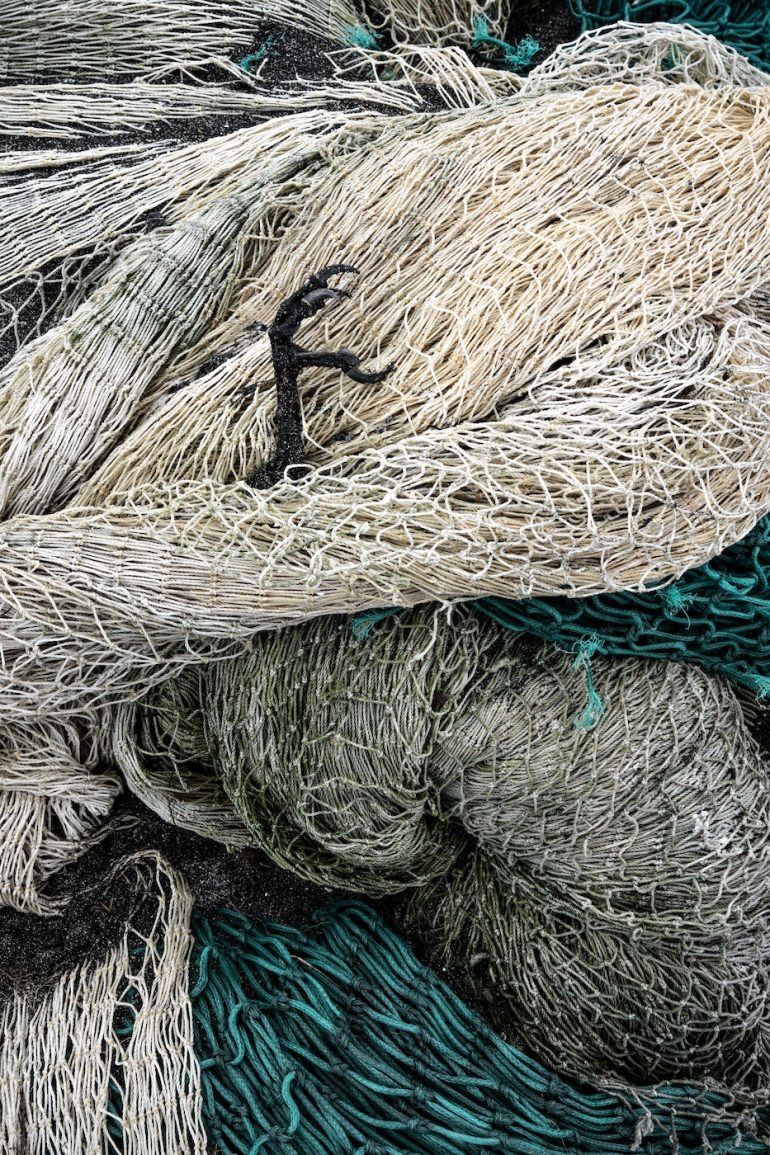
Alex was photographing the structures and textures of old fishing nets in Iceland when he noticed a crow’s foot emerging from the tangled ropes. At first glance, the scene appeared as an abstract composition of lines and patterns, but the dark claw revealed a more unsettling detail. The contrast between the sharp black foot and the pale woven nets transforms the image from a study of texture into a subtle reminder of how wildlife and human activity intersect in unexpected ways.
Camera: Sony A1
Lens: Sony FE 24–70mm f/4
ISO: 5000
Aperture: f/14
Shutter speed: 1/400sec
Accessories: None
Pete Burford
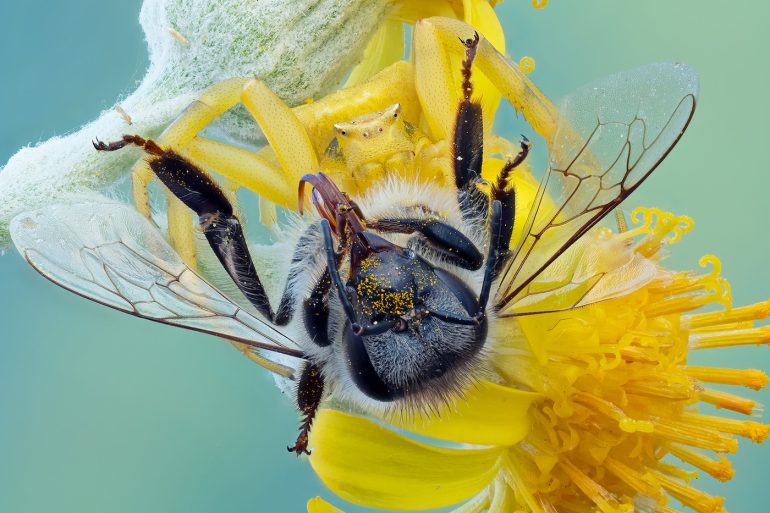
Near the beach by my hotel in Crete, Pete discovered a cluster of flowers inhabited by several flower crab spiders. These spiders can change color to match their surroundings, and bees were constantly visiting the flowers for nectar, giving the spiders the perfect opportunity to ambush any that ventured too close. When Pete found this particular spider feeding on a bee, he wanted to capture the moment from the bee’s point of view as most crab spider predation shots focus on the spider, not the prey. Because both spider and bee were hanging downward, he flipped out my LCD screen and positioned the camera directly underneath, shooting upward to frame the bee head-on. The Cretan sunlight was so intense it blew out the background completely, so Pete used a card behind the flower to control the backdrop. Focus stacking was challenging in the sea breeze, and he had to time each burst carefully between gusts.
Camera: OM System OM-D E-M1 Mark II
Lens: OM System 60mm Macro
ISO: 200
Aperture: f/5.6
Shutter speed: 1/200sec
Accessories: Godox V350 flash with Cygnustech diffuser, background card
Post processing: Focus stack processed in Photoshop, Topaz DeNoise for cleanup.
Emanuele Biggi
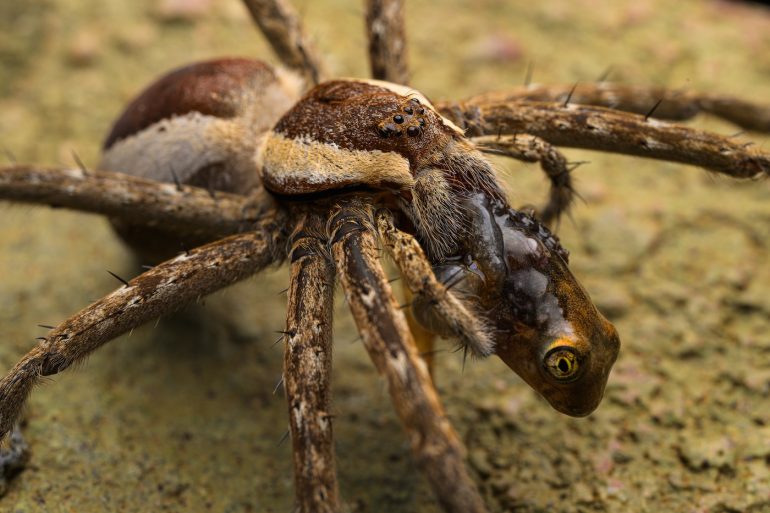
Emanuele was photographing tadpoles and froglets around a shallow stream pool on the island of Nosy Komba, Madagascar when he caught a rapid movement out of the corner of my eye. He turned to see this large fishing spider (Nilus sp.) clutching a freshly caught froglet. The photographer began shooting this tiny but dramatic scene of predation in the middle of the Malagasy forest. The spider fed from the back of its prey, so the lifeless eye of the froglet remained visible almost to the end of the feast.
Camera: Nikon Z8
Lens: Nikon Z 50mm Macro
ISO: 64
Aperture: f/22
Shutter speed: 1/100sec
Accessories: Flash with custom diffuser
Jason Gilbody
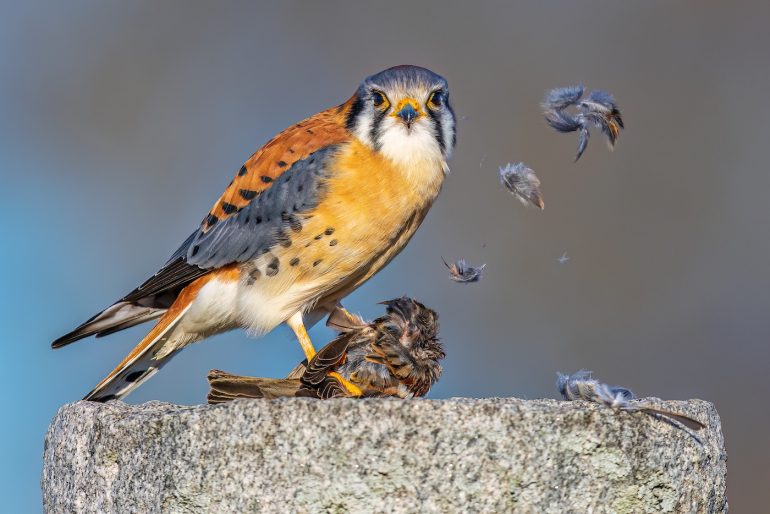
‘This American kestrel and its family reside in a local cemetery in Massachusetts. It habitually hides its prey in the flower pots placed at the gravestones. On this occasion, the kestrel pulled a sparrow from one of those pots and brought it to a nearby gravestone to feed. It was a windy day, so as it plucked the sparrow, the feathers floated away in the breeze, a fleeting, almost poetic scene set against the stillness of the cemetery.’
Technical information:
Camera: Canon EOS R5
Lens: Canon EF 600mm f/4L IS II USM
ISO: 320
Aperture: f/4
Shutter speed: 1/4000sec
Accessories: None
Martin Malies
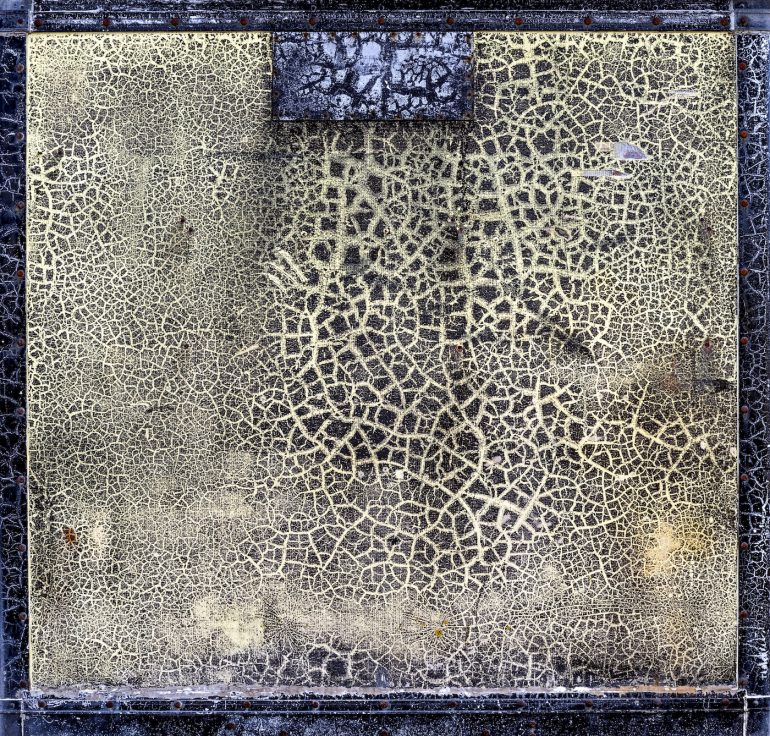
This is part of an abandoned shipping container on Dungeness Beach, Kent. Martin was fascinated by the chaotic, abstract patterns of the dilapidated paintwork, which were conveniently and very effectively framed by the dark metal edges of the container. The cracked and peeling surface had taken on a life of its own, with layers of colour and texture that felt more like an abstract expressionist painting than the side of a rusting box.
Camera: Nikon D750
Lens: Nikon 70–200mm f/4G at 70mm
ISO: 100
Aperture: f/8
Shutter speed: 1/125sec
Accessories: Tripod, cable release
David Silsbee
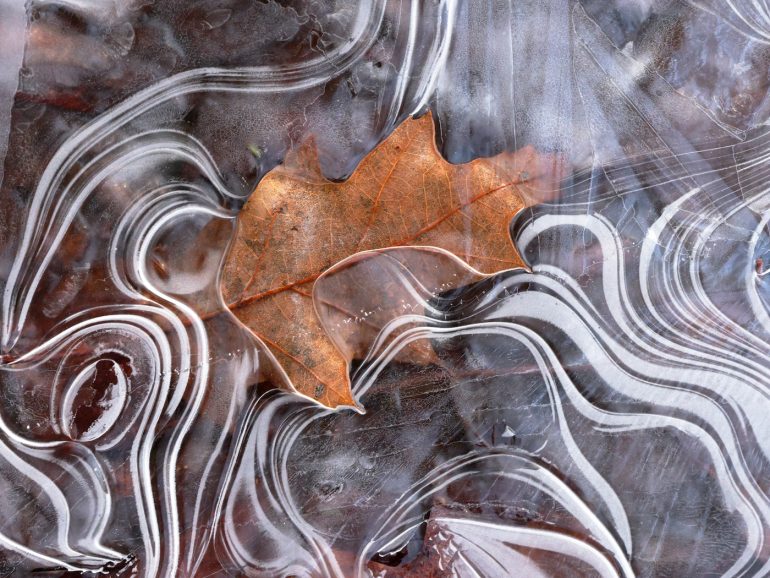
Walking along a river on a cold January morning in Connecticut, David had planned to photograph the icy water. Instead, my attention was drawn to swirling patterns of ice in woodland pools away from the river. The ice was unsupported in places where the water had receded and was extremely fragile. He couldn’t step on the edge or even slide a tripod out without it cracking or collapsing. The challenge was to lean out as far as David could over the ice to photograph it from above without breaking anything. he couldn’t compose carefully in that awkward position, so he shot wider and cropped afterwards.
Camera: Canon EOS R5
Lens: Canon 24–70mm at 70mm
ISO: 1600
Aperture: f/11
Shutter speed: 1/80sec
Accessories: None
Jacek Hensoldt
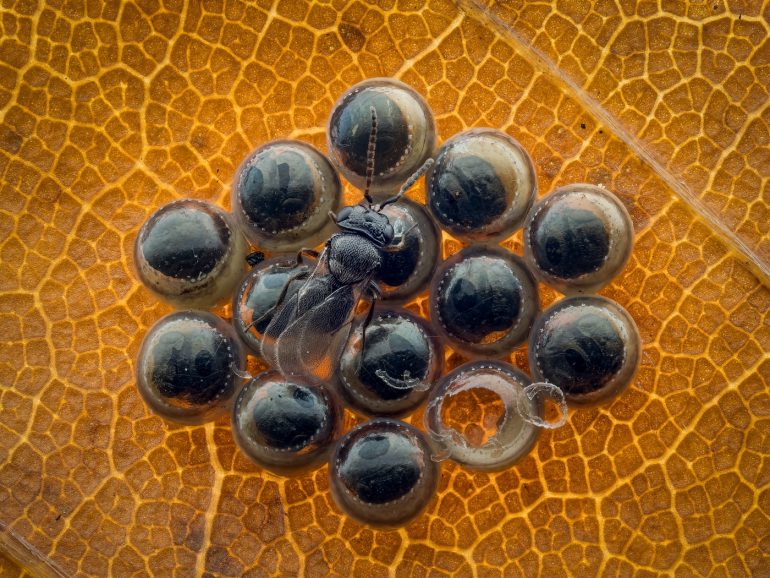
This is a cluster of shield bug eggs parasitised by the wasp Trissolcus semistriatus. The females lay their eggs inside the host eggs, where the larvae feed on the contents – the death of one becoming the prerequisite for the life of another. Through the translucent eggshells, the tiny heads of the developing wasps are already visible; in some, you can even distinguish compound eyes and antennae. One adult has already emerged but seemed in no hurry to leave without its siblings, which allowed me to photograph the scene at a relaxed pace. The adult wasps are only 0.9–1.3mm long and completely harmless to humans. What fascinates Jacek most is how symmetrically the eggs are arranged. The final image is a focus stack of 32 frames merged in Helicon Focus.
Camera: Olympus OM-D E-M1 Mark III
Lens: M.Zuiko Digital ED 90mm f/3.5 Macro IS + MC-20 2x teleconverter
ISO: 200
Aperture: f/13
Shutter speed: 1/50sec
Accessories: Godox V860III flash with diffuser
Post processing: Focus stack of 32 shots merged in Helicon Focus.
Ken Bluma
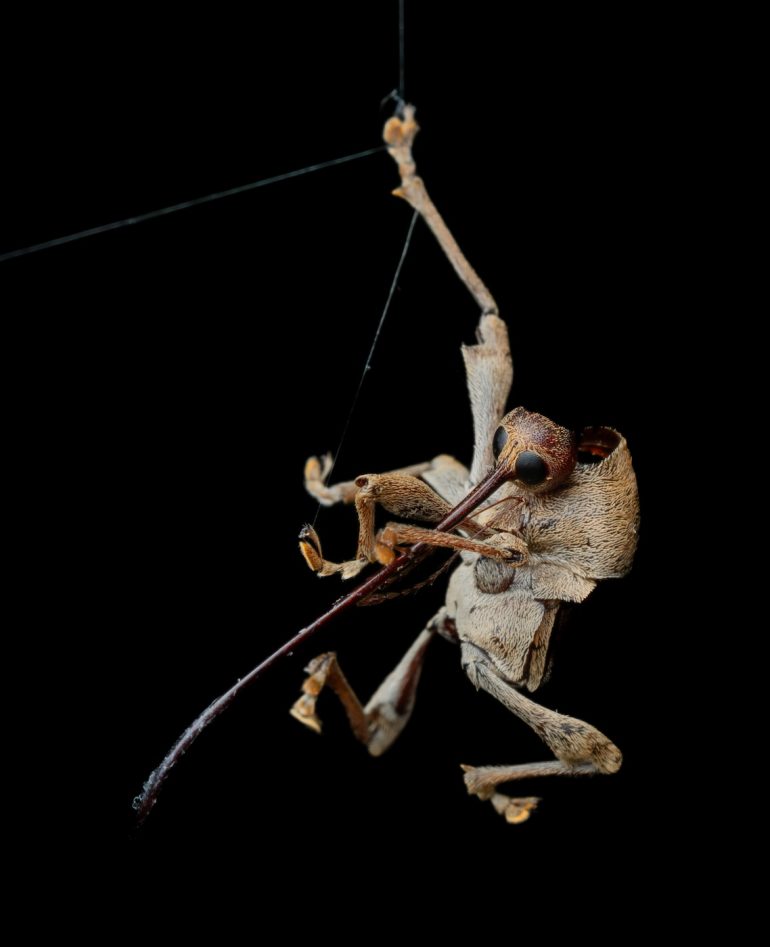
While exploring my local state park in Illinois, Ken noticed a small object hanging in the vegetation at the edge of the trail. After a closer look, he could see it was an acorn weevil, or rather what remained of one. Looking through the macro lens revealed it had died some time ago and all that was left was its hollowed-out exoskeleton, suspended on a strand of silk. The scene slightly resembled a string puppet performance, the tiny body twirling gently in the breeze. Ken kept my lighting low, which he felt matched the sombre mood of the scene.
Camera: Olympus OM-D E-M1 Mark III
Lens: M.Zuiko 60mm Macro
ISO: 200
Aperture: f/10
Shutter speed: 1/160sec
Accessories: Godox V350 flash with Cygnustech diffuser
Juan Jesus Gonzalez Ahumada
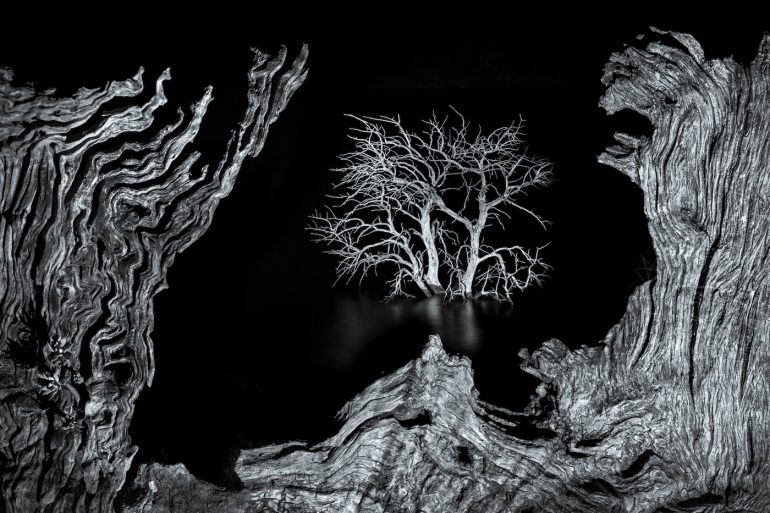
On the edge of the Zahara de la Sierra reservoir in southern Spain, the remains of a fallen tree take on the appearance of a gnarled, talking face. Beyond it, standing in the dark water, another dead tree rises like a ghostly apparition – its counterpart on the shore seemingly praying for its soul. To capture this image, Juan employed a complex in-camera technique, combining two focal lengths in a single long exposure. Working on a completely dark night with no moon or light pollution, he began at 70mm, using a halogen flashlight to illuminate the foreground wood. Then, in total darkness, he zoomed to 200mm and lit the distant tree for a few seconds, giving it greater prominence in the frame.
Camera: Canon EOS 6D
Lens: Canon 70–200mm f/2.8L USM
ISO: 100
Aperture: f/4
Shutter speed: 33sec
Accessories: Tripod, halogen flashlight
Pål Hermansen
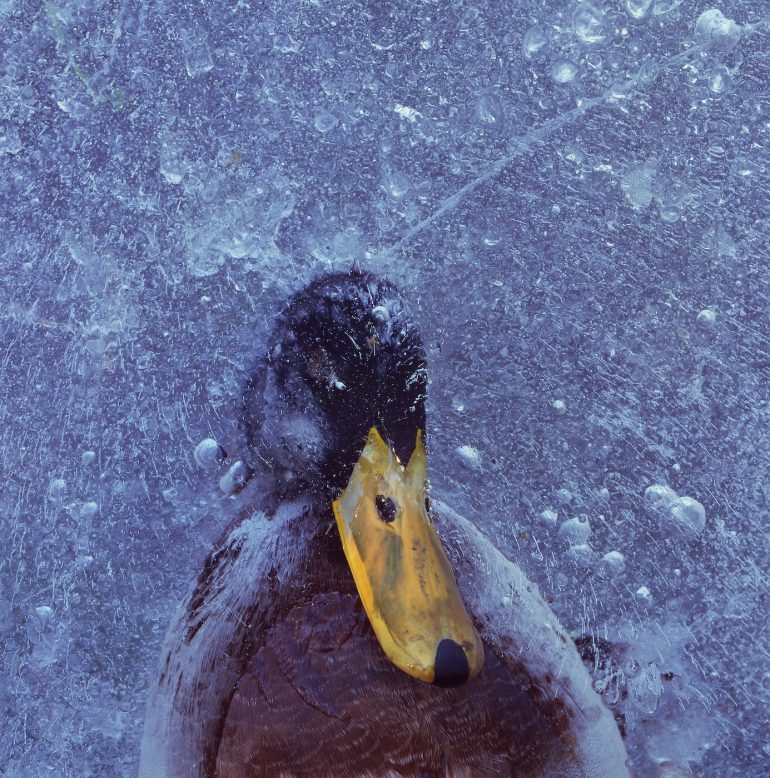
Pål discovered this dead mallard lying in a small lake that had just frozen over. He realised it could make an interesting image, so he decided to cut out a piece of ice including the bird and take it up onto the bank. There he could make a portrait of the duck, seen from below – the ice acting as a window into death, preserving every feather in perfect detail.
Camera: Hasselblad 203 FE
Lens: 50mm
Film: Fuji Velvia 50
Aperture: f/16
Shutter speed: 1/125sec
Accessories: Tripod
Post processing: Drum scan, no processing
Shortlist
Pål Hermansen
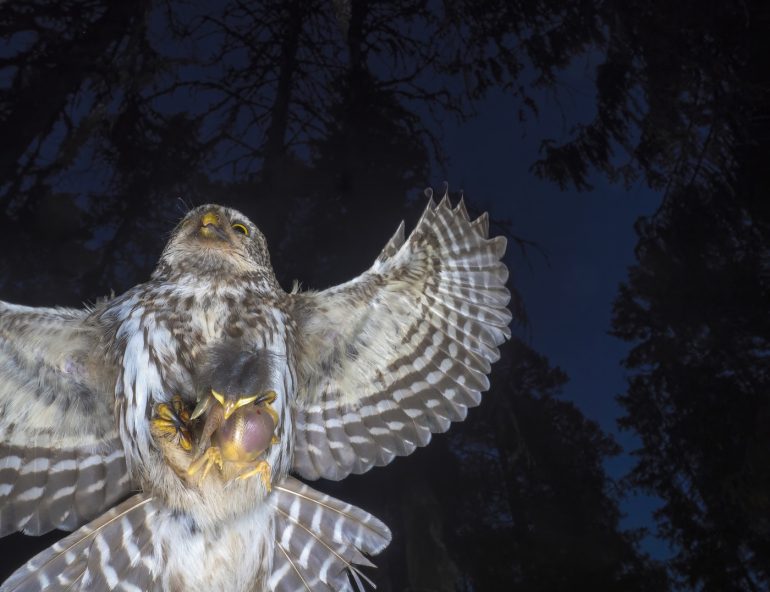
Pål found the nesting site close to my home and decided to try to catch the bird in flight. He noticed it flew from a low position up to the nest, so Pål positioned a remote camera from below along what the photographer expected to be the flight route. The first night he set up the camera without taking any images, just to be sure the bird was not disturbed. The next night Pål tried the flash, and it took no notice whatsoever, returning a handful of times during the night. After many trials over several nights, the photographer managed to catch the bird in the frame. The prey was either a mouse or a small bird – in this image, he feel the tiny baby bird is the main attraction.
Camera: Olympus OM-D E-M1X
Lens: 12mm
ISO: 200
Aperture: f/14
Shutter speed: 1/320sec
Accessories: Tripod, remote control, macro flash
Indranil Basu Mallick
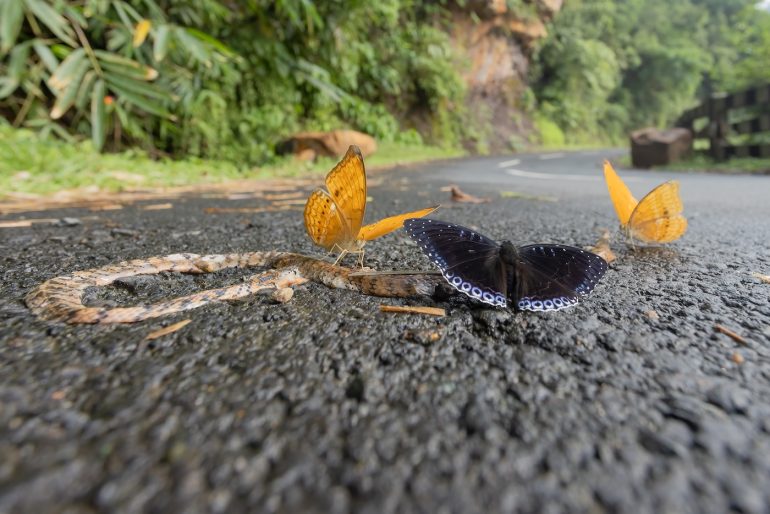
Indranil was on a family trip to Meghalaya and wildlife photography was not my priority, but he had packed my wide-angle and macro lenses just in case. While returning from the Root Bridge at Cherrapunji, he noticed something on the road and quickly pulled over. A snake, tragically run over by a vehicle, had become an unexpected source of life – three vibrant butterflies were intensely drawing moisture and minerals from its body. Indranil had heard about this phenomenon but had never witnessed it. Meghalaya, one of the wettest places on earth, supports huge butterfly populations, and this grim roadside scene perfectly illustrated nature’s relentless efficiency: death immediately feeds new life.
Camera: Canon EOS R5
Lens: Canon EF 17–40mm f/4L USM
ISO: 500
Aperture: f/8
Shutter speed: 1/250sec
Accessories: Handheld
Sophie Mijnhout
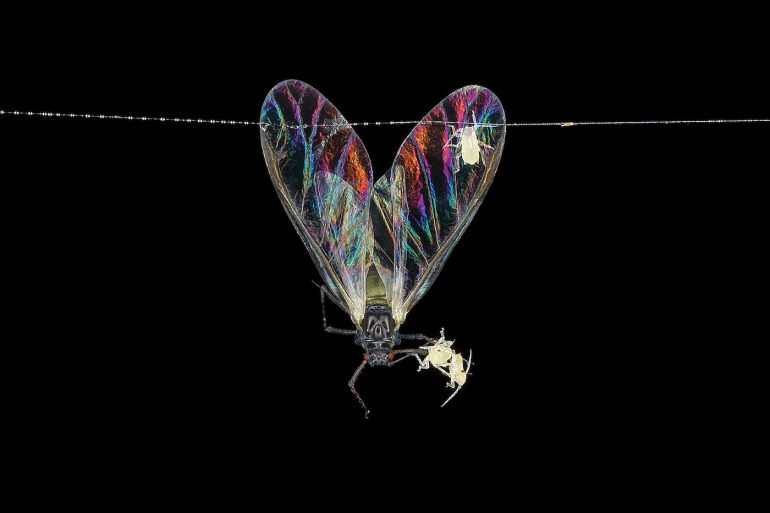
In the morning, Sophie noticed an aphid hanging from a single strand of a spider’s web, like a piece of laundry on a clothesline. It was too windy to photograph, so she returned in the late afternoon when the air had calmed. The aphid was still alive, but now tiny white specks were clinging to it. Through the macro lens she could see they were baby aphids – the mother had given birth while hanging in mid-air. The little ones, like her, had nowhere to go. A micro-drama that few people will ever have witnessed.
Camera: Canon EOS 5D Mark IV
Lens: Canon EF 100mm f/2.8L Macro IS USM
ISO: 100
Aperture: f/13
Shutter speed: 1/60sec
Accessories: Two Canon EF 25mm extension tubes, Canon MR-14EX II Macro ring flash with diffuser
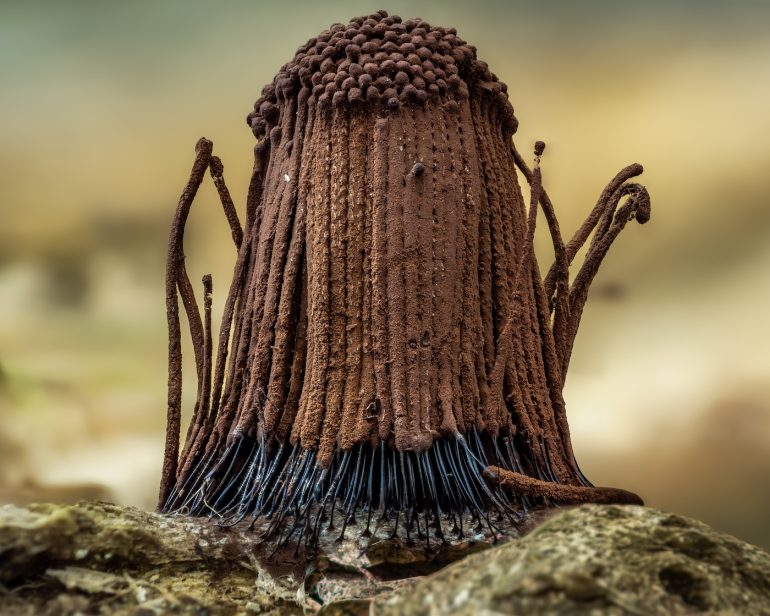
In his previous job, Nelson used to lead nature walks at a local community park. Nobody was in attendance on that particular day, but he didn’t want to go back to the office and waste a perfectly good summer day, especially as he had my camera. During my walk, Nelson came across a decaying log and on one side found a mass of what he thought looked like chocolate cake. I mentioned this to a colleague who was more experienced with fungi and he immediately said: “Chocolate slime mould!” As an entomologist, Nelson always been fascinated by minute organisms, and this looked like a sci-fi creature to me. he was fairly new to focus stacking at the time, so the final image took several attempts to get right.
Camera: Olympus OM-D E-M1 Mark III
Lens: M.Zuiko 60mm Macro with Raynox DCR-250
ISO: 200
Aperture: f/4.5
Shutter speed: 1/50sec
Accessories: Godox TT350 flash with AK diffuser
Post processing: Focus stack merged in Helicon Focus.
Ed Phillips
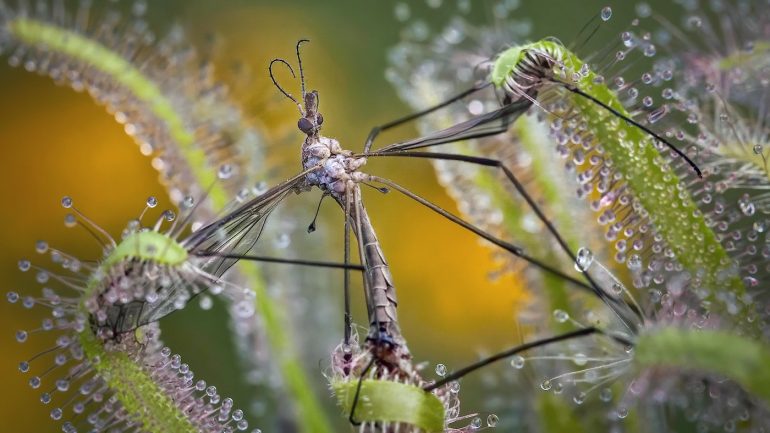
Ed has a collection of carnivorous plants in his Staffordshire garden. Lots of craneflies emerge in September and this unfortunate individual had become entangled in one of the sundews (Drosera). He had never seen this before, and hasn’t since. The sundew’s specialised leaves had curled around the cranefly, so Ed assumed it had been trapped for some time. It was a remarkable example of the slow, deliberate violence of carnivorous plants.
Camera: Canon EOS-1D Mark IV
Lens: Canon 100mm f/2.8L Macro
ISO: 1600
Aperture: f/8
Shutter speed: 1/1250sec
Accessories: None
Emanuele Biggi
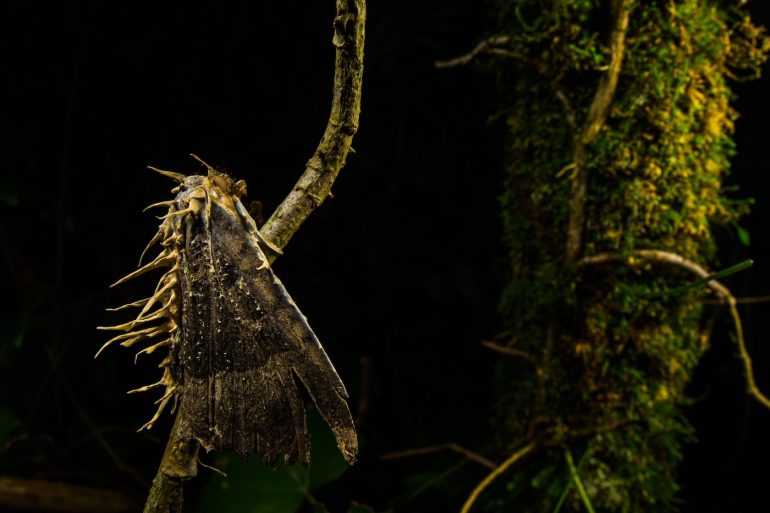
Emanuele was walking among rocks along a tiny stream lost in the Central Apennines, not far from Rome, when something odd attracted my attention from a nearby bush. Hanging on a stem, a moth had met a gruesome end at the hand of a fungus which had taken over its body and eventually killed the insect. He has found “zombie fungi” before, many times in the tropics and a few other times in Europe, but I didn’t expect to find such a large one here. Emanuele grabbed my wide-angle macro lens and documented this death-and-life drama happening in a little corner of my beautiful Italy.
Camera: Nikon Z9
Lens: Nikon 8–15mm fisheye
ISO: 64
Aperture: f/16
Shutter speed: 1/80sec
Accessories: Flashes with custom diffusers
Get rid of the ads!
Did you enjoy reading this article as much as we enjoyed writing it? There's a way to support us and our reporting, getting ad-free navigation and more as a bonus. Subscribe to us for less than a coffee per month —just $3.99— or take advantage of our yearly subscription with a hefty discount for only $25.- An ad-free experience
- A free mystery box for Lightroom or Capture One
- All the books in our store
- 20% discount on Capture One
- 30% discount on Imalume Photo Theft Protection
- 20% off Herbs and Kettle Tea Company.
- 20% off your order from MPIX printing services.
- 5% off Viltrox Products via their eCommerce store.
- 10% off all film developing, printing and scanning services from Blue Moon Camera and Machine
- 15% off 7Artisans products: The lens and accessory maker is offering a sweet discount for Phoblographer's readers.