


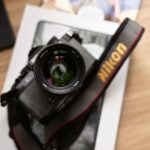
“I’m not even done with it yet, dude,” is what I told my good friend over the weekend who saw the Brightin Star 50mm f1.05 on my camera and immediately was drawn to it. He wanted to borrow it because of all the intrigue that it gave him. In the darkness of a bar that would require a camera to expose the scene at ISO 6400, I could see how his eyes lit up. And everyone who calls themselves a photographer and has lusted over the Nikon 58mm f0.95 Noct will perhaps be much more enamored with this lens.
Where Nikon’s Noct lens weighs 4.4 lbs, the Brightin Star 50mm f1.05 feels lighter than a box of tea shipped to my doorstep. Sure, it’s not an f0.95, but it’s close! At 39 years old, it’s taken a lot of therapy to realize that I don’t need to bear heavy burdens on my shoulders all the time like a warrior atoning for sins in some dark-Abrahamic inspired video-game universe. I don’t need to prove my strength to anyone and I’m not part of a group of photographers who wear cameras and lenses like armor. Instead, I know that there’s a time and a place for those things. And the biggest reason why I’d never bring a lens out with me is that it’s not weather-resistant. But the second biggest reason is that it’s too heavy.
And that is ultimately where my conundrum lies: I only ever want to use weather-resistant cameras and lenses. But the Brightin Star 50mm f1.05 does something very, very unique. First off, it’s one of the only lenses that I’ve ever tested with an aperture like this. It’s also natively for Nikon F mount, amongst many others. And while there are no electronic contacts, the Nikon Zf can manually record an aperture if it’s set to do so in the non-CPU lens data section. That means that when using the lens, I have to be super intentional.


I’ll first start by looking at the scene and figuring out how much of it I want in focus. Then I’ll stop the lens down and either zone focus it away or put the camera to my eye and focus on said scene/subject. Then I’ll adjust the exposure settings — rarely have I felt I needed to go beyond ISO 1600, and I’ve always been so much more of a film-like ISO guy anyway. Then I’ll press the shutter and make a photograph. This is a very, very different way of doing things because I need to slow down and breathe — which is what I feel lots of modern photography isn’t about. Instead, it’s more about acting like a pouncing cat at each and every moment. Sometimes, however, I think it’s best to let the scenes come to us.
Luckily, with zone focusing, the Brightin Star 50mm f1.05 can do both — sort of. The focusing ring gives you these odd distances that don’t really make things very simple. It’ll go from three feet to six feet, for example. If you’re photographing on the subways here in NYC, then six feet is a well-known distance when you’re sitting across from someone. But otherwise, it can surely be annoying to not have many focusing distance markers. This is one of the reasons why I love Leica lenses so much — they’re great at helping you achieve exactly where you want to focus even if you don’t want to peer through the viewfinder.
But that’s the really wonderful thing: even when the images are out of focus, I don’t really care. They look organically so the way that photographs used to look before the Japanese camera manufacturers tried to make every photographer a robot through marketing efforts to sell their cameras. If you disagree with that statement, then you should really consider whether or not you’ve made yourself replaceable.
What you’re probably really wondering about though is the image quality. After all, that’s one of the reasons why you’d want to buy this lens, right? Well, it really depends on the camera that you’ve got. With the Nikon Zf, you can use Nikon’s Picture Control Profiles as well as the new ones that are offered. But on a camera like my buddy’s Nikon Z7 II, you can’t use all the same picture profiles at all unless you’re doing them in post-production.
What I often found is that the RAW files are really just as plain as Nikon has ever been. The magic really comes out after you’ve spent a lot of time customizing and crafting the JPEGs to look satisfactory to you. Here’s what I’m talking about.
The following images are unedited, and one with Scott Tucket’s Nikon Vintage Film picture control profile. The Black and white ones have Vincent Versace’s profile applied. For what it’s worth, I like these a lot more.


The following images were edited using the Phoblographer’s Photojournalism presets. You’ll see that sure, there’s nice bokeh and colors. But not enough to really stand out from all the other lenses on the market.


I’m not saying that these images don’t look nice at all. But I surely do think that I like what comes out of the camera more than anything else.
At the same time, consider this: there’s nothing special about the Brightin Star 50mm f1.05 besides the fact that it has a very shallow depth of field ability. Otherwise, many other lenses can do the same and you probably wouldn’t be able to tell if these images were made with a Viltrox 50mm f1.4 Z or not. Indeed, when I looked back at my review, I couldn’t tell the difference even if I pixel peeped.
So while the Brightin Star 50mm f1.05 is a wonderful lens in terms of the build quality, the humanistic mental experience, and the image quality, it lacks in weather sealing and standing out from the rest of the pack on image quality.
I’m awarding the Brightin Star 50mm f1.05 4 out of 5 stars. And at the super affordable price point that it’s offered at of less than $500, it’s an easy reason to pick it up.
For the record, Brightin Star let me keep the lens. It’s important that you know this because I’m a journalist. It doesn’t at all affect how I cover it.
Get rid of the ads!
Did you enjoy reading this article as much as we enjoyed writing it? There's a way to support us and our reporting, getting ad-free navigation and more as a bonus. Subscribe to us for less than a coffee per month —just $3.99— or take advantage of our yearly subscription with a hefty discount for only $25.- An ad-free experience
- A free mystery box for Lightroom or Capture One
- All the books in our store
- 20% discount on Capture One
- 30% discount on Imalume Photo Theft Protection
- 20% off Herbs and Kettle Tea Company.
- 20% off your order from MPIX printing services.
- 5% off Viltrox Products via their eCommerce store.
- 10% off all film developing, printing and scanning services from Blue Moon Camera and Machine
- 15% off 7Artisans products: The lens and accessory maker is offering a sweet discount for Phoblographer's readers.