Why Lower End Zoom Lenses Make Great Doorstops

by Chris Gampat on 02/26/2011

In this posting written a while back, I’m constantly asked about my opinions on lenses like an 18-135mm, 18-200mmand others. And in general, I give the same response: I hate them. Before writing this posting, I envisioned marketing reps, PR reps and others saying something like, “No Chris, don’t write it because we sell thousands and thousands of them!” While this is true, it is because most consumers don’t have any idea of what they’re purchasing and are instead blinded by the marketing. Here is an attempt to clear through the fog.

Aperture Values

When people, who aren’t fully knowledgeable about photography, read about a new lens like a 55-250mm F/4.0-5.6, they say to themselves, “Oh wow, that’s a great zoom range! I’ll be able to spy on my neighbors with that and then shoot birds from far away and when I go to see my favorite band in concert there will be no stopping me!” Or something like that.

Wrong! Well, sort of. I fell into the same trap when I was a young intern at PCMag.com. You’re only paying attention to the zoom range and you’re totally overlooking the F-stop value!

Seagull Battle

Photographing birds in flight? Good luck; shoot in Auto mode and your camera will just be cranking up the ISO settings for you to find something that many of you often complain about: noise. What does this have to do with apertures? When you’re zooming in all the way, you’re at a very small maximum aperture setting that still doesn’t usually make capturing birds in flight very easy to do. In contrast, if you had a more expensive zoom lens then you would either have a constant aperture throughout the zoom range or if you had a variable aperture the glass quality inside the lens would be of much higher manufacturing standards.

Because these lenses are also cheaply constructed, less care goes into them and so the apertures may not even be what the camera is telling you it is. In fact, it will be just an approximation but even less of one than with a higher end zoom lens.

Let me explain: There is a difference between F-stops and T-stops. T-stops are used in the movie industry on cinema lenses. When lenses are created with the intention of them having F-stops, there is an approximation of just how closed down the aperture values are. That means that F/4 can be something instead like F/4.3.

T-stops were standardized partially out of the fact that the movie industry and studios essentially said, “Enough of that nonsense, we need exact values all the time!” Because of this, much more effort goes into getting F/2 to actually display an image that is F/2. Hence, it is actually T/2 and they are much more expensive.

So while you think that those super expensive lenses with the constant apertures are expensive, remember that even those won’t have the exact values that T-stops provide for the user.

So why does this matter to you? Combine:

The fact that you are purchasing and using a lens of cheap design with cheap elements + aperture values that will not be near the correct actual value vs higher end lenses or lenses with T-stops + usually not the best motors = potentially very bad image quality

This is a classic example: the Canon EF 70-300mm f/4-5.6 IS USM

vs the new Canon 70-300mm F/-5.6 L IS USM.
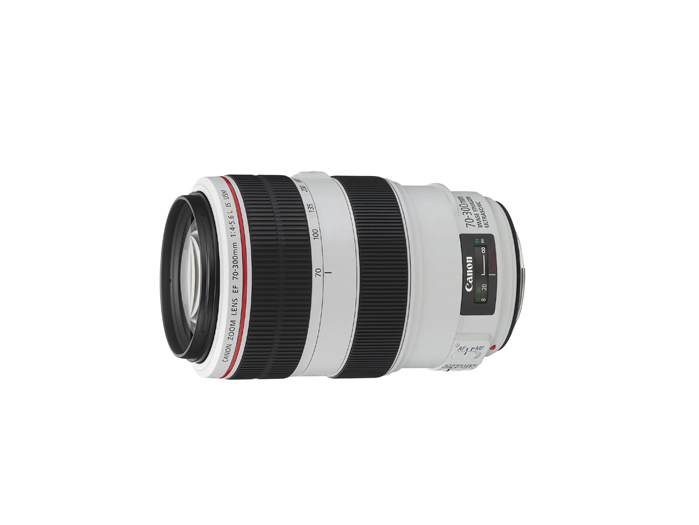
What are the differences?

- The L lens has two UD elements, the other version has one

- The L lens has a protective fluorine lens coating

- The L lens is dust and weather resistant

- The L lens has four stops of IS and the non-L has three stops. Believe it or not, when you’re photographing birds and objects far away this can actually make a huge difference for most amateurs.

- The quality of the L lens will be vastly sharper than the non-L.

Here’s a section from my Guide to Terminology (download at this post):

Aperture- This is also known as an F stop. It controls how much of your image is in focus or not (IE what is clearly and sharply seen and what is blurred out.) It also controls how much light comes into the lens of your camera and hits the sensor (the equivalent of film.)

In general:

f1.4 = Enables high shutter speeds, not much is in focus.

f2.8 = Enables almost as high shutter speeds, more is in focus. Great for portraits.

f11 = Needs slower shutter speeds, much more is in focus.

f22 = Needs the slowest of shutter speeds. Everything you point your lens at should be in focus. Best used with a flash unless there is tons of available bright light.

On your camera this is also known as AV mode.

Lenses without constant apertures are also one of the reasons why I prefer primes as opposed to zooms in the budget range. You’re best off purchasing a lens with a constant aperture rating or that was designed with better elements for better sharpness.

Beyond this, try photographing in a dark concert venue and capturing a sharp photo. Your small apertures most likely won’t be able to help you very much because in order to capture fast motion, you’ll need to shoot at a faster shutter speed. You can crank up your ISO settings, but you’ll get grainier images and since your aperture values change throughout the zoom range you’ll need to constantly change your shutter speed or ISO settings to compensate for the light loss or gain from the variable F-stops.

Sharpness Issues

Moth on a Flower

Many of these kit lenses aren’t sharp enough for professional use. In fact, they will be quite soft at times. The above photo was shot with my old Olympus E-510 with a 40-140mm lens. While it is a gorgeous shot, it could have been significantly sharper if I only knew what I know about lenses now. During the E-5 review, I used the 12-60mm F/2.8-F/4 lens. That lens is pretty darn sharp. This is partially because of the elements put into the lens.

What makes a lens sharp? Well, this is up to debate but I believe that it is the lens’s resolution and acutance.

The resolution is determined by your sensor’s ability to distinguish fineness of detail among closely placed elements in an image, like hair or the texture of fabric. Other factors in resolution are the obvious number (and quality) of pixels on the sensor, the algorithms your camera uses and many other very technical factors contribute to a camera’s resolution. This is why the processors in your camera are important and how something like the new engine in the Olympus E-5 can deliver finer details than it’s predecessor.

Now, acutance has to do with edge sharpness. It depends on the quality of your  lens and your sharpening methods in post-production. When we use software to sharpen a digital image, the software looks for tonal transition areas where it increases contrast.

Additionally, the higher end lenses with a constant aperture tend to deliver results with better resolution: which in turn means more detail is actually resolved from the sensor. This is partially a reason why primes are preferred by many photographers.

In essence, this is also what people are talking about when they say something along the lines of a lens out-resolving a sensor or vice-versa.

You Purchase a DSLR To Get Better Images

While I will admit that point and shoots cannot compare to cameras with larger sensors such as DSLRs, the reason why you purchase a DSLR in the first place is because you want better and sometimes professional quality images. Purchasing a DSLR, however, isn’t the cure-all to your photographic woes. If you genuinely want to up the quality of your images, a solid knowledge of lenses outside of the standard kit lenses is essential.

Now here’s something to keep in mind: your lighting is very important! Good light from the well-reviewed Orbis gave me the shot above when combined with very good glass. You really can’t get detail and colors like that from lower end lenses. The elements in the more expensive lenses are designed to render better colors in your images. Additionally, some of these lenses are designed to deliver micro-contrast, which makes your subjects pop a bit more.

Said lenses are also quite a bit more expensive and have faster apertures. The faster apertures allow you to have more flash output and therefore also keep your ISO levels down lower: which delivers clearer and crisper images.

Even if you use something like a cheap 50mm F/1.8, on a DSLR, you’ll be able to achieve better results than most of the zoom lenses out there. I tested this when I used the Ray Flash (but those results weren’t shown.) Further, I used the 50mm F/1.8 on Will’s Canon XTi and the Ray Flash and was still able to deliver very good images.

An XTi? Isn’t that a really old camera?! Yes! And it is ultimately the photographer that creates the images. You need to work at getting those images by paying attention to light and your settings. The faster and sometimes more expensive lenses allow you to have more versatility in your results.

Please Support The Phoblographer

We love to bring you guys the latest and greatest news and gear related stuff. However, we can’t keep doing that unless we have your continued support. If you would like to purchase any of the items mentioned, please do so by clicking our links first and then purchasing the items as we then get a small portion of the sale to help run the website.

Also, please follow us on FacebookFlickr and Twitter.

  • http://thelensthatwalks.blogspot.com/ KH

    true true. i quite hate them with those decent quality but many choose these lens because probably it wont cost a lot. you know buying one multi zoom is better for our finance compare to buying many lens.

    as for me, i previously bought a sigma 70-300. good lens for beginner, but after a while i kinda hate the slow focusing and the zoom creep. but again as for student like myself having a geat fixed aperture zoom lens can be expensive.

    • Chris Gampat

      You’re a student? This may sound old school (no pun intended) but you should be shooting with a 50mm prime lens and nothing else to force you to be more creative and work with different perspectives.

      Good luck in your studies!

      • http://thelensthatwalks.blogspot.com/ KH

        thanks. i do own a Canon 50mm f/1.4. great lens but im not much of a fan of 50mm. i prefer 35mm or even wider range. anyhow, thanks for the advice. Will try to use the 50mm more often ;)

        • Chris Gampat

          Wow, you’re one of the first that I’ve heard that from. What camera do you have though?

          And in the story, I really wasn’t kidding about using a 50mm F/1.8 (the cheaper version of your lens), a flash like a 430 EX II and a Ray Flash to create compelling images.

          • THoody

            He has a point people, but so do you guys. It should not be an argument.  Great photos,  ones that would sell, can be shot on any thing even on the Holga. Art is in the eye of the beholder it does not make you bad photographer to have cheaper lenses. I have both and I can testify to good lenses and my 17-55 2.8 Nikor lens is my favorite, but I have sold work with my 18-200 and my 18-70. The good lenses are just for me and I do not expect the public, except the snooty art world, to care. My motto is get those lenses when you can and if you cant keep shooting and you will.

            THood
            Photo Instructor and lab owner.

        • http://thelensthatwalks.blogspot.com/ KH

          Canon 450D. Well, the canon 50mm and the camera both belong to my father, after he turn to Nikon.

          but yeah, i know how good the images could turn up using nice lighting and a prime.

  • Jamie

    I agree with what you say, Chris, although being rather young, I don’t have that much cash around to put into photography, so a budget ‘all-in-one’ lens is almost perfect for me, since I can’t afford to splash out hundreds on high-quality fixed aperture zooms. Of course, I know that the results will be far from the best possible quality, and if I had the money, then no doubt I would be using top-quality L lenses, but for now I’m happy enough with my superzoom and a fast 50mm :)

    • Chris Gampat

      If you’ve got a fast 50mm then you don’t need those L zooms with fixed apertures. In fact, if you just get my recommended primes in my budget link then you’ll be well off. Plus fixed focal lengths can give you less to worry about since your focal length isn’t changing constantly and you won’t always need to change your shutter speed to compensate for sharpness due to the reciprocal rule of focal lengths.

      • Jamie

        Thanks for the advice, Chris.

        • Chris Gampat

          Even if you don’t see it now, trust me: later on you will. That’s why IS is also so important.

  • http://chrismlindsey.com Chris

    The reason most of us have to buy these kit lenses or variable aperture zoom lenses is the price. As a non-professional, I can’t justify the cost of the much nicer lens. I love wildlife photography, and I would love to make a job out of it, but I can’t afford these lenses.

    That said, do you have any recommendations for budget prime lenses that could be used for wildlife photography?

  • http://www.chrisjonesfoto.blogspot.com chris jones

    Man, and I was just about to drop 600 on a Nikon 18-200 for travel purposes.

    I guess I need to reconsider…

  • http://www.phillyclick.net theoinpa

    Boy I really, really, disagree with you. Whenever you compare an L lens to a normal lens your argument is on very shaky ground. Any dslr and almost any zoom lens takes better pictures than 90% of point and ahoots and gives you a good entry point. Actually taking pictures, and not sitting around watching Tv while you are saving for you 1000.00+ lens to use with your 500.00 body is a no-brainer for me. It’s the same argument as not driving because you can only afford a Ford Focus instead of a Mercedes. Get out and shoot with what you have and what you can afford, that way you will have the skills to use that good glass if you can afford it.

    I do agree every starting DSLR owner in should be using the 50mm prime of thier brand rather than zooms, but catching a great moment can be as good as a technically good shot, so I understand the need for low end zooms and I use them, because as many said above I cannot afford L lenses (I keep my 18-135, and my 50mm in my bag always).

    my biggest gripe is using wide aperatures on low end zooms. people read about pros using lenses wide open and try to imitate and don’t really learn thier lenses. I stay at f8-f11, unless the moment really requires other, knowing I am sacrificing sharpness for catching the image.

  • Don Pope

    I completely disagree. You’re looking at things from the POV of a professional photographer or an enthusiast with money. Most consumers are neither.

    Most people buy DSLRs for vacation and family photos, not to make art or commercial grade work. They want something that produces better photos than their point and shoot. Entry level DSLRs with their cheap kit lenses and set to full auto mode produce vastly better images than ANY point and shoot in the same hands.

    As an enthusiast, I would love to have a high quality zoom lens, but I just can’t afford one. Used primes for the mid-ranges and cheap zooms for the long and wide ends allow me to practice my hobby on the cheap. Sometimes I even produce nice photos. An expensive lens would not improve my photos that much. More practice with my cheap lenses will.

    • Chris Gampat

      What camera do you have? How about cropping your images and using the primes?

    • Chris Gampat

      Also, I never state that you NEED to purchase the expensive zooms. Cheap primes work well.

      I’m glad you acknowledge that fact.

  • Pingback: On Using Your Environment As a Tripod at The Phoblographer

  • Pingback: The Guide to Telephoto Zoom Lenses for Non-Professionals at The Phoblographer

  • Mark Kalan

    I stopped using non-OEM or “consumer” lenses after a shoot i did in 1974. I was photographing airplanes plane-to-plane. I had a Nikon Zoom and a non-OEM lens made by the top brand of aftermarket equipment. the Nikon lens despite being an old (yes-old in ’74!) performed fabulously. The off brand lens had perfect exposure on the first frame but every moto-driven frame after was slightly more overexposed than the frame before. We traced to problem to the auto-aperture which had a spring that wasn’t strong enough to react in time with motorized shooting. I haven’t used a non-OEM or “consumer” version since. And today I only shoot with prime lenses.

    Here’s the deal – if someone is PAYING you to shoot then it is your responsibility to provide the best quality image – it you’re out shooting for “fun” or “hobby” then it doesn’t mater. Your family snaps will be fine.

  • Nope

    Another angry pretentious photo blogger deterring visitors like wildfire with their rediculously annoying comments. There are plenty of people who get perfectly good images with these “oh so terrible” zoom lenses you reference.

  • http://www.facebook.com/min.phtogrphr Kim Min

    I don’t care about the article; to each their own. Personally I hate those kit lenses as well, and especial Canon ones, but that’s beside the point. What really bothers me is the photo writer used to supplement his paragraph about “getting better images.” Did the writer not have any other photos that are at least decent enough to put in his article? I mean, come on, it’s a photography blog for Christ’s sake!

  • Dan

    I had several mediocre zoom lenses that I was happy to use for video but not for still photos.

    That was until I had an opportunity to take a few workshops with some top photographers.

    One of them in particular, an extraordinary wildlife photographer, had several lenses which I believed to be of low quality and quite soft wide open. But he shot everything at f/8 and they were great at f/8, despite not being expensive.

    When you buy the best of the best lenses, you’re paying for them to be sharp wide open. That has it’s uses, but as long as you’re shooting in adequate light, many cheap zooms deliver more than adequate sharpness and can deliver extraordinary images.

  • sweeperdave

    As a professional who has more than a fair share of primes and pro-level zooms, I find myself with a long-range zoom more than a few times on pro shoots. As I cover events, especially fast evolving corporate and news projects, I don’t have time to change lenses or switch cameras. I’d far rather get the pretty decent shot with the 18-200mm than the perfect shot I never take with the 85mm because I had to pull off the 28mm first. When I’m shooting product shots, of course the 11x lens stays home. Horses for courses. As long as clients are buying, I’m sticking with whatever allows me to get the coverage I need. If that means a consumer level zoom, I’m using a consumer level zoom.

  • Kai

    I totally agree. These kit lenses do take soft photos and have a very subpar feel to them. They are usefully or a whole lot if you have some primes to cover the range or nicer zooms. They do have one extremely good use though, at least the 18-55′s. they make the perfect focal length to use for reverse lens macro. You flip one of those suckers around and you have a 1:1-4:1 macro lens. Just keep it clean, stop it down, and get a flash and you’ll have the best budget super macro you can find.

  • http://www.facebook.com/jesse.scroggins Jesse Scroggins

    I’ve owned a sigma 18-200mm f3.5-5.6 for about five years. It doesn’t get near as much use as my primes (50mm f1.4 & 28mm f1.8), but since I have a crop sensor camera the primes reduced field of view can be bothersome when I need to be up close with a wider angle.

    I take quite a bit of dance portraits and the 18-200 works quite well outdoors or with lighting set up when I need a wide angle. I usually stop it down to try and get it as sharp as possible. The signa is surprisingly sharp when stopped down. I probably never use the longer end of the zoom range for anything somewhat professional. I usually just switch lenses at that point.

  • http://www.jameshedley.com/ James Hedley

    Disagreeing with the article because you can’t afford the higher end lenses seems an odd reaction. I shot a wedding this weekend, primarily on the Canon 35mm f/1.4 – why? Because it’s the best tool I’ve found for the job. I’ve owned the 70-300 f/4 and I’ve owned the 70-200 f/2.8 – The images aren’t comparable.
    I don’t think the point of the article is to insult images taken on more convenient lenses, just to stress that, having that convenience means compromises elsewhere.

Previous post:

Next post: