

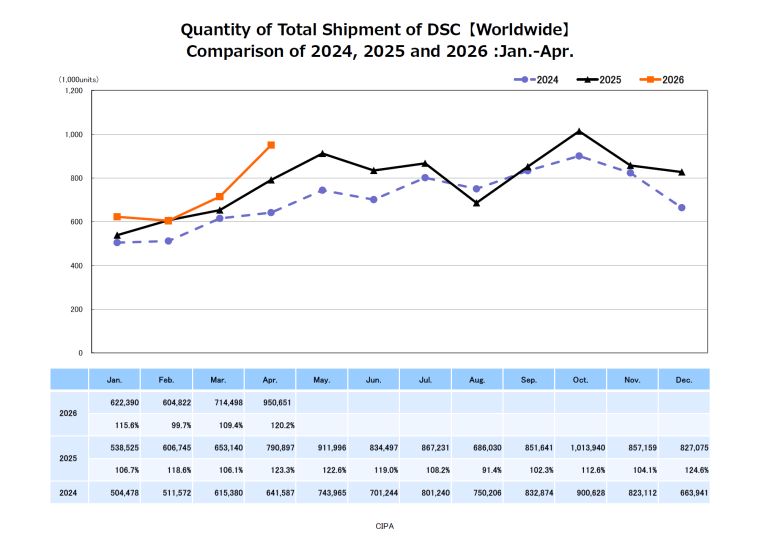
The camera industry has seen some challenges over the last few years. From mirrorless race to the pandemic to the ongoing wars, there are various factors affecting the growth of the current market. While everything appears a bit blue, it is not really the case anymore. In a new report by the Camera and Imaging Products Association of Japan (CIPA), there have been some improvements in shipments in the month of April. Here’s a look at what the numbers say.
According to the report, mirrorless cameras have seen an 11% rise in units shipped and shipped value. The interchangeable lens cameras, for instance, saw production at 593,333 units, which was up by 33.1% compared to April 2025 and 20.2% year-over-year basis. Between the January-to-April period, total production reached 2,048,925 units. As for shipment of all digital cameras, that’s at 950,651 units.
Similarly, compact cameras saw a 30% increase in units and 26% in shipped value. In fact, since 2024, compact cameras have not shown a sense of slowing down. Compact cameras also saw a production of 211,162 units in April, with January to April showcasing 790,164 units produced.
The persistent weak spot for this was DSLRs, which are down by 31% in units and 39% in shipped value year-to-date. About 45,401 units of DSLR were produced in April, while January to April saw the numbers at 160,087 units. However, DSLRs also showcase a 10% improvement in performance compared to last month, which suggests that the rate of is reducing rather than accelerating.
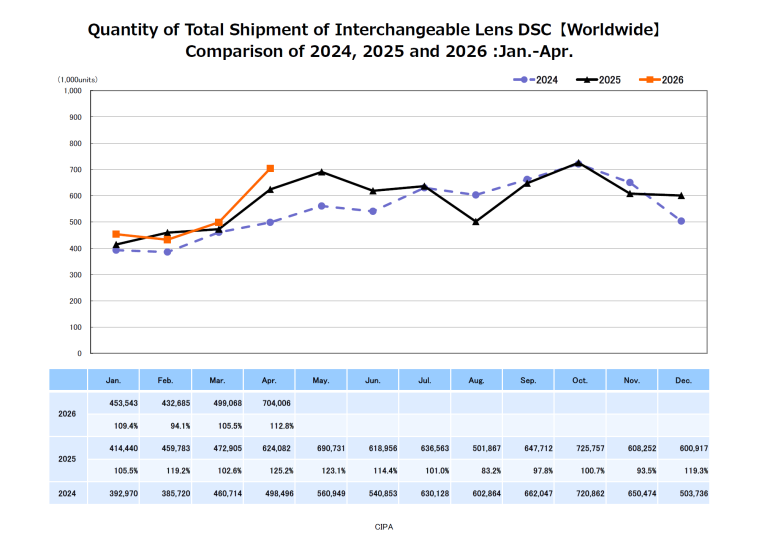
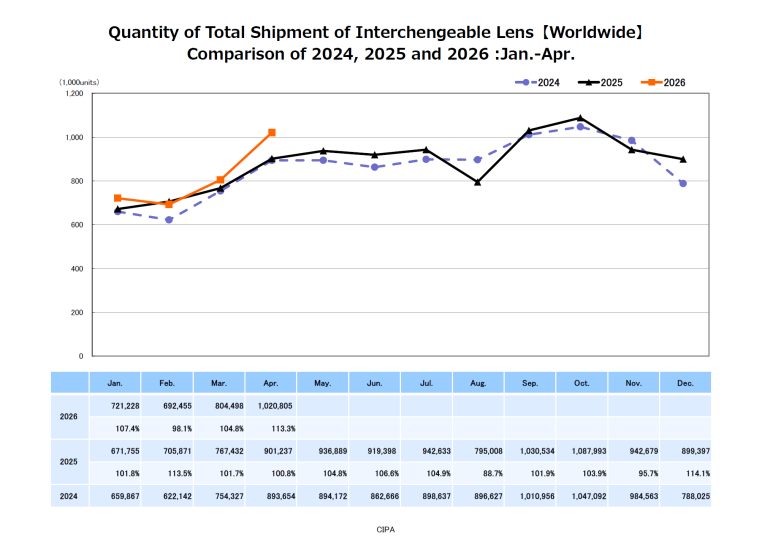
Interestingly, cameras with sensors smaller than 35mm were higher in unit production as well. They stand at 410,753 units in April, compared to 182,580 units of larger than 35mm cameras. Lenses for smaller than 35mm sensors saw a 12% increase in units and 21% in value. As for full frame or large format lenses, they see a 3% increase in value. The lens-to-body sales ratio of 1.55, which means about 1.55 lenses are sold for every camera body. This number has remained constant since last year. So, if the camera market grows, the number of lenses being sold will grow at the same time.
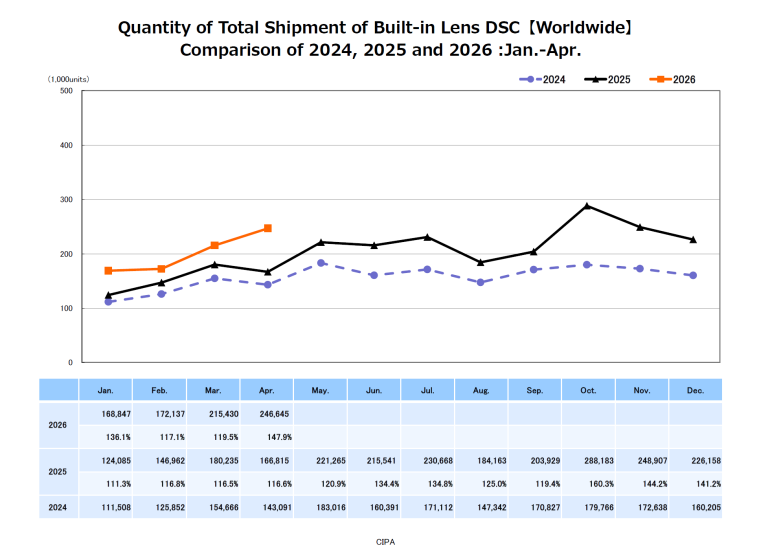
The yearly interchangeable lens camera body sales are projected to be between 6.27 and 7.4 million units for 2026.
The country that has seen the most dramatic growth in shipments is the Americas, with a 4% increase month over month and a 44% increase year-over-year. Moreover, the April shipments to the Americas were worth 21.7 billion yen. As for China, this month’s shipments saw a 39.1% month-over-month increase. On the other hand, Japan was down 7.1% month-over-month but up 3.7% year-over-year. Last but not least is Europe, which has seen a 4% year-over-year growth on a monthly basis.
The CIPA report has always been a great way to see trends and what they can mean for the industry. Compact cameras will continue to grow, especially since Canon, Nikon and Sony are all reviving the format. Similarly, APS-C cameras continue to command production, and the reason behind that could be hybrid use. Nikon Z50 II is an example of such a demand. Similarly, Americans have always preferred 35mm sensors, something we pointed out earlier.
The decline of DSLRs is not as telling as it was six or seven years ago. Everyone is moving to mirrorless, and the reasons are better EVF, speed, and ISO capabilities, amongst others. It will be interesting to see if this trend spins on its head. Until then, let’s see if the digital cameras can hit the number the industry is predicting.
Get rid of the ads!
Did you enjoy reading this article as much as we enjoyed writing it? There's a way to support us and our reporting, getting ad-free navigation and more as a bonus. Subscribe to us for less than a coffee per month —just $3.99— or take advantage of our yearly subscription with a hefty discount for only $25.- An ad-free experience
- A free mystery box for Lightroom or Capture One
- All the books in our store
- 20% discount on Capture One
- 30% discount on Imalume Photo Theft Protection
- 20% off Herbs and Kettle Tea Company.
- 20% off your order from MPIX printing services.
- 5% off Viltrox Products via their eCommerce store.
- 10% off all film developing, printing and scanning services from Blue Moon Camera and Machine
- 15% off 7Artisans products: The lens and accessory maker is offering a sweet discount for Phoblographer's readers.