As a millennial who turns 40 in a year, I often look at Gen Z and wonder why the traditional media hates them with bitter passion in the same way that they did to us so many years ago. In Gen Z, there’s a similar story but with different opening paragraphs. They hate AI — and in some ways they’re far more savvy than us digitally. When asked about the difference between art and content, they’ve got a much healthier boundary than many of my similarly aged peers. So when I heard that they were getting into Film photography, I was so curious.
All images in this article were used with permission from the photographers we interviewed.
Gen Z has continued the human affinity for analog beyond what we as millennials have done. The latter portion of Gen X started the Film renaissance. Millennials solidified it — albeit with detours in inauthentic digital simulations. And members of Gen Z have entered the darkroom and emerged after seeing magic tricks happen with a bit of water, chemical baths, and fixer.
This isn’t just for Film photography though: it’s for all the retro-nostalgic stuff we can get our hands on.
As a journalist of 20 years, I had to pause after writing that sentence. I type this with a tear in my left eye. Now they’re in both eyes and ready to roll down my cheeks. What the bigger camera brands say is a niche audience, smaller brands have shown affinity for. Each of them has watered their own community garden amongst the large swathing forests of brands like Canon, Nikon, etc.
Where Gen X and Baby Boomers experienced Film photography at its height, they often questioned why millennials like me wanted to shoot film. And it’s because we never had that experience — and the tactile nature of things was starting to really disappear with our generation. But we wanted to have an experience that some of us never had. Few amongst the older generations would really understand the appeal of wanting to try new things.
Gen Z never had the Film experience either in a hyper-digital world. Many were born after 9/11 put parents into a panic and made us all get cell phones.
To that end, Gen Z has always wanted to see it for themselves, too. Unlike our generation’s predecessors, I embrace them wanting to get experimental.
Roots in the American Education System
Often in the news, we hear about problems in America’s education and issues with teachers. We don’t hear a lot about the success stories though. But in the Film photography world, Gen Z has surely experienced some success thanks to the American Education system.
Despite tremendous cuts to arts education, the three members of Gen Z I spoke with all started out in Film photography in school — therefore demonstrating the perseverance of a few teachers to really show the old ways. This, to me, is quite fascinating as we millennials didn’t always have Film labs or even photo labs to work in. To that end, I sometimes find us millennials to be a little less photography-literate than other generations.
Photographer Holden Calliff, who goes by @cryptkeeperrr on Instagram, was encouraged by his father and the Nikon D40. “Photography was a passion for him as much as it was part of his professional life; so I was lucky enough growing up to be surrounded by it,” Holden tells the Phoblographer. His curiosity was fed on a diet of television and movies. When he went away to camp, he took darkroom classes instead of doing sports. For Holden, it was like an experiment done by a mad scientist.
“It was here that I learned how cameras work, how to print, and how to understand the balancing act of light and dark…The alchemical mystery of photography scratched an itch in my developing mind.”
Holden Callif
Soon after, he returned to digital photography just for practicality’s sake. But today, he adores his Canon A-1 and Ilford HP5+ — which he brought to a meet-up with me. It revived his attention to detail and his sense of being present.
Holden’s experience is similar to that of others. Hobbyist Film photographer Stan Zhang doesn’t totally identify with Gen Z — and his beginnings were with a Sony Cybershot camera in the 2000s. In high school, he signed up for an introduction to photography class.
“We had an amazing photography teacher and access to a well-equipped lab/darkroom,” Stan tells the Phoblographer. I’m surprised and jealous of his answer “The earlier classes went through the evolution of photographic techniques, from the history of film to contemporary digital workflows. Later classes focused on photography as a visual art, covering artistic techniques and theory.” The program gave him plenty of hands-on experience taking photos, developing film, and enlarging prints.
To this day, Stan says that he owes his continued interest in photography to his high school teacher and the environment she fostered. With a Canon Rebel G in hand, he’s often reaching for Kodak Tri-X 400, and occasionally T-Max, Ilford HP5 Plus, or Arista EDU Ultra.
Here in NYC, Alisha Shimpi also owes her love of the art to schooling. At the age of 13, she used her aunt’s digital camera and fell in love with photography. “It became a very vital tool to connect with peers and friends, something I had difficulty with as a socially awkward preteen,” Alisha tells the Phoblographer. “We would dress up after school and walk around to abandoned alleyways or pretty coffee shops and take what we thought were publication worthy editorials (they were not). Taking photos came easy to me, much easier than painting or sculpting, and its complex scientific aspects satisfied my fascination with math and physics at the time.” Later at FIT, she took a Film photography class.
“…I remember being incredibly frustrated by the process. I think I only got a small handful of legible prints that summer (one of which I still have, hanging in my studio). I gave up on it until years later, in the photography program at the same college, I reached a point in my practice where I wanted to see what film could offer, and if I could learn how to love it.”
Alisha Shimpi
When the pandemic hit, so many folks dove deeper into their screens. This meant that she took a break from it again. But that didn’t stop Alisha from getting back into it. Her daily driver is a Mamiya 645 s1000, but she also owns a Canon 5D Mk IV for digital work that she does. She jokes that she may be a bit of a poser for not developing at home — but with a tight budget and not enough space, it’s hard for her.
Why Gen Z Loves Film
With Gen Z, we’re seeing a repeat of history — the similar one that millennials went through: the affordable nostalgia and the charm that comes with it.
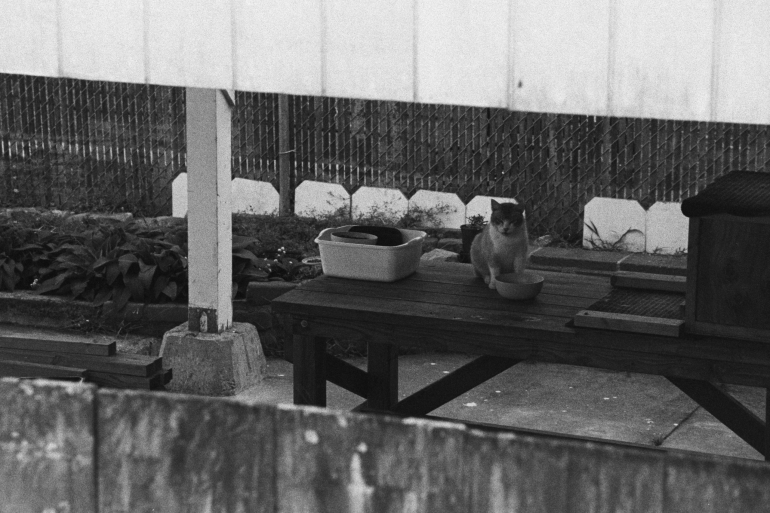
“For photography, digicams currently sit in that nostalgic sweet spot for Gen Z,” explains Stan. “Anything digital
is also compatible with today’s online culture, and our generation is certainly quite online. On the other hand, online culture may be causing some backlash.” He explains that many of his friends are really sick of pervasive and invasive digital experiences.
“It’s nice to have an object that is just a camera…I enjoy working within the limits of the medium and getting my hands dirty…”
Stan Zhang
For other photographers, Film photography is a protest and reconnection in the face of desensitization and overstimulation. Alisha prefers being present to the physical process of making art — and her friends feel the same way.
Gen Z, compared to many millennials, also seems to have a better understanding of content versus art. “Content is something made to fill your time, to take your attention, most often to sell you something,” explains Holden. “Art is something created to pose you with questions, or to allow you to think in ways you wouldn’t normally consider.”
Many of them grow tired of it.
“Literally new to me, a reversed image meant I moved my body in new ways and processed in new ways. Digital was suddenly too easy. Flat. Boring. Film offered the practice of magic, of being more aware of my surroundings and circumstances. I had to learn to be patient, mirroring the mental and community work I was documenting in my life.”
Alisha Shimpi
AI Doesn’t Belong Here
“Personally, I hate it with everything in me,” Alisha explains to me when I ask about her thoughts on AI in photography. “To see the world starting to rely on it, use it for content making, and taking away jobs is really heartbreaking. I believe that actual photography still satisfies our society’s yearning for human made and involved art.” With that said, she believes that there’s a need for authenticity. But understands that it has its place. Specifically, she points to a thesis project of a peer who used AI tools altering self-portraits to discuss grey areas in the gender binary.
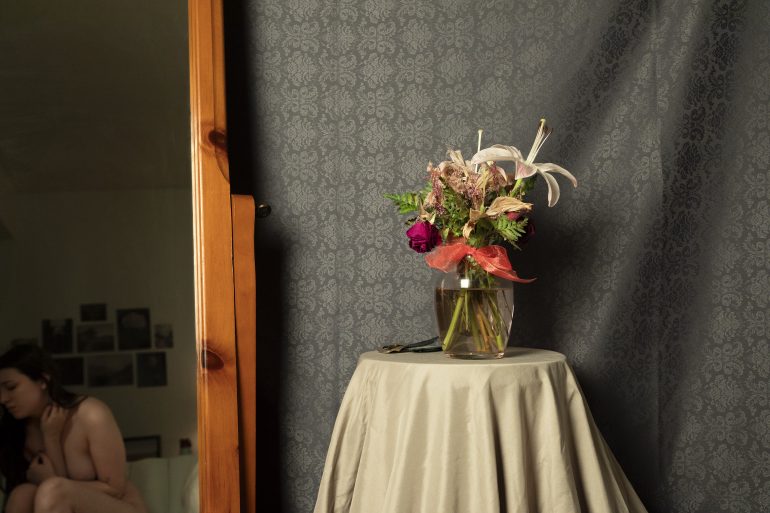
In workplaces all across America, people are being told that they have to use AI. Here at the Phoblographer, we stopped using Grammarly a while ago, and we sometimes use Claude for research because Google’s search is getting worse and worse — though I’ve been switching to Duck Duck Go instead. Regardless, our AI usage is minimal, and the members of Gen Z that I interviewed really think that it has no place in photography.
“AI creates imitations of reality, but there is nothing real that it represents,” explains Holden. “With film, there is this important sense of reality, a real object casts a real shadow, reflects real light into my lens, everything in the picture was really there. AI is constantly at war with reality, dulling our connection to the world we live in and submerging us deeper into a growing world of simulation.”
Similarly, Stan finds them soulless. He compares it to any other art form that can tell a story and elicit a reaction from a human.
Does Film Have a Future With Gen Z?
If I were to sit here and be asked if Film photography had a future, I’d undoubtedly say yes. Lomography isn’t going anywhere. Fujifilm still makes film. Several directors still work with Kodak to use Film in the making of their movies, too.
And the members of Gen Z I spoke to agree. “…I think that younger people across the board are more accustomed to instant gratification,” Holden tells us. “Film not only requires time and intention, but also trial and error. It’s a hands-on learning process that a generation brought up with AI and infinite scrolling may have a harder time becoming accustomed to.”

For Alisha, it seems like a race against time. She expressed hope for the younger generations and feels nice about watching her community also embrace analog formats. But she’s afraid that as people become more and more addicted to AI, social media, and digital mediums that it’s going to be harder for people to feel connected to art again.
What I hope Gen Z does is innovate in the world of film, where both Gen X and Millennials haven’t. The Wright Brothers of Cinestill are around my age — and we can thank them for a pretty innovative product that digital still can’t easily duplicate without a lot of Photoshopping. But aside from that, we’ve been mostly working with the same mediums over and over again.
Get rid of the ads!
Did you enjoy reading this article as much as we enjoyed writing it? There's a way to support us and our reporting, getting ad-free navigation and more as a bonus. Subscribe to us for less than a coffee per month —just $3.99— or take advantage of our yearly subscription with a hefty discount for only $25.- An ad-free experience
- A free mystery box for Lightroom or Capture One
- All the books in our store
- 20% discount on Capture One
- 30% discount on Imalume Photo Theft Protection
- 20% off Herbs and Kettle Tea Company.
- 20% off your order from MPIX printing services.
- 5% off Viltrox Products via their eCommerce store.
- 10% off all film developing, printing and scanning services from Blue Moon Camera and Machine
- 15% off 7Artisans products: The lens and accessory maker is offering a sweet discount for Phoblographer's readers.