

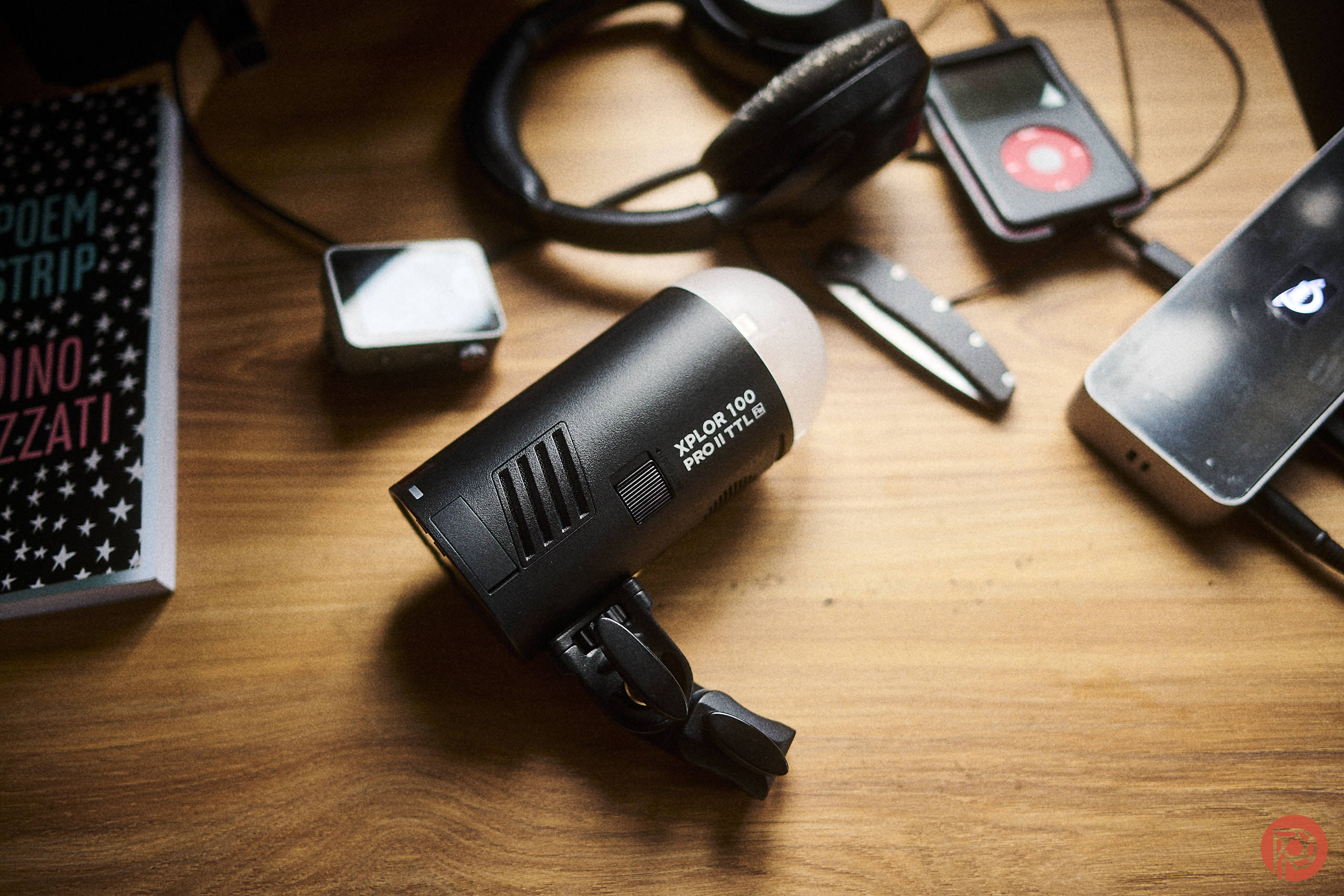
For many years, I’ve been really cautious of what I consider to be weaker flashes. When I’d see photographers use them at events, I’d kind of wince knowing that they’d have to do a lot of post-production afterwards to fix the lighting. But then we called in the Flashpoint XPLOR 100 Pro II TTL for a series of workshops that the Phoblographer is hosting. And honestly, I’m impressed. When I say that it mostly replaced my Profoto B10, I’m not kidding.


I’ve been using the Flashpoint XPLOR 100 Pro II TTL for product photography and event photography. There are a few things that you should know. First off, there are these adorable and very useful magnetic attachments for the light’s front part to shape the light. I originally thought that these would fall off during shoots, but I was wrong. The Flashpoint XPLOR 100 Pro II TTL is Adorama’s variant of Godox’s lights and even uses much of the same interface/accessories. In fact, at times, subjects bumped into the soft diffusion dome, and I just slipped it back into place. It never even fully came off.
To power up the flash, you turn on the button on the back and then turn the wheel. Navigating the settings is pretty simple and much of the flash’s interface can be controlled from the radio trigger. What’s really nice is that both the transmitter and the Flashpoint XPLOR 100 Pro II TTL’s battery can be charged via USB-C.
This light can be mounted on a light stand or used with its handle in one hand. That’s my preferred way to use it. I took it with me a while back to Rib King 2026, and used it with the Canon EOS R3 and a fisheye lens. The combo did a great job most of the time. The only time where I found the Flashpoint XPLOR 100 Pro II TTL to be a bit lacking was with really fast moving motion where I’d use continuous shooting bursts. The power just couldn’t keep up then. But with high speed sync, I was quite impressed.


Realistically, I don’t think that most modern photographers would care too much about color consistency with a light this affordable. However, it did a good job. I tend to lock my white balance and even lock the color profile. And the output was very consistent to where I didn’t have many problems at all.
Something that you need to remember, however, is that you have to set the flash to HSS in order for it to actually sync with Canon’s shutter. We had the same issues with Nikon, but didn’t find this to be the case consistently with Panasonic LUMIX.
The Flashpoint XPLOR 100 Pro II TTL isn’t as powerful as my old B10, but it surely can almost hold its own to it. It’s also significantly lighter, though a bit more complicated to use.
What truly amazed me, the Flashpoint XPLOR 100 Pro II TTL kept working even in a light rainfall. I thought that it would’ve melted like the wicked witch of the west. But nope, it kept on being reliable and didn’t even misfire with other transmitters in the area.
If you’re a beginner, I can’t recommend the Flashpoint XPLOR 100 Pro II TTL light enough. But know that you shouldn’t use it for continuous shooting — only for one frame a second. And also know that you eventually will need to upgrade to a bigger light. It’s super affordable, too.
Get rid of the ads!
Did you enjoy reading this article as much as we enjoyed writing it? There's a way to support us and our reporting, getting ad-free navigation and more as a bonus. Subscribe to us for less than a coffee per month —just $3.99— or take advantage of our yearly subscription with a hefty discount for only $25.- An ad-free experience
- A free mystery box for Lightroom or Capture One
- All the books in our store
- 20% discount on Capture One
- 30% discount on Imalume Photo Theft Protection
- 20% off Herbs and Kettle Tea Company.
- 20% off your order from MPIX printing services.
- 5% off Viltrox Products via their eCommerce store.
- 10% off all film developing, printing and scanning services from Blue Moon Camera and Machine
- 15% off 7Artisans products: The lens and accessory maker is offering a sweet discount for Phoblographer's readers.