


The Olympus system has had some wonderful lenses over the years for wildlife photographers. The company has introduced incredible options, including 150-600mm, 50-200mm, and 12-100mm, amongst others. It now appears that while there are multiple options, some lenses are losing their value in today’s time. Which lens is it and why? Let’s take a dive in.
The lens we are talking about is the Olympus 150-400mm f4.5 Pro. Introduced in 2022, the 150-400mm lens features built-in teleconverters. This means the lens is the equivalent of 300-800mm, and all this along with weather-resistance. The only other company that has been able to achieve this is Nikon’s offerings, which cost far more than the Olympus 150-400mm f4.5 Pro.
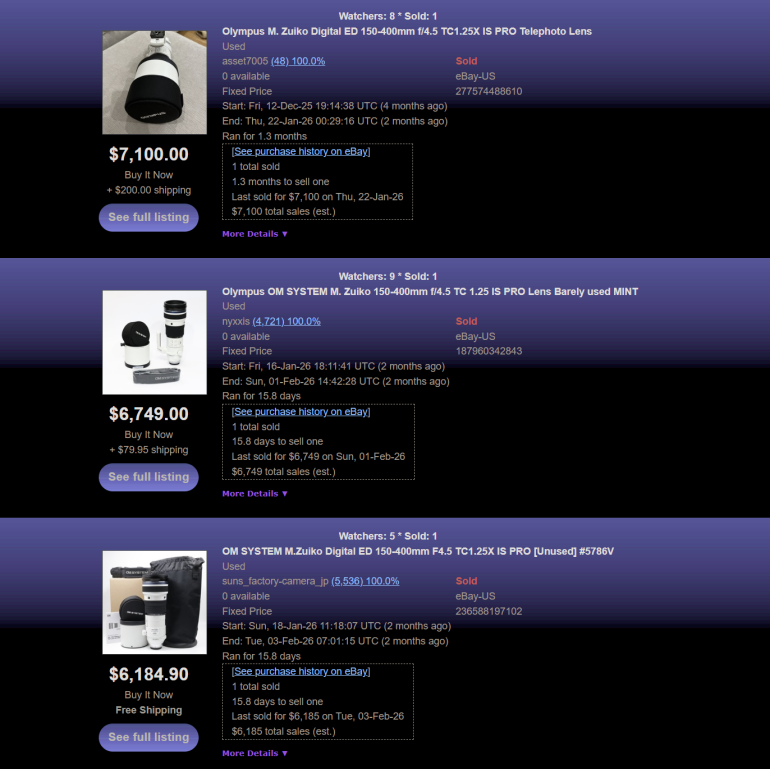
At the moment, the 150-400mm f4 lens costs about $9,000, which is a lot given its price point. However, on eBay, the lens is now being sold at $7,100, $6,749, or $6,184. Overall, this means you see a reduction of between 21.11% to 31.29%. Or, you can see $1,900 to $2,816 loss.
The Olympus 150-400mm TC is better suited for sports, wildlife, bird photography, and photojournalism. Portrait photographers can rely on it, especially if they are shooting from a distance.
In our review, the Olympus lens is pretty fantastic. It is quite lightweight, very quick, and has nice weather sealing. There is also sharpness, beautiful image quality, and has an internal zoom mechanism. You also get beautiful colors and bokeh. But while things work out in most cases, there are some challenges as well, such as the focus being slow and the high price. As we said in our review:
The Olympus 150-400mm f4.5 PRO lens offers some of the most versatility I’ve ever seen in the photography world. Lenses with built-in teleconverters can be something special. Wildlife and sports photographers will really like what this lens can do for them. I think wildlife and bird photographers are going to benefit the most here.
MFT is a niche system, and they are facing competition from full frame. Now, launching a lens that costs as much as the full frame offering, this means the value proposition that once justified the 150-400mm’s premium price. Furthermore, the MFT market is small, so the resale liquidity is limited, and sellers reduce prices to move inventory. The grey market further pressure undercuts domestic use prices.
For those who want a wildlife lens, this is a great time to invest in the 150-400mm. Sure, the lens is still expensive, but you end up saving a lot of money if you know where to buy from. This can be helpful for professionals who are tired of the rising prices in the States.
Get rid of the ads!
Did you enjoy reading this article as much as we enjoyed writing it? There's a way to support us and our reporting, getting ad-free navigation and more as a bonus. Subscribe to us for less than a coffee per month —just $3.99— or take advantage of our yearly subscription with a hefty discount for only $25.- An ad-free experience
- A free mystery box for Lightroom or Capture One
- All the books in our store
- 20% discount on Capture One
- 30% discount on Imalume Photo Theft Protection
- 20% off Herbs and Kettle Tea Company.
- 20% off your order from MPIX printing services.
- 5% off Viltrox Products via their eCommerce store.
- 10% off all film developing, printing and scanning services from Blue Moon Camera and Machine
- 15% off 7Artisans products: The lens and accessory maker is offering a sweet discount for Phoblographer's readers.