


When the Sigma 35mm f1.4 DG Art II came in for review (linked here), I was immediately quite shocked. Sigma had managed to make a lens that’s pretty much the size of the LUMIX 35mm f1.8 (reviewed here) — which is one of my favorite lenses. And even on Reddit, I remember coming across a thread asking about whether or not someone should upgrade. That, ultimately, is the wrong vernacular. I’m going to tell you why this is the worst thought you can have in the post-capitalistic world that we’re in. If you’re rolling your eyes at that statement, you’re probably rolling in money or you don’t understand how the brands are giving you diminishing returns.
A Faster Aperture Doesn’t Mean a Better Lens in 2026
Before I go on, you should know something: a faster aperture doesn’t mean that you’ve got a better lens necessarily anymore. One great example of this is the Canon 42mm f1.2 — which lacks weather resistance and all the features that make an L-series lens desirable. Then there’s the Nikon 35mm f1.4 and the 50mm f1.4 — both are designed to deliver “character” instead of being like the f1.8 and f1.2 high-end S-series variants.
So just because the Sigma lens has an f1.4 aperture doesn’t mean that it’s necessarily a higher end lens. If anything, it’s a negligible amount of extra light that’s going to be absorbed by your sensor in the most favorable of conditions.
Build Quality
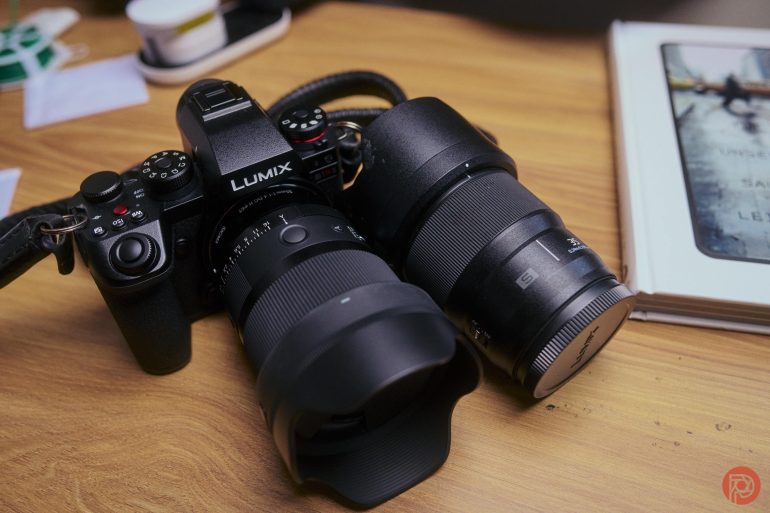
Both the Sigma 35mm f1.4 DG Art II and the Panasonic LUMIX 35mm f1.8 have weather resistance. I’ve tested both lenses out in the elements and was quite surprised at what they’re capable of doing. For the record too, I own the Panasonic lens and I’ve been using it for several years now after I purchased it used.
Panasonic’s option is lighter even though both lenses are around the same size. Both have a 67mm filter thread — which is ideal for so many lenses these days. This is a trend started by Tamron that every manufacturer has started to cater to.
During a photo session, I held and put both lenses in my jacket pocket. The Sigma lens was noticeably heavier. And even at one point, I put the lenses in the hands of a friend who was astonished at how lightweight the LUMIX option was.
In the past, brands would’ve said that the higher end f1.4 lens has better build quality. But modern engineering proves that to not always be the case for weather resistance.
Look, both lenses have a great build quality to them. But the truth is that you’re always going to take the lighter lens with you if you can. So LUMIX wins in this case.
Autofocus
I founded the Phoblographer not with the idea that we should do lab tests, but that real-world tests make so much more sense. The Phoblographer is a publication for photographers who are interested in gear and technique and not for lab techs. So with that said, I tested both lenses in the same conditions over time on the Panasonic S1R II. I purposely chose this camera not only because I own it, but also because I knew that people would want to know how it works on a higher resolution camera body.
Ultimately, the Panasonic 35mm f1.8 outpaced the Sigma by just barely a bit. And that makes sense because Sigma hasn’t always been known for using their best motors in every lens they make.
For this section of my comparison, I went back and looked at my Sigma 35mm f1.2 Art II review. There, I said the same thing: LUMIX is still faster.
So if you’re looking for autofocus speed performance in a practical manner, the LUMIX lens still does better.
Unlike with other camera systems and the DSLR days, the L-mount alliance doesn’t try to screw each other over in subtle ways. All the information is given through the lens mount and it isn’t bottlenecked at all.
In the end, the Panasonic lens just has better autofocus motors.
Image Quality


So what about image quality? Well, here’s the honest truth: unless you’re pixel peeping, you might not be able to tell the difference between the two lenses. And even so, it’s very negligible of a difference in a world where you’re probably going to do post-production to the images.
Each photo also has a caption saying which it is. For the record, I used scene detection and in another test, I didn’t use it at all. No post-production was done to the photos above either.
Sigma ever so slightly takes the lead here.
Is the Sigma Really an Upgrade?
To reiterate what I’ve been saying for years and years now, we don’t always have a good need to choose a higher-end lens. And even so, the definition of a higher-end lens can vary so much. To me, a higher-end lens means that it will perform better in terms of autofocus speed. The reason why is because that’s giving me something that I can’t do in post-production. If I’m able to accurately snap the photograph I want, then I can work on it in post-production if I wish. But if I can’t even get the image, then it won’t matter.
In the end, I want performance.
If you want sharper image quality, you’re paying quite a higher premium. The LUMIX lens goes for around $700 and the Sigma goes for a bit over $1,000. And if you buy the lenses used, you’re going to get the LUMIX even cheaper.
Why would I not choose the Panasonic lens?
Get rid of the ads!
Did you enjoy reading this article as much as we enjoyed writing it? There's a way to support us and our reporting, getting ad-free navigation and more as a bonus. Subscribe to us for less than a coffee per month —just $3.99— or take advantage of our yearly subscription with a hefty discount for only $25.- An ad-free experience
- A free mystery box for Lightroom or Capture One
- All the books in our store
- 20% discount on Capture One
- 30% discount on Imalume Photo Theft Protection
- 20% off Herbs and Kettle Tea Company.
- 20% off your order from MPIX printing services.
- 5% off Viltrox Products via their eCommerce store.
- 10% off all film developing, printing and scanning services from Blue Moon Camera and Machine
- 15% off 7Artisans products: The lens and accessory maker is offering a sweet discount for Phoblographer's readers.