


As a woman photographer, I feel I would not have made it to where I am had there not been for those who came before. Today, women continue to fight for their place in the photography circle, but sometimes, we tend to forget the contribution of those who stood against a narrow-minded, patriarchal society to create works that were never deemed artistic enough. Some have been forgotten over time, but there are a few whose legacy continues to live on. So, this Women’s History Month, we look at women photographers who have redefined the medium.
Table of Contents
Anna Atkins

Known as one of the earliest women photographers, Anna Atkins’ legacy was forgotten to time. An English botanist and illustrator, Anna was the first woman photographer to publish her cyanotypes in her own photobook, beating William Henry Fox Talbot, the creator of photography, by a few months. She learned about the lensless photography process from John Herschel, and in 1841, at the age of 42, launched British Algae: Cyanotype Impressions. While her work was overlooked, it was after several decades that she finally got the recognition she deserved.
Julia Margaret Cameron

A 19th-century portraitist, Julia Margaret Cameron, began photography at the of 48 in the British colonies of India and England. While she only photographed the British upper class, Cameron’s works were best known for their soft focus that gave the sitters an ethereal glow. Furthermore, the images were grounded in reality, but the sepia tone and the mix of soft and sharp details made her a stand-out photographer in her own time.
Gertrude Käsebier

Gertrude Käsebier was one of the American photographers who also helped in shaping pictorialism. She moved to New York from Colorado and, as a teenager, took photography lessons as a founding member of Alfred Stieglitz’s pictorialist Photo-Secession Society, and from there on, there was no looking back. However, Käsebier began to become one of the prominent women photographers and even financially successful, thanks to her surreal photographs of women with their children.
Frances Benjamin Johnston

Frances Benjamin Johnston was the first woman press photographer in the US who documented several events in Washington at the end of the 19th century. What made her different was her awareness as a role model and as a woman photographer in a male-dominated field. In an interview in 1893, Benjamin Johnston said: “It is another pet theory with me that there are great possibilities in photography as a profitable and pleasant occupation for women, and I feel that my success helps to demonstrate this, and it is for this reason that I am glad to have other women know of my work.” Johnston was unapologetic, and she continued to contribute despite the odds against her.
Imogen Cunningham


A representative of Gertrude Käsebier, Cunningham is one of the most celebrated and important women photographers of the 20th century. She began her journey with pictorialism (like Käsebier), but unlike the latter, the former was also surrounded by controversy. In 1915, a nude portrait of her husband called The Bather scandalized people. However, Cunningham was not bothered. Her nudes gradually changed, and today, she is well-known for her flower motifs and close-ups of Lilies and other blooms.
Claude Cahun


A French photographer, Claude Cahun was best known for her surrealist photographs, mainly focused on self-portraits. However, her work always commented on gender binaries, as she dressed up as an androgynous person and questioned viewers about what is masculine and feminine. In a way, Cahun’s contribution has been immense, as she went on to influence generations of photographers, including Cindy Sherman.
Germaine Krull


Germaine Krull had an interesting life. She was a left-wing activist who was expelled from Bavaria because of her commitment to her cause. She moved to Paris, where she came in contact with Man Ray, Sonia Robert Delaunay, and others. There, she developed her nudes and commercial photography. In 1928, she published Metal, a photobook about steel buildings, including the Eiffel Tower. In World War II, she became the first woman war correspondent in Indochina, and after that, she went on to own a hotel.
Ilse Bing

An unconventional woman photographer, Ilse was a part of the Parisian avant-garde movement. She was known to use her Leica, which was unheard of then, as many photographers used heavy equipment that needed a tripod stand at the beginning of the 20th century. Gradually, she began to earn her name for her harsh contraction and unusual framing, which led her to collaborate with Vogue and Harper’s Bazar, amongst others. Ilse’s work cemented her legacy as one of the well-known women fashion photographers of her time.
Dorothea Lange
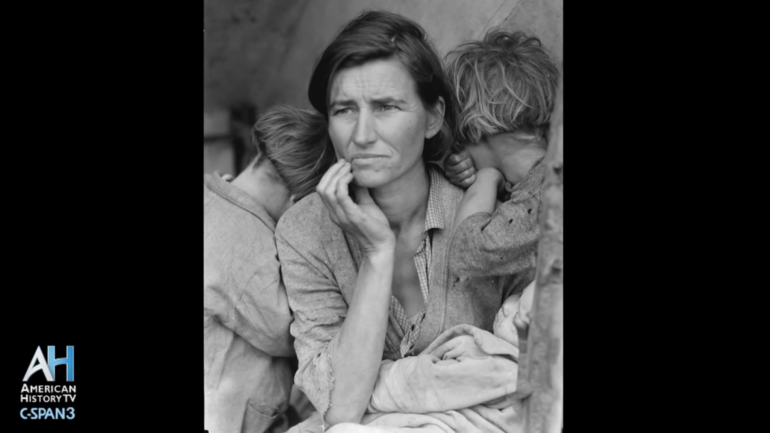
Dorothea Lange gave us a photograph that defined the Great Depression. One of the most successful women photographers, Lange’s The Migrant Mother is one of the most iconic images of the 20th century. The picture went on to become a stamp in the USA in 1998, and in fact, the picture went on to influence a new generation of photojournalists and documentary photographers.
Berenice Abbott


Berenice Abbott began her journey with Man Ray as his assistant between 1923 and 1925, after which the photographer went on to photograph artists, including James Joyce. While that work may have brought her fame, it was French photographer Eugène Atget‘s series that left an immense impact on her. Based on Atget’s pictures of Paris, Abbott began to document the streets of New York. Architectural photographs are considered the most important contribution to photography today.
Lee Miller


A model turned photographer, Lee Miller was best known for her surrealist photographs. However, with time, she moved on to become one of the best-known women photographers in the field of photojournalism, as she heroically captured World War II from the front lines. She has photographed some truly historical moments, including the liberation of the Buchenwald and Dachau concentration camps. She was also one of the few accredited women by the US Army as military corresponded.
Diane Arbus

One of the most controversial women photographers, Diane Arbus, captured the portrayal of people of New York, who were often living on the fringe of society. She captured portraits of twins, transgender or anyone who was deemed as the other in society. While her images were sensitive, Diane’s legacy is often misunderstood. She also became the first US photographer to even be presented at the Venice Biennale in 1972. Even today, she is revered by many but is also looked at through the lens of discomfort by others.
Vivian Maier

Vivian Maier’s legacy was founded posthumously, but in a short period, she went on to become one of the most legendary street photographers in recent years. Although she sustained herself through her role as a nanny, she continued to document her life and her surroundings in the most special way. Today, her work continues to inspire a young generation of photographers who are discovering her images via her documentaries or books.
Nan Goldin

Born in 1953, Nan Goldin began photography as a teenager. However, as she grew up, she was drawn to the works of Diane Arbus, Larry Clark, and August Sander, whose influences can be seen in her work even today. One of Nan’s most iconic photobooks is the Ballad of Sexual Dependency, where she documents her life and that of her friends in the most honest and thought-provoking way. In addition, she has also photographed the lives of transgender, gays, lesbians, and other people in 1980s New York with utmost humility and respect.
Cindy Sherman

As we mentioned previously, Cindy Sherman was inspired by Claude Cahun and used self-portraits to highlight gender roles and questions of identity. In the past 30 years, Sherman has used varied disguises and used her work to present female stereotypes from TV, film, and advertising.
Francesca Woodman


Like Sherman, Francesca Woodman is also one of the best-known women photographers of our time. Although she passed away by suicide at just 22, Woodman’s self-portraits, captured between the 970s and 1980s, highlight the feminist discourse. Wooman used photography to reclaim her body and her sexuality. At its heart, they also spoke about what it means to be a woman, while her work dabbles with vulnerability and introspection.
Get rid of the ads!
Did you enjoy reading this article as much as we enjoyed writing it? There's a way to support us and our reporting, getting ad-free navigation and more as a bonus. Subscribe to us for less than a coffee per month —just $3.99— or take advantage of our yearly subscription with a hefty discount for only $25.- An ad-free experience
- A free mystery box for Lightroom or Capture One
- All the books in our store
- 20% discount on Capture One
- 30% discount on Imalume Photo Theft Protection
- 20% off Herbs and Kettle Tea Company.