

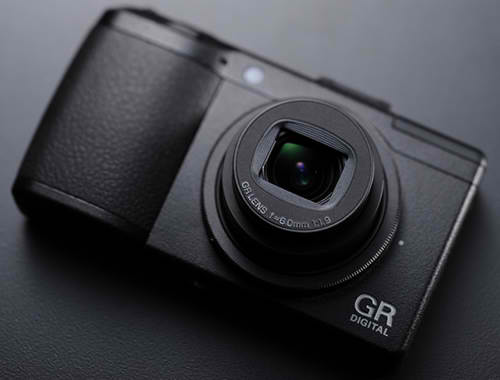
Using the Ricoh GRIII For Street Photography: A Review by Eric Kim

by Chris Gampat on 06/04/2011

When you are shooting street photography, it is hugely important to have a small and inconspicuous camera which prevents you from†sticking†out like a sore thumb. I didn’t always know that. When I first started shooting street photography, I used a Canon 5D DSLR, which is quite large and intimidating. I found out it was hard to stay low-key when I was in the streets, as it was large, bulky, and had a loud shutter sound. Recently I was able to get my hands on a Ricoh GRIII digital, which is a truly incredible camera. I had heard about the camera about a year back, and noticed that everybody who used the camera only had good things to say about it. If anything, it has its own little cult following. I was quite curious back then, but now I know. Without spoiling anything, it is truly the best compact camera for street photography, and everybody who is serious about shooting in the streets should have one. Keep reading to read my in-depth review of the Ricoh GRIII digital.

Editor’s Note: this is a special guest posting by Eric Kim, street photography expert.

Unboxing:

Ricoh GRIII Digital

Ricoh GRIII Digital

Ricoh GRIII Digital

Ricoh GRIII Digital

Ricoh GRIII Digital

Ricoh GRIII Digital

Ricoh GRIII Digital

Ricoh GRIII Digital

Ricoh GRIII Digital

Ricoh GRIII Digital

Ricoh GRIII Digital

Ricoh GRIII Digital

Ricoh GRIII Digital

Ricoh GRIII Digital

Look and feel:

Ricoh GRIII Digital

When you first pick up the Ricoh GRII, the first thing you will notice is that it doesn’t feel like a point and shoot. It has a wonderful weight, a nice matte black body, and a†textured†rubber grip which gives the camera great handling. The magnesium body makes this feel like a true precision knife of a camera, rather than a toy.

Ricoh GRIII Digital

Considering it has a nice grip, it is quite comfortable to hold and handle. Many other point and shoots out there don’t have a grip, which makes it difficult to handle. When shooting with the Ricoh GRIII, I was able to hold onto it all day without having any issues.

Features:

“Snap Focus” – the most amazing feature ever

One of the main problems about most street photography compact cameras such as the Canon S95 and the Panasonic LX-5 is that they have a considerable amount of shutter lag. If you tell any street photographer, this is an absolute no-no as it makes you miss “the decisive moment.” However with the Ricoh GRII, that isn’t the case. It has an amazing feature called “snap focus” which essentially allows you to set a certain focusing distance (1m, 1.5, 5m, etc) and then doesn’t have any shutter lag. ZERO, NADA. This is by far the best selling point of the Ricoh GRIII.

Built-in Flash

Ricoh GRIII Digital

Another great feature of the Ricoh GRIII is that it comes with a built-in flash. Many of the micro 4/3rds cameras out there (think the Olympus EP-2) don’t have built in flashes, which can be quite annoying at times. The built-in flash of the Ricoh GRIII is strong, and I have been using it considerably much when shooting on the streets. I have been able to capture great images that are very similar to that of Bruce Gilden.

28mm f/1.9 Prime Lens

Ricoh GRIII Digital

The Ricoh GRIII comes with a 28mm f/1.9 fixed focal lens. As everybody knows, I hugely advocate the use of wide-angle primes. Why? It allows you to get incredibly close with your subjects, while the fast aperture allows you to shoot at night with faster shutter speeds. The lens is incredibly sharp, and creates beautiful looking images. You’d be surprised that the photos that come out of it are from a point and shoot.

ISO capabilities

Many people ask me about the ISO capabilities of the camera. Well first of all, it ain’t a DSLR. That means that above ISO 800 you will be able to see considerable grain in your images. However I see this as a strength, rather than a weakness as the grain actually looks like film grain. I can’t quite explain it, but the files that the Ricoh GRIII shoots out (in black and white) look like black and white film images. Also generally speaking for a compact camera, the high-ISO is pretty solid.

Customization

Ricoh GRIII Digital

One of the strengths of the Ricoh GRIII is that it is incredibly flexible. In the back of the camera, there is a Function 1 and Function 2 button which can be set to whatever you want. I have the Function 1 button for the “snap focus” feature while the Function 2 button sets the ISO. There are very few cameras which allow for this type of functionality, which I find amazing. Every street photographer out there has his or her own style, and being able to customize the camera is quite wonderful.

Viewfinder/LCD

You are also able to shoot with a viewfinder with the Ricoh GRIII (it comes as an accessory) — but I haven’t shot with it. Rather, I find using the LCD as far better. The reason is because I am able to make interesting compositions (when shooting really low to the ground) or shooting people from the hip. The LCD screen looks great, although it can be a bit difficult to shoot when the sun is quite bright outside.

On the streets

Low-key and Stealthy
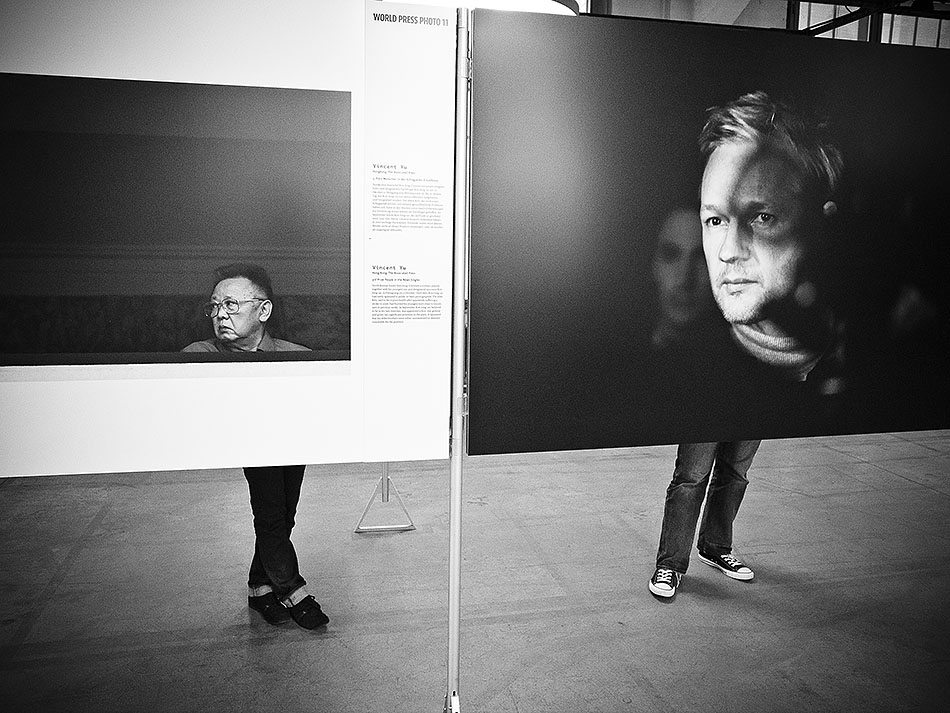
It is important to be low-key when shooting on the streets, and the Ricoh GRIII definitely allows for that. The camera is small and†inconspicuous, and it doesn’t shout “pro photographer” the way a DSLR typically does. Therefore when you are shooting other people, they don’t feel as threatened and most of them simply assume you are a tourist. Not only that, but with its nearly silent shutter, I can take photos in quiet buses or libraries without people even noticing me.

RAW functionality

The Ricoh GRIII also shoots in RAW with 10mb files. The RAW files look great on the computer, and work seamlessly with any RAW editor. My only complaint about shooting in RAW with the Ricoh GRIII is that when you are shooting too quickly, the buffer gets full. My way to counter this issue is to take fewer and more deliberate shots. For the most part, I haven’t missed many shooting opportunities because my buffer was full.

Ricoh GRIII compared to a DSLR

Having shot street photography with a DSLR for so long, the Ricoh GRIII is a godsend. It is small, portable, and an easy camera to carry around with you all of the time. Recently I went on a trip to the UK and Switzerland to teach street photography workshops, and I loved how it was so light. My last trip with my DSLR was a pain in the ass, as it was so large and heavy. The Ricoh GRIII truly packs a punch without all of the cumbersome weight.

More Street Photography with the Ricoh GRIII

Ricoh GRIII Digital

Ricoh GRIII Digital

Ricoh GRIII Digital

Ricoh GRIII Digital

Ricoh GRIII Digital

Ricoh GRIII Digital

Ricoh GRIII Digital

Ricoh GRIII Digital

Ricoh GRIII Digital

Ricoh GRIII Digital

Ricoh GRIII Digital

Ricoh GRIII Digital

Ricoh GRIII Digital

Ricoh GRIII Digital

Ricoh GRIII Digital

Ricoh GRIII Digital

Ricoh GRIII Digital

Ricoh GRIII Digital

Ricoh GRIII Digital

Ricoh GRIII Digital

Conclusion

Pros:

  • Compact size
  • Sturdy build and solid feel
  • “Snap focus” feature (no shutter-lag)
  • Price (cheaper than other†cameras†for street photography)
  • Shoots RAW
  • Sharp and 28mm f/1.9 prime lens
  • Great battery life

Cons:

  • Slow RAW buffering speed

You can buy a Ricoh GRIII brand-new for $500, which is an incredibly great price for what it is. In-fact, I no longer like shooting with my Canon 5D DSLR and see this as †my primary street photography camera. Although $500 is not cheap, it is a bargain when considered to most micro 4/3rd cameras as well as DSLR’s which typically start in the $800-1000 range.

In conclusion, the Ricoh GRIII is one hell of a camera and the best bang-for-your buck for street photography. I highly recommend everyone to purchase one to use as either a main camera or even a secondary camera for street photography. Don’t delay and get one now!

Please Support The Phoblographer

We love to bring you guys the latest and greatest news and gear related stuff. However, we can’t keep doing that unless we have your continued support. If you would like to purchase any of the items mentioned, please do so by clicking our links first and then purchasing the items as we then get a small portion of the sale to help run the website.

Also, please follow us on FacebookFlickr and Twitter.

  • Christopher

    You get can it cheaper here in Japan, where it has been popular for quite some time.

  • Christopher

    You get can it cheaper here in Japan, where it has been popular for quite some time.

  • Sevenmarek

    You guys are idiots, the camera doesn’t matter…

    • Chris Gampat

      Hi Sevenmarek,

      We know it’s the photographer that takes the pictures, we always say that. But this is a coveted camera of many street photographers.

  • Ray

    I recently got a GRD3 also and agree with most of what you say. I love the snap focus too, but I strongly disagree on one point regarding the comparison between the GRD and the LX5 (which I also own). The Canon S90 has considerable shutter lag regardless of focus mode. The LX5 is much faster in auto focus and has just as little shutter lag as the GRD when you use it in manual fous – IOW, none, zero, zilch. I’ve done quite a bit of street shooting with the LX5 and set up for hyperfocus in manual focus mode, its shutter lag is an absolute non-issue. Just as with the GRD3. True it doesn’t have snap focus, but given the huge DOF of these small lens/sensor combinations, in any sort of decent light, hyperfocal is about as effective as snap focus. So, on that point, I think you missed the mark, not on the GRD3, but on the LX5.

  • GServo

    I want to get this camera in my hand. I love my D90 but i am would like something  this for traveling and when i cant have my DSLR with me.

  • El D

    Can’t agree more about the ergonomics of the GRD. And the photographs you present are enough evidence in themselves.

  • Dan

    Great review, Eric!

    I couldn’t agree with you more. I’ve had it slightly more than a year and it is fantastic!

  • Dan

    Great review, Eric!

    I couldn’t agree with you more. I’ve had it slightly more than a year and it is fantastic!

  • http://pulse.yahoo.com/_KZAUBZYOPVTVGCIDMTHKGF5UVM bullrider

    95% of street candid photos, I would never care to see a second time. Usually I resent having seen them a first time. Including these.

  • http://pulse.yahoo.com/_KZAUBZYOPVTVGCIDMTHKGF5UVM bullrider

    95% of street candid photos, I would never care to see a second time. Usually I resent having seen them a first time. Including these.

  • http://www.weisserth.net Tobias W.

    Nice post. However, I disagree with Eric on his resentments towards the Canon S90/95 and Micro Four Thirds in general.

    I still haven’t understand the big deal about the Ricoh’s “snap focus”. Essentially, it allows you to pre-focus to a specific distance? You can do the same with Canon’s S90/95. Turn the camera to manual focus and you can set the focus to a distance using the backside control wheel, nicely visualized with a distance scale on the display. You can also turn off the manual focus magnification square on the display (allowing for easier composition without distraction). On manual focus with the focus pre-set, the camera then has no shutter lag at all. I understand this is essentially what the Ricoh does? Not so special in my eyes when compared to the S90 I have.

    Concerning ease of use I can hardly imagine that any compact comes close to Canon’s S90/95. The most amazing feature of the Canon S90/95 is the customizable control wheel around the lens, that is mode context sensitive and can be used to change ISO, focal length, white balance, manual focus (in steps), aperture or exposure compensation. Also, a short cut button on the rear can be customized with a function and a C mode which remembers any combination of settings you save in the menu. I use C mode for panning (slow shutter speed, no horizontal image stabilization). I never have to go into the menu at all. The S90 is actually a much much better camera in terms of usability than my E-PL1 that constantly makes me go into the menu whenever I need to change any exposure setting.

    Given from what I’ve read, the only thing that sets the Ricoh apart is its prime lens (which is not really faster than the S90/95 at 28mm) and the hot shoe and maybe the grip which can be bought for the S90/95. Also, the S95 is a lot cheaper than $500.

    As a side note, the S90 I have also works with CHDK, an alternative, open source firmware that can be used to extend the camera with loads of new features, the coolest being able to run scripts on the camera that automates taking pictures in many ways.

    Regarding Micro Four Thirds: the GF1/GF2 and PEN range is also a nice choice for street photography, although it suffers mostly from a noisy shutter (in my opinion). I use the E-PL1, which has a flash. The E-PL2 has a flash as well, as does the GF2. So most of the smaller Micro Four Thirds cameras have a flash, contrary to what Eric assumed in his review. Also, the price for most Micro Four Thirds cameras has dropped below what Eric assumed. Although the E-P2 does not have a flash, you can get a brand new one online in Europe for about 400€ (as it’s rumored to be out of production with a replacement model being announced this month). When I got my E-PL1 months ago, it was already below 400€. So in fact, you can get a system camera with a much bigger sensor, still suitable for street photography in most situations for  a little more than what the street price for the Ricoh GR3 is in Europe (340€ online in Germany). One more nice thing about the PEN range is the black and white grainy art filter which is much better at creating a grainy black & white image with “true grit” than anything I managed to do in post-production.

    My street photography set is actually threefold. Mostly, I use my E-PL1 with the excellent Panasonic 20mm f/1.7 or the kit lens or one of the many adaptable legacy lenses I possess. The Voigtländer 25mm for Micro Four Thirds is now also in my portfolio. Most of the times I actually enjoy using the EVF accessory. When I want to be able to put the camera into the pocket of my jeans, I take the S90. When I need a little bit of distance to my motives and need a fast autofocus (when doing my panning shots), I actually take my E-5 (with the S90 still in my jeans pocket).

  • http://www.facebook.com/michaelpennphotography Michael Penn

    As someone that uses a GRD III for street photography I haven’t found another P&S compact camera that can keep up with it.

    http://www.michaelpennphotography.com

  • http://www.facebook.com/michaelpennphotography Michael Penn

    Some other strengths of this camera are the ability to turn the LCD off while shooting, a locking mode dial, very well laid out controls, built in lens cover, shoots DNG, uses a very common battery, can use AAA batteries in a pinch, a very simple  menu and 3 true “My Settings”

  • Pingback: Ricoh GR-D III for street photography – Shutterbugging dot Net

  • Anonymous

    The GRIII sounds great, but I want to point out that the LX5 does indeed have a “snap focus” feature. In Manual Focus mode (which is achieved by sliding a switch on the lens barrel — no menu pecking needed) you simply point at something and touch the “Focus” button on the 4-way controller (thumb buttons on the back). Bingo, the camera locks focus on whatever you were pointing at, and stays locked. You can even turn the camera off, and when you turn it back on, focus is still locked at that distance.

  • Anonymous

    The GRIII sounds great, but I want to point out that the LX5 does indeed have a “snap focus” feature. In Manual Focus mode (which is achieved by sliding a switch on the lens barrel — no menu pecking needed) you simply point at something and touch the “Focus” button on the 4-way controller (thumb buttons on the back). Bingo, the camera locks focus on whatever you were pointing at, and stays locked. You can even turn the camera off, and when you turn it back on, focus is still locked at that distance.

  • http://twitter.com/DanielFisher Daniel Fisher

    Sounds like a great camera for street shooting, though I’m sticking with my S95. I’ve never seen better images coming out of a point and shoot.

  • Pingback: Silence on CaNikon Front, Apple’s iOS5 Aims at Photographers and the Bottomless Memory Card | DailyCameraRumors

  • Bytefreak

    Great post! about the writing time…  i noticed a HUGE diference in writting speed using a fast sandisk extrem sd Vs a kingstom standard sd… (2 seconds vs 5 seconds or more…)

  • Russelh

    I had a GR I which was an absolute rocking camera. Sold it when times were particularly tough, and only much later replaced it with a G9. Which is also an amazing camera. Reading your review makes me want to buy a GRIII

  • Pingback: break melody » Silence on CaNikon Front, Samsung NX20 & NX200 Coming and the Bottomless Memory Card

  • Pingback: The Ricoh GRIII: The Ultimate Compact Camera for Street Photography Review — Eric Kim Street Photography

  • http://flavors.me/rogeriosm Rogério Salgado-Martins

    Eric, did yours really come with a external viewfinder as an accessory? What a nice giveaway. At least at BH it doesn’t. It’s as optional item and costs US$ 200,00. 
    I use the external viewfinder with my PEN (the same setup as Tobias, actually, with the Lumix 20mm f 1.7), and I couldn’t  disagree more about the LCD composing. Not to mention it brings more attention to your camera and it’s power consuming.

    • Anonymous

      If I may interject, I love composing on my LCD with the EP-2. It doesn’t
      draw attention to me because I’m holding it close to me and I’ve learned to
      read body language and judge accordingly who would think that I’m a,
      “threat” and how to approach them. All it takes is confidence and
      perseverance.

      Granted, I also use the pancake lenses because they don’t jut out.

      Chris Gampat,
      Editor in Chief
      The Phoblographer

  • http://twitter.com/EnglisheyesMark Mark Lawrence

    Try the Nikon P7000, I did a side by-side comparison with the GRIII, Canon, Lumix etc and overall the Nikon won hands down, I shoot Leica M9 primary but carry the Nikon P7000 everywhere, its always in my pocket or bag, a fantastic camera for street work, very light, compact and fast, also feels good in the hand.

    • http://www.weisserth.net Tobias W.

      Hi Mark,

      The P7000 mostly gets out of reviews losing against the S95 and LX5. DPreview’s final statement in their side by side comparison:

      “Given that the S95 and LX5 offer extremely similar image quality, unless you really need the 200mm (equivalent) lens, we would recommend both over the P7000, which languishes in third place in this test.”

      Being curious, what makes it a better camera in your eyes? I never owned a digital Nikon.

      Personally, the Nikon would be too bulky for me. It’s considerably bigger than the S95 or LX5.

      In the end it comes down to personal taste, doesn’t it?

    • Chris Gampat

      I’m sorry to say this, but the P7000 makes a great doorstop, and that’s all. It’s a pain otherwise.

  • http://twitter.com/EnglisheyesMark Mark Lawrence

    Hi Tobias, yes it does come down to personal taste. If I listened to every review I would have never bought a camera, or for that matter any other producst at all!
    Nikon, Canon, Leica, Olympus, Sony, Pentax etc etc etc, thay all produce great cameras and lenses, in fact its not the camera its the photographer that really makes the difference. My decision to buy the P7000 was simple, I had all the cameras of choice together in the store and i took identical shots, portraits, close up’s on text, macro, black and white, flash, wide angle and max zoom, and in my humble opinion the P7000 won out on the majority of shots. but this is down to my personal taste, i guess its like liking Canon or Nikon, the colour rendition is not the same, the feel of the camera in your hands is not the same etc.
    I would gladly use a Ricoh GRIII, S95 or LX5 if they were given to me too :)

  • http://twitter.com/bdrkan bedri

    i use GRD II. You didn’t mention about 1:1 format, the best feature i like about Rigcoh GRs

    • http://twitter.com/NewsBack NewsBack

      Why you like 1:1 format?

  • Pedromedario

    I had the first model of the GR Digital, and while the controls were fantastic, the sensor was a piece of crap, it produced noisy pix even shooting at 200 ISO… Unless Ricoh improved a lot the sensor (which at the end of the day is the heart of the camera) I wouldn’t buy another GR.
    Then doing street photography without a viewfinder is a pain in the arse. And no offence but I find the pictures of yr Ricoh ad blog very mediocre.

  • Pedromedario

    I had the first model of the GR Digital, and while the controls were fantastic, the sensor was a piece of crap, it produced noisy pix even shooting at 200 ISO… Unless Ricoh improved a lot the sensor (which at the end of the day is the heart of the camera) I wouldn’t buy another GR.
    Then doing street photography without a viewfinder is a pain in the arse. And no offence but I find the pictures of yr Ricoh ad blog very mediocre.

  • http://www.facebook.com/kohsh1 Koh Shang Hwan

    I have a question, how would you comment about Nikon P300 for street photography? Thank you

  • Pingback: Review: Ricoh GXR with A12 Leica M Mount Module at The Phoblographer

  • http://twitter.com/NewsBack NewsBack

    I just do not know why people like taking black-white pictures. Unlike colorful pictures, the black-white ones omit a lot of information.

  • Pingback: Kamera poket kelas premium: RICOH GR DIGITAL III (lensa 28mm F1.9) - Ceriwis - Indonesian Community

  • http://twitter.com/FLAMEDidea rafael john

    Is this still better than the new canon g15 in terms of street photography? Thoughts please? :D

Previous post:

Next post: