

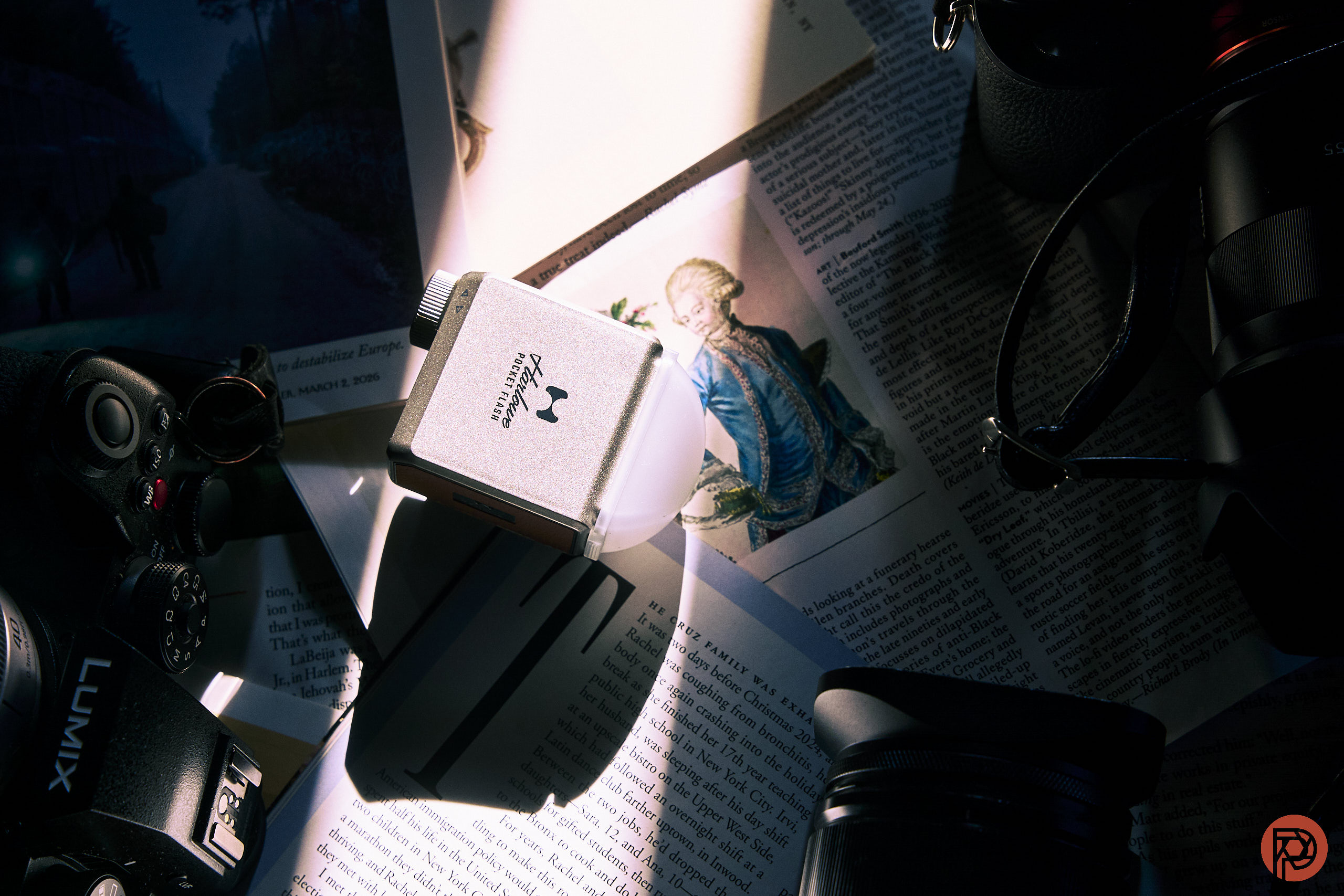
I’ve known that Harlowe was working on a flash for many years. The company, known for their gorgeous LED lights, realized a while ago that sometimes LEDs can’t do everything. So they started building a flash. With that said, I truly hope that the Harlowe Hybrid Pocket Flash isn’t the only one that they’ll build. This little thing is designed for street photographers and others. But I’ll be really honest here: it’s weak. And if that’s what you’re looking for, then this could work well. Aside from that, this is also the single most innovative flash that I’ve used in several years. If Harlowe makes a far more powerful and professional version, I truly might just give up my Profoto lights — and I don’t say that lightly.
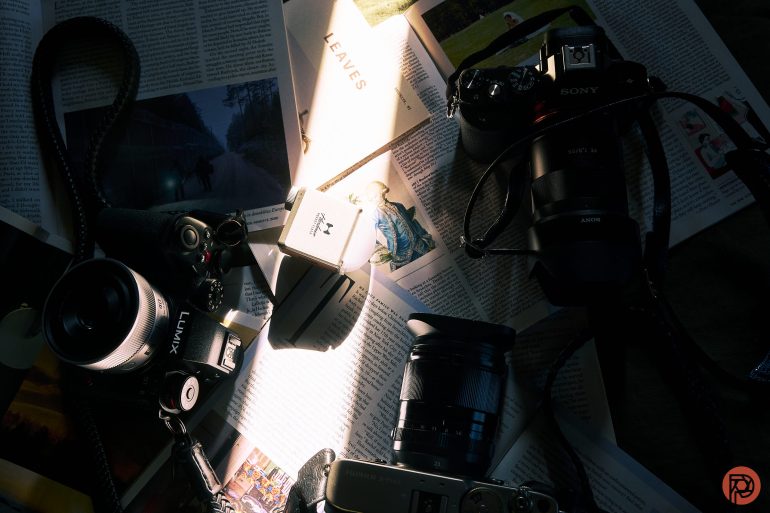
When you look at the Harlowe Hybrid Pocket Flash, it immediately looks like something that you’d expect street photographers to use. It fits into your pants pocket with ease and even has a magnetic diffusion cover for the front area of the light output. But that’s not the coolest thing about it.


I say this next statement with the most fervent belief I’ve ever bestowed upon a lighting company since I reviewed the original Phottix Odin flash transmitters back in 2011. The Harlowe Hybrid Pocket Flash is the single best and most innovative thing in lighting that I’ve used since the launch of the Profoto B10.
This little pocket flash can grow taller, do backbends, etc. But it can’t turn from left to right — and that’s just fine honestly. Tilt it towards the ceiling, behind you, up and to a 45-degree angle, etc. I haven’t seen anything else do something like that. In fact, I’d liken it to a full yogi sun salutation — for those of us who do yoga.
Then there’s the light output — it can do both flash output and LED constant lighting. And it’s not all done using the same bulb.
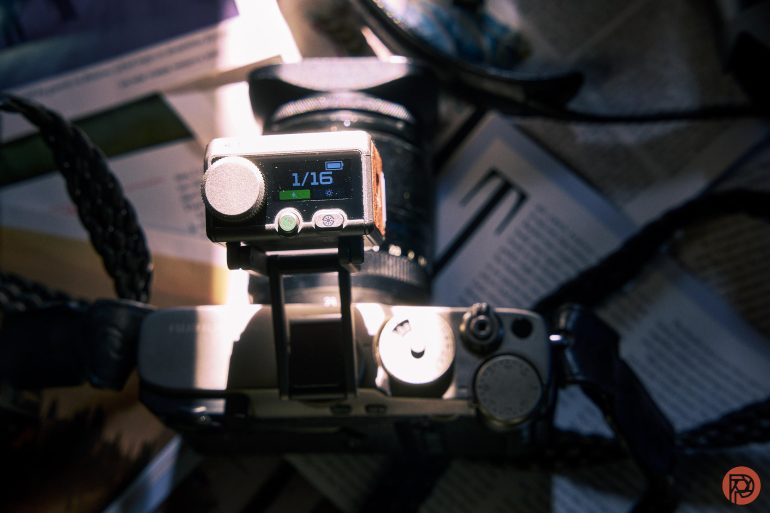
The back of the flash has a small LCD screen for controls. You turn it on by pressing and holding the flash button. Then to switch to the LED, you press that button on the right. To control it, you use the dial. The output is all manual, no TTL.
It’s so simple, effective, and wonderful. At this point, it’s obvious: but we should mention the good looks too.
There’s a lot going for the Harlowe Hybrid Pocket Flash — but this variant of it isn’t for me and I will probably never use it again. Why? The flash output is too weak for me and the LED output is also something that I don’t like using for good reasons. For starters when I used the LED output, everyone I used it on complained that looking at it was too bright. And I feel that — especially as a legally blind man.
Years ago, I remember going to a Seiko event and there was a photographer who, instead of using a flash and bouncing the light output off the ceiling or wall, would activate an LED each and every time on top of his camera and then shoot. It was annoying as hell and really bright. Constant lighting for events can be way more difficult on the eyes than a simple flash. Quite literally in my notes for this article, I wrote to myself, “It’s a dick move to use LEDs.”
And I agree with every word that that former version of myself wrote.
Additionally, I had a lot of flash firing problems with the Harlowe Hybrid Pocket Flash. Sometimes it would go off, sometimes it wouldn’t. I used it with the Leica SL2s, the Fujifilm XT3, the S1R II, and the Panasonic L10. It worked just fine on the XT3. And the only two cameras that it worked fine on otherwise were the Canon EOS R5 and the EOS R3. To me, it sounds nuts to use this little thing on such expensive cameras. What’s more, Canon’s EXIF data didn’t even register that the flash fired even though I know that it did.
Nothing is more frustrating than wanting to do street photography with a flash and your flash not firing off.


This could be a pre-production issue that may get fixed eventually. But as it is, the Harlowe Hybrid Pocket Flash is still a better LED than it is a flash. Still, it gets me excited for the company’s future and I hope that more powerful studio lights come from Harlowe with a radio transmission system and TTL.
Truly, I may never use this light again simply because of the sync issues and the weak flash output. If they make it more powerful, I’d be all in. And by that, I mean that I should be able to see the output even at ISO 50 or ISO 64. Typically, I try to never shoot above ISO 400. And if I’m at ISO 6400 and using a flash or an LED, I think that I’ve sometimes got a bigger problem than just lighting. Just stating the facts here.
I think that the Harlowe Hybrid Pocket Flash is worth buying mostly as an LED that sometimes functions as a flash. But otherwise, I really hope the company launches a real flash with LED output built in. Then, I want a studio light that will replace my Profoto B10 with TTL and all.
Get rid of the ads!
Did you enjoy reading this article as much as we enjoyed writing it? There's a way to support us and our reporting, getting ad-free navigation and more as a bonus. Subscribe to us for less than a coffee per month —just $3.99— or take advantage of our yearly subscription with a hefty discount for only $25.- An ad-free experience
- A free mystery box for Lightroom or Capture One
- All the books in our store
- 20% discount on Capture One
- 30% discount on Imalume Photo Theft Protection
- 20% off Herbs and Kettle Tea Company.
- 20% off your order from MPIX printing services.
- 5% off Viltrox Products via their eCommerce store.
- 10% off all film developing, printing and scanning services from Blue Moon Camera and Machine
- 15% off 7Artisans products: The lens and accessory maker is offering a sweet discount for Phoblographer's readers.