


Third party lens manufacturing has improved immensely over the years. While people were relying on brands such as Zeiss to provide good options, Japanese manufacturers have pushed the envelope a bit more. One such example is Sigma, who has introduced cost-effective alternatives to Canon, Sony, and Nikon users. It now appears, the company may have some plans up their sleeves for a unique lens. Have a look.
According to a report by Asobinet, how2fly, a leaker with a track record of accurate Sigma prediction, spoke about a new lens on X. Per his report, Sigma is working on a fast lens.
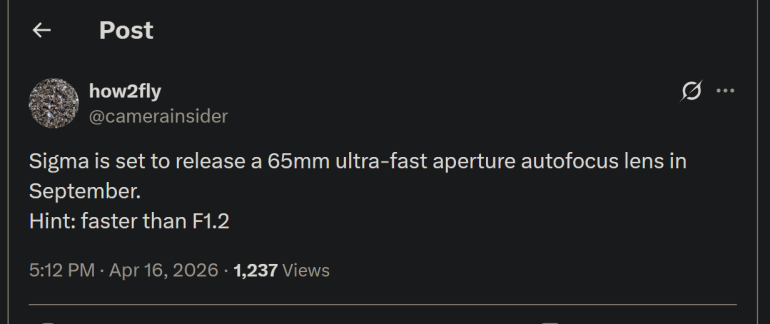
The lens is slated to launch this year, and if true, it will be one of the fastest primes made for a mirrorless system. Sigma already has a 65mm f2 lens, which was released in 2020, as part of their premium lens series. The focal range was odd, offering a bit more than the standard 50mm and a bit less than 75mm. Either way, it is a versatile option for photographers who want something new.
While the lens already offers f2, which is a pretty bright aperture, a f1.2 will certainly be a challenge. One of the challenges will be the lens’ weight and size. A f1.2 is a big aperture that results in a larger front element. The current Sigma f2 option has 12 elements in 9 groups; a f1.2 will likely increase those elements, and perhaps, even its price.
By all means, you can say that the Sigma 65mm f2 is a fantastic and nearly perfect lens. And we’d almost agree with you. This is a lens that’s targeted at anyone and everyone. It’s built off the idea that cinematographers use the 65mm focal length a lot. So the image quality should be very cinematic. But Sigma decided to instead make it very sterile. It’s clinically sharp. And yes, you can add all of the other stuff in post-production.
Chris Gampat, on Sigma 65mm f2 lens review
In fact, a lens like this is likely to compete with the Canon 50mm f1.2L, as well as Nikon’s 58mm f0.95, and Leica Noctilux 50mm f0.95. Each of these lenses are expensive, costing thousands of dollars, and certainly not created for enthusiasts. In that regard, if Sigma is able to introduce something brighter, it can help photographers with better low-light capabilities.
However, if they do, Sigma should not look at sterile images. Instead, make the 65mm a cinematic piece with features such as nice lens flare. If every lens is looking to replicate Sony, then what is the point of having something similar, at a lower price?
While the Sigma 65mm might be possible for f1.2, it does not with its fair share of challenges as well. And the increase in price. We must have to wait a bit before specs or images. And now that Sigma is officially working with Canon (albeit with APS-C cameras), they have a better chance of getting more photographers on board. What’s more, this is more of a focal length that’s valued by cinemtographers.
Conversely, Sigma can introduce a different focal range all together. For now, we simply have to wait and see how it pans out. If Chinese lenses manage to launch something before Sigma, then the demand may dwindle. But knowing how Sigma has been trying to offerings something different, they may just win users’ hearts again.
Get rid of the ads!
Did you enjoy reading this article as much as we enjoyed writing it? There's a way to support us and our reporting, getting ad-free navigation and more as a bonus. Subscribe to us for less than a coffee per month —just $3.99— or take advantage of our yearly subscription with a hefty discount for only $25.- An ad-free experience
- A free mystery box for Lightroom or Capture One
- All the books in our store
- 20% discount on Capture One
- 30% discount on Imalume Photo Theft Protection
- 20% off Herbs and Kettle Tea Company.
- 20% off your order from MPIX printing services.
- 5% off Viltrox Products via their eCommerce store.
- 10% off all film developing, printing and scanning services from Blue Moon Camera and Machine
- 15% off 7Artisans products: The lens and accessory maker is offering a sweet discount for Phoblographer's readers.