

Kodak has been one of the few companies that was ahead of its time. They introduced some truly iconic films, but also cameras that were ideal for professionals and amateurs. While there are many options to choose from today, a camera that truly was ahead of its time was the Kodak Advantix Preview. Launched in 2000, it was a camera that was a bridge between film and digital.
The camera understood where photography was headed, and that is one of the reasons why the device is ahead of its time even today. With digital cameras becoming popular in 2000, Eastman Kodak hoped to create a device that balanced both worlds. While today this has been possible with certain retro mirrorless cameras, what Kodak did was quite unique.
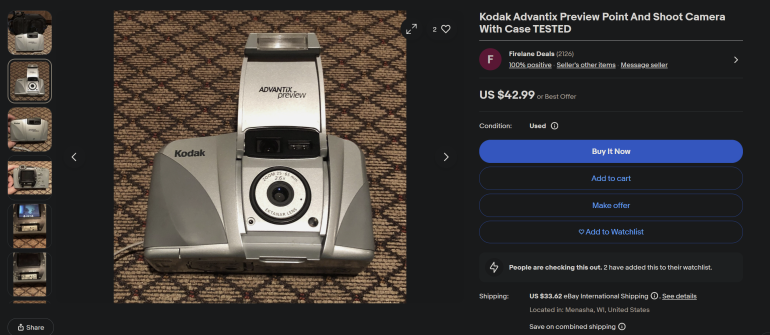
The Advantix Preview had an autofocus zoom viewfinder but also an LCD screen that allowed you to review your last image. If you did not like the shot, you can let it go. But if you did, you could request up to 9 prints. The image on the LCD was shown through the viewfinder that had a silvered mirror. This engineering details make the camera strange but also fascinating. This proves that the camera was not digital, but rather a film device using a secondary electronic imaging system purely for the purpose of seeing what one was documenting.
Here is a look at its spec per camera wiki:
- Film Format: APS
- Lens: 25-65mm Ektanar lens
- Focus system: Passive, multi-spot Auto Focus
- Recommended Focal Range : 2 feet to infinity
- Exposure: Automatic, programmed
- Shutter: 1/2-1/400
- Aperture: f4.3-10
- Automatic ISO Coding: 50-800 ISO
- Motordrive: Yes
- Built in Flash: Yes
- Power: 2xCR123A
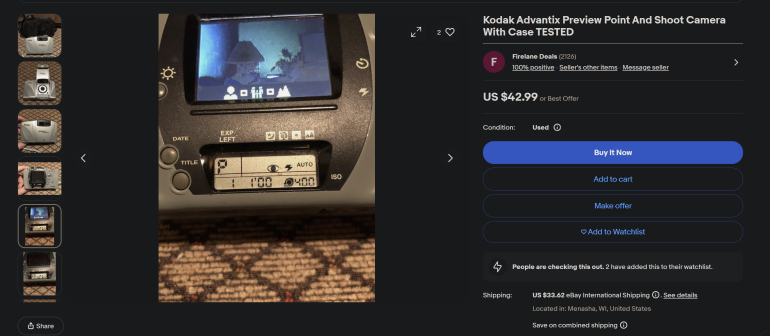
Interestingly, the preview could only store one photo at a time, and it could not be transferred easily. This was one of its biggest pitfalls, and that can be challenging for any user. Moreover, you could see only the last time you had shot and not any of them that were captured before it. The print ordering system was built-in the LCD, where a special screen later allowed one to add titles to images and number of prints. There was also an illuminated indicator providing information on the number of photos remaining and camera status.
One of the reasons behind this was that ordering prints at the point of shooting would save money as one gets reprints at the first-time printing rate. And if you didn’t like the photo, you don’t have to print it. While this helped to increase sales, the major issue was that film photography’s future was dwindling. In a time when digital cameras were showcasing all the images, and were about $100 to $150 dollar costlier, one could often choose digital over film.
Had the camera arrived a decade or two earlier, then the chances of its surviving would have been better. What one can do is certainly applaud its ability to think about the future and give the photographers some agency. Kodak’s idea was right, but the timing was one of the things that got in the way.
Get rid of the ads!
Did you enjoy reading this article as much as we enjoyed writing it? There's a way to support us and our reporting, getting ad-free navigation and more as a bonus. Subscribe to us for less than a coffee per month —just $3.99— or take advantage of our yearly subscription with a hefty discount for only $25.- An ad-free experience
- A free mystery box for Lightroom or Capture One
- All the books in our store
- 20% discount on Capture One
- 30% discount on Imalume Photo Theft Protection
- 20% off Herbs and Kettle Tea Company.
- 20% off your order from MPIX printing services.
- 5% off Viltrox Products via their eCommerce store.
- 10% off all film developing, printing and scanning services from Blue Moon Camera and Machine