


Last Updated on 01/30/2025 by Lara Carretero
The wilderness offers us exceptionally unique flora and fauna, which many of us cannot appreciate. However, a handful of photographers take a chance and capture nature in its brilliant hues and colors. To honor them, the Close-up Photographer of the Year announces its sixth edition winners, many of whom have documented nature’s complex and delicate elements. The photographs are truly otherworldly and continue to prove why we must cherish and conserve the wild before it’s too late.
The lead image is by Imre Potyó, courtesy of Close-up Photographer of the Year. All pictures are used with permission.
This year, the contest attracted over 11,000 entries from 61 countries, and after over 20 hours on Zoom calls, the 25 jurists revealed the winners. The contest has eleven categories, with the top three winners in each. The overall title winner will receive 2,500 pounds and a universal license for the Affinity app, where the winners of the Young CUPOTY will be awarded a Sigma 105mm f2.8 DG DN MACRO | Art lens, alongside a universal license for the Affinity app. Winners of each category will receive 250 pounds, an Affinity license, a FRAMES subscription, and Retouch4me Dust, Color Match, and Portrait Volumes plug-ins. Without further ado, here are the winners:
Table of Contents
Close-up Photographer of the Year
Svetlana Ivanenko | Clash of the Titans
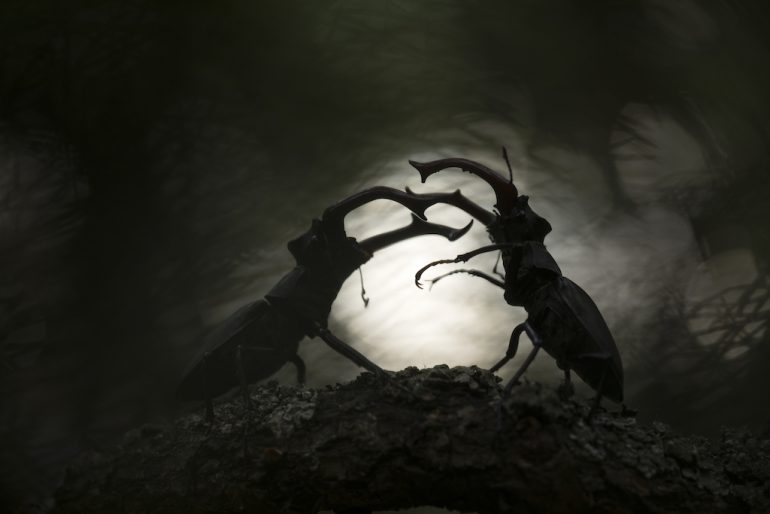
“For a brief period in the summer, stag beetles (Lucanus cervus) engage in fierce battles for mating rights. These elusive creatures inhabit oak forests, making them hard to find. Witnessing this beautiful event makes me want to share it with everyone.” said Svetlana. The image also won the Insects category.
Technical information: Canon 5D M4, Canon 100 mm, f4.5, 1/160 sec, ISO 400.
Young Close-up Photographer of the Year
Andrés Luis Dominguez Blanco | Spring (14 year old)
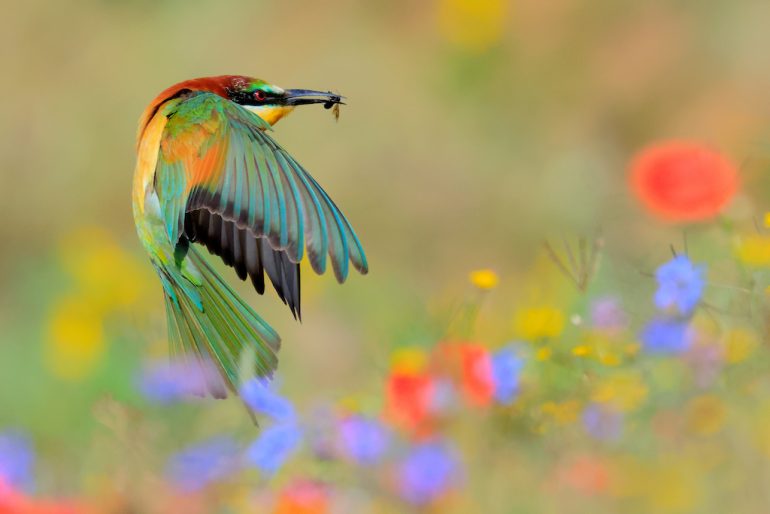
“I captured this image in late spring in southern Spain. Having previously observed bee-eaters with binoculars, I knew exactly where they would fly after hunting insects. This allowed me to strategically place a hide so that I could get a low point of view to blur the foreground and background flowers in the picture. I spent several weekend mornings in the hide, watching each bird catch 15-20 insects per hour, which provided ample opportunities for me to capture some attractive images. Using a high shutter speed, I was able to freeze the bird in flight, clearly showing the insect in its beak,” says Andrés. The image also won the Under 18 category.
Technical information: Canon EOS R7, RF 100-500mm F4.5-7.1L IS USM, f8, 1/6400 sec, ISO 2500, and Tripod and hide.
Insects
2nd place: Imre Potyó | Mayfly Arena
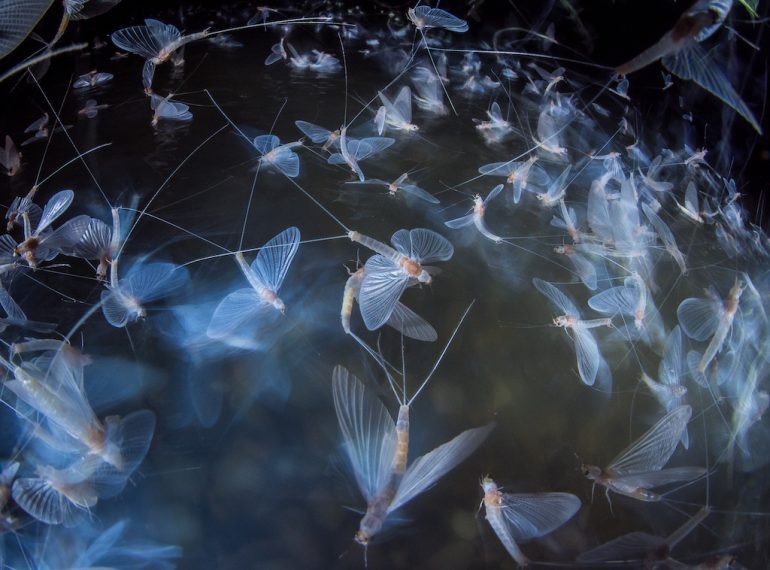
After decades of absence, the spectacular and endangered Danube mayfly (Ephoron Virgo) returned to the River Danube in 2012, likely due to improving water quality. This species had vanished from Middle European rivers for decades owing to pollution.
For the past 12 years, the photographer has spent up to 25 nights each summer photographing the mayflies as they swarm on quiet nights. These insects have a fleeting lifespan of just a few hours, and their swarming behavior is unpredictable. At some point, they will emerge after sunset and begin their dance just above the water’s surface.
Using a fisheye lens and a combination of continuous light and flash, the photographer captured the mesmerizing sight of female and male mayflies chasing each other in an endless mass. These images are incredibly precious to the photographer, as they help raise awareness of these spectacular and endangered water insects.
Technical information: Nikon D7200, Nikon 10.5mm fisheye lens, f22, 1/8 sec, ISO 640, flash, flashlight, and Adobe Lightroom.
3rd place: Avilash Ghosh | My Own Galaxy
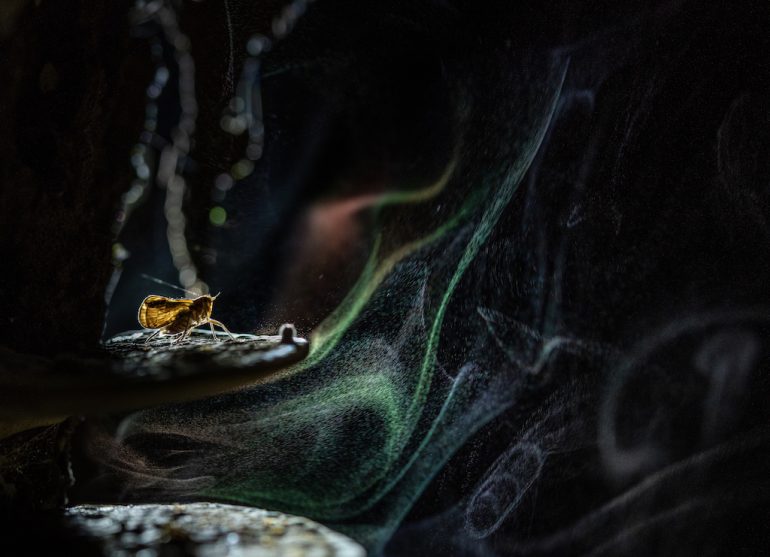
During a night walk at Bhagwan Mahavir Wildlife Sanctuary in Goa, India, Avilash found this bracket fungus. It was producing clouds of spores, which drew me over. As he approached, a leaf hopper landed on the fungus. Using an LED torch allowed him to backlight the scene and capture the swirls of spores around the fungus and insect.
Technical information: Nikon D850, Tamron 90mm macro, f8, 1/250 sec, ISO 1000, LED torch light, and basic processing in Adobe Photoshop.
Animals
Winner: Santiago J. Monroy García | God in the Shadows
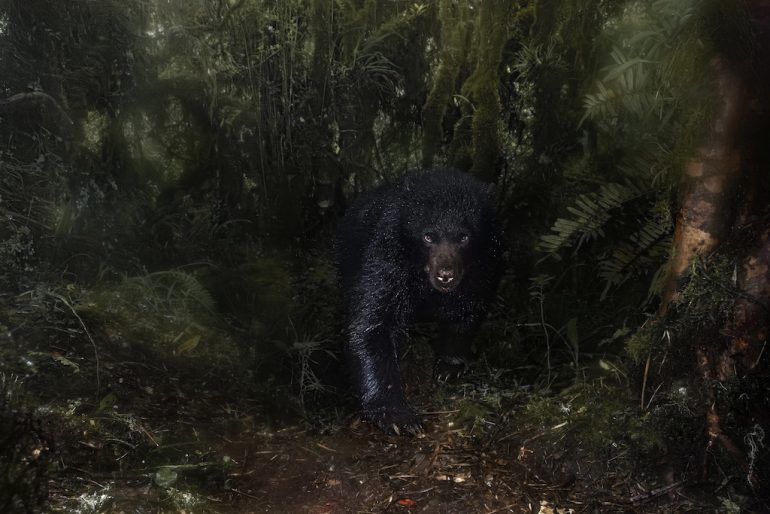
The highland rainforests of the Andes are among the densest, coldest, and most humid forests on the planet. They are home to the only bear species native to South America: the Andean Bear. This particular individual, known as Nariz de Calavera (Skull Nose), is one of the largest bears living near Bogotá, Colombia, at the Ecopalacio Nature Reserve, about 30km east of the city.
Santiago wanted to capture the bear behaving naturally in its environment, seeking an intimate picture that showcased the unique ecosystem as though it were part of a dream. Using a camera trap, he could record the local wildlife without causing any disturbance.
After several unsuccessful attempts, extensive research on the species, consultation with experts, and a great deal of patience, in 2023, I finally captured the image Santiago had envisioned. Fortuitously, the rain splashed the lens in just the right spots, creating brushstrokes and textures that immerse the viewer in the humidity and cold of the highland Andean forests of Colombia. No bait was used to make this image.
Technical information: Nikon D7200, Nikkor 18-55mm f3.5-5.6, 800 ISO, f11, 1/80sec, camtraptions system, two flashes, and one motion sensor.
2nd place: Imre Potyó | Moonlight
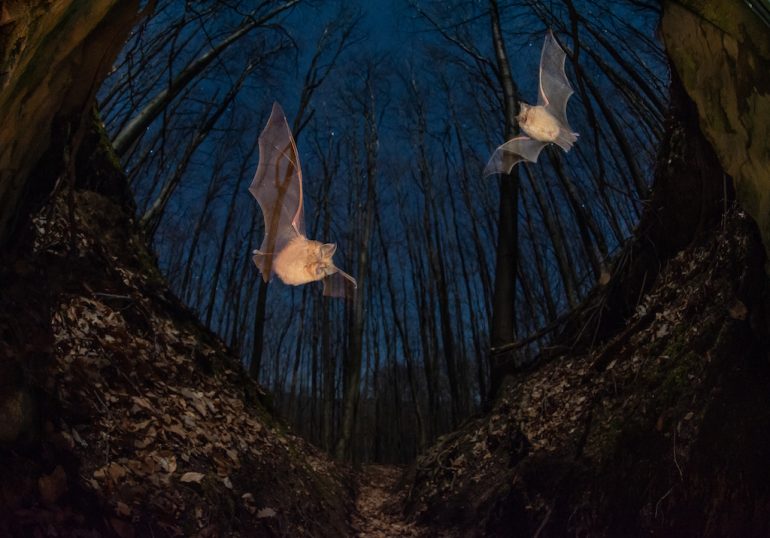
In the freezing cold of winter, the 10°C environment inside an abandoned iron ore mine attracts lesser horseshoe bats. Researchers have noted that, unlike other bats, these insect-eating species hunt even during winter, often flying out from the mines to feed in the forest on winter-flying moths. It’s remarkable to see bats taking flight among the bare trees of the Börzsöny mountains.
Imre experimented with setting up a camera trap near the mine’s entrance for weeks. On a moonlit night, a long exposure helped illuminate the forest, capturing the bats’ winter flights without any disturbance or artificial guidance, strictly adhering to ethical photography guidelines. Witnessing their flight and feeling the air currents from their wings is truly magical. The picture shows two separate individual bats in a single exposure, revealing the hidden nocturnal wonders of a wintry forest in the moonlight. That’s why it came second in the Close-up Photographer of the Year awards.
Technical information: Nikon D7200, Nikon 10.5mm fisheye, f10, 30 sec, ISO 1250, flash, camera trap, and Adobe Lightroom.
3rd place: Csaba Daróczi | Pine Marten Portrait
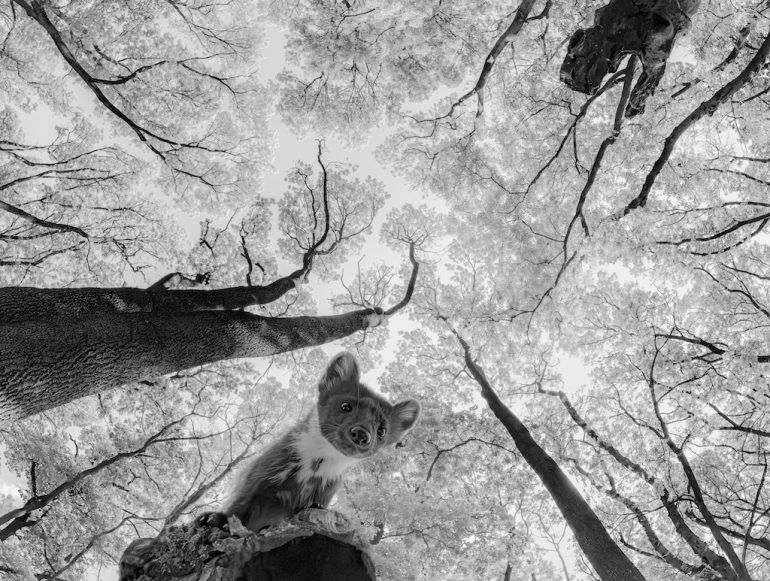
After setting up camera traps to monitor forest wildlife over an extended period, Csaba discovered a daily winter visitor—a pine marten. Capitalizing on this routine, he positioned his GoPro camera under the tree, configuring it to trigger with motion detection. After numerous experiments and adjustments, Csaba finally captured a photograph of the elusive pine marten.
Technical information: GoPro 11, 2.71mm f/2.5, 1/1700s, ISO 793, Tripod, Adobe Lightroom.
Butterflies & Dragonflies
Winner: Yong Miao | Damselfly by the Waterfall
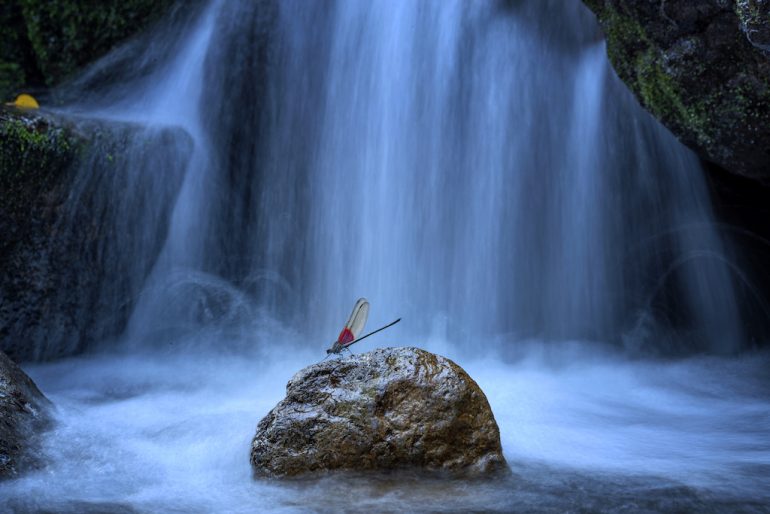
Tianmushan Nature Reserve in China is immersed in a hot and romantic atmosphere in July. This is the fourth consecutive year that Yong has stepped into this primeval forest, tracing the footsteps of that murmuring stream. Just as the sky was about to darken, he was still exploring the stream’s upper reaches when, at the bottom of a turbulent bend, he discovered a damselfly (Archineura incarnata) resting on a rock. Its head was lowered to the water’s surface as if appreciating its own reflection. At that moment, time seemed to stand still. Any slight disturbance would make it fly away, so Yong immersed his body in the water and cautiously crawled toward it. From a distance of about two meters, he firmly set his camera and captured this precious scene.
Technical information: Canon EOS-1D X Mark II, EF80mm f3.5L Macro USM, f16, 0.6 sec, ISO 50, handheld.
2nd place: Ferenc Kocsis | Sphere
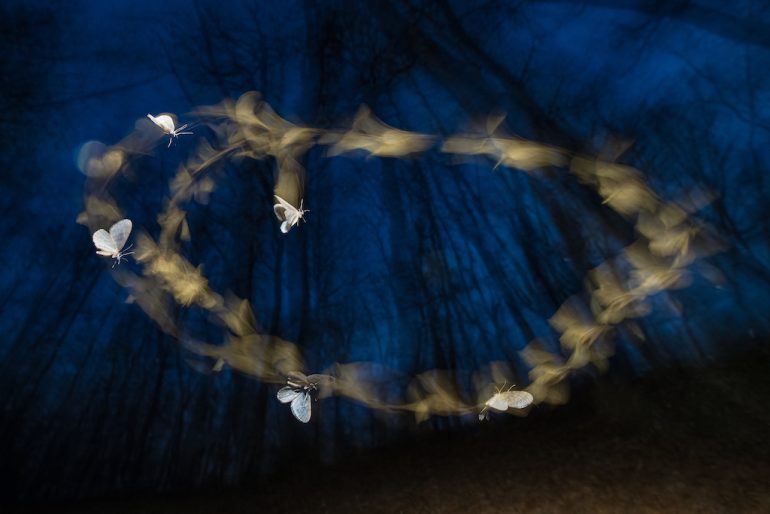
Winter moths are active throughout the winter months. After sunset, females climb tree trunks to release pheromones, attracting males that flutter around in search of them. This nocturnal dance is invisible to us unless we shine a light on it. When the light is cast, the forest transforms into a fairy tale, with hundreds of pale grey moths slowly flitting about.
This image was captured using a stroboscopic flash. It shows a single winter moth frozen in five positions as it flew along its circular path, with the small light from Ferenc’s headlamp tracing its movement. That’s why it came second in the Close-up Photographer of the Year awards.
Technical information: Nikon Z8, Laowa 15mm f4 Wide Angle Macro, f8, 2 secs, ISO 1600, YN560IV speedlite, headlamp, Lightroom and Photoshop for normal modifications.
3rd place: Imre Potyó | December Moth
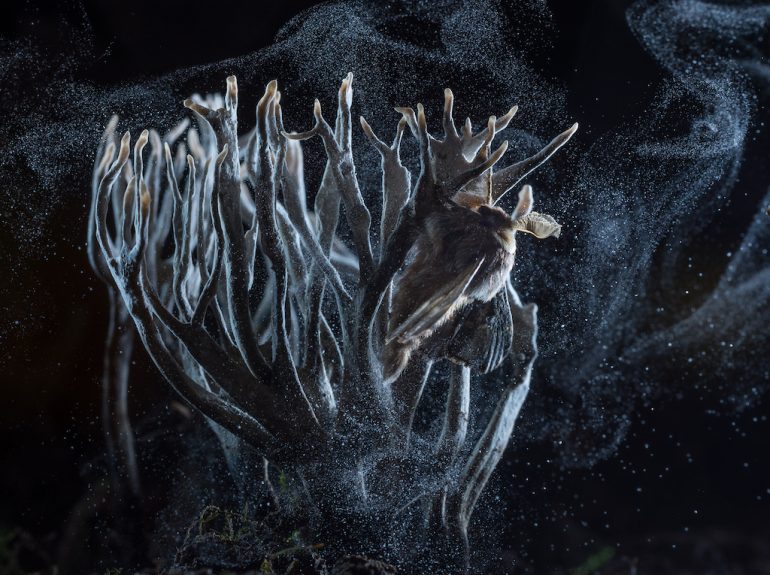
On a cold winter’s evening, Imre was photographing a striking 5cm tall Candlesnuff fungus (Xylaria hypoxylon) using backlit flash to capture the movement of the spores. Suddenly, a December moth (Poecilocampa populi) fluttered around him in the near-freezing darkness. Freshly awakened, it landed near his equipment and then onto the fungus. With his flash lighting up the scene, the moth walked and flapped its wings on the fungus, causing more spores to swirl in the air.
These are unforgettable and tense moments for Imre. He believes that their photographs can raise awareness of these natural wonders.
Technical information: Nikon D7200, Tamron 60mm macro lens, f22, 1/160 sec, ISO 100, Flash Lightroom for post-processing.
Arachnids
Winner: Pierluigi Rizzo | Queen of Hearts
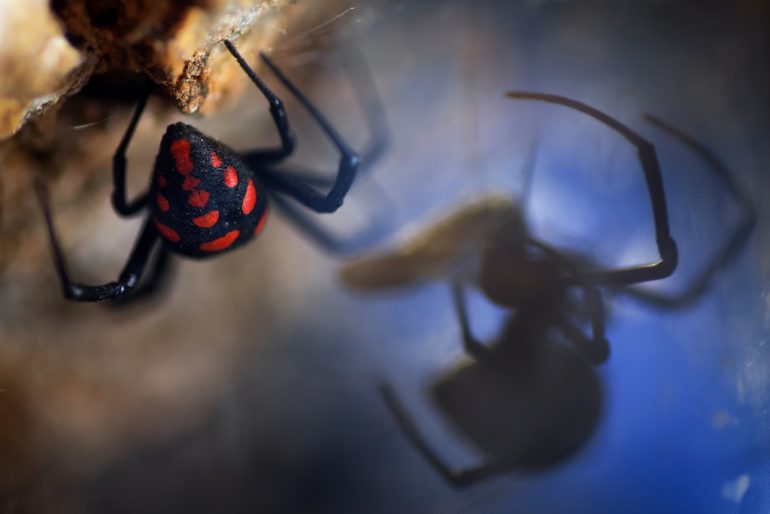
The photo portrays a female Mediterranean black widow intent on eating its prey. It results from overlapping two photos, taken and designed for this purpose. Pierluigi shot the spider’s abdomen in the first photo to emphasize its characteristic red spots. In the second photo, he aimed to capture the moment of feeding, so he placed a flash with a blue gel behind the spider to obtain its silhouette. The two photos were merged in-camera.
Technical information: Nikon D7200, Tamron SP 90mm f2.8 macro lens, f9, 1/200 sec, ISO 400, Meike MK-MT24II 2.4G Wireless Macro Close-up Twin Lite Flash.
2nd place: Avilash Ghosh | Fire Stream Scorpio
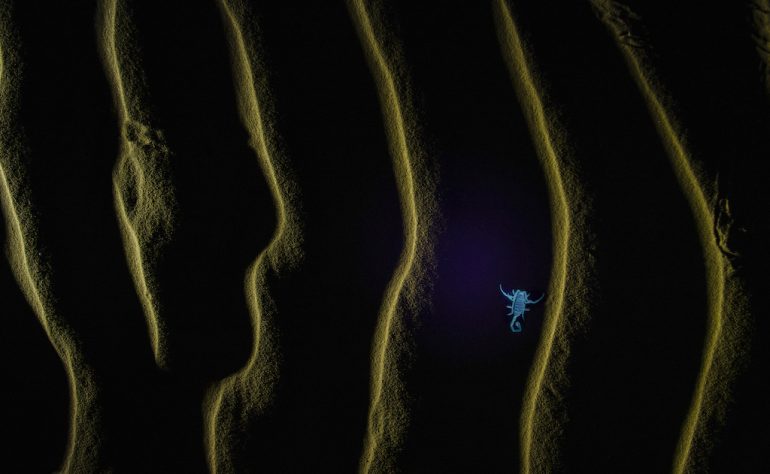
Avilash searched for scorpions at night in the Thar Desert of Rajasthan, India. After spotting one, he cautiously approached it to avoid disturbing it. Once close enough, he lit up the ripples in the sand with an LED torch and made the scorpion glow blue with a faint UV light.
Technical information: Nikon D850, Nikon 20mm 1.8, ISO 320, f4, 1/160 sec, LED Torchlight, and UV light.
3rd place: Artur Tomaszek | Crazy in Love
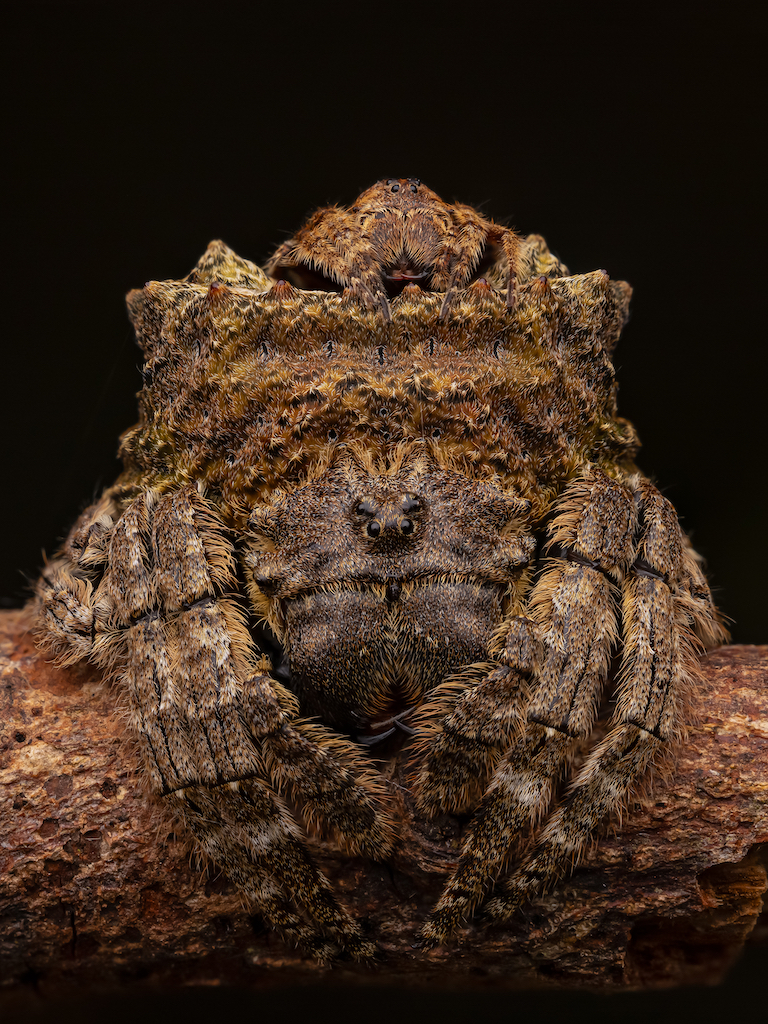
Artur was very lucky to encounter a stunning female Broad-Headed bark spider (Caerostris sumatrana) with a tiny male perched on her abdomen in Thailand. Initially, he didn’t notice the male at all.
Caerostris spp. spend the day on a tree’s bark and descend to their webs, which they recreate every night when it gets dark. Their camouflage is brilliant, so to photograph this species on the tree, one must first find them on their web at night, then return during the day and thoroughly search nearby tree branches.
Their love life is rather fascinating, and that’s what this image is really about. Males can piggyback subadult females for some time, ready to mate with the female as soon as she molts to maturity.
Technical information: Canon EOS R5, LAOWA 100mm f2.8 CA-Dreamer Macro 2X, f11, 1/200 sec, ISO 320, Light diffuser, and stacked using seven photos.
Invertebrate Portrait
Winner: Aran Gibbs | Bark is Worse than Its Bite
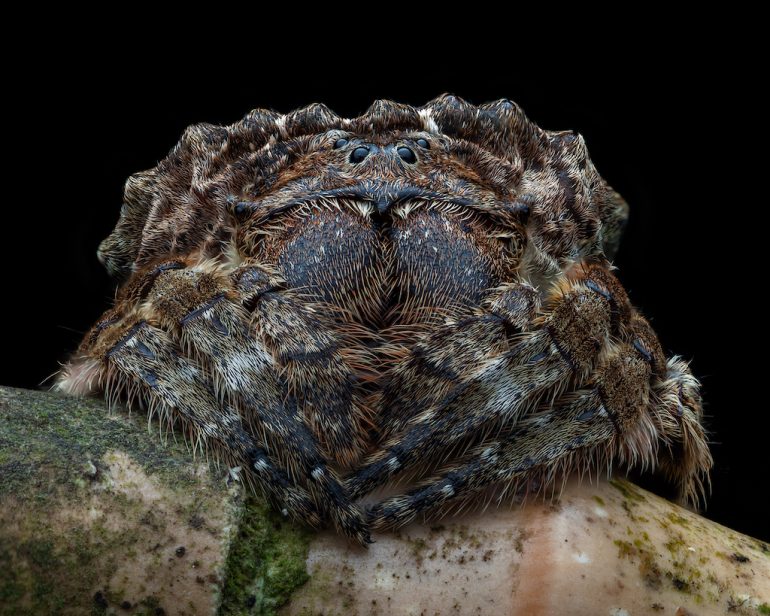
During a recent trip to Malaysia, Aran discovered an amazing bark spider after a long night trek up a mountain in the jungle. He captured this shot at the summit using a 50-image handheld focus bracket set. The spider rested on a stick while Aran steadied his camera on his backpack for additional stability. That’s why it won the Close-up Photographer of the Year award.
Technical information: OM-D E-M1 Mark II, M. Zuiko 90mm f3.5 Macro, f5.6, 3.5 sec, ISO 250, Godox V860III-O Flash with a Cygnustech Diffuser and backpack for stability. 50 raw files stacked in Helicon Focus.
2nd place: José Manuel Lois Rial | Stauropus Fagi
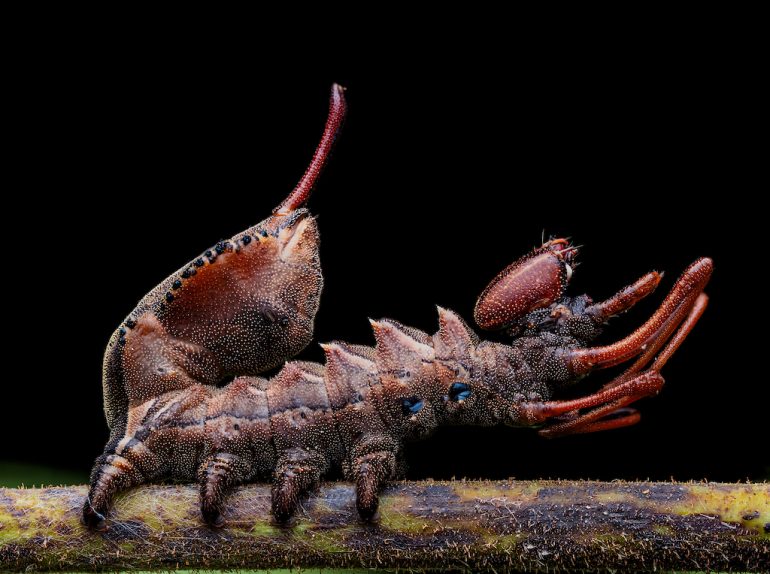
On a night-time excursion in his garden in Spain, José Manuel was searching for spiders when he encountered a Lobster moth caterpillar on a branch. It seemed very calm, which allowed him to take several hand-held shots. He was particularly struck by its incredible shape.
Technical information: Olympus EM1 Mark ii, Zuiko 60 mm Macro, ISO 200, f5.6, 1/50 sec, Flash Godox V860 ii, Cygnustech diffuser, hand-held focus bracketing, Lightroom and Helicon Focus for exposure, highlights, shadows, whites, blacks, saturation, and sharpening.
3rd place: Manfred Auer | Lynx Spider
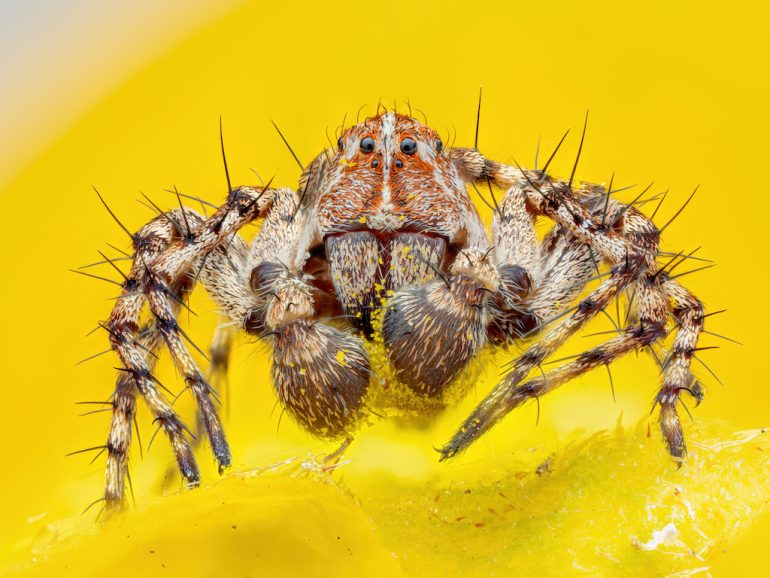
Manfred was strolling through the flower meadow of his backyard in Austria, checking for insects and spiders as usual, when this magnificent little critter caught his eye. He immediately ran to the house to get his camera. Luckily, he was fast enough and managed to capture a few stacks of it before it disappeared. He really loves its mandibles, which look like tiny boxing gloves.
Technical information: OMD EM1 MkIII, OM System 90 mm f3.5 Macro IS ED Pro, ISO 200, f8, 1/50 sec, Cygnustech Diffuser, Godox V860III, Lightroom, Photoshop, Helicon Focus, Topaz DeNoise AI.
Underwater
Winner: Gabriel Jensen | Everything’s A-OK
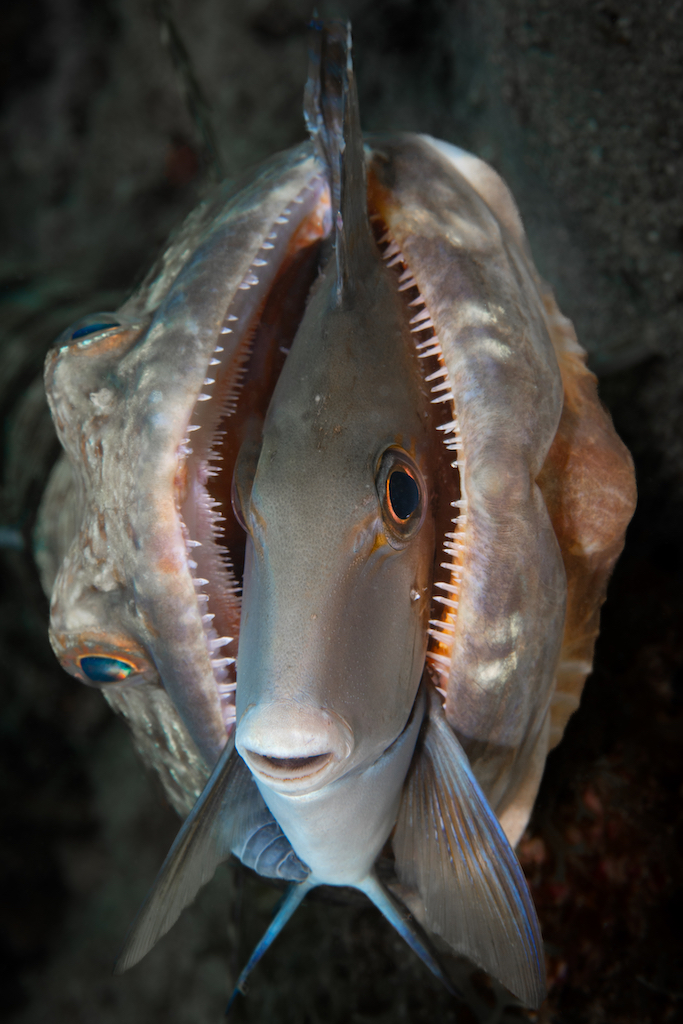
Summer brings calm seas to South Florida, where a dedicated community of shore diving photographers heads out nearly every day to survey the world’s third-largest coral reef for interesting wildlife. One morning, Gabriel was signaled over by his friends, Dewalt and Evelyn, who had spotted a lizardfish (Synodus foetens) grappling with a challengingly large doctorfish, its eyes seemingly larger than its mouth.
The comically calm doctorfish (Acanthurus chirurgus) steals the limelight, displaying a remarkable defense mechanism with splayed pectoral and dorsal spines. After a few minutes of struggle, the doctorfish managed to escape. This image now sits on Gabriel’s desk at work, serving as a reminder that even on tough days, “Everything’s going to be A-OK.”
Technical information: Sony A7R IV, Sony 90mm Macro, f13, 1/80 sec, ISO 200, Nauticam Underwater Housing, Dual Backscatter MF-2 Strobes. The image was edited in Adobe Lightroom. It was rotated 90 degrees to emphasize the doctorfish, and light dodge/burn was used to recreate the focus of being underwater and witnessing the struggle firsthand.
2nd place: Jenny Stock | Search for the Dragon
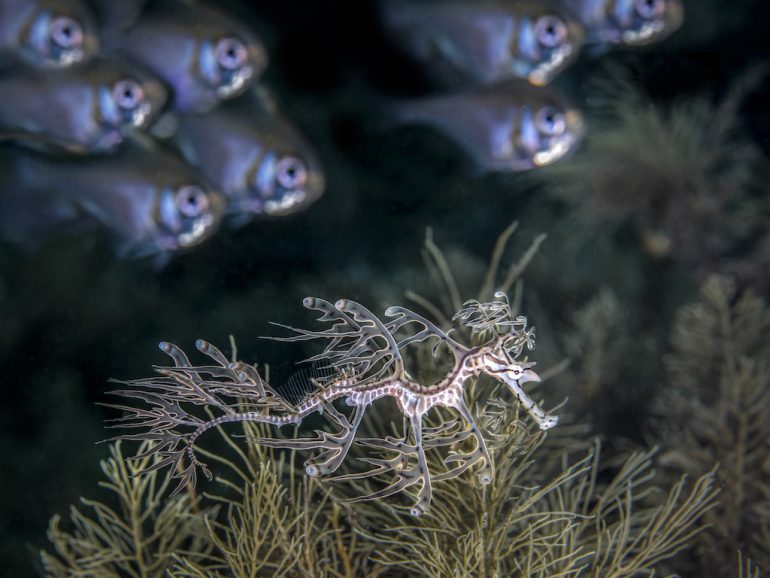
After descending the steps of Rapid Bay Jetty, South Australia, into the 18ºC water, Jenny found this baby leafy sea dragon at a depth of 15 meters, next to a small school of Rough Bullseye fish. Although the fish appeared incredibly interested in the subject, sea dragons have few predators. Their combination of excellent camouflage, tough jointed plates, and sharp dorsal spines offers adequate protection. Their main threat is habitat destruction, being caught by collectors, or being destroyed for use in the traditional medicine market—an unfounded use.
This baby leafy sea dragon was only eight centimeters long. Jenny set the camera as low to the seabed as possible and used two underwater flashguns to highlight the animal’s reflective parts, making it ‘pop’ in the image.
Technical information: Canon 5D Mark IV, Canon 100mm f2.8 Macro Lens, f10, 1/200 sec, ISO 320, Two Inon Strobes. Post-processed in Lightroom and Photoshop to enhance a black background and bring in the rough bullseye fish.
3rd place: Saeed Rashid | A Caring Mother
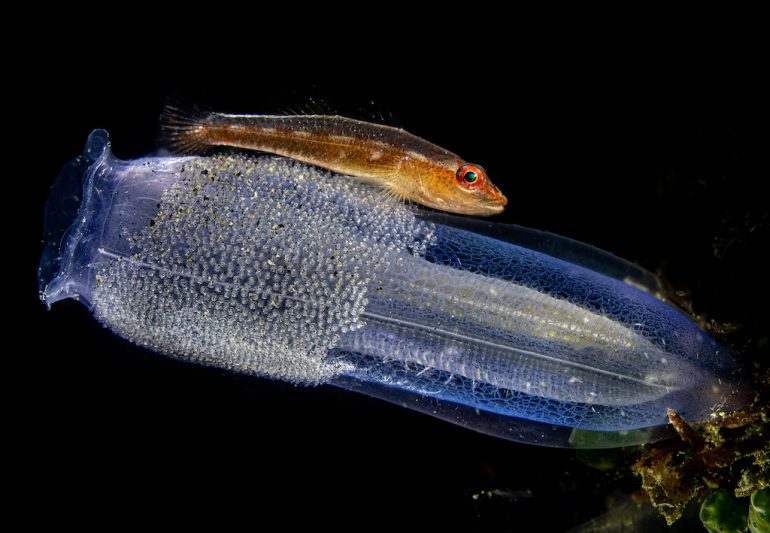
In July 2023, Saeed had the rare privilege of finding a reef goby in Lembeh Strait, Indonesia, with its eggs in a remarkably photogenic position on a blue tunicate. He used backlighting to illuminate the blue tunicate and goby eggs to highlight the scene.
Technical information: Canon 7D Mark II, Canon 60mm f2.8 macro lens, f8, 1/250 sec, ISO 200, and Anon Z240 strobes.
Intimate Landscape
Winner: Jean-Philippe Delobelle | A Network of Life and Death
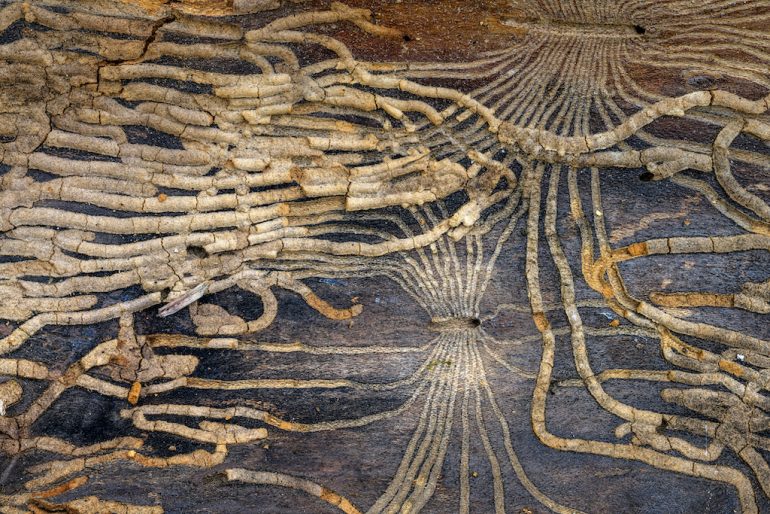
At the base of a dead spruce tree, Jean-Philippe captured this intricate network of tunnels carved by bark beetle larvae (Ips typographus). Emanating from the egg-laying site of the female, the tunnels widen as the larvae grow—a symbol of life for the larvae and death for the tree. This is why the image won in the Close-up Photographer of the Year awards.
Technical information: Nikon Z7 II, Tamron 90 mm macro, f/9, 1/30 sec, ISO 64, Tripod, natural light.
2nd place: Andrew Mielzynski | Fall Matrix
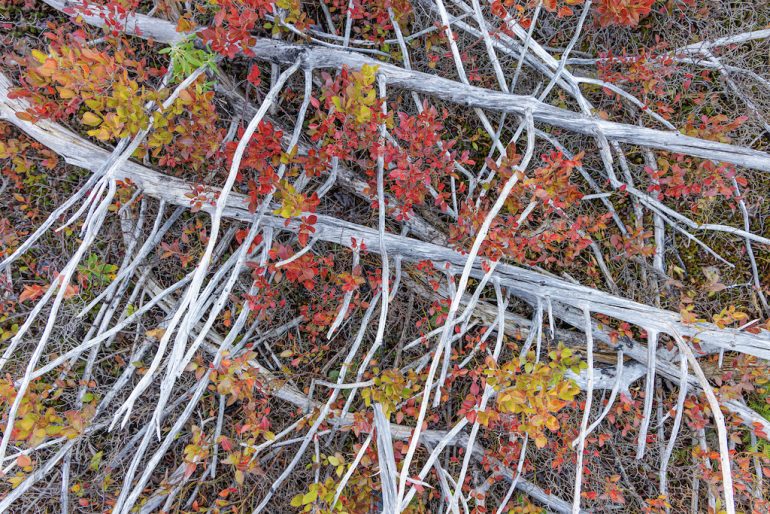
The Jackpine-Crowberry Barrens, a type of pine barren found almost exclusively along the Atlantic coast of Nova Scotia, Canada, fell victim to the ‘Spryfield Fire’ in 2009. The blaze left many Jack Pines burned, their skeletons standing amidst low-growing Broom Crowberry and huckleberry plants. It is the huckleberry plants that burst into a fiery red come autumn. On a mission to capture these stark skeletons framed by lush, colorful huckleberry leaves, Andrew and three photographic friends ventured into the Barrens.
Upon entering, a pile of dead Jack Pine branches atop a patch of huckleberry plants caught Andrew’s eye. He took a couple of handheld shots, composing the bleached branches diagonally across the frame, believing this would create a pleasing composition. The monochromatic tone of the dead wood against the vibrant fall huckleberry leaves captivated him. This image became his favorite of the day, serving as a valuable reminder to keep his eyes open even en route to a location, and not to fixate on preconceived ideas, goals, or images.
Technical information: Canon EOS R5, Canon R24-105mm (at 26mm), f9, 1/25 sec, ISO 800.
3rd place: Sigfrido Zimmermann | Among Giants
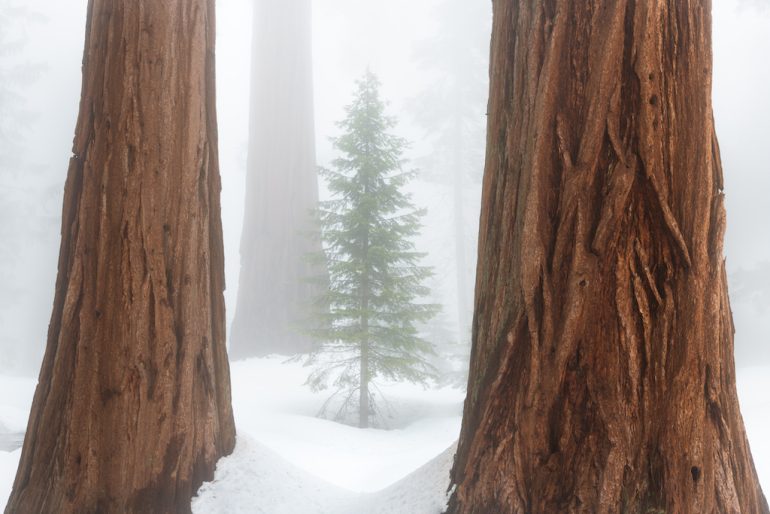
A walk through a montane forest with giant sequoias is a feast for the senses. Thriving at elevations of 4,500 to 7,500 feet along the western slope of the Sierra Nevada, these titans are resistant to fire, can live up to 3,400 years, and are the largest trees in the world.
Having visited Sequoia National Park for many years, this trip marked Sigfrido’s first encounter with giant sequoias in the snow and fog. The familiar scenes, transformed by the weather conditions, sparked his creativity, and he saw possible compositions everywhere he went. He revisited this particular grove, and the white fir tree had grown significantly!
Technical information: Nikon D850, Nikon 16-35mm, f/8, 1/13 sec, ISO 64, Tripod.
Fungi & Slime Moulds
Winner: Barry Webb | Ear-Pick Fungus
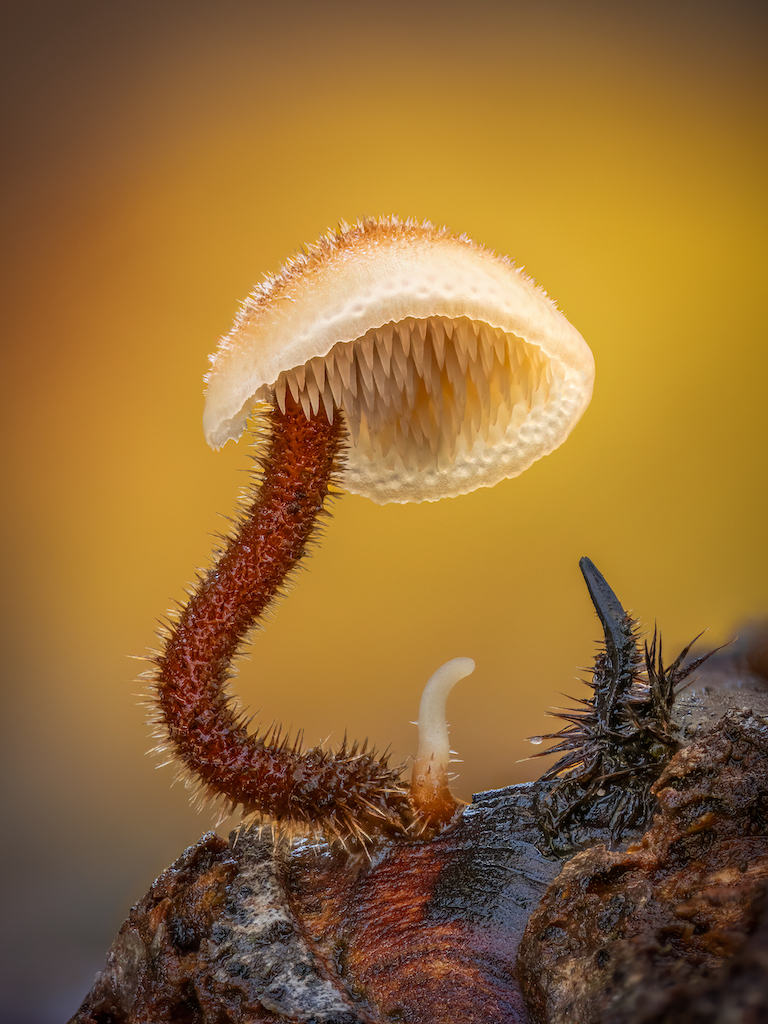
Barry had seen ear-pick fungus several times before, but this was the first one he found himself. Auriscalpium vulgare grows on pine cones and has an eccentric stem attached to one side of the cap, with unusual and distinctive downward-pointing, teeth-like gills. This specimen was particularly small, at around 15 mm tall. He placed a leaf carefully behind the pine cone to create a complementary background and fired off 74 focus-bracketed shots to obtain sufficient field depth and keep the background nicely diffused.
Technical information: OM1, M.Zuiko 90 mm f3.5 Macro IS PRO, f4, 1/60 sec, ISO 640, Gitzo tripod, remote cable release, stacked in Zerene Stacker, Topaz Denoise.
2nd place: José Luis Gigirey González | Autumn Storm of Spores
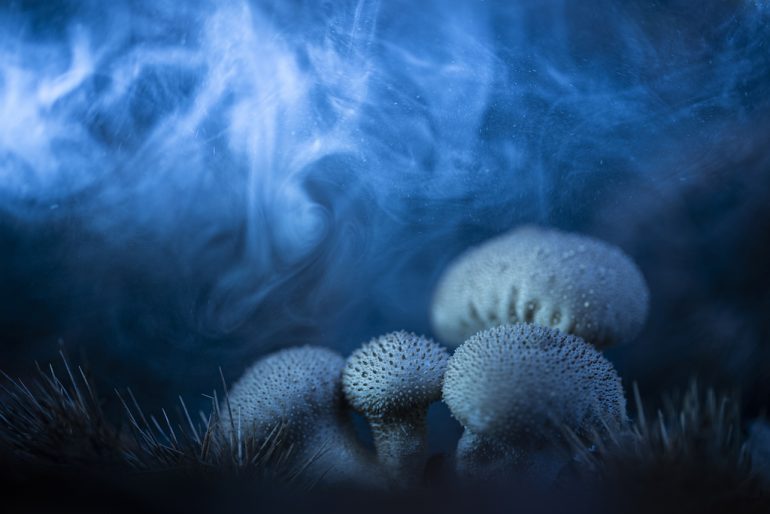
In late November, José ventured into a chestnut forest in Covas, Spain, where he found some puffball (Lycoperdon perlatum) mushrooms. As he watched the mushrooms, he saw an explosion of spores that created a magical atmosphere in the forest. Using a flashlight and two flashes, he captured the swirling spores, and by adjusting the white balance, he could render the atmosphere he experienced.
Technical information: Canon EOS 6D Mark II, Canon EF 100mm Macro f2.8L IS USM, f2.8, 1/60 sec, ISO 100,
tripod, flashlight, and two flashes.
3rd place: Jamie Spensley | Sandy Mushroom
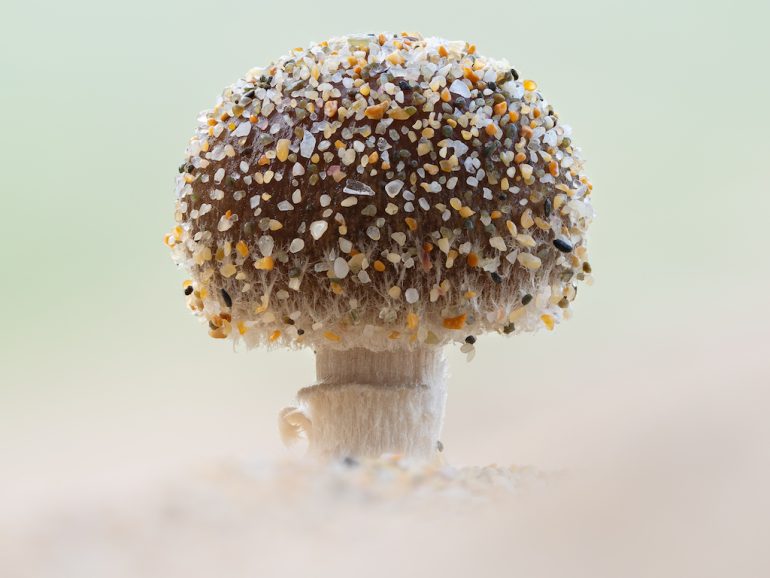
While exploring the sand dunes on Holywell Bay Beach in Cornwall, Jamie came across a tiny mushroom poking out of the sand. His priority was on photographing insects, but the sandy coating on this mushroom intrigued him. He set up his camera on the ground and used the focus-bracketing feature of his camera to capture all the frames needed to reveal as much detail as possible.
Technical information: OM System OM-1 Mark II, OM System M.Zuiko ED 90mm f3.5 Macro IS PRO, f5.6, 1/30 sec, ISO 200, Flash off, Cygnustech diffuser kept on, color grading in Lightroom, focus stacking in Zerene Stacker, and final touches in Photoshop, including sharpening, dodging, and burning.
Plants
Winner: Piet Haaksma | Mosses
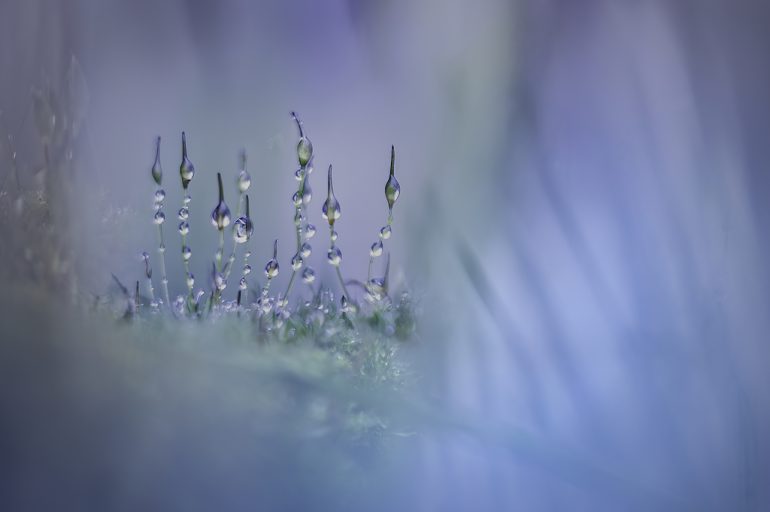
After a foggy night in early spring, Piet noticed many water droplets still clung to some moss in his garden. He used a large aperture with a 150mm macro lens to create a soft, quiet background. Only after combining two shots of the same area and adjusting the color temperature to create a dreamy blue tint did he achieve the image he had in mind.
Technical information: Nikon D810, Sigma Macro 150mm, f2.8, 1/25 sec, ISO 200, Tripod.
2nd place: Sébastien Blomme | Tournicoti
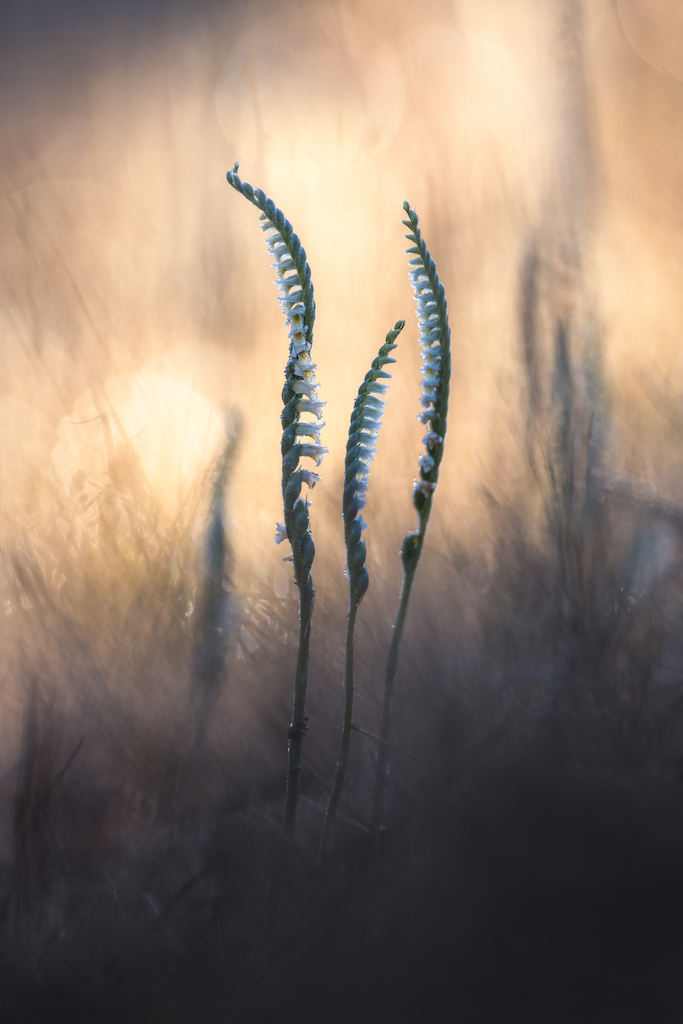
Sébastien has a particular fondness for these small orchids (Autumn lady’s-tresses) as they symbolize nature’s renewal in the “second spring.” Their elongated shape and gentle spiral give them an especially graceful appearance. He photographed these three, only a little larger than a blade of grass, in the city of Toulouse one October morning. This is why the Close-up Photographer of the Year awards chose this in the second place.
Technical information: Pentax K1, Pentax DA 300mm, f4, 1/400 sec, ISO 200, Lightroom only for light and color modifications.
3rd place: Sigfrido Zimmermann | Flowing Kelp
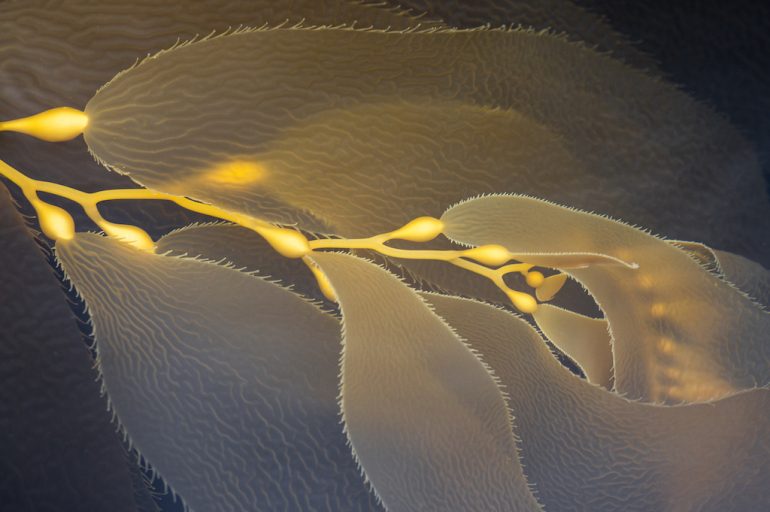
As a marine biologist working in Southern California, Sigfrido is lucky to have the opportunity to scuba dive in kelp forests. This image was made during a surface interval between dives at one of his favorite dive sites on Santa Barbara Island in Channel Islands National Park. His goal was to evoke a calm flow throughout the image to help show the elegance of giant kelp.
The giant kelp’s pneumatocysts (gas-filled bladders), blades, and stipe can be seen in this photograph. The pneumatocysts help the kelp stay upright in the water column. The blades, or leaf-like structures, are where photosynthesis occurs. The stipe holds everything together. In ideal conditions, giant kelp can grow at a rate of up to two feet per day. When giant kelp reaches the surface, it grows and forms a canopy on the water’s surface. This image represents only a small portion of the canopy in this particular kelp forest.
Technical information: Nikon Z6, Nikon 105mm f/2.8, f8, 1/160 sec, ISO 800, and circular polarizer. Post-processing: Basic adjustments in Lightroom, contrast added with the tone curve, white balance corrected, dodging and burning applied with local adjustments.
Studio Art
Winner: Rob Blanken | Artificial Landscape
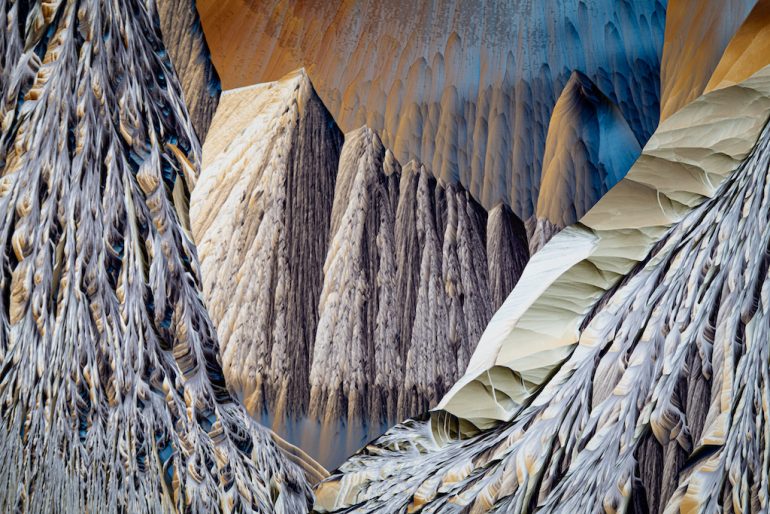
This image showcases the crystals of amino acids created by first making a solution of beta-alanine and L-glutamine in water and ethanol. The solution is then carefully heated on a microscope slide. Over time, the crystals form on the slide and can be made visible with the help of polarization filters. Rob creates these images because of the fascinating shapes, colors, and endless variations they offer. Its sheer beauty made it as one of the winners in the Close-up Photographer of the Year awards.
Technical information: Nikon D850, Laowa 25mm f2.8 2.5-5x, f5.6, 1/10 sec, ISO 160, Tripod, macro rail, Lightroom, general corrections.
2nd place: Matt Vacca | Drift 5

Drawing from his experience as a jazz musician and architectural photographer, Matt’s macro photography emerges from improvising structure in everyday objects and spaces. By focusing on movement, texture, shape, and form, he captures an evolving dance of contrasting elements, echoing the idea that “architecture is frozen music.” He invites the viewer to discover order and rhythm while experiencing a sense of balance and calm in the mundane and often overlooked.
Technical information: Nikon D850, 105mm lens, f16, 1/200 sec, ISO 100, and tripod. Post-processing: Lightroom for basic raw adjustments, Photoshop for adjustments and cleaning
3rd place: Paul Kenny | Copper Works No. 13 – 2024
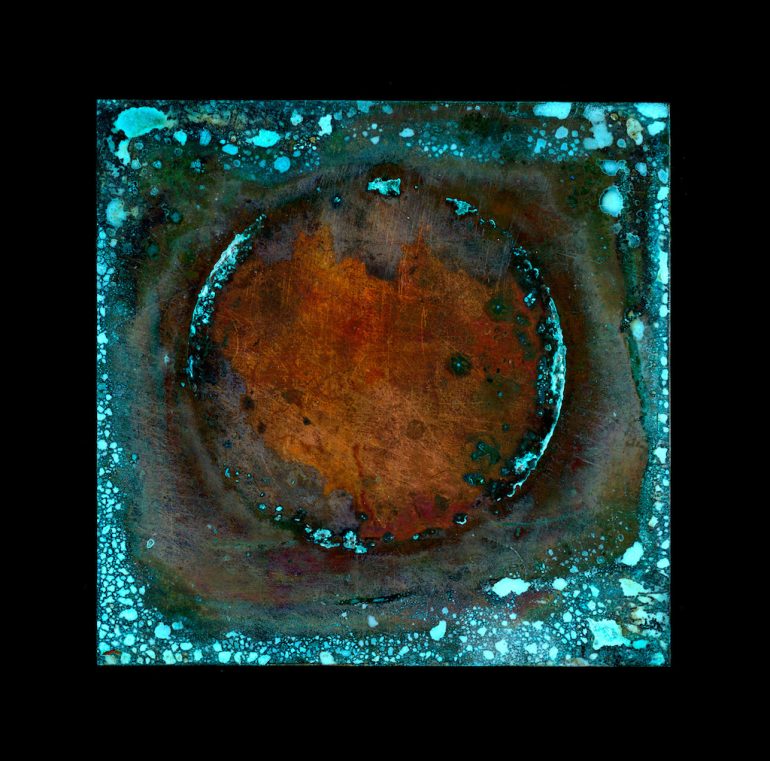
Over the winter of 2023/24, Paul created a series of works inspired by childhood memories of growing up in an almost Victorian industrial landscape. The work was prompted by a move into the inner city after 35 years of living in a rural seaside location. This change in environment encouraged him to apply the techniques he had developed over 50 years of photographic practice. He created the work on 6×6 inch copper plates, using household products to oxidize, distress, and enhance the metal surface. Once the plate was “finished,” he scanned it using a flatbed scanner, resulting in large digital files that he then processed in Photoshop Elements.
Technical information: Epson V850 Pro and flatbed scanner lens. Post-processing: Photoshop Elements for histogram adjustments and color saturation.
Young (Under 18s)
2nd place: Alexis Tinker-Tsavalas | Afternoon Snack (17 years old)
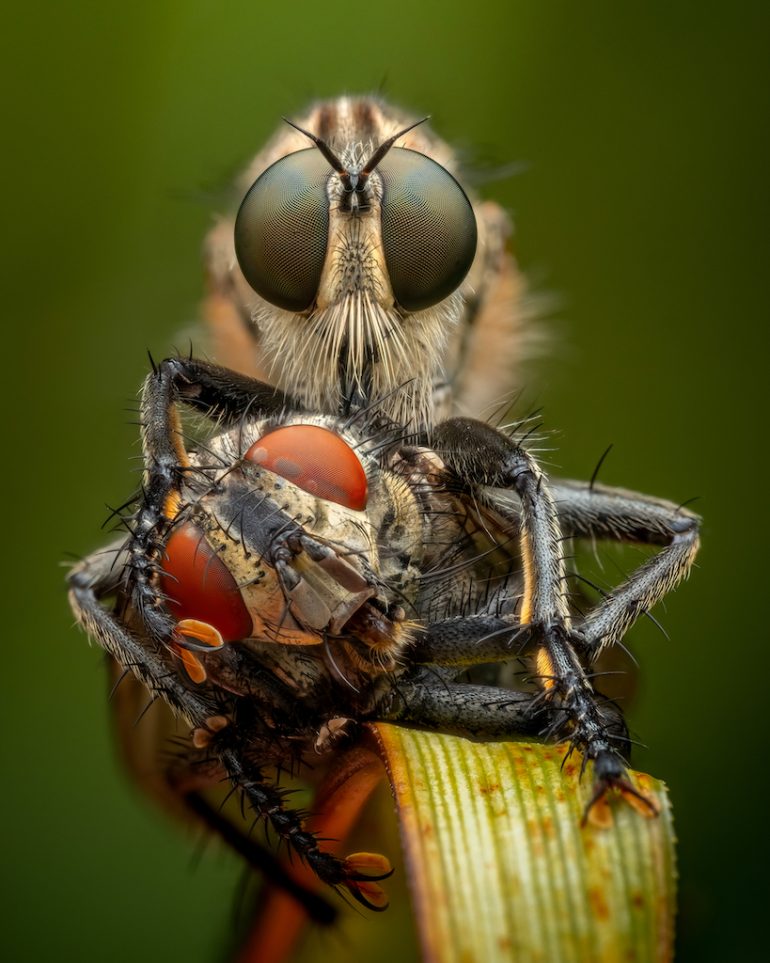
Robber Flies are among Alexis’s favorite subjects to photograph, but capturing a macro image of one is no easy task. They are quite skittish, and during the day, they usually fly away long before you can get close enough for a good shot. This particular individual was no exception. Alexis spotted it on a hot, sunny day and couldn’t get near it on the first few attempts. However, Alexis noticed it had prey, and since they had been hoping to capture a Robber Fly with prey for quite some time, they decided to keep trying.
Eventually, Alexis got lucky, and the fly allowed them to get within range for a good photo. But one shot wasn’t enough—Alexis wanted to create a focus stack to ensure the eyes of both flies were sharp and in focus. Fortunately, the fly stayed still for a few more seconds, allowing Alexis to capture this focus stack of 24 images.
Technical information: Fujifilm X-H2, Laowa 65mm f/2.8 macro, f5.6, 1/200 sec, ISO 200, and Godox v860iii flash with Cygnustech Diffuser. Post-processing: Basic adjustments to colors and lighting in Lightroom, focus stacking in Zerene Stacker, noise reduction and sharpening in Topaz DeNoise, final masking, and local lighting adjustments in Lightroom.
3rd place: Alexis Tinker-Tsavalas | Pandora (17 years old)
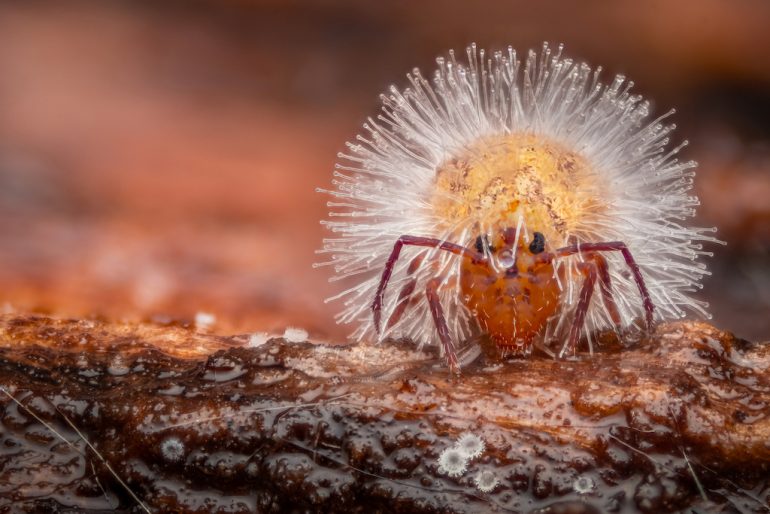
Robber Flies are among Alexis’s favorite subjects to photograph, but capturing a macro image of one is no easy task. They are quite skittish, and during the day, they usually fly away long before you can get close enough for a good shot. This particular individual was no exception. Alexis spotted it on a hot, sunny day and couldn’t get near it on the first few attempts. However, Alexis noticed it had prey, and since they had been hoping to capture a Robber Fly with prey for quite some time, they decided to keep trying.
Eventually, Alexis got lucky, and the fly allowed them to get within range for a good photo. But one shot wasn’t enough—Alexis wanted to create a focus stack to ensure the eyes of both flies were sharp and in focus. Fortunately, the fly stayed still for a few more seconds, allowing Alexis to capture this focus stack of 24 images.
Technical information: Fujifilm X-H2, Laowa 25mm f2.8 2.5-5x ultra macro, f2.8, 1/200 sec, ISO 250, Nikon sb900 flash with Cygnustech Diffuser. Post-processing: Basic adjustments in Lightroom, focus stacking in Zerene Stacker, noise reduction and sharpening in Topaz DeNoise, final masking and local lighting adjustments in Lightroom.
For more information about the Close-up Photographer of the Year, head to their website.
Get rid of the ads!
Did you enjoy reading this article as much as we enjoyed writing it? There's a way to support us and our reporting, getting ad-free navigation and more as a bonus. Subscribe to us for less than a coffee per month —just $3.99— or take advantage of our yearly subscription with a hefty discount for only $25.- An ad-free experience
- A free mystery box for Lightroom or Capture One
- All the books in our store
- 20% discount on Capture One
- 30% discount on Imalume Photo Theft Protection
- 20% off Herbs and Kettle Tea Company.
- 20% off your order from MPIX printing services.
- 5% off Viltrox Products via their eCommerce store.
- 10% off all film developing, printing and scanning services from Blue Moon Camera and Machine
- 15% off 7Artisans products: The lens and accessory maker is offering a sweet discount for Phoblographer's readers.