


“My work balances between high post-production projects, mixing different softwares, and straightforward photography with no post-production,” photographer Jean-Yves Lemoigne tells the Phoblographer. “Even when post-production is involved, I strive for an organic approach. In advertising, the final choice often depends on the agency or client, but I push for natural results as much as possible.” The strive for authenticity is real these days. And sometimes, it gets so good that it can fool even an experienced photo editor.
All images by Jean-Yves Lemoigne. Used with permission. For more, please check out his website and Instagram.
Jean-Yves Lemoigne: The Photographer
Jean-Yves Lemoigne has been a photographer for 20 years. Before that, he was an art director at a top ad agency in Paris. “For ten years, I focused on concept photography with storytelling and special effects, mainly creating ad campaigns for magazines and billboards in Europe,” he tells us. “Eventually, I wanted to step out of my comfort zone, so I began capturing bodies in motion, such as dancers and athletes. Concept photography is highly controlled, but with sports and dance, there’s a dynamic performance aspect that is fascinating to capture.” Jean-Yves is really excited about all the different ways to convey motion in a still image.
He uses a Phase One IQ3 camera to make his work. For action, he uses a Canon 1Dx, 5DSR, and R5. But he’s been looking at the new Sony a9 III with the global shutter. He lights everything with Profoto and Broncolor lights.
Photography, for me, is closely connected to physical mediums like paper and print. With the decline of these and the rise of social media and screen technology, photography may seem less relevant. However, its simplicity, immediacy, and effectiveness will ensure it remains with us for a long time.
Jean-Yves Lemoigne
The Shoot
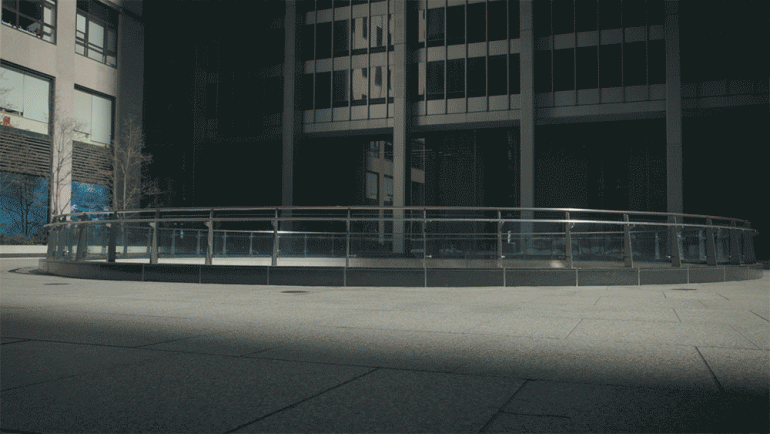
“I have explored athletes in motion extensively, aiming to capture it in a single static image,” he tells us. “A few years ago, I created a series using a stroboscopic effect to achieve a sequence look in-camera. This time, I wanted to experiment with motion blur, capturing a two-second blur without overexposing the shot.” For this project, he handled all the post-production himself. Jean-Yves tends to experiment with Photoshop, After Effects, and CGI with Cinema 4D. For this, he wanted to capture two seconds of motion while keeping it real and organic feeling. The resulting images are two seconds of time, blending 120 frames a second into single still images.


Indeed, making a unique image is a challenge. But with sports photography, Jean-Yves says that there are limitless possibilities. He works to see sports from a fresh perspective. “For example, using a long shutter speed, an athlete could appear blue at the beginning and red at the end of the capture,” he states. “This is how I approach projects. Through practice and testing, I can predict the results and then experiment with various options.”
The resulting images are stunning pieces of work where layers are stacked to make a single image.
The commercial side of things, according to Jean-Yves, seems a bit scary when it comes to AI. Here’s what he has to say.
I believe AI will significantly impact photography. The more images there are, the less value they hold. Major advertising agencies are already trying to cut costs on photo production, and AI provides an opportunity to do everything in-house. Many agencies have set up their own “AI Studios” investing sometimes millions of dollars(I know some people working there), so I expect a strong shift towards AI-generated content soon. AI can create images tailored to individual preferences, leading to highly effective bespoke ad campaigns. We are transitioning to an industrial age of photography, moving from a craft akin to haute couture to a factory-like production of thousands of images daily. Photography will still exist, but making a living from it will be much more challenging. Now, photography competes with video, CGI, and AI…\
Jean-Yves Lemoigne
Authenticity Statement about Jean-Yves Lemoigne
As part of the Content Authenticity Initiative, The Phoblographer works with human photographers to verify that they’ve actually created their work through shoots. These are done by providing us assets such as BTS captures, screenshots of post-production, extra photos from the shoot, etc. We do this to help our readers realize that this is authentically human work. Here’s what this photographer provided for us.
Get rid of the ads!
Did you enjoy reading this article as much as we enjoyed writing it? There's a way to support us and our reporting, getting ad-free navigation and more as a bonus. Subscribe to us for less than a coffee per month —just $3.99— or take advantage of our yearly subscription with a hefty discount for only $25.- An ad-free experience
- A free mystery box for Lightroom or Capture One
- All the books in our store
- 20% discount on Capture One
- 30% discount on Imalume Photo Theft Protection
- 20% off Herbs and Kettle Tea Company.
- 20% off your order from MPIX printing services.
- 5% off Viltrox Products via their eCommerce store.
- 10% off all film developing, printing and scanning services from Blue Moon Camera and Machine
- 15% off 7Artisans products: The lens and accessory maker is offering a sweet discount for Phoblographer's readers.
- 15% off a VSCO One subscription: Get a bunch of great tools with their all-in-one package.