


Last Updated on 01/26/2026 by Chris Gampat
Unless you are completely new to photography or you’ve been living under a rock for the past 5 years, it’s safe to say you’ve heard of Canon’s “S” line of cameras. The S90 proved that camera manufacturers can make a truly pocketable camera with a large (for a compact) sensor and all of the manual controls that many photographers demand. When the S95 was released, it only brought minor updates to the S90. So, is the S100 another step in the evolution of Canon’s S line or is it more than that?
Table of Contents
Update January 2026
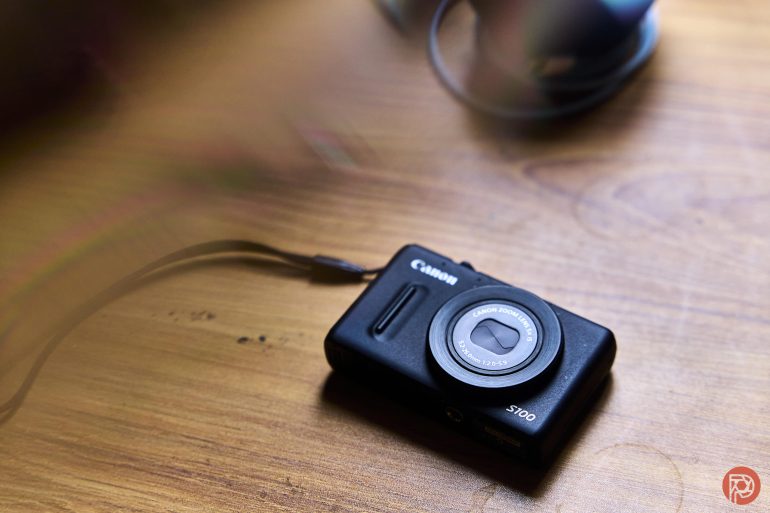
In January 2012, Mike Pouliot originally wrote the review of the Canon S100 for the Phoblographer. And in 2026, I, the site’s founder and Editor in Chief, was gifted one of these cameras by one of my very good friends. So now, I’ve got the Canon S100 and the S95 — which I’ve already given immense praise to.
I’m fortunate enough to run a publication that has been around for almost 20 years and to also still be at the head. So when I say that I was there to experience the original Canon S100, I really do mean it.
The Canon S100 is every bit as cool as I’d expect it to be. There’s a lot to love about it too. The S100 packs in GPS at a time before cameras defaulted to using the Wifi signal from your smartphone. On top of that, it lets you shoot RAW, apply in-camera filters like the positive film setting, and remains really small and versatile. Plus, there’s cool features like image stabilization, a simple menu interface, and good image quality.
I’m a middle millennial — and I’m writing this update a month before I turn 39. My 31 year old friend, who is on the other end of the millennial side, wondered why Gen Z was getting into digicams like the S100. And when I explained it to her, it made so much more sense.
Cameras like the S100 have returned because of the cost, the fact that the camera isn’t trying to do everything for us, there’s less AI algorithm processing, and the images just truly feel organic. What’s more, when you interact with a camera, you interact with a phone far less. And in 2026, so many of us want to get away from our phones. In a Discord group that I’m in, one of the men talks about how when his iPhone dies, he’s going to switch to a dumb phone of some sort.
Though I’ve always been around using dedicated cameras as part of my job, I totally get what Gen Alpha and Gen Z are saying about using their phones too much. I wear analog watches, recently bought a reconditioned iPod to own my music after years of streaming, play video games on my switch, and have mostly returned to using a computer to do tasks instead of relying on my phone.
In the same way that many of us Millennials were all about film cameras when we first were coming up, these humans are all about retro tech from another era. Unlike Gen X and Baby Boomers before us who discouraged us from having these experiences, I am surpassing that generational trauma to tell younger humans to embrace it and experience. Most importantly, I hope that they have these experiences more in-person than through a digital simulation.
Billion-dollar companies generally don’t really seem to care about their customers until their bottom line is affected. Using a camera like the S100 is a peaceful protest against the dopamine casino that slips generative AI into our drinks the way that a shady bartender would try to roofie you. I’m really sick and tired of the dopamine casino that is social media. And I’m very tired of being sick of generative AI.
With that said, the Canon S100 still exhibits good enough image quality at 12.1MP. It’s crazy to think that even today, Sony still puts out the Sony a7s III — which boasts 12MP. The S100 is also pocketable, fun, has a built-in flash, kookie effects, a zoom lens, RAW file capability, and it makes me have to use my brain. That’s important in a world where technology is actively trying to rob us of cognitive thinking. If anything, not adopting the tech is making us smarter because by willingly choosing to be luddite-like, we’re preventing our regression back to being mindless apes in this case.

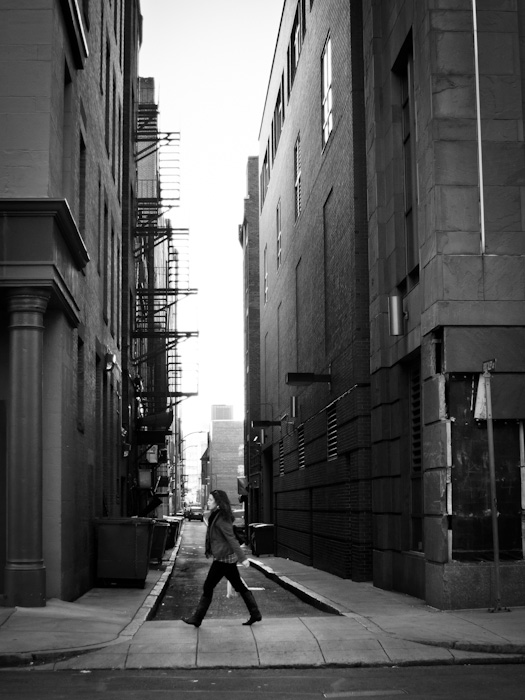
Canon S100 review sample images 
Canon S100 review sample images 
Canon S100 review sample images 
Canon S100 review sample images 
Canon S100 review sample images 
Canon S100 review sample images 
Canon S100 review sample images 
Canon S100 review sample images 
Canon S100 review sample images 
Canon S100 review sample images 
Canon S100 review sample images 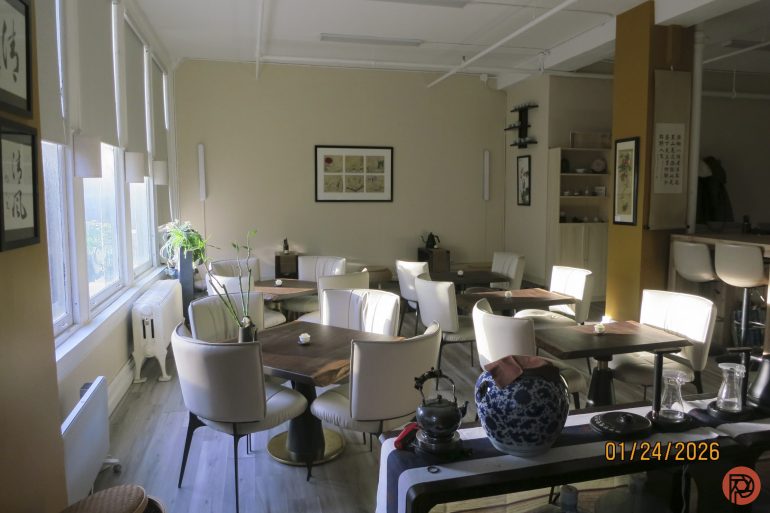
Canon S100 sample image 
Canon S100 sample image 
Canon S100 sample image 
Canon S100 sample image 
Canon S100 sample image 
Canon S100 sample image 
Canon S100 sample image
Canon S100 Specifications
| Imaging | |
|---|---|
| Resolution | Effective: 12.1 Megapixel, Actual Pixels: 13.3 Megapixel |
| Sensor | 1/1.7″ CMOS |
| File Formats | Still Images: JPEG, RAW Movies: MPEG-4 AVC/H.264, MOV Audio: Linear PCM |
| Max Resolution | 4000 x 3000 @ 4:3 |
| Other Resolutions | 4000 x 2248 @ 16:9 2816 x 1584 @ 16:9 1920 x 1080 @ 16:9 640 x 360 @ 16:9 4000 x 2664 @ 3:2 2816 x 1880 @ 3:2 1600 x 1064 @ 3:2 640 x 424 @ 3:2 2816 x 2112 @ 4:3 1600 x 1200 @ 4:3 640 x 480 @ 4:3 2992 x 2992 @ 1:1 2112 x 2112 @ 1:1 1200 x 1200 @ 1:1 480 x 480 @ 1:1 2400 x 3000 @ 4:5 1696 x 2112 @ 4:5 960 x 1200 @ 4:5 384 x 480 @ 4:5 |
| Aspect Ratio | 1:1, 3:2, 4:3, 4:5, 16:9 |
| Image Stabilization | Optical |
| Optics | |
|---|---|
| Lens | EFL: 5.2-26mm (35mm equivalent: 24-120mm) Aperture: f/2.0 (W) – 5.9 (T) |
| Zoom | Optical: 5x Digital: 4x Intelligent Zoom: 20x 1 |
| Focus Range | Wide: 1.2″ (3.05 cm) – Infinity Telephoto: 12″ (30.48 cm) – Infinity Wide Macro: 1.2″ (3.05 cm) – 1.6′ (48.77 cm) Tele Macro: 12″ (30.48 cm) – 1.6′ (48.77 cm) Normal: 2.0″ (5.08 cm) – Infinity Normal: 12″ (30.48 cm) – Infinity 2 |
| Exposure Control | |
|---|---|
| ISO Sensitivity | Auto, 80-6400 |
| Shutter | 15 – 1/2000 seconds |
| Exposure Metering | Center-weighted, Evaluative, Face Detection, Spot |
| Exposure Modes | Modes: AE Lock, Aperture Priority, Auto ISO Shift, Manual, Program, Program Shift, Safety Shift, i-Contrast Compensation: -3 EV to +3 EV (in 1/3 EV steps) 3 |
| White Balance Modes | Auto, Cloudy, Daylight, Flash, Fluorescent, Fluorescent H, Manual, Tungsten, Underwater |
| Burst Rate | Up to 9.6 fps for up to 8 frames |
| Self Timer | 10 Second, 2 Seconds 4 |
| Flash | |
|---|---|
| Built-in Flash | Yes: Auto, Auto/Red-eye Reduction, Exposure Compensation, FE Lock, Flash On, Flash On w/ Red-eye Reduction, Off, Slow Sync 5 |
| Effective Flash Range | Wide: 1.6 – 23′ (0.49 – 7.01 m) Telephoto: 1.6 – 7.5′ (0.49 – 2.29 m) |
| External Flash Connection | None |
| Memory | |
|---|---|
| Built-in Memory | Not Specified By Manufacturer |
| Memory Card Type | SD SDHC SDXC 6 |
| Still Images per GB | Not Specified By Manufacturer |
| Recording | |
|---|---|
| Video Recording | Yes, NTSC/PAL |
| Video | |
|---|---|
| Video Clip Length | Up to 16GB or 3 Hour Limited by Memory Card Capacity |
| Audio Recording | With Video, Stereo |
| Viewfinder/Display | |
|---|---|
| Viewfinder Type | None |
| Screen | 3.0″ LCD (461000 pixels) |
| Connectivity/System Requirements | |
|---|---|
| Connectivity | HDMI C (Mini), USB 2.0 |
| Software Requirements | Windows: XP, Vista, 7 |
| Environmental | |
|---|---|
| Operating/Storage Temperature | Operating 32 to 104 °F (0 to 40 °C) Humidity: 10 – 90% |
| Power | |
|---|---|
| Battery | NB-5L Rechargeable Lithium-Ion Battery Pack, 3.7VDC |
| AC Power Adapter | CA-DC10 (Optional) |
| Physical | |
|---|---|
| Dimensions (WxHxD) | 3.93 x 2.34 x 1.05″ / 99.82 x 59.44 x 26.67 mm |
| Weight | 6.1 oz / 173 g (Camera Only) |
Experience
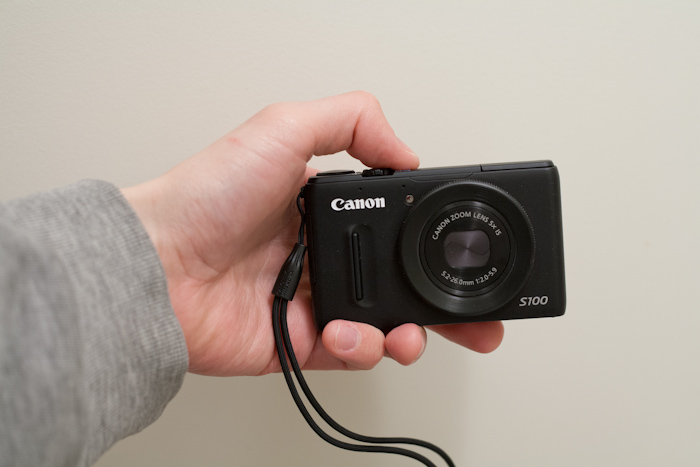
Most people will be interested in the S100 for it’s size and I’m happy to report that like the previous S modeles, the S100 continues the trend of being a truly pocketable camera. The S100 is actually the smaller than the S95, albeit only by fractions of an inch. This means the S100 can easily and comfortably fit into your jeans pocket without anyone asking you if you’re happy to see them. I find it amazing that a camera this advanced can easily fit inside your pocket.
Isn’t technology wonderful?
The S100 looks similar to the S95 in may ways, but there are a few distinguishing design characteristics of the S100. The first, and most noticeable to the eye, is the small rubber grip on the front of the camera body. A grip this small may seem rather useless, but it actually does make holding this tiny camera slightly easier. In addition to the grip, another major difference from the S95 is the paint finish to the camera. The S95 improved on the S90’s slippery feel by adding a bit of texture to the paint but the S100 kicks it up a notch. The S100 sports a flat/matte black paint finish with a textured surface that makes it very easy to grip and hold on to. For you pickup truck owners out there, it almost feels like a scaled down Rhino Liner coating.
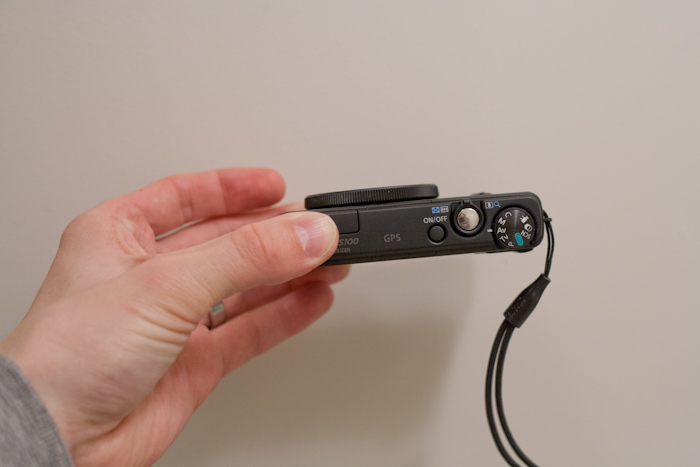
There are several advanced compacts on the market (I wouldn’t consider many of them “compact”) that have similar features to the S95 but very few can keep up with the S100’s usability. The buttons, features and menus on the S100 are both intuitive and easy to access. If you are used to shooting with a DSLR, the S100‘s control layout will make you feel right at home. But, if you are fairly new to photography, the S100 can be as easy to work as any other point and shoot. Because of this, shooting with the S100 is both fun and easy.
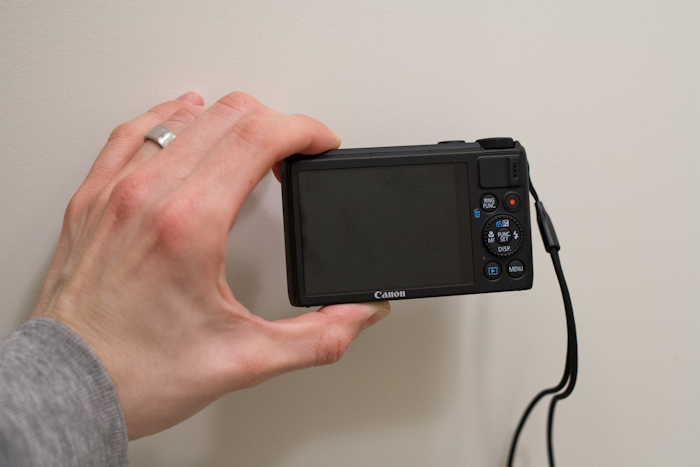
The S100 has the normal controls that you see on most of today’s cameras, like PASM dial, dedicated video button, 4-way rocker button with dial, etc. But one of the most talked about features of Canon’s S series is the control ring which is positioned around the lens. This ring lets you change different settings of the S100 depending on what mode you are in. For example, in aperture priority mode, the control ring allows you to change your aperture settings which is both convenient and intuitive. But what if you want the control ring to change something else while you are in aperture priority? Not to worry, the control ring has a function button on the back of the camera that allows you to change the function of the control ring to almost anything you need (ISO, shutter, zoom control, etc.). This allows you to setup the S100 to fit your needs.
What’s Changed from the S95
Whenever any update is made to a line or series of cameras, there are always throngs of people that want to know the million dollar question, “Should I Upgrade?” Well, that’s a personal choice but I can try to provide you with enough information to make the decision easier for you. Below is a list of the upgrades the S100 brings over the S95:
- Better processor (DIGIC 5 vs. DIGIC 4)
- More Mega Pixels (12MP vs. 10MP)
- Faster Shutter Speeds (1/2000 sec vs. 1/1200 sec)
- Faster FPS and burst mode (2.3 vs. 1.9)
- Slightly and I do mean SLIGHTLY smaller body
- Longer Zoom Range
- A wider angle lens (24mm vs. 28mm)
- Sensor Change (CMOS vs. CCD)
- Higher max ISO (6,400 vs 3,200)
- Higher Rez movies (1o8op vs 720p)
| Zoom Range | |
|---|---|
 |  |
The S100 also brings completely new features to the S line of cameras:
- Burst Mode: The normal fps of the S100 is up to 2.3fps from the S95’s 1.9fps but the burst mode lets you capture up to 9.6fps while shooting JPEG. Burst mode is an actual mode, like an auto mode, so you have little to no exposure control. I guess that is something you have to live with to get 9.6fps.
- GPS: GPS is a nice feature to have in a travel camera. I have lots of pictures from trips where I can’t remember exactly where a photo was taken. I can usually narrow it down to a state or country for international travel…but that isn’t always good enough. This GPS module can simply track where your photos where taken OR it can track your travels while the camera is on. This information can then be downloaded to your compter.
- Internal Neutral Density Filter: Honestly, I’m pretty excited to see Canon add an ND filter to the S100. I like being able to slow down my shutter speed during daylight ours…something that is not easily done.
Image Quality

As a pervious owner of a Canon S95, I know that these little S cameras can produce some outstanding images. I can happily report that the S100 continues with the trend of producing very good images. I spent most of my time shooting JPEG+RAW and while I usually go for RAW files so I can edit them to my liking, I found myself simply going with the JPEGs of the S100. JPEG processing is kind of a personal thing, you either like it or you don’t. Overall, I found that Canon’s JPEGs didn’t over do it on saturation or sharpening, something that other manufactures seem to push, especially on compact cameras.

ISO performance is also fairly good for a compact camera. Based on the images I’ve taken, it looks as though the S100 does do a better job at managing noise than the S95 even though Canon packed two more megapixels into the S100. I’m sure some of the credit should go to the DIGIC 5 processor. If you’re pixel peeping (something we don’t don’t like to do here at The Phoblographer), JPEGS start to get a little soft/mushy over ISO 800 but they are definitely usable. I’d recommend using RAW over ISO 1600. Yes, there will be quite a bit of noise but I’d personally rather clean up noise in post processing than deal with soft JPEGs.

As far as dynamic range goes, it’s tough to say without any real technical tests. From what I can tell, it performance looks similar to the S95. Even if there is a slight improvement, it’s still nothing to write home about. You have to remember, this is a compact camera and even though it’s sensor is larger than most compacts, it’s still not as good as a Micro Four Thirds or an APS-C sized sensor.

One rather disappointing component of the S100 is the lens. I’m glad to see that Canon bumped the S100 up to 24mm at the wide end but they did so at a price. The S100’s max aperture of f/2 can only be achieved at 24mm. I don’t know about you, but I find 24mm to be a bit too wide for everyday use. And because the widest aperture starts at 24mm, longer focal lengths have cannot let in as much light as the S95. It would have been nice to have f/2 available at 24-28mm to keep the aperture/focal length values the same as the S95. In addition to all of that, I found the lens be a little soft. We aren’t into super technical analysis of products here at The Phoblographer, but based on my time with the S95 and other advanced compacts, I think Canon could have done a better job with this lens.
Video
As I’ve stated in my other posts, I rarely use the video feature in any camera and the S100 was no different for me. But, to provide the readers with a sample, I forced myself to press the dedicated record button. While shooting, I did notice a few things:
- Overall video quality is what I would consider to be quite good.
- The audio when recording seems to be very sensitive. You can adjust the audio sensitivity, just keep in mind that the default may be a bit high. Take the video above for example. You would think you were at Niagra Falls based on the sound levels. I walk by this little waterfall everyday on my way to work and it is not loud at all…it’s actually quite calming.
- Even though the S100 has built in image stabilization, videos still come out a bit shaky. Honestly, I think this due to the size of the camera. I shot the video above with one hand (probably should have used two) but I’ve seen better I.S. performance from camera’s like the Olympus XZ-1.
Overall Thoughts
I’m going to be short and sweet here, I loved shooting with the S100. Too keep things easy to digest, I’ve made a list of my top likes and dislikes of the S100.
- Look and Feel: The flat black matte finish of the S100 combined with it’s small size makes this advanced compact look and feel great in the hand. I have large-ish sized hands with the majority being in my lanky fingers. Small cameras are not always fun for me, but the S100 is actually a joy to use. Do I wish it was slightly bigger? Sometimes, but then it wouldn’t be truly pocketable and that is not a tradeoff I’d be willing to make. I think Canon has made the right choice in keeping the S100 as the only clear choice for a truly pocketable advanced compact.
- Size: The most appealing feature of the S100 for most people will be it’s size. When you look at the other advanced compacts on the market, nothing can really compare to the S100‘s feature set and size. I’ve traveled with the S100 as my only camera and while I did miss my 5D on occasion, not having to lug around a camera bag is a nice change of pace.
- Speed: The S100 is fast in almost every way. Startup times are quick and AF is very good for a compact camera that relies on contract AF. Even when switching between menus and changing settings, the S100 never lags behind. The only situation where I felt the S100 lag was when applying exposure compensation. When you turn the rear dial to apply EC, it takes a second or two for the results to show up on the rear display. This isn’t a deal breaker for me, but I find it strange that this is the only feature/setting that the S100 struggles with.
- Controls/Flexibility: The control ring along with the 4-way rocker and rear dial means your most used/needed functions are only a click away. Because I shoot mostly with my Canon 5D or Panasonic GF-1, I’m used to having quick access to my vital settings so I felt right at home shooting with the S100. Beyond the standard controls, the S100 allows for a decent amount of customization. You can change the function of the control ring and it does have a dedicated function button that can be programmed with a pretty vast amount of settings.
- Stealth: The S100 is small, fast, black and SUPER quiet. These are all good things for street photographers. If you turn off all of the electronic beeps, the S100 hardly makes a sound; you just hear the faintest of “clicks” when the shutter is released.
- Image Quality: As I stated in the previous section, the S100 produces very good images straight out of the camera. Personally, I think Canon leads the market when it comes to JPEG image processing.
- New Features: GSP and a built in ND filter are welcomed additions to Canon’s S line. I didn’t think I would use GPS, but it actually quite hand, especially when traveling. The ND filter may not seem like a big deal to most, trying to get a shallow depth of field with a compact means you have to shoot wide open. Shooting wide open in bright sunlight means a fast shutter speed. While 1/2000 sec is good, 1/2000 with an ND filter is better. Nice touch Canon.

- Battery Life: Battery life is definitely the Achilles Heel of the S100. It’s a small camera so you’d expect it to have a small battery but the S100’s battery life is pretty bad. I was able to get 175 shots and a ten second video out of a full charge. I don’t know about you, but that certainly isn’t enough juice for a typical day of shooting for me when on vacation. I did have GSP running for the majority of the time (shot tagging only) but I still find that be be rather unacceptable. If I were to buy this camera, I would definitely pick up a few extra batteries as one is not enough to get you through one day of shooting.
- The Lens: As I stated earlier in the review, I think Canon could have done a better job with the lens. Distortion and lack of sharpness/detail leaves Canon room for improvement with the S100’s sucessor. Does the lens ruin the camera? No way, I still think the S100 is an excellent camera but I do think the lens is limiting the sensor and DIGIC 5 processor.
- Price: Coming it at just over $400, it’s a pretty steep price to pay for a second, or in my case a fourth camera. Yes, it is feature packed and it is quite the little performer, but at this price you are starting to enter the entry level DSLR and EVIL camera price range. Obviously, DSLRs and most, if not all EVIL cameras are not pocketable so you are paying a premium for convenience. Still, I’d like to see the S100 at a sub $400 price point…I’d even take $399. It’s current price would be easier to digest if they threw in a few extra batteries…you’re going to need them.
Conclusion

So, to answer the question asked at the beginning of this post, I would say that the S100 is not a major revolution in Canon’s S line of cameras. Rather, the S100 is another step in the evolution of the S series. Is that a bad thing? Hell no, at least I don’t think so. Even though it did have some limitations, the S90 was a great camera and Canon has simply been improving it with each release. The S100 brings some welcome additions to to the S95 that will draw many new users along with those that want to upgrade from the S95.
If you are looking for a truly pocketable camera that with manual controls and most of the functions of a DSLR or EVIL camera, then the S100 should be on your short list. While the lens may limit the S100 from performing as well as it could, it is still a great compact camera and it may be the ultimate daily shooter as you can take it anywhere. I had a great time shooting with this camera and if Canon can improve the optics a bit within the S series (maybe S105?) then I’ll be first in line to buy.
Please Support The Phoblographer
We love to bring you guys the latest and greatest news and gear related stuff. However, we can’t keep doing that unless we have your continued support. If you would like to purchase any of the items mentioned, please do so by clicking our links first and then purchasing the items as we then get a small portion of the sale to help run the website.
Get rid of the ads!
Did you enjoy reading this article as much as we enjoyed writing it? There's a way to support us and our reporting, getting ad-free navigation and more as a bonus. Subscribe to us for less than a coffee per month —just $3.99— or take advantage of our yearly subscription with a hefty discount for only $25.- An ad-free experience
- A free mystery box for Lightroom or Capture One
- All the books in our store
- 20% discount on Capture One
- 30% discount on Imalume Photo Theft Protection
- 20% off Herbs and Kettle Tea Company.
- 20% off your order from MPIX printing services.
- 5% off Viltrox Products via their eCommerce store.
- 10% off all film developing, printing and scanning services from Blue Moon Camera and Machine
- 15% off 7Artisans products: The lens and accessory maker is offering a sweet discount for Phoblographer's readers.