

Optics are pretty important for many photographers. Whether you are into documenting streets, weddings, portraits, or even wildlife, a good lens can take you a long way. Canon has been one of the few brands that has managed to provide the best options for photographers of varying degrees. However, there is one lens that keeps getting expensive by the year. Have a look.
Additional reporting provided by Chris Gampat.
Called “dream lens,” the Canon 50mm f0.95 was introduced in August 1961, as reported by BlueMoon Camera. The lens was designed for rangefinder cameras, and it came into existence as a means to outdo Leica’s optics.
The race to release low-light lenses began in 1953, with the Zunow 50mm f1.1 for the Nikon S-Mount. Then came the Leica 50mm f1.2 and f1 Noctilux. However, what Canon did was that it launched the fastest lens in the world at that time, which was designed by Mukai Jirou, the creator of Canon 35mm f1.5 and 35mm ff1.8 LTM.
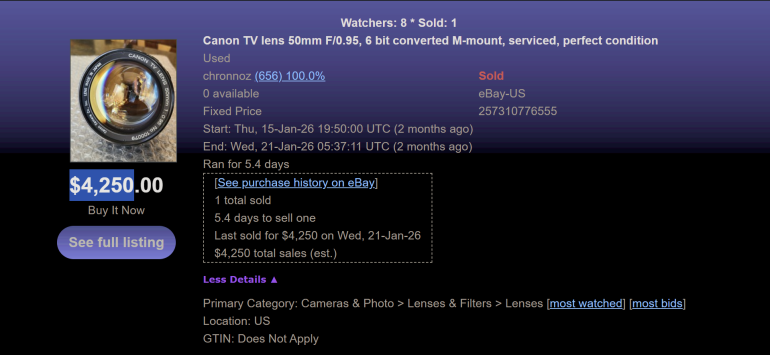
Upon its launch, the Canon lens reportedly cost about 57,000 yen (over $4000 dollars). However, on Watch Count, the lens fetched $4,250, which means the $250 only adds to the growing value. This proves that the legendary is holding its value, despite the years that have passed.
Over the years, the price of this lens has steadily gone up and down. Our research has shown that starting in 2008, it cost around $800–$1,800. By 2015, the price almost doubled. By around 2020, the price was around $4,500. During the pandemic era, it was seen selling for $5,500. And these days, it’s apparently also going for somewhere in the $6,000 range. However, that’s in the high range as the normal price is somewhere between $2,500 and $3,000. And it’s typically sold for around $2,750.
Some of the things that the lens does well include 10 aperture blades, a minimal focusing of 1m, and it weighs 605g. It also features a slimmer design, with a massive front element, but the rear was shaven down to avoid interference with the rangefinder cam mechanism.
The company introduced various versions, including 1 Type 1, which had 19,456 units and 3 TV/Cine versions, which also offered 7,000 units. The lens also featured a proprietary negative bayonet mount that was designed for Canon cameras. At the same time, the lens was modified to be adapted to Leica cameras. This further resulted in the minimum focusing distance from 1.0m to 0.65m.
Even today, the lens produces “dreamy” images, thanks to the swirly bokeh. While there are options such as the Noctilux f0.95, Canon’s option is vintage, having stood the test of time, and is ideal for those who are collectors or work with older lenses. In fact, the spherical aberration creates a beautiful bloom effect on highlights that many photographers prize for portraiture. The overall metal construction is further advantageous as well.
The Leica lenses have always been expensive, and a Canon lens being adapted to Leica only further helps to increase its price. Vintage lenses are highly desirable, and are only for those who use film cameras even today. Professional photographers will adore this, and its historical significance will continue to grow as time goes by.
Considering the value of the market right now and that it’s about to become summer in the Northern Hemisphere, Mid-May would probably be the best time to sell this lens before everyone starts traveling again for the summer. In fact, travel articles have been performing well here on the Phoblographer recently. So currently, it will be more of a seller’s market than a buyer’s market.
Get rid of the ads!
Did you enjoy reading this article as much as we enjoyed writing it? There's a way to support us and our reporting, getting ad-free navigation and more as a bonus. Subscribe to us for less than a coffee per month —just $3.99— or take advantage of our yearly subscription with a hefty discount for only $25.- An ad-free experience
- A free mystery box for Lightroom or Capture One
- All the books in our store
- 20% discount on Capture One
- 30% discount on Imalume Photo Theft Protection
- 20% off Herbs and Kettle Tea Company.
- 20% off your order from MPIX printing services.
- 5% off Viltrox Products via their eCommerce store.
- 10% off all film developing, printing and scanning services from Blue Moon Camera and Machine
- 15% off 7Artisans products: The lens and accessory maker is offering a sweet discount for Phoblographer's readers.