


If you told me that the image above was a photograph, I’d never believe you. Instead, I’d say that it’s graphic design, or a composite, or Photoshop. But this is an image straight out of the camera. More importantly, this is an image that was actually made with intent. It’s the type of image that gets me excited for many reasons. As a journalist testing cameras for close to 20 years, I’m always really excited when I get try something new that I haven’t experienced before. More importantly, when it doesn’t feel the same as everything else, I’m positively elated to know that digital photography still has places to go beyond AI. All of this came from the Olympus TG320 — a camera that’s well over a decade old.
If it weren’t for a good friend gifting me a camera that wasn’t being used in his household anymore, I probably would’ve never questioned photography like this. But amazingly enough, I am still so puzzled to the point where even formulating the questions is a bit tough. But to really summarize all these questions, I think of this one, big thing that’s now burning a hole in my head:
If photography is the act of painting with light, then is digital post-production not at all photography? The darkroom requires you to use lights to burn in and out; the digital darkroom doesn’t at all.
The lead image of this article was done straight out of the camera, and by definition, it is the act of painting with light.
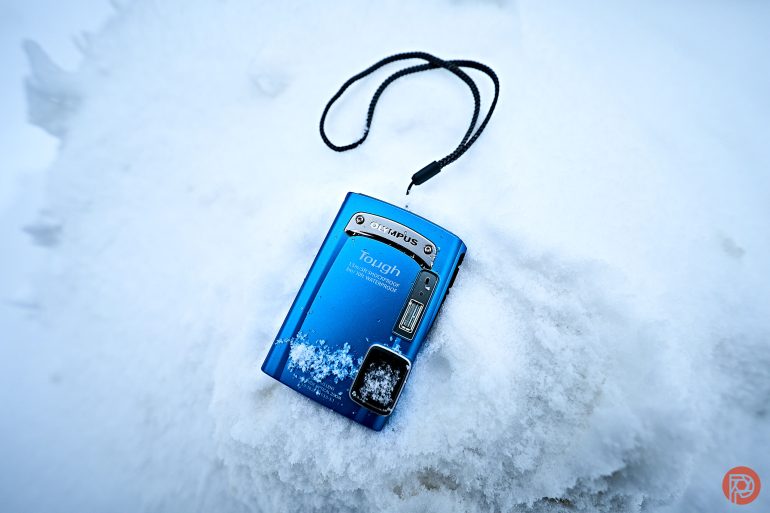
In contrast, the product photo of the Olympus TG320 above was shot in-camera, brought in Capture One, and edited using manual adjustments. After that, it was exported. After I shot the image with my Panasonic S1R II, it stopped being an image upon importing into Capture One. Instead, it became a digital canvas. The canvas was exported into a JPEG file, which ultimately is a piece of digital art.
It blows my mind that a camera like this can still function, still resist the super cold temperatures of NYC’s blizzards, and create images that can have me thinking about what a photograph really is. For a long time now, I’ve had the idea that digitizing your photographs to then edit them in Lightroom or Capture One means that they cease to exist as a photograph. And to a certain point, I still believe this.
This camera goes for an insanely affordable price point. In fact, a carton of pistachio milk can cost more.
After working with such complicated cameras that give me full manual control for a while, I’m pleasantly surprised by what this humble point and shoot can do. It’s still weather resistant after almost two decades, offers up 14MP, a ton of art filters, a good image quality. Truly, a camera like that shouldn’t be this good. Modern cameras don’t even have me thinking this hard about the art form.
And this, is the tough part. I know it’s a rare mindset and I know that it’s going to be insanely difficult to convince a ton of photographers that they’re wrong when the marketing machine has said otherwise. And on top of that, it’s going to be hard to convince photographers that maybe, just maybe, we’re all actually frauds. But this camera really has me doing that.
Here are a bunch of sample images from the Olympus TG320 that I absolutely adore.


Yes, I know a lot of them look like they’re from old punk rock zines. But those zines were made with a printing process. This, instead, is made with pixels and light then processed through an onboard image processor to render the scene in a different way. By all means, it’s a photograph because it’s a direct result of painting with the light hitting the sensor.
But how could I say the same otherwise?
Get rid of the ads!
Did you enjoy reading this article as much as we enjoyed writing it? There's a way to support us and our reporting, getting ad-free navigation and more as a bonus. Subscribe to us for less than a coffee per month —just $3.99— or take advantage of our yearly subscription with a hefty discount for only $25.- An ad-free experience
- A free mystery box for Lightroom or Capture One
- All the books in our store
- 20% discount on Capture One
- 30% discount on Imalume Photo Theft Protection
- 20% off Herbs and Kettle Tea Company.