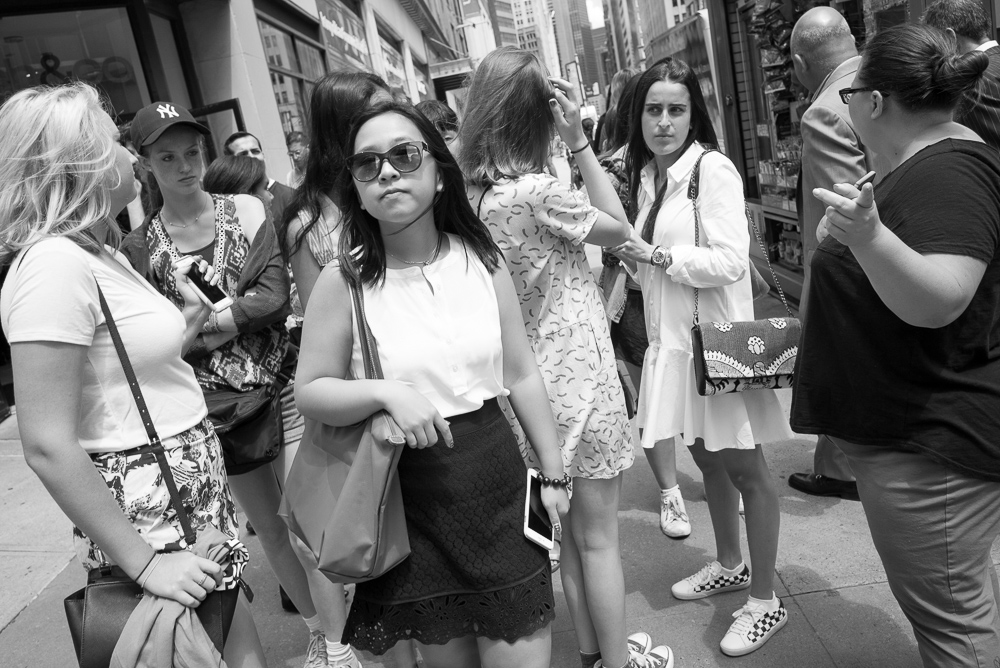
The rule of thirds are a wonderful thing to tell photographers to follow when they’re first starting out. But when you’re advancing, it’s a good idea to throw them out. And as you become even more advanced, perhaps all you’ll end up doing is centering your subjects in the middle of the frame. The good thing to remember, especially about street photography, is that there really are no rules or set tribe saying what’s good and what’s not. So forget about the rules!
This article is a dive into our archives and was originally published with the title, “Screw the Rule of Thirds: “Composition” For Street Photographers.” It is being republished here with a new introduction and is meant to spotlight articles we’ve done way before anyone ever questioned that what we were writing was done using AI.
All images by Mason Resnik
“I’VE SEEN THIS PICTURE BEFORE.”
It may be cliché to say that rules are made to be broken, but it can be argued that the genre of street photography is the photographic discipline where breaking the rules will most likely allow you to see—and capture—more interesting photographs. Traditional compositional rules come out of pre-photographic art forms. Leading lines, the rule of thirds, centered subjects and so on were developed over centuries by painters, and others using two-dimensional forms in order to organize the content of their images and create a common visual language. Visual artists—painters, photographers, cinematographers and the like—are taught these rules and mostly conform to them.
What are these rules, anyway?
What are these rules, and why are they, well, so 19th century? A quick recap: The Rule of Thirds (AKA “Golden Thirds”): Imagine an image was a tic-tac-toe board, divided into vertical and horizontal areas. The lines that mark off these areas intersect. According to this rule, you should align the subject of your image with one of the four intersections if you want to create a more pleasing, dynamic composition.
Leading lines: Leading lines are lines that lead the viewer’s eye through the image. They are a strong compositional element. One example would be receding train tracks. Fences, bridges, winding roads, horizons and architecture all can provide strong lines that will guide the viewer’s attention.
Centered Subjects: Plop the subject in the center of the frame. Shoot. It’s balanced.
Patterns: Repeating patterns, whether they appear in nature or are man-made, create a rhythm in a photo that can be pleasing.
Balancing elements: If you have a strong element on one side of the photo, you should have something on the other side to balances it. Heaven forbid you should have everything concentrated on one side of the image. It might tip over.
There are other rules, but these are the most well-known. They trace their roots to classical painting and drawing, dating back centuries. They work great when you are planning to create a piece of art. But when it comes to street photography—spontaneous, reactive, and chaotic—the rules of composition can limit the photographer. Photographs are created in an instant. Yes, you can set up and carefully compose a shot, but that’s more of an illustration using photography as a medium. In short, street photographers can easily become visually hamstrung by the rules. So, screw ’em. Here’s how.
Form and Content
To understand a more purely photographic approach to creating a successful street photo, let’s drop one word, “composition,” and redefine another, “subject.” Replace composition with form and content. Form is the structure of the photo—the elements within the frame that hold it together. The Content is what’s going on in the photo. This is not a new concept. Cartier-Bresson described it as the Decisive Moment. His words: “To me, photography is the simultaneous recognition, in a fraction of a second, of the significance of an event as well as of a precise organization of forms which give that event its proper expression.” Garry Winogrand took this idea a step further and said that the greatest photographs “showed a tension between form and content.” In fact, it is Garry Winogrand’s definition of a photograph that points the way for street photographers:
“A still photograph is an illusion of a literal description of how the camera saw a piece of time and space.”
Let’s parse that, because a deep understanding of that statement shall set you free.
1. A still photograph is an illusion: A photograph, dear friend, isn’t real. No matter how realistic it appears to be, it is two-dimensional. As you might be aware, the world exists in three dimensions. Oh yeah, it also doesn’t stop.
2. …a literal description…: Although it is an illusion, photographs look real because they describe what was going on at that moment. Still photography is uniquely equipped to describe things literally.
3. …how the camera saw…: Our perception is continuous. We cannot stop time, although we can recall moments in our memory. The camera is accurate (assuming focus and exposure are correct) in recording the scene in front of it at the moment you, the photographer, clicked the shutter release.
4. …a piece of time…: The camera exposes the scene for a fraction of a second—a piece of time. Contrast that with painting, where the painter imagines a scene and creates it over time, either hours, days, weeks or sometimes years.
5. …and space.: The camera captures everything within a four-sided frame, reducing it to the size of a print. Nothing exists outside those four edges, so whatever exists within the edges is important to the photograph.
So, to further paraphrase and parse Winogrand, how the camera saw that piece of time and space is responsible for how it looks. And that means, a photograph can look any way, and there is no way that a photographer has to look. And that means…ta-da…no external preconceptions of how an image looks need be applied to photographs. Now, let’s redefine “subject”: The subject of the photograph is the photograph itself! Forget figure-ground relationships. Uncle Joe is not the subject of the photograph; he’s an element within the photograph, just like the trees and the back of the toolshed are elements. The subject is everything that’s going on within the frame.
That’s it. You’re now free to drop your rules of thirds. While Winogrand made heads spin with his photographic theorems, I think I can boil it down to four sentences that should be simple to understand:
1. Photograph things that interest you.
2. Find interesting ways to photograph them.
3. Take a lot of pictures.
4. Edit tightly.
If your mind is filled with rules, when you are in the moment the process of forcing your photos to conform to those rules you might miss a more interesting picture. Instead of looking for a horizon that’s parallel to the horizontal edge of the image, look for a strong vertical element that’s parallel to a side edge. Instead of neatly placing your elements on the left or right thirds of the image, look for parallel action at different distances, and fill the frame with them. Use buildings, trees cars and whatever else is in the background to strengthen the form of the photo. Watch people interact. Look for ironic juxtapositions.
With all of that going on, you won’t miss the rule of thirds.
Get rid of the ads!
Did you enjoy reading this article as much as we enjoyed writing it? There's a way to support us and our reporting, getting ad-free navigation and more as a bonus. Subscribe to us for less than a coffee per month —just $3.99— or take advantage of our yearly subscription with a hefty discount for only $25.- An ad-free experience
- A free mystery box for Lightroom or Capture One
- All the books in our store
- 20% discount on Capture One
- 30% discount on Imalume Photo Theft Protection
- 20% off Herbs and Kettle Tea Company.
- 20% off your order from MPIX printing services.
- 5% off Viltrox Products via their eCommerce store.
- 10% off all film developing, printing and scanning services from Blue Moon Camera and Machine
- 15% off 7Artisans products: The lens and accessory maker is offering a sweet discount for Phoblographer's readers.