


Cameras and lenses have undergone plenty of evolution over the past few years. Companies such as Canon, Nikon, Sony, and Fujifilm have been innovating their models, with some often standing out more than others. Similarly, the landscape for lenses has undergone a significant shift, with some types of optics gaining popularity over others. Today, we take a look at how our choices have been shaping the camera industry.
DSLRs are still searched for

DSLRs were the most searched terms in 2020, but as the years passed, mirrorless cameras gained popularity. However, by 2025, one sees an overlap between the two formats, with mirrorless cameras gaining the most attention between August 26 and September 5 of this year. However, it is unclear what could have led to such a spike, given that the only launches were around the Hasselblad X2D II and Ricoh GR IV.
The patterns also reveal a consistent interest in mirrorless and full-frame cameras, while DSLRs show a gradual decline. The pattern has also been more volatile, which means that people may change their minds based on rebates and sales. Similarly, APS-C cameras continue to show minimal interest, which is fascinating given that Canon’s most popular camera was the R10 in 2024. Compact cameras are not too far from APS-C cameras, but they seem to have performed a bit better in the past few months. The latter two could also face lower search results, as some people may be looking for specific models.
Zoom Lenses are Everyone’s Favourite
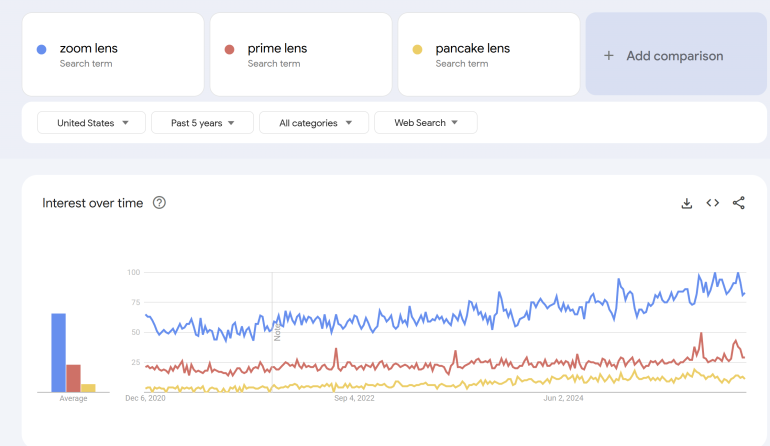
Over the past five years, zoom lenses have remained dominant leaders in the market, followed by prime and pancake lenses. However, zoom lenses have also been volatile, which could be affected by seasonal fluctuations. Despite this, zooms have an upward-facing rise, while my prime shows continuous growth, and pancake lenses prove that they can also grow. The latter could be due to the limited number of pancake lenses. Fujifilm, Viltrox, TTArtisans, Canon, Nikon, and Olympus are some of the brands that have launched these models, but they do not come as frequently as zoom lenses.
In fact, this proves that zoom lenses are chosen for their versatility, while prime and pancake lenses are often selected for their form factor or fast aperture. In fact, given the type of mirrorless cameras and the form factor we pursue, pancake lenses have a chance of growing if we introduce more models.
Overall, mirrorless full-frame cameras and zoom lenses are the more in-demand options today. Some individuals opt for full-frame DSLRs, but the number of buyers can fluctuate based on factors such as budget, sales, or the introduction of a new product. With more third-party lens manufacturers entering the industry, it remains to be seen if things will change for zoom lenses.
The next five years can continue this trend, or we may see something different, such as medium formats becoming mainstream. Anything is possible, given the current trajectory we are on.
Get rid of the ads!
Did you enjoy reading this article as much as we enjoyed writing it? There's a way to support us and our reporting, getting ad-free navigation and more as a bonus. Subscribe to us for less than a coffee per month —just $3.99— or take advantage of our yearly subscription with a hefty discount for only $25.- An ad-free experience
- A free mystery box for Lightroom or Capture One
- All the books in our store
- 20% discount on Capture One
- 30% discount on Imalume Photo Theft Protection
- 20% off Herbs and Kettle Tea Company.