

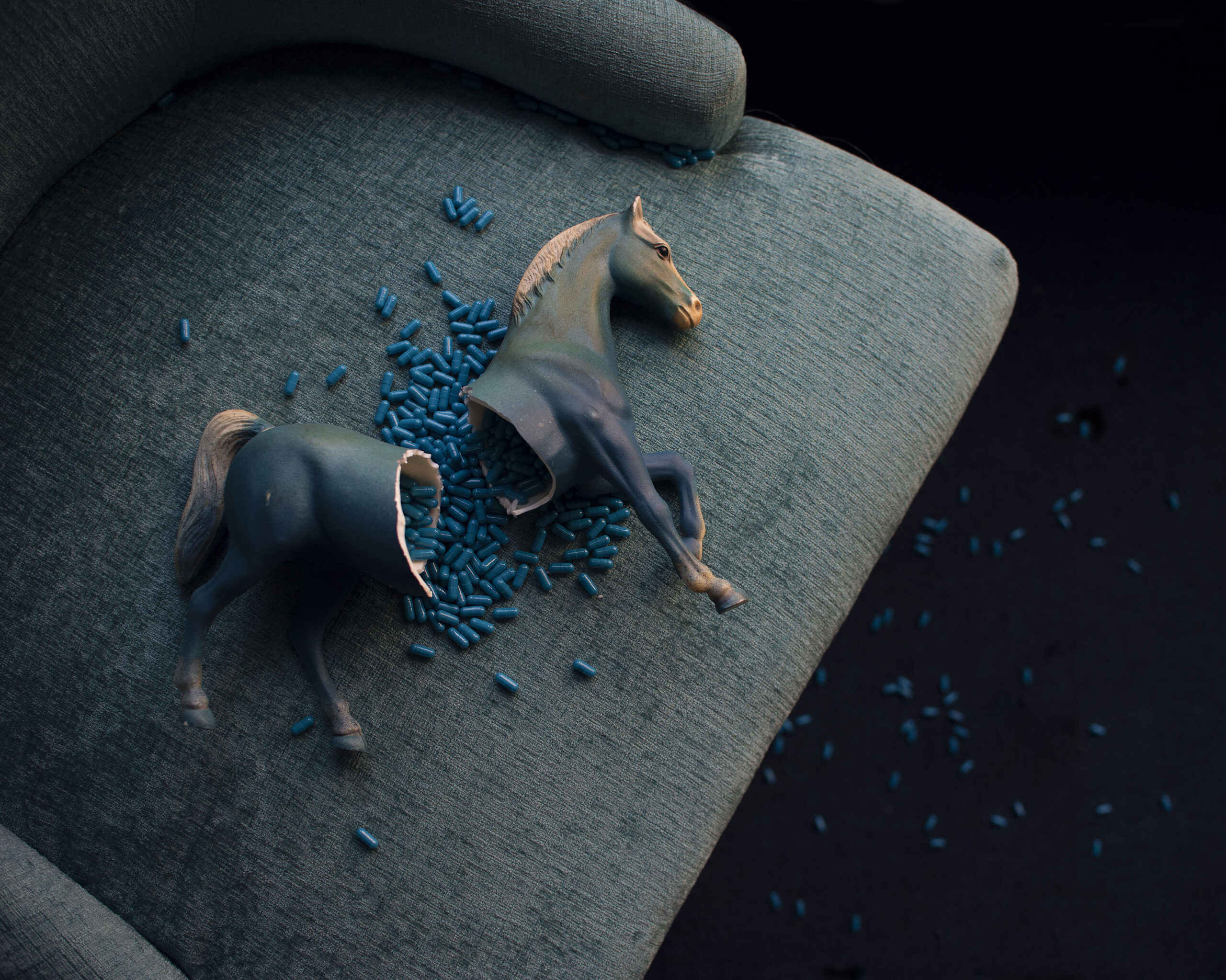
According to the World Health Organization, about 5% of the population around the globe has been diagnosed with depression. In other words, about 280 million continue to move about their day, despite having no motivation or interest in their day-to-day activities. In the United States alone, about 21 million Americans have depression, with 15% of the young population between the ages of 12 and 17 having severe symptoms. While there are medications, the stigma around depression, even in the most developed countries, is immense. In a bid to de-stigmatize and empathize with those suffering even today, we bring to you a round-up of photographers who have created brilliant images that address the topic. Their photographs and words will make you understand the significance of keeping an open mind.
All images in the article are courtesy of the photographers, used with permission.
Jonathan Higbee
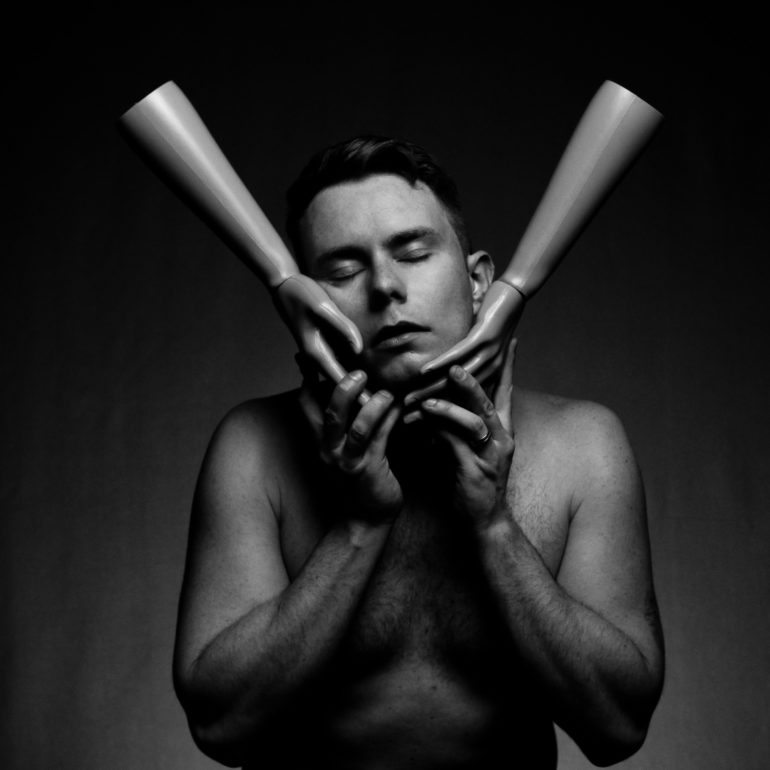
Jonathan Higbee began his series, Akathisia, when the photographer was struggling with depression, and after years of medication, trying to wean himself off it. The images showcase his challenges and how going off the medication resulted in immense withdrawals. Blood on the flood, the acceptance of touch, or simply feeling safe in one’s own mind and body are some matters that Higbee tried to translate into his self-portraits. Using both color and black and white, the photographer reminds us that depression and antidepressants can make one feel helpless, and even lead to self-isolation.
As he said in his interview with us:
On the days I couldn’t get out of bed because the withdrawals were too fierce, I worked hard to channel my fear into a photography project. I worked through the unsettling feelings and immense discomfort by trying to focus on expressing them in visual art.
Dana Stirling

Dana Sterling series sheds light on how depression can gradually creep into our day-to-day life. Her images, often showcasing the beauty of what’s around us, hint at how people don’t truly show what they are struggling with. Each of the images was photographed as they happened around her. In fact, the mere act of releasing the shutter helped her to maintain a “distance from the sadness itself.” In capturing the world that reflects her emotions, Dana gradually began to find a much-needed meditative space for herself.
As she told to us in an interview:
Sadness, for example, often hides beneath layers of routine, the brave face we show to the world, and the daily grind. You have to look closely to uncover what lies beneath the surface. In the same way, my images may appear as simple still lifes at first glance—captured moments that seem beautiful—but beneath them, there can be an undercurrent of sadness and heaviness that reflects my own emotions as the artist.
Heather Evans Smith
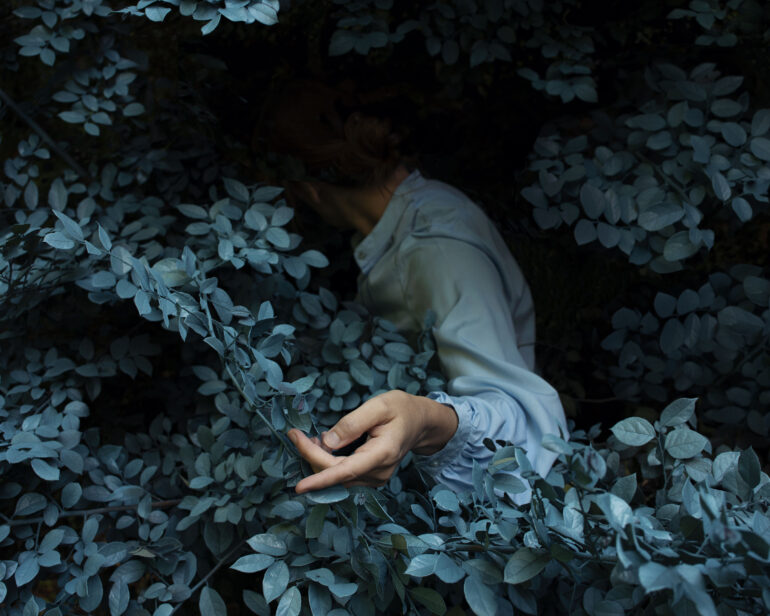
The World Health Organisation states that depression is often found more in women (about 6%) than in men (about 4%). Realising that many women go through mid-life depression, Heather Evans Smith created her enchanting series, Blue. The images are surreal conceptual photographs that showcase what it may feel like for one suffering from depression. The image above, for instance, can be read as one of the symptoms where people self-isolate to avoid any kind of interaction with the world outside. In a way, they cocoon themselves with their sadness. A picture is worth a thousand words.
As Evans Smith said to us in an interview:
Wanting to express mid-life depression in women (particularly myself) was my main inspiration for the series. I started to think about the slang we use for depression, such as saying, ‘I feel blue’ and ‘having the blues.’ For hundreds of years, this color has been associated with melancholy and sadness.
Ravinder Singh Pal
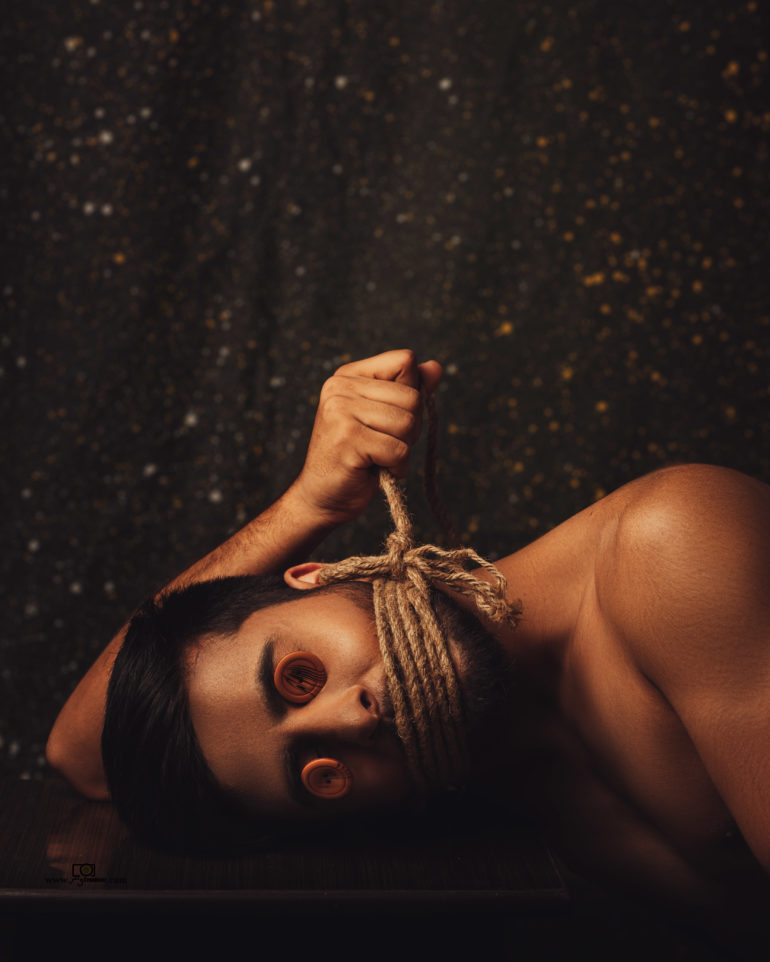
Ravinder Pal Singh learned that the conversations around depression have become more acceptable. Yet, the stigma attached to it has not waned. In his series Silenced, the photographer showcases how people suffering from depression often do not share their problems and keep most things to themselves. To showcase this, the photographer decided to use a rope and button eyes. The latter is a way to depict that despite seeing one’s friend or relatives’ readiness to help, people still have little hope, just like the dots of the button. A hard-hitting portrait, but it does hit the point straight.
As he said to us in our interview:
These days we hear a lot about depression and sadness. Then there are people who are shy about discussing their problems. I thought of doing this series because I wanted to give a message that I don’t think it’s just an incurable problem; try to look beyond or above your problem.
Holly Stones
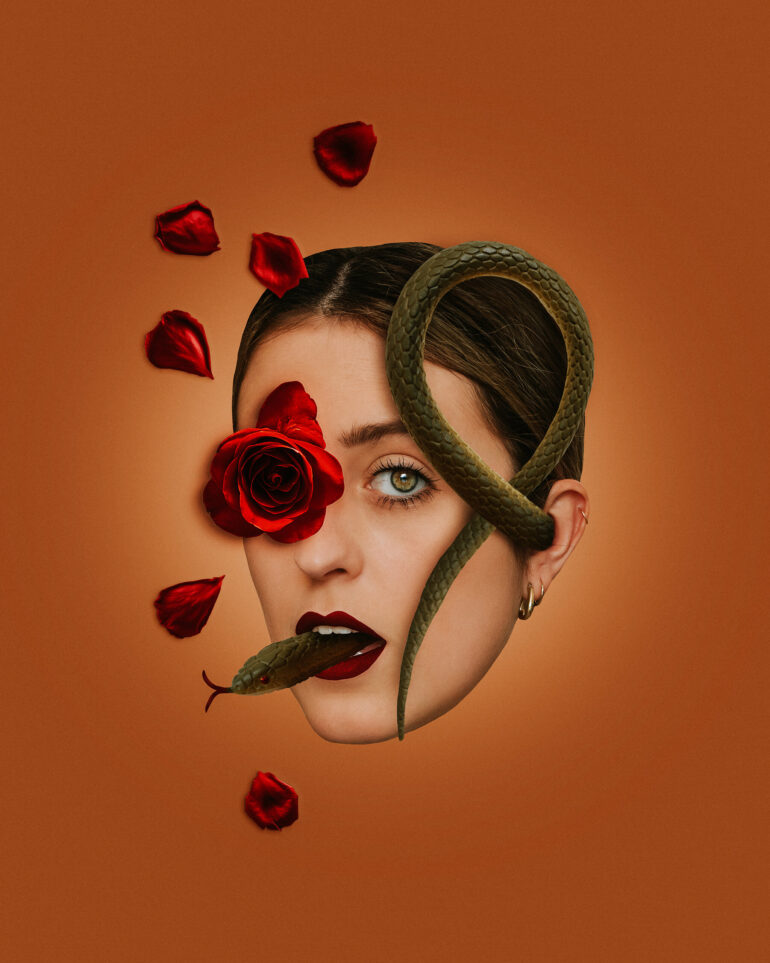
Holly Stones is a conceptual photographer who uses bright colors and great props to create expressive self-portraits. She has captured the Pink, Green, and Blue series, each following a monochrome tone, with the photographer dressing up in the same colors. However, while some pictures are fun, some are dark. Like the image above. Putting herself before the camera has helped her to deal with her depression, while also continuing to express how she feels. The image above showcases the fragility of self, with the flower, while also highlighting self-doubt that brews in her mind, through the inclusion of the snake.
As Stones said to us in an interview:
“I have suffered a lot with self-doubt, crippling anxiety, and depression over the years. Self-portraiture has helped me to channel those emotions. It allows me to express myself vulnerably, which in turn resonates with others and makes me feel connected to the world.”
Al Mefer

A Spanish photographer, Al Mefer’s series, Phantoms of the Brain, may seem like a series of long exposures of abstraction, but the series is designed to showcase the “tortured soul.” He reveals that anatomist Wilhelm His called neurons “dendrites” (from Greek “déndron”, translated as “tree”) to depict the transfer of electrochemical. Thus, by using trees, the photographer aims to highlight what goes through one’s mind during turbulent times, including “anxiety, depression, and despair.” In a way, one can realize what happens when one goes through any mental illness, and that is not their fault.
We hope each of these photographers has helped you have a better grasp of what it feels like to live with depression, and if you are someone going through the same, then you must give photography a chance to feel better. It may not happen in an instant, but when it does, you will be happy that you picked up the camera.
Get rid of the ads!
Did you enjoy reading this article as much as we enjoyed writing it? There's a way to support us and our reporting, getting ad-free navigation and more as a bonus. Subscribe to us for less than a coffee per month —just $3.99— or take advantage of our yearly subscription with a hefty discount for only $25.- An ad-free experience
- A free mystery box for Lightroom or Capture One
- All the books in our store
- 20% discount on Capture One
- 30% discount on Imalume Photo Theft Protection
- 20% off Herbs and Kettle Tea Company.
- 20% off your order from MPIX printing services.
- 5% off Viltrox Products via their eCommerce store.
- 10% off all film developing, printing and scanning services from Blue Moon Camera and Machine
- 15% off 7Artisans products: The lens and accessory maker is offering a sweet discount for Phoblographer's readers.