

Last Updated on 02/23/2025 by Nilofer Khan
Photographers around the world now have an exceptional opportunity to advance in their careers: the Xposure Photography and Film Festival in Sharjah, U.A.E. Launched in 2021 by the Sharjah Government Media Bureau (SGMB), Xposure has been designed to help image-makers from varied walks of life. An example of this is the U.K.-based photographer David Gibbon, who recently asked wildlife about how to create a winning wildlife image. If you are someone who has recently begun your journey, we are certain his tips will come in really handy, too.
Editor’s Note: The Phoblographer was part of the press trip to Sharjah. We were invited to see the festival, interact with the photographers, and share our insights with our readers. Since we believe in transparency, we want to let our readers know that the trip was entirely paid for, but this post is not sponsored. All the tips were part of David Gibbon’s talk, which we appreciated.
Minimalism

Quite recently, The Phoblographer spoke about how minimalism can be used for visual storytelling. It is a powerful tool that can yield positive results. At Xposure, Gibbon began his talk with the first rule: to use minimalism to bring out the narrative. He explained this by illustrating an image of a group of musk oxs he photographed at the North Pole. The image is stunning because it removes noise or disturbing elements and showcases the group of ox sharing in Gibbon’s direction. For this, he used exposure compensation to make his surroundings brighter. The use of minimalism helped him to be a runner-up in the Nature Photographer of the Year 2023.
Using The Elements

This is yet another tip that showcases how one can utilize the environment to create an image. For this, Gibbon showcased a fox caught in a snowstorm. What made the image stunning was the rule of thirds, coupled with negative space. The fox was at the right-hand corner of the image, with a wide expanse of the picture being covered with the snowstorm. This helped to showcase the plight of the animals in the wild as well as the sheer beauty of nature.
Placing an Animal in its Environment

One of the best ways to win an award is to showcase an image that helps us to understand the place where the animal thrives or survives. An example of this was a photograph of an Arctic Fox weathering a snowstorm. Gibbon was able to capture the image by following the footprints of the fox, understanding its route, and setting up a camera trap at f16. This resulted in a photograph of the fox’s home as well as the Atlantic Ocean and the mountains of Hornstrandir in the background. By simply adding the background, Gibbon achieved an image that will help environmentalists for their cause.
Using Light
Light is one of the most important parts of photography. However, in this case, Gibbon suggested that using the golden hour could help wildlife photographers stand out. He illustrated this at Xposure with a photograph of a Barn Owl listening for the voles on a fence. What stands out here is the use of the water on the grass below, which gives a lovely bokeh effect due to the golden hour. Similarly, in another photograph of two Black Grouse fighting for their mate, Gibbon used the dew as the foreground to create a bokeh and lead the eye to the bird at the back. As a result, light can be really helpful in separating the main subject from everything that is happening around it.
Creative Photography
Who says wildlife photography has to be documentary in style. One of the most important points that David Gibbon touched on was using techniques like slow shutter or multiple exposures. In one photograph, Gibbon used minimalism and multiple exposures of 9 images to create a pencil sketch-like image of a bird. It takes some time to figure out what is happening in the picture, but that is exactly what works in its favor. In another image, he focused on the beak and the eyes of the bird and showed the image using a slow shutter. While everything else resembled a painting, the beak in focus helped you figure out that it was a picture.
Using Behavior

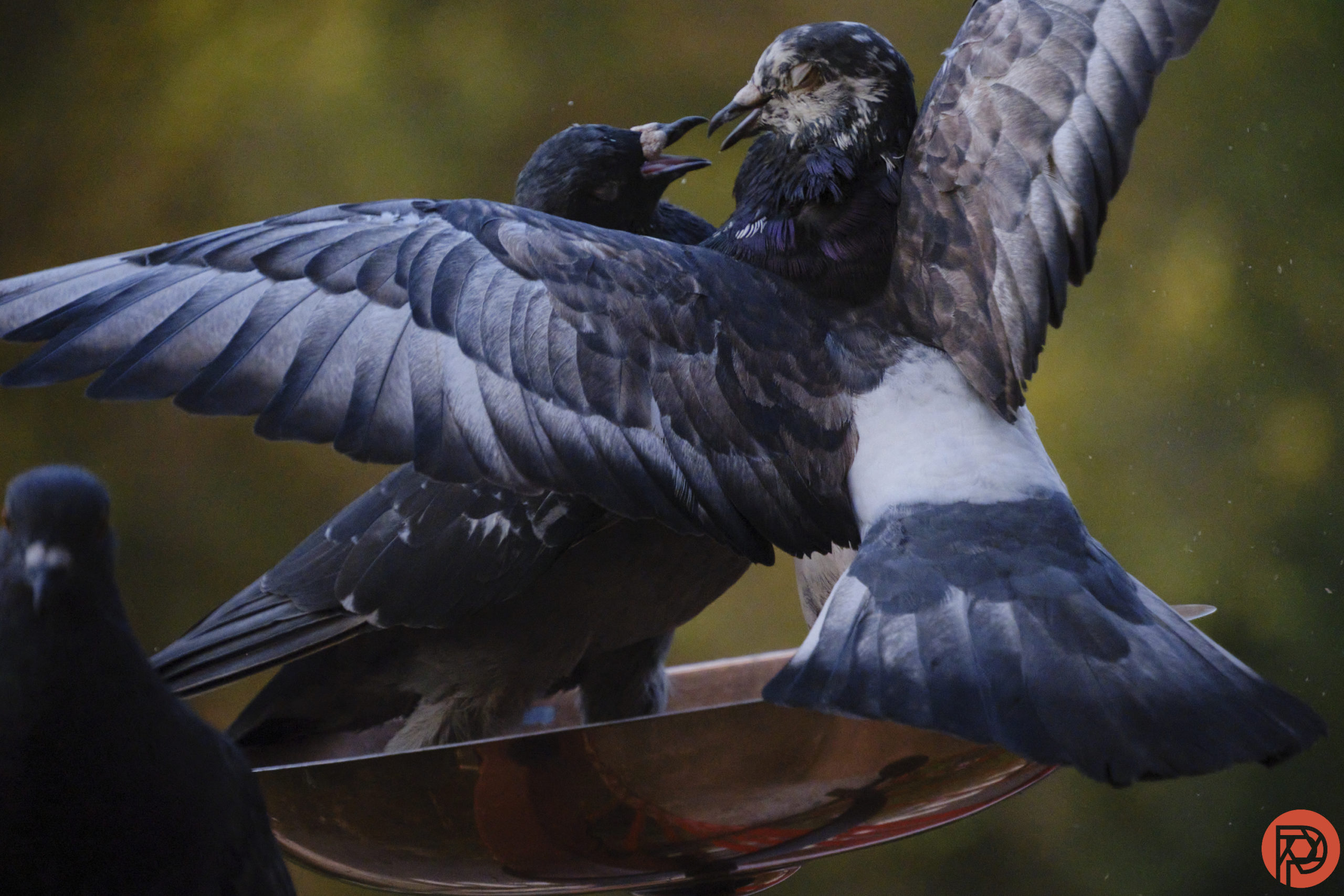
Last but not least, use all the tips given above and focus on the animal’s behavior to create an image. An example is the rare righting of two Arctic hares fighting in the wild. It is unlikely that you will ever see a sighting like this soon, but when you photograph their behavior in their environment, you get a truly special image. There is also another image of a bird that looks angrily at the camera as it flies above Gibbon. The striking photograph showcased its wide open beak and raging eyes, making one realize its defensive mechanism. Other examples, such as mating calls, hunting, and motherhood, are a few instincts and behaviors that can be utilized to get the winning shot.
Overall, Gibbon noted that perseverance, patience, and the ability to shoot for oneself are some things that can help you go a long way. Gibbon has been photographing in minus-degree temperatures, waiting hours to get one photograph. But when he sees a scene, he makes multiple images, which he minimally edits in Lightroom. We do hope that you apply these suggestions to your journey and create an image that not only wins awards but also satisfies your artistic side.
Get rid of the ads!
Did you enjoy reading this article as much as we enjoyed writing it? There's a way to support us and our reporting, getting ad-free navigation and more as a bonus. Subscribe to us for less than a coffee per month —just $3.99— or take advantage of our yearly subscription with a hefty discount for only $25.- An ad-free experience
- A free mystery box for Lightroom or Capture One
- All the books in our store
- 20% discount on Capture One
- 30% discount on Imalume Photo Theft Protection
- 20% off Herbs and Kettle Tea Company.
- 20% off your order from MPIX printing services.
- 5% off Viltrox Products via their eCommerce store.
- 10% off all film developing, printing and scanning services from Blue Moon Camera and Machine
- 15% off 7Artisans products: The lens and accessory maker is offering a sweet discount for Phoblographer's readers.
- 15% off a VSCO One subscription: Get a bunch of great tools with their all-in-one package.