


The main reason I gravitate toward retro-styled digital cameras is the connection they offer to a more analog-like experience. There’s something about the tactile feel of the dials and the slower, more deliberate process that brings me closer to the act of creating a photograph. This is exactly what draws me to cameras like the Nikon Zf and Fujifilm X-H2. Despite their modern design elements, those classic dials preserve the timeless essence of photography. Recently, a 3D designer envisioned replacing those dials with e-ink screens, and while I can appreciate the innovation, I’m not entirely sold. The physicality and simplicity of traditional dials are part of what makes the experience so rewarding. Replacing them with screens would strip away some of that, and it’s not a direction I’m eager to see photography go.
All renders seen in this article have been provided by Vladimir Markov and have been used with permission. Please visit his Behance page to see more of his work.
We first noticed these renderings in an article on Fujirumors. Digital artist Vladimir Markov created a concept showcasing e-ink screens and, more importantly, e-ink dials on a camera inspired by the Voigtlander Bessa. I enjoy the simplicity of these designs, but I wonder if it’s more of the smoothness and uncluttered feel of the camera that makes me feel this way. Anyhow, the idea behind this concept of Valdimir’s is not to showcase the camera itself but to see what e-ink dials on it would look like. To understand why this idea could have come about, it’s important to understand the benefits of e-ink displays and screens. But first, let us take a moment to acknowledge that camera manufacturers these days have embedded LCD screens into places we never thought we’d see them.

More LCDs Anyone?
Like in lenses, for example. The above image shows a small LCD screen on the Nikkor 105mm f2.8 Z lens. It’s primarily used to show a digital distance scale, although I think it can show various other values depending on what the control ring is used for. I presume the customizability of the display will be useful to those who make the most out of it, but I do wonder if it’ll just be another thing that will become harder to find replacement parts for in the future.
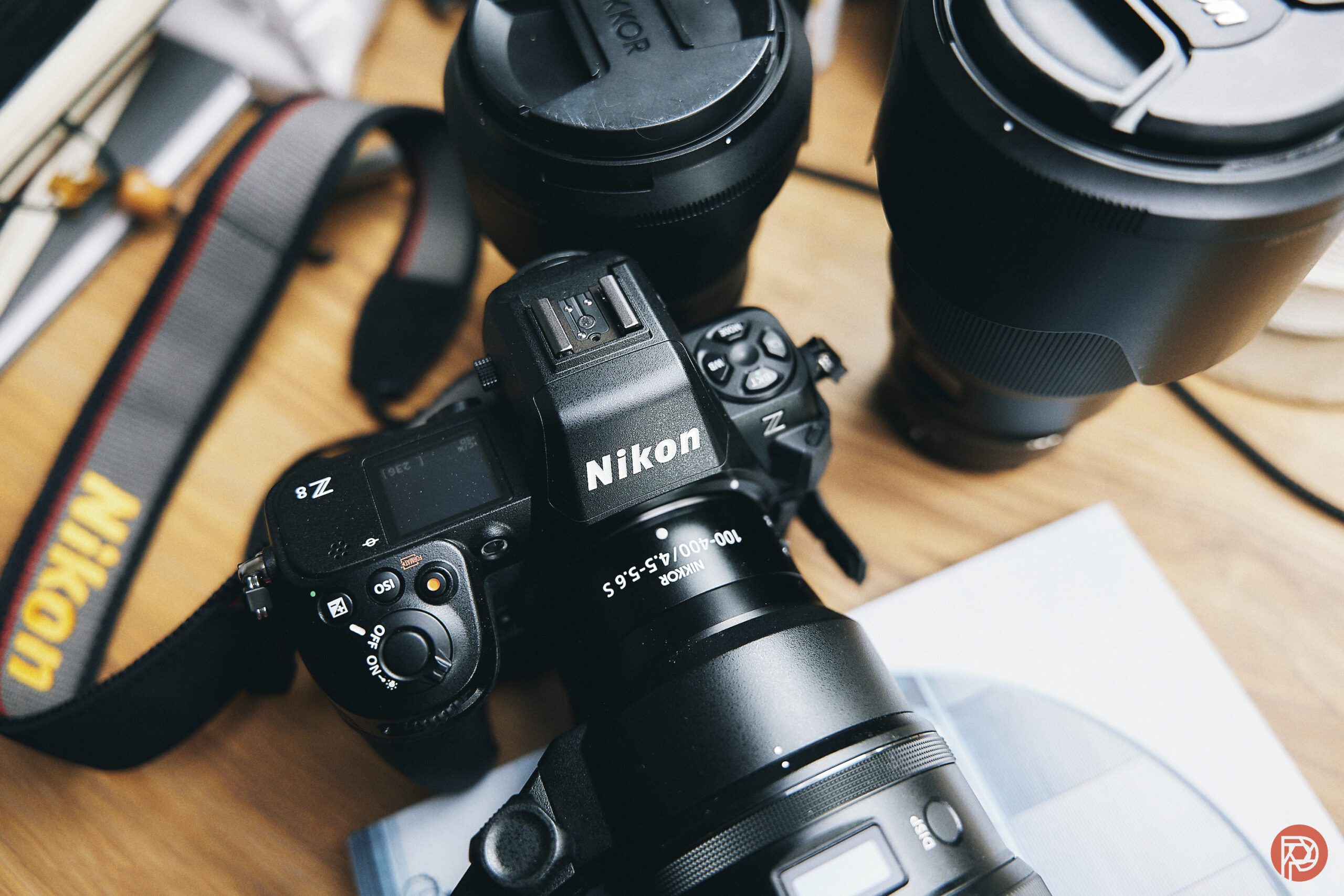
Aside from this, many cameras these days also have LCD screens on the top to give you a quick view of the EXIF data and other parameters being used to take your next photo. Could such screens be replaced by e-ink screens at some point in the near future? Why would companies even consider doing this? Let’s look at some of the benefits of e-ink displays over LCD and LED ones:
Why Would E-ink Screens Be Good In Cameras?

E-ink screens might not have the same flair as high-resolution OLEDs, but they bring some advantages that can’t be ignored. First off, readability in bright light is a game-changer. If you’ve ever tried to read an email or check settings under direct sunlight, you know the frustration of glare. E-ink solves that problem by mimicking the look of printed paper, giving you crisp, clear views in any lighting condition. For photographers who shoot outside, this can be a huge plus. E-ink displays only draw power when they refresh, so once an image or text is set, it stays visible without eating into your battery. But the real appeal? E-ink screens feel deliberate. There’s no flashy color or endless refresh rates pulling your attention away from what matters. It’s a focused, minimalistic approach that slows things down—just enough to make you appreciate the essentials. You’d think this would already be enough for camera companies to start integrating e-ink screens into cameras, so why haven’t they already done so?
Here’s Probably Why E-ink Screens Aren’t In Cameras Yet

While e-ink screens have their merits, they come with some downsides, especially when compared to the versatility of LCDs. First off, the refresh rates on e-ink displays are painfully slow. For something like reading or static content, sure, it works. But if you’re looking for real-time responsiveness, whether you’re adjusting exposure on a camera or scrolling through images, e-ink just doesn’t cut it. And even if you limit the use of e-ink to just the top of the camera, you don’t want to have a massive refresh/lag difference between this display and the main camera LCD. The one big drawback, however, has to do with colors. LCDs are bursting with vibrant hues, rich blacks, and punchy contrast, and e-ink—at least for now—struggles to keep up. At best, you tones that appear muted or lacking contrast, which isn’t quite what photographers or anyone who cares about visual accuracy really wants.
What Does Vladimir Feel?

I was curious to know what inspired Vladimir to create this concept, so I reached out to him via Behance, and he responded back quickly. He told me that he’s a designer based in Japan currently who occasionally does event and product photography, and that this e-ink concept was actually done for a project in usability some years ago. “As I enjoy photography quite a lot, that is what I chose. Since then, I have been making camera designs whenever I have some free time, more as a fun practice to keep up to date with various software and to explore and visualize some ideas,” Vladimir shared. While these designs were not intended to be fully developed products, they allowed him to experiment with new ideas in camera usability and functionality.
The idea is to always use what makes sense in a design and mixing the flexibility of information on a screen with a dial is the way to go at least for cameras, I believe. It is enough to live in Finland or Canada for a year to understand the appeal of dials.
When asked about whether e-ink screens would diminish the tactile experience of using traditional dials, Vladimir acknowledged the current trend of touchscreens dominating the market. However, he pointed out the importance of balance in camera design. “There is a huge craze nowadays with touchscreens, and indeed, they are very flexible compared to an analog interface, as it is possible to design and redesign an interface into oblivion. However, this is an unbalanced approach. The idea is to always use what makes sense in a design, and mixing the flexibility of information on a screen with a dial is the way to go, at least for cameras, I believe.” He emphasized the practical advantages of physical dials, particularly in harsh climates: “It is enough to live in Finland or Canada for a year to understand the appeal of dials.” Designers and engineers face a delicate balance of usability, marketability, and technical constraints, all of which could slow the introduction of such concepts. “Users generally like to see a lot of features when purchasing (bang for the buck), but in use prefer less (simplicity of use), a difficult-to-solve issue,” Vladimir added.
It Could Take A Long Time
Vladimir’s thoughtful responses highlight not only his deep understanding of camera design but also the challenges of blending tradition with modern technology while maintaining the tactile experience photographers love. When it came to whether the main LCD itself could someday be replaced by e-ink screens, Vladimir was skeptical. “There might be more options like the current Leica M11-D; however, the back screen has quite a few other uses, such as reviewing images, ease of use on a tripod, setting up focus on the touchscreen, etc., so I do not see a reason for it to be replaced as of yet.” He did, however, mention potential future integrations with smartphones, citing the Sigma FP as an example of an underutilized concept: “Sigma released an SDK, a great decision in itself, but left it entirely to others to create something with it.”
Get rid of the ads!
Did you enjoy reading this article as much as we enjoyed writing it? There's a way to support us and our reporting, getting ad-free navigation and more as a bonus. Subscribe to us for less than a coffee per month —just $3.99— or take advantage of our yearly subscription with a hefty discount for only $25.- An ad-free experience
- A free mystery box for Lightroom or Capture One
- All the books in our store
- 20% discount on Capture One
- 30% discount on Imalume Photo Theft Protection
- 20% off Herbs and Kettle Tea Company.
- 20% off your order from MPIX printing services.
- 5% off Viltrox Products via their eCommerce store.
- 10% off all film developing, printing and scanning services from Blue Moon Camera and Machine
- 15% off 7Artisans products: The lens and accessory maker is offering a sweet discount for Phoblographer's readers.