


Some of the best places to see compelling landscape photography are Behance, Flickr, Tumblr, and VSCO. The images there don’t conform to trying to please an algorithm. Instead, it lets a photographer indeed be who they are. But let’s be honest, sometimes it gets very plain. We can change it up a bit with special methods like longer exposures. However, most of that magic in landscape photography then comes out in post-production. That’s where photographers tend to just mess around. Very few of them really have a creative vision in mind, but if you shoot infrared, then your creative vision and how you see the world completely changes.
We’re exploring the idea of looking vs. seeing if you haven’t read many of our other pieces recently. Looking at a scene, you can capture it the way it is. But when you see something differently than what’s in front of you, you start to create and connect your technical and artistic sides of the brain. By design, the human brain can’t see in infrared. When you start to shoot with it more and more, you start to understand how to see in this way. The same goes for shooting photographs in black and white.

Infrared photography, especially full-spectrum photography that turns greens into different shades, intrigues us because it’s something totally different. Because it’s so unexpected, the brain wants us to stare at the images for a longer period of time. Here’s how that works:
- You’re probably looking at a landscape photo of an area they’ve often seen or never at all. If you’ve seen it often, then the area becomes boring to look at. But if you’ve never seen this area, you probably become a bit slower with scrolling past the image. This is a key reason why people don’t like looking at the same travel and tourism photos repeatedly. They all look the same.
- When you add in an infrared element, then things massively change. If infrared is being added to an area that you’ve seen often, the image suddenly becomes fascinating. That effect is amplified if you’ve never seen photos of the area that you’re currently peering into.
I realized this a while ago when I converted a Sony a7 camera to full-spectrum infrared by Kolari Vision. I decided to go photograph several spaces around NYC. And the result was a completely different rendering of the city.

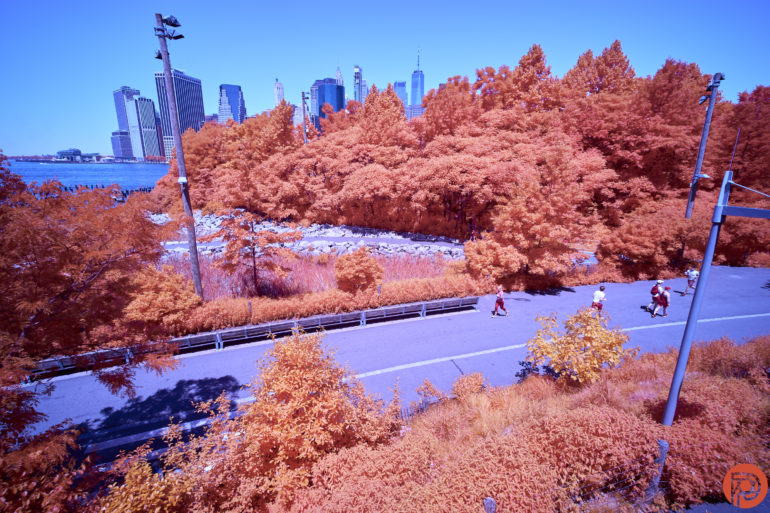


You’ve probably see some variant of the six images above in some way or another over the years. But when adding infrared to the scene, they suddenly look different. Another photographer could’ve probably done an even better job with this. When you look at the images you can tell that something isn’t quire right. By that, I mean that it’s not what our mind expects due to the fact that it’s breaking conformity.
It’s also a reason why drone landscape photography is so popular these days. We don’t often see those vantage points clearly and easily with the human eye.
This is what photography really has to start to become. We need to find ways to differentiate ourselves from others and not be replaced by AI algorithms. AI takes direction based on inputs, and most humans probably don’t know or understand how to express themselves well enough to an AI. That’s where you still have the advantage in making something unique.
Get rid of the ads!
Did you enjoy reading this article as much as we enjoyed writing it? There's a way to support us and our reporting, getting ad-free navigation and more as a bonus. Subscribe to us for less than a coffee per month —just $3.99— or take advantage of our yearly subscription with a hefty discount for only $25.- An ad-free experience
- A free mystery box for Lightroom or Capture One
- All the books in our store
- 20% discount on Capture One
- 30% discount on Imalume Photo Theft Protection
- 20% off Herbs and Kettle Tea Company.
- 20% off your order from MPIX printing services.
- 5% off Viltrox Products via their eCommerce store.
- 10% off all film developing, printing and scanning services from Blue Moon Camera and Machine
- 15% off 7Artisans products: The lens and accessory maker is offering a sweet discount for Phoblographer's readers.