Sony A77: First Impressions from a Nikon User’s Perspective

by Andy Hendriksen on 04/28/2012

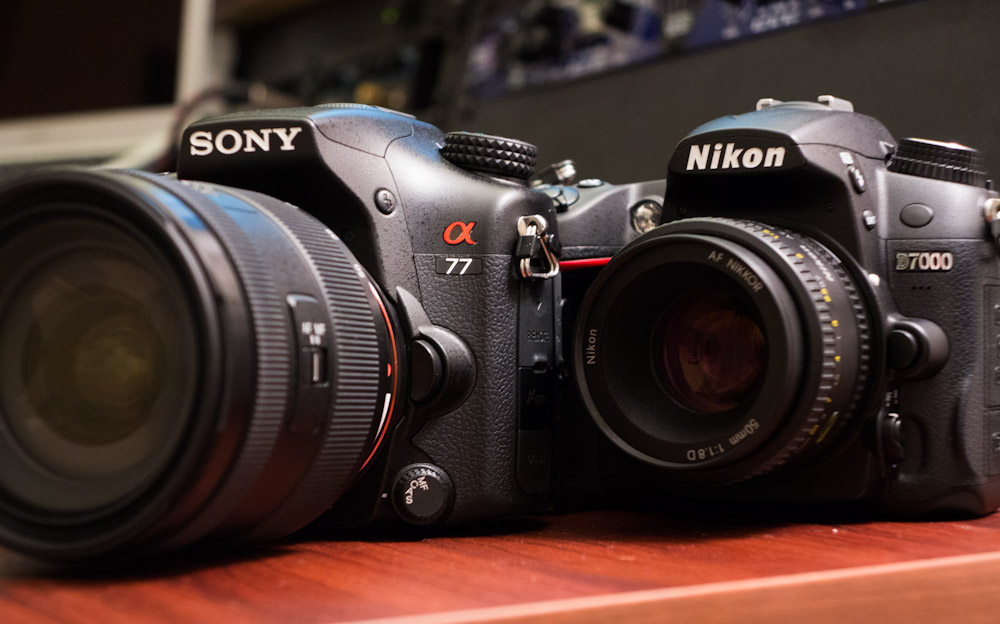
Here it is, the lovely Sony A77. I have this camera in my hands for a few weeks, and will be doing a full review on it, including tons of sample shots, and looking at 3 different A-mount lenses. In the mean time I wanted to tackle my first impressions and initial thoughts on the A77 from a Nikon D7000 user’s perspective. How does it feel to me?

Editor’s Note: When this was written, it was with the older firmware. We have updated it and noticed less lag. But with our unit, it doesn’t seem entirely gone.

Ergonomics and Build Quality

As soon as I picked it up for the first time, I thought, “wow, this camera is huge”. It dwarfs my D7000, and it’s size rivals that of even some full-frame DSLRs, despite this only having an APS-C sensor inside. The grip on this camera is chunky, and feels very good in the hand–much better and more secure than my D7000. It even has a nice little lip on the back for your thumb to hang onto for an even more secure grip.

Build quality seems decent, and while the camera is made mostly of magnesium alloy, it doesn’t quite seem to have the same high quality feel of some high end Nikons or Canons. The rubber covering on the grip is slightly loose, and seems to move around a bit, which doesn’t instill much confidence in it’s lasting ability. Nothing about this camera feels cheap, but it doesn’t necessarily scream “$2,000 camera” to me.
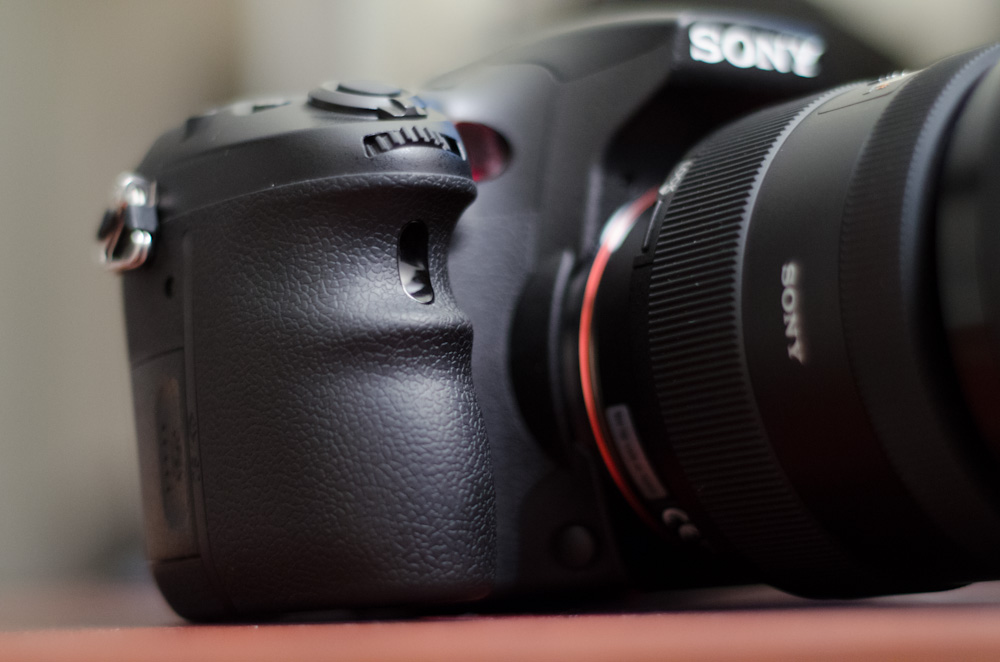
The “kit” lens, a 16–50mm f/2.8, feels absolutely fantastic in the hand. I put “kit” in quotes because Sony chooses not to call this a “kit” lens, as it seems to have a bit of a negative connotation to it. This certainly doesn’t feel like your ordinary kit lens, with it’s very hefty, high-quality feel, and it even has a reasonably fast constant aperture of f/2.8 throughout the entire zoom range. Rare to find something like that in a kit lens, regardless of price.

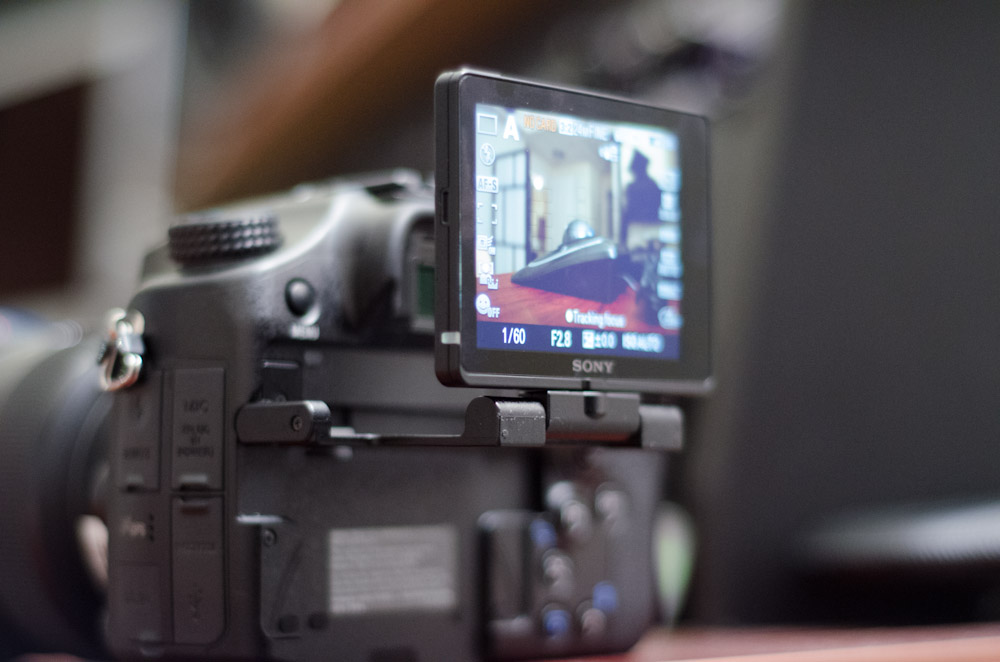
The articulating screen is smooth to use, and I could certainly see that being useful, particularly when shooting video with this camera, as I imagine many are likely to do. It does, however, stick out from the body of the camera slightly to accomodate the articulating mechanism, which results in increased nose grease marks on your screen after looking through the viewfinder. Not a big deal, but a small annoyance.
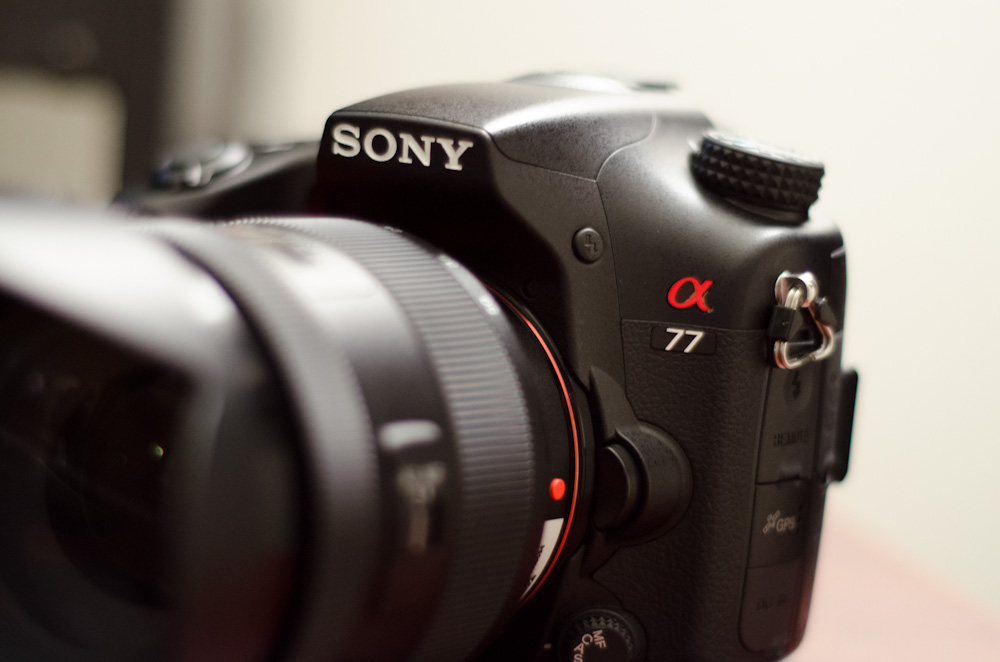
Overall I feel that the build quality is fine, but definitely not anything to write home about. I can’t help but feel like a camera in this price range should feel a little more solid, and I believe that there are many even less expensive cameras from Nikon and Canon that feel better. At the end of the day though, that’s not why you choose a camera, and it’s certainly not going to fall apart, so let’s move on.
In Use

I’ve only had this camera for a few days, and I will be doing a full review on image quality and features, but in the mean time I’ve shot a few images with the A77 and the “kit” 16–50mm f/2.8 lens, and I can report that I’m pretty impressed with it so far.

Because this is a translucent mirror “DSLT” camera, the mirror doesn’t move, but instead is able to reflect the light onto a phase-detection autofocus sensor, along with passing light through the mirror to the image sensor. The result is lightning quick autofocus all the time, even in video mode, where most DSLRs fall short, due to their use of the inferior contrast-detection autofocus system.

The issue with Sony’s translucent mirror system though, is that you lose the optical viewfinder. Instead, it’s been replaced with Sony’s brilliant OLED electronic viewfinder that has received a lot of praise from reviewers of the new Sony NEX–7. It’s the very same viewfinder in every way, and for an EVF, it’s really quite good. Colors are accurate, response is quick, and I didn’t often find myself longing for the “old fashioned” optical viewfinder on my D7000.

The problem though, is when you’ve spent so much time with an OVF, you’ve become very accustomed to the act of bringing the camera to your eye and immediately having an image in your viewfinder. The EVF on the Sony A77 uses an eye sensor to tell when you’ve brought the camera to your eye, and it introduces a split second delay before turning on the viewfinder. This is jarring at first, but I found I quickly become comfortable with it, and it rarely bothers me at this point.

The speed of this A77 is a bit confusing. On one hand, shooting with the camera is lightning fast. It can shoot up to 12fps in burst mode, and autofocus is brilliantly quick, particularly with this lens. On the other hand, almost everything else about the camera seems incredibly sluggish. Moving through menus, I always felt like it was one step behind me, and couldn’t really keep up with where I was trying to navigate. Even simple things like changing the aperture or shutter speed lag a second or so behind your finger twisting the dial. It’s certainly not a deal breaker, but it does feel strange that such a quick camera to shoot with can be so sluggish in other aspects.

When shooting though, it’s brilliant. Because the mirror doesn’t move when you take a shot, the shutter sound is nothing but the sound of the actual curtain in front of the sensor. It’s a very quiet camera, and feels right at home in street use. It’s not at all your typical DSLR sound, but it’s very refreshing.

I don’t want to make any true conclusions on image quality yet, as I haven’t had nearly enough time to shoot with it. Fortunately though, what I’ve seen so far has been awfully impressive. There will be a more in-depth look at image quality in the next post.

Looking Forward

I’ve been a Nikon shooter for years, and not until recently would I have ever considered Sony a viable alternative to the big guys. Sony has created something pretty interesting with the A77, and I believe it’s enough to make people think twice before diving into the Nikon or Canon systems. For me, it’s refreshing to know that there’s good alternatives out there. Options are good, and competition drives innovation. Sony’s diving into a pretty competetive market with the A77, and I’m happy to see them taking a slightly different approach.

I’ll be making more in-depth conclusions about the A77 in my future posts, but for now, I can say that I’m pretty impressed, and really excited to shoot with it some more.

Stay tuned for more coverage on the Sony A77, the 16–50mm f/2.8, 70–300 f/4.5–5.6, and the 50mm f/1.4.

Check out the Sony A77 on Amazon or B&H.

Please Support The Phoblographer

We love to bring you guys the latest and greatest news and gear related stuff. However, we can’t keep doing that unless we have your continued support. If you would like to purchase any of the items mentioned, please do so by clicking our links first and then purchasing the items as we then get a small portion of the sale to help run the website.

  • Tristan

    Please make sure your review unit is running the latest firmware released a 2-3 weeks back. It increases the responsiveness of the camera greatly. You can also turn of the automatic switching from lcd screen to the evf.

    • Andy Hendriksen

      Good to know, thank you. Looks like my review unit may need to be updated. I’ll be sure to talk about that in my full review.

      Also, I like the automatic screen/evf switching, I just wish it were quicker.

      • Mike

        With the screen folded in to face the camera there is no delay in switching the viewfinder on.  This is how it should be compared with the OVF because with OVF if you had live view on the screen it would take you even longer to re-enable OVF .

        • http://www.andyhendriksen.com/ Andy Hendriksen

           But then you’d have to flip out the LCD every time you wanted to review an image on it, which slows you down even more. I understand you can review images in the EVF, but I’m not sure that there’s much interest in doing that.

          There is no way to make a direct comparison, as they are completely different beasts. I was merely making an observation that shooting with an EVF is a distinctly different experience than shooting with an OVF, and it can take some time to acclimate to it, particularly if you are accustomed to a standard DSLR.

          • Mark

            While reviewing an image in the viewfinder will not be practical in all situations, it does have one huge advantage – the dioptric correction.  Many photographers don’t have “perfect” vision, needing reading glasses to view closer subjects, but who don’t photography while wearing glasses.  Using the viewfinder to review photos allows the photographer to get a “crisp” view rather than a “blurred” view on the rear LCD without reading glasses, or having to put on their glasses.  While this advantage won’t always be practical in all shooting conditions, it is nice to have when there is time to use it.

            • Dave

              Agreed. The diopter adjusted image in the EVF enables a wearer of reading glasses like me to leave the reading glasses in the pocket most of the time. One might still need them to confirm which buttons to press while making settings changes. But reviewing and enlarging stills in the EVF is a huge bonus to reading glasses wearers.

          • YellowHammer15

            You can also use the button that allows you to have the EVF always on and review your pics in the viewfinder itself. Or you can push the button on the top next to the EVF to switch to the LCD. I personall always keep the LCD turned in, that way when your eye is not up to the EVF nothing is on and this gets much more battery life  out of each charge. 

          • http://eswenson.smugmug.com/ Eric Swenson

            It’s extremely useful to be able to use the EVF for reviewing photos if you’re in a low-light environment where you don’t want to disturb people. I find the A77′s specs fit a low-light theater performance photography situation almost perfectly. If you use the electronic first curtain shutter combined with focus peaking at times to perfect focus accuracy even under harsh lighting conditions, the A77 literally checks off every single box. I always rather use the EVF and check exposure before taking the shot instead of with OVF DSLRs where I have to rely more than I’d like on the metering system.

  • http://www.facebook.com/albin.roussel Albin Roussel

    I stopped reading after the non sense of the sluggishness.
    they used the old firmware to review the camera.
    Now the lag with the dial is gone, end of.
    the camera IS uber fast.
    can’t wait to get mine

    • Andy Hendriksen

      I have now updated to the latest firmware and while the sluggishness is improved, it’s not gone entirely.

      • Tristan

        Thank you for looking into that. It was an issue when I first tested the camera (two weeks before the announcement and running 0.95 firmware). With each update there has been an improvement. I have not however requested it with the latest firmware. I just know some owners of the camera who said it was greatly improved.

  • Pingback: sonyalpharumors | Blog | Sony A77 at Cameralabs (Nikon D3200 vs A77)

  • Mike

    I think your comment on A77 size being so huge comes from the fact that you reviewed it with the 16-50mm lens.  I don’t think there is such a big difference in body size alone to D7000.  Overall A77 body is only about 10% bigger (mostly due to a more agressive grip) but also 10% lighter than the D7000.

    • http://www.andyhendriksen.com/ Andy Hendriksen

       It is indeed lighter than the D7000, but because of the large grip, it feels much larger in the hand, regardless of the lens attached.

  • Shearwater

    Regarding your point on the noseprints on the articulating screen – the screen holder articulates enough for the screen to face inwards so it never has to be exposed to the messy noses of the photographer.

  • AS

    Contrast AF is not what other DSLRs use, they also use phase detection but this can only operate when the mirror is down. Mirrorless cameras use contrast AF (e.g. Sony NEX series, Olympus Pens etc.)

    • http://www.andyhendriksen.com/ Andy Hendriksen

       That is correct, as I explained in my post, DSLRs use contrast-detection when in video mode, which is why they fall short of the phase detection system the A77 uses.

  • YellowHammer

    Great post, as a Sony shooter it is good to get the perspective of someone who normally shoots Nikon or Canon.I love my A77 but I am also objective. I know Sony still has something’s to improve on to compete with the big boys. One of the main areas being how they market to the professional and prosumer. We need more lenses also!!! As a professional wedding and portrait shooter, I will say that the Zeiss lenses we have are amazing. My 24-70 f2.8 is as sharp as most prime lenses, we just need more of them.

    • http://www.andyhendriksen.com/ Andy Hendriksen

       I agree. I’m really impressed with what Sony is doing these days, and it’s fantastic to see some real competitive cameras coming from them. But the lens selection is still an issue, and that’s something Nikon or Canon are going to have over Sony for quite a while to come.

      • YellowHammer

        Based on your brief time with the OLED viewfinder, do you think that the EVF will be able to eventually surpase the OVF? Or is this more an area of preference. I find that having the instant feedback a great way to shoot. However with the current technology low light shooting introduces to much noise. The A77 does have the nice feature that allows you to turn off the instant feedback, making it more like an OVF. I have had to use this for low light shooting with off camera lighting.

        • http://www.andyhendriksen.com/ Andy Hendriksen

           I’m not sure OVFs are going to go away anytime soon, but I will say that the OLED EVF gives me hope for EVFs. I’ve never liked them until I used the one on the A77, but I still prefer a standard OVF. Maybe it’s a matter of personal preference, and when there’s new breeds of photographers that haven’t been using OVFs for years, I doubt they’ll even think twice.

  • David Howland

    Have you tried working with any of the files in Lightroom or PS yet? I’ve often heard (and thought after using a NEX3 for a while now) that the Sony files don’t play as nice with Lightroom and PS and Nikon and Canon do. Nothing I can quite put my finger on but it just seems like the Sony files are more difficult work with. Any comment on that with regards to the A77?

    • http://www.andyhendriksen.com/ Andy Hendriksen

      I’ll be talking more about this in my full review, which I’m finishing up as we speak. But I can’t say that I disagree with you…

      • David Howland

        I’ll look forward to reading your full review then.

  • http://WWW.ABETTERDJ.NET/ A BETTER DJ AND PHOTOGRAPHER

    Very nice review! We’ve taken over 50,000 excellent photos with our 2 Sony A77s and probably 1,000 videos and I have to say that this camera lives up to its hype and then some.

    We shoot primarily weddings and concerts and were selected last December as the official photographers on the Rock Legends Cruise over ( http://www.rocklegendscruise.com ) all the Canon and Nikon users that applied. We shot over 9,000 excellent photos in 4 days and our first concert video came out spectacular. They liked our photos well enough to have us back to shoot Rock Legends Cruise 2 in January 2013!

    After upgrading to firmware 1.05 the Sony A77 camera has become very responsive to quickly adjusting settings on the fly. The EVF is incredible and one of the things that many reviewers fail to mention is that you can see your setting changes BEFORE you take the shot. This comes in very handy when adjusting exposure in difficult lighting situations.

    The video on these cameras is nothing shot of amazing. We have Asian versions so we only shoot at 50FPS instead of the 60FPS that US version gets but it still looks like you are watching HD movies on cable. With every other camera I ever tried to shoot concert video with the sound was useless if I was shooting on-stage or front row because the on-board mic clipped continuously. With the A77 I don’t need to use an external mic!

    As far as the photos I think the camera performs better in low light than most of the reviews. IMO wedding receptions provide some of the worst lighting situations and with a few quick adjustments the camera performs well.
    We have also shot thousands of concert photos without flash and had about a 90% useability rate.

    We have in depth reviews on both the Sony A77 and the Sony 16-50 lens as well as  lots of sample photos and videos on our site at http://www.abetterdj.net

  • Serge77au

    Selling my A77 +Minolta  50mm 1.7 + Minolta 80~200 2.8.
    All in mint condition, camera 6 months old. Going back to Nikon D800.
    Need the extra rez  for my panoramic landscape work. Contact me privately if interested.
    serge77au @yahoo.com 

    Some images here
    http://forums.dpreview.com/forums/readflat.asp?forum=1037&message=41348342

  • Pingback: Review: Sony Alpha A77

Previous post:

Next post: