

Four Reasons Why We’re Thinking About the Death of DSLRs All Wrong

by Chris Gampat on 02/03/2012

Read any consumer publication or self-proclaimed guru on the web and they will tell you that the death of the DSLR is coming. With the heralding of mirrorless interchangeable lens cameras combined with exceptional image quality, fast focusing, and lots of features in a smaller package, why wouldn’t one think that the DSLR has reached the end of the road?

Allow me to smack you in the face while you pretend to know what you’re talking about.

Editor’s Note: This is a very opinionated piece, but sometimes an Editor needs to speak from the heart.

Most Consumers Don’t Know What They’re Talking About

First off, most of these publications target audiences that are simply none other than fanboys. And to say that a DSLR will die to a fanboy is absurd when most of those people will sit there pouring over lab tests all day instead of going out and creating photos. I’ve seen them when people post our reviews in forums and complain about vignetting as if they can’t move a slider in Lightroom a couple of levels to the right or desaturate a certain color to get rid of fringing.

And these people will also probably never buy a camera.

Shot with film

Most people sitting there saying, “I want to the Canon 5D Mk III” are sitting there only fantasizing. The Mk II is still an excellent and formidable camera that took other manufacturers years to catch up to.

And sometimes, it seriously pisses me off that marketing machines do just that: confuse customers into thinking that they will never be able to take better photos unless they buy their product.

Mirrorless Cameras Can’t Catch Up in Sports

Most of said consumers will watch to capture sports, their kids running, their dogs, etc. Ever try doing that with a mirrorless camera? It’s not easy. Even the Olympus EP3 has a tough time getting objects extremely sharp and it can’t compare to the focusing algorithms in the Canon and Nikon DSLRs (60D and D7000 and above.)

And when someone says, “We’ll get there” the focusing algorithms in a DSLR with a mirror and pentaprism will turn the world upside down on its head.

As one technology goes up, so does another one proportionally.

Real Viewfinders

Think about it: people love cameras right now. They’re in love with them, in fact! Students in college will be trained on old cameras with real viewfinders for years and years to come. And they’ll become used to those old school viewfinders. Indeed, I can use both EVFs and OVFs. But an OVF’s experience can’t be topped by an EVF. Even the Olympus VF2 and Sony TruFinder still can’t beat it.

DSLRs Could Become Novelty Items

Let’s think about it: people love mirrorless cameras because of their sexiness (partially.) And one can easily argue that a DSLR is ugly.

Okay, that’s a fair accusation. But can you really tell me that a DSLR can’t evolve to become a sexy novelty item with excellent imaging capabilities?

Then there is the argument that it is too big.
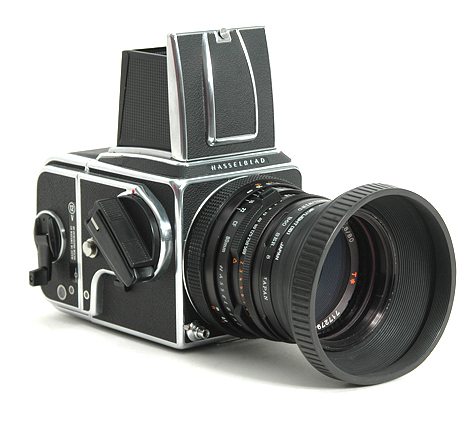
I want you guys to feast your eyes on the Hasselblad 500C: loved by Lomography lovers everywhere and actual photographers plus those that love novelty items. This thing is larger than most other DSLRs out there (though it is in fact a film SLR). Why is it loved though?

- Built like a tank

- Exceptional image quality

- Cheap

- Easy to Use

- Reliable

- Common item to find

- Shoots a large negative

With all that said, owners of the camera have no problem lugging one around. In fact, I’d buy one if I can.

Now who is to say that a DSLR can’t have an all metal build, be kept relatively light, be built like a tank, and also not shoot exceptional images? If one was made, it would probably be a big hit amongst all the consumers and magazines alike.

Think about it: we’re focusing too much on the mirrorless and not thinking about how the DSLRs will evolve proportionally. It is bound to happen.

I’d love to hear your thoughts in a discussion via the comments.

Please Support The Phoblographer

We love to bring you guys the latest and greatest news and gear related stuff. However, we can’t keep doing that unless we have your continued support. If you would like to purchase any of the items mentioned, please do so by clicking our links first and then purchasing the items as we then get a small portion of the sale to help run the website.

  • Jdtx83

    Agree with you to a point but mirror less cams will out selll dslrs at least when it comes to dslrs under $1000. I gave up my d90 for a Sony nex and Sony a33 & have never looked back. I’m happy with my gear. The majority of your readers are not pros hence the majority will buy a mirror less over a dslr because of marketing, size and final image quality. For me I will take a EVF over a OVF because I like what the sensor sees as oppose to what the lens sees. But again this is my opinion.

    • http://twitter.com/chrisgampat Chris Gampat

      Not necessarily. Lots of people who want mirrorless cameras mostly go for the sex appeal and because of the technology. But what you’re missing is that if a mirrorless has great technology, a new DSLR can outdo it by far in proportion.

      • Rob

        Chris… You are missing the issue of size/weight.  Technically, I certainly agree with you — But, if you are say, snowshoeing up the side of a mountain, you might find that a APS-C mirrorless is a much better compromise… 

        Also true for DSLR’s.  I wouldn’t use my 5D Mk II for sports — too slow!  So you pick the best compromise you can afford for a particular shooting environment. 

        • Anonymous

          If I’m shooting street photography, I agree with you as well about mirrorless cameras. But once again, as mirrorless technology grows, DSLR tech will grow in proportion and everyone will just sit there lusting over them.

          Think about how many people are holding out for the 5D Mk III or D800. Many of them I’m sure considered a mirrorless camera.

          What I’m personally waiting for is a Mamiya 7 II digital.

          *-Chris Gampat*
          Editor in Chief, ThePhoBlographer.com
          Twitter.com/Phoblographer
          Facebook.com/ThePhoblographer
          The Phoblographer on Google +
          The Phoblographer on Tumblr

          • Rob

            Ha!  I sold my Mamiya 7…. Great camera, but I just don’t shoot film that often.  A 7 II Digital?  That would be interesting!

            Waiting for Nikon/Canon?  Agreed… people are used to much faster product cycle times of phones, iPads, computers — and it doesn’t work for DSLRs :-(    I wonder how much futher N/Canon will consolidate their mid-upper range lines to be more responsive?  Not to mention Sony’s recent advances in Sensor designs.

          • http://twitter.com/jrphotographybc John Roberts

            A Mamiya 7 II D, yea… I am on board with that idea. 

  • Pingback: TheShutterSnap » Four Reasons Why We’re Thinking About the Death of DSLRs All Wrong – The Phoblographer (blog)

  • Rob

    I don’t think DSLRs are going away, just the market for them is starting to change. The last 5-6 years has been an odd trend, with everyone thinking they need a DSLR to get good image quality. Mirrorless cameras have shown people that isn’t true. For people who shoot casually mirrorless makes more sense. For people who love photography, I think there will always be a place for both types of camera. 

    • http://twitter.com/chrisgampat Chris Gampat

       Yes, but as mirrorless technology grows, DSLR tech will too.

      • http://www.facebook.com/PhotoJohn John Shafer

         This is absolutely true. As awesome as the auto focus on the Nikon 1 system cameras is, what I really want to see is that same system in a digital SLR. And it’s just a matter of time :-)

      • Jdtx83

        Yes they will by dslr having the mirrors removed for EVF and faster auto focus.

  • Rich

    I think it depends very much what you intend to shoot, not how seriously you take your photography. I consider myself quite serious, and yet have moved from an EOS 50D to a Panasonic G3 and a bag of primes. I mainly shoot landscape, and when scurrying around on cliff tops, the 50D was just more weight than I needed. I’ve owned a huge variety of cameras over the years, including OMs, Contaxes, EOS (film and digital), a Mamiya 645 and each had it’s pluses and minuses and a clear purpose. I can safely say that for me, the G3 is probably one of the best all-rounders (as much as I miss my lovely Contax Aria). 

    I can certainly say I now take a lot more pictures that when I used the 50D – taking the 50D out required a reason, taking the G3 becomes routine. I know there are limitations to mirrorless, but I don’t have much of a need for fast continuous AF (landscapes don’t move all that quickly!), and for my purposes mirrorless is ideal. “Horses for course”, as they say, everyone has different requirements, and it’s not fair to say that if you use mirrorless you’re in some way less serious than someone who uses a DSLR – believe me, I know a lot of people who should have bought a decent compact, rather than buying a DSLR!

    • http://twitter.com/chrisgampat Chris Gampat

       Have you played with a full frame camera? Use one and you’ll never want to go back to a Micro four thirds again.

      • http://www.facebook.com/PhotoJohn John Shafer

         I think full frame is overrated. Most people think they need it to do better photography. But they never really break down the pros and cons. Yes, the image quality will always be better. But so what? Do we always need better image quality? No.  Sometimes I need to spend less money, have a smaller camera or have the extra reach a crop sensor offers.

        • Rich

          Absolutely – as they say “the best camera you have is the one that’s with you”.

      • http://twitter.com/jrphotographybc John Roberts

        I have a full frame camera, and a M4/3… guess which one I carry on a daily basis and which one sits at home in the hard case until needed

      • Rich

        Did you actually read my post?? I have actively chosen m43 because of the advantages it has –  which are completely at odds with full-frame. This idea that you need to be using full-frame to be doing anything right is complete nonsense perpetuated by over-analysing techno-bores.

        • Anonymous

          Have you ever shot something wide open at F2 with medium format at all? It looks amazing. Yes I read your post. You can’t get that at all with Micro Four Thirds.

          -Chris Gampat
          Editor in Chief
          The Phoblographer

          • Rich

            Yes, I have, but I have also lugged a MF camera around fields with me and must say I prefer the portability of m43. Besides, why would I want ultra-shallow DoF when as I said, the majority of my work is landscape? I’m aiming for deep DoF 95% of the time. Of course sharpness and detail would be better, but probably not that you’d notice at the sizes I print at. As I said in my original post, it’s horses for courses, and currently the best fitting horse for my stable is m43.

            My point is that everyone has their own requirements – some need super-shallow DoF, other need no noise at ISO 256,000. Others, like me, need a camera that is small enough that it isn’t a burden on 10 mile hikes, but offers good enough quality for A3+ size prints (which I produce regularly with the G3). If I could find something full-frame that suits my requirements (and my budget), I’d get it. Problem is it doesn’t exist. At the moment, for me (and I have no doubt for a lot of other people) m43 offers the best trade-off in size, image quality and price. That’s not to say it’s the best; it’s the best FOR ME at the moment – and that doesn’t make me less serious than someone with a 5DII who can’t take pictures. 

            The point of Photography is art, although I think technology constantly tries to make it a science. Technology has always been a means to an end, but I think increasingly people seem to see science itself as the end. There were always bores who tirelessly experimented to try to achieve the perfect combination of developer, time, temperature and film, I think nowadays they’re just more prevalent (and visible, thanks to the internet).

  • http://www.facebook.com/PhotoJohn John Shafer

    Yeah, buddy! Nice article!

    I agree that digital SLRs are not going away. However, I do think they will move towards being a specialty camera, just like film cameras and medium format. The reality is, most people just don’t need the performance benefits they offer. For 80% or more of photographers, a compact system camera will get the job done with room to spare and do it for less money and cause less neck and shoulder trauma. The big test for me was when I took the E-P3 to Europe last summer. Sure, it wasn’t the best for mountain bike photos, but overall it did a great job and it was way better to travel with than my full digital SLR kit. Taking the E-P3 was absolutely the right thing to do. That said, when I’m going out to shoot a race or some serious ski or mountain bike photos, I take the DSLR and big lenses. As much as I love the Micro Four Thirds and Sony NEX systems, my digital SLR is still way better.

    • Anonymous

      Have I ever expressed how much of an honor it is when you comment? :)

      *-Chris Gampat*
      Editor in Chief, ThePhoBlographer.com
      Twitter.com/Phoblographer
      Facebook.com/ThePhoblographer
      The Phoblographer on Google +
      The Phoblographer on Tumblr

      • http://www.facebook.com/PhotoJohn John Shafer

         Pshaw! You embarrass me sir :-)

  • Ryan

    regardless of the changes in technology, you’re going to have to pry my DSLR from my cold dead hands.

  • http://twitter.com/chrisgampat Chris Gampat

     Agreed

  • Rob

    Strong arguement, but I think it needs tempering….
    The market IS changing, and certainly, DSLR’s are, and always have been a relatively small market niche for the vendors. Furthermore, the Smartphone is taking away the low end of P & S.  That said, A Sony exec. said, a while back, Nikon and Canon have the mid-high end DSLR market captured.  They will contine to refine products in that area and remain dominant. So, Sony is pushing mirrorless.  It is not good for focusing speed, as you pointed out, but you neglect the advantages… Faster shots/sec, lighter, smaller, cheaper.  Yes, you have to deal with EVF — But you forget that all camera catagories are a compromise of some sort or another.  I own and shoot 4X5, Medium format film, DSLR’s, P & S, and a mirroless Sony NEX 5N.  They all have their place.  There are times when I won’t carry my DSLR with two/three lenses when I can cover the same FL with two small lenes on my NEX.  And let’s not forget the iPhone is “Always with you”.

    No, the consumer articles really don’t apply to us photographers — but we tend to loose sight of the camera mass-market, and their needs, their tastes (or lack thereof), and features they want.  Talk to any BestBuy camera salesman — “What’s the feature most asked about?” — Answer:  which has the biggest zoom.

  • http://twitter.com/jrphotographybc John Roberts

    While the mirrorless (CSC’s) are up and coming, there are those that just want the optical viewfinder. I firmly believe that DSLR’s are here to stay, and will always have a place. And I am a M4/3 user for my personal work, but when I am being paid to shoot, the DSLR is still what I grab to be my workhorse. 

  • http://www.facebook.com/albin.roussel Albin Roussel

    I like the idea of mirrorless cams but my hands are way too big to make sense of them.
    the only one that ergonomically is good to my hands is the NEX-5 (N) but it is way too expensive!
    for that money I could get some cracking lens for my DSLR or buy an other rangefinder (film) cam + scanner.
    I’d love to see more old school design in the DSLR world though.
    most of the current ones are ugly beasts!

    I think the DSLR will die when people will start to have their hands shrinking in sizes!
    this is one of the only reason people love DSLR, everything is within reach at the press of a button, imagine that on a tiny mirrorless? erm not possible without getting confusing and losing any customer friendliness.
    I like when an editor shouts and is raging! always refreshing:)

  • Leosilve

    This like the Mac versus PC argument… a total waste of time. I have both platforms, use them, enjoy them for different reasons and purposes. I also have a Nikon D700, Canon 7D (for video), Panasonic GH2 & Olympus E-PL2… and I LOVE THEM ALL! Cameras are tools and each one of these have their own strength and weaknesses. As a guiding rule, for work, I would prefer DSLRS, for hobby personal shooting, m4/3s. I think DSLR will continue to evolve. Pros will always want them and demand features that they need which hopefully manufacturers will implement. Likewise, Im really enjoying my m4/3 cameras I mostly use them with legacy film lenses. Their image quality vs size and convenience make  for a compelling alternative for personal shooting.

  • http://www.facebook.com/dmelges Dave Melges

    Wow, you’re so terribly far off base, and I’m not just saying that because I announced the eventual death of SLR almost a decade ago.  Nothing has changed, and we’re at that doorstep now.    The irony of your blog post is that you use the term “fanboy” like its an insult, but you’re clearly an SLR fanboy, lol.    You believe things like SLR will continue to improve as mirrorless does, but mirrorless is at the BEGINNING of its development and SLR has been bell-curving, improving at a slower and slower rate…..you’re not going to see SLRs get significantly faster than they are now, but its very reasonable to expect mirrorless to improve a great deal.  Of course if you’re referring to how SLR’s will have better and better image quality, yeah, of course, but then their image quality isn’t a function of being an SLR.

    And the notion that anybody prefers an optical viewfinder is absurd.  Only people that haven’t experienced a GOOD EVF, or are FANBOYS, cling to the optical.    All you see through an optical is what you see without a camera at all, only smaller, and darker.  In a TRUE LIVE VIEW camera, you also see EXACT exposure, depth of field and white balance…..for an artistic shooter Live View is infinitely better than optical view, which is essentially shooting blind.

    But your point appears to be that SLRs will somehow manage to remain better at sports photography…you even suggest that sports photography is the most common interest.  You should jet around photography sites and do some research….its not all that common.   But you’re right, it can be very challenging shooting moving kids, etc, without fast autofocus and fast shutter release and fast continuous focus and drive.   Absolutely true.  Too bad the FUTURE fastest cameras won’t be SLR… in fact, in some ways, the fastest cameras RIGHT NOW already aren’t SLR.

    Try shooting a SONY SLT for a while, and then get back to us one whether NON-SLR cameras can be FAST.   While SLRs are, BY DEFINITION, relegated to only focusing until they take a picture, SLTs can focus continuously, NEVER having to stop focusing to flip a mirror, never losing track of a moving subject……..think they’re fast right now?  On generation TWO?  Wait till SLT has two more years to perfect that system and SLRs will be proverbial DUST.  The Sony a77 already blows away Canon and Nikon in every speed category except follow focus, and that one minor lack is NOT a result of the non-SLR technology.

    And that Sony OLED 2mp+ electronic viewfinder (watch for one even better in the a99) is already almost optical in quality, but with the added bene of showing you EXPOSURE, and WHITE BALANCE.   And all of this argument doesn’t even need to include the facts that mirrorless cameras are LESS EXPENSIVE, SMALLER, and LAST SIGNIFICANTLY longer.   My Sony a33 as ONE POINT FIVE MILLION exposures on it!  Try that with even a $5000 camera with a moving mirror….no chance.

    Whats funny about your errant post, is its just not even close…..this isn’t a 60-40 kind of debate…..SLR is a dinosaur technology, already maxed out, and just waiting for the junkyard.  You are right about it becoming a novelty item though……but thats like arguing with yourself.  Anything that becomes obsolete becomes a novelty item, lol.

    • jake

      yeah you are all right and I know it  cause I use A77V , NEX7, NX200 and D7000, but most of pro DSLR people never try to listen to me or any one that thinks the death of DSLR and RF are coming……

      but once you use it , then you realize there are many more pros for the ILC  cons for it and as you said the AF of the A77V is much better than that of the D7000 , it keeps tracking and tracking and the EVF ever gets blackout.

      the NEX7 literally has 20ms  shutter lag that is the shortest of all.  the EVF lag that always D-SLR lovers use  to dismiss the ILC or mirroless is actually much less significant issue than the shutter lag and mirror blackout issue of the DSLRs.

      the NEX7 is really fast and NEX5n is eve faster and the A77V is really amazing, its AF is the best of its kind , it easily keeps up with the D3s or 1D4.

      and as you said this is at the  beginning stage of  ILC/mirroless development.

      so, at least in a couple of years or so, I bet about 70 percent of people shooting mirroless and probably D5 or 1DX2 wont have the annoying mirror.

      • Anonymous

        The A77 is a DSLR and its better than the D7000 because the D7000 isn’t meant to take it on. The D400 if it ever comes out will be.

        The A77 replaces the A700, Sony’s older APS- king.

        Please get your facts straight people.

        -Chris Gampat
        Editor in Chief
        The Phoblographer

  • ronin

    Two different characteristics of cameras:  The shooting and the carrying.  If you know you’re going to be shooting constantly, use the best possible.  If you’re likely to be carrying more than shooting, or maybe even not shooting, you go for lighter weight.

    Otherwise, honestly, unless we’re talking about a compact p&s, they’re not that different.

    A lot of marketing- including marketing by pretend fanboys- is planned to make us feel bad about ourselves- or in this case, our cameras.  SLRs are SO HEAVY and SO BIG.  They weigh 40 pounds and are the size of a Labrador dog.  Therefore, you must buy our product.  We use less materials and eliminate the mirrorbox, so they cost less to produce.  They have distorted uncorrected lenses that must be corrected in software, so they cost less to produce.  But they cost as much as small SLRs and SLR lenses and the quality is less.  So you must be convinced their value is to replace those gigantic heavy SLRs.

    I bought a Panasonic G3.  I was surprised how big it was- I had expected smaller.  Nice camera and all, but it was not THAT SMALL and not THAT LIGHT.

    I do like nice compacts.

    Don’t get me wrong, they are all nice cameras.  But it’s interesting how when SLRs sales slow way down, companies create whole new segments, and convince us to buy, in order to maintain corporate growth.  Marketing is amazing.

    • jake

      try a NEX7 or NX200 , then you may change your opinion.
      the ILC cameras with APS-C are designed with digital sensor and CDAF in mind and that should be able to replace most of DSLRs.

      that said , I dont think all DSLRs  die out so soon but they will just like films and Range Finder or large format.

      • Anonymous

        I’m honestly done with APSC. As stated earlier, I need full frame or medium format.

        -Chris Gampat
        Editor in Chief
        The Phoblographer

        • Anonymous

          I thought so too, But I dumped my D300 for the D7000 and once I shot that and the D700 together for several months, I dumped the D700. YMMV, but APS-C continues to track a couple of stops behind with very little difference otherwise. So if you don’t shoot in the dark for a living, then not much difference. Of course, perhaps you are producing 50″ prints for a living … then I get your point, I suppose. (And even then … the next generation’s gonna have a lot of pixels.) Managing the light makes a whole lot more difference than the size or number of pixels the vast majority of the time …

  • Alex Z.

    I am of the opinion that mirrorless
    will supersede SLRs because SLRs were designed with film in mind and
    are disadvantaged in some digital aspects. The biggest one (and most
    important to me) is the histogram display. I love that thing. Being
    able to see a spectrum of light values of the image in my camera and
    being able to see the different color values really help get exposure
    and colors correct. That easily beats my old film SLRs with their -1
    to +1 exposure display.

    I can’t think of an SLR that can show
    the histogram through the viewfinder. But mirrorless cams with
    electronic viewfinders can (and some of them only show the histogram
    in the back display and just do away with viewfinders altogether,
    which is not surprising for the consumer market. What was the last
    point-and-shoot you’ve seen with a viewfinder?)

    Sure my Canon DSLR can show me a
    histogram but only while reviewing images (through my back display
    screen) or through live view (again, back display screen). The
    viewfinder display hasn’t advanced much in the past few years in
    DSLRs like you’re predicting they will in the future, but the display
    screen has become very useful and will continue to advance. And
    that’s my most important point; camera technologies that can best
    utilize digital advances will win out because they are more useful.

    Will the DSLR die out? I think only in the same
    way view cameras, rangefinders, and (God forgive me for saying this)
    film did. All of these things are still around but they’re used for
    specific purposes because other cameras can do general work better.
    Will the shift happen soon? Doubtful. It took decades for SLRs to be
    adopted because it took time for the technology to be perfected. The
    same could be said with mirrorless cameras.

    • jake

      agreed , the DSLRs were designed with film in mind and analogue so-called 35mm lenses.
      so, they are not fully digital and should be re-invented to fit in this digital era of photography and the answer might be NEX, NX type of ILC cameras,

      byt, I hate to use the word “mirroless”, it should be called CSC or ILC.

  • Michael Shaw

    Chris…the Hassie is cheap???

    • Anonymous

      The reason why I didn’t link to craigslist is because its localized. But yes, the entire kit can go for $700 in good condition. Metered prism, body, 80mm lens, 120mm back. When you want grips, it’s another story.

      -Chris Gampat
      Editor in Chief
      The Phoblographer

      • Michael Shaw

        Wow…who knew! Doesn’t make me want to go back to film, but that was a setup I used to want to try back in the day…

        • Anonymous

          To be honest with you, I’d encourage you to try medium format film at least in a Bronica ETRS or a Lubitel. Portra is amazing and its easy to tell the difference in medium format to 35 or APSC

          -Chris Gampat
          Editor in Chief
          The Phoblographer

      • Mannock

        I bought a Hasselblad 500C/M with an 80mm Planar (black barrel) Softar 3 filter, self timer, regular waist level viewer, chimney viewer, lens shade, vignette holder, back and dark slide, light meter film advance AND the instruction manual…for $750.00. Works like a charm. Yes, it can be bought!

  • Anonymous

    I think one of your major points is fundamentally flawed. When one technology progresses, another one doesn’t necessarily go up proportionally. It’s rather easy to prove that point: mirrorless cameras use electronic viewfinders, while dSLRs use optical. Do you seriously argue that optical viewfinder technology has progressed (or will progress) at an equal pace as electronic? Mature technology simply does not progress as much as emerging.

    Similarly, contrast detect autofocus is to a large part dependent upon processing power and sensor readout speed. Development in this area has lately progressed faster than phase-detect systems. Playing catch-up does actually mean that the gap becomes smaller. If your argument was true, the gap between contrast detect and phase detect AF system would have remained the same the last 5 years. It certainly has not.

    And there is actually such a thing as “good enough” autofocus: a dSLR have to add value, and if a contrast detect autofocus system covers the needs of almost all shooters, what added value does an even faster system provide?

    That doesn’t mean I think dSLRs will go away. But the mirror only serves two purposes: it feeds the AF system the OVF. These two arguments for choosing a dSLR will not go away, but they will become less relevant.

    (other current advantages of dSLR systems, such as lens selection, pro-bodies etc have nothing to do with the technology as such).

  • Bumpy

    Two reasons the DSLR will go away (sort of) and medium/large format film will stick around:

    1) Mirrorless and Mirror are simply not that different.  The mirror can and will be replaced by EVF mostly because the shutter will become electronic (NEX has electronic first curtain, next generation both curtains will likely be electronic) and the reduction in vibration (nothing moves) and speed (no mirror to get out of the way) will prove decisive advantages (also cost w/ no mirror or mechanical shutter will be a big advantage).  Another advantage is that EVF shows image you’ll get w/ all settings vs. Mirror shows what lens sees, not what sensor sees.  Everyone (pros and amateurs) will get better pics w/ mirrorless. Once EVF is good enough and auto-focus accurate and fast enough no one will mourn the loss of the mirror – and I think in another generation or two both will be “good enough”.   By then there will surely be large pro FF mirrorless (and mechanical-shutter-less) cameras geared to all-day pro shooting which will be hard to argue aren’t “DSLRs” in any sense other than that they lack a mirror – so will DSLR really have gone away?

    2) The larger issue is DoF.  Anyone check when diffraction kicks in on APS-C or FF once MPIX count is enough to enlarge to 20-30 at 300dpi?  First that’s 54MPix – APS-C may not even be able to get there, if FF does I believe diffraction starts softening your image at about f5.6 (unless your lens already has).  Stop down to f16 or f22 and you’ll lose as much detail IQ as you gain in-focus depth.  If you want 30×40 at 300dpi you need 108MP – don’t hold your breath for a 108MP FF sensor….  If you want large prints and are in the f64 camp you’ll never be happy with less than medium format.  That is a matter of physics, not technology advances.  FF only buys a small amount of DoF over APS-C – to get serious in-focus DoF you need a larger sensor/transparency.  Current “DSLR” will slowly get squeezed out as “lesser” CSC improves to the point few pros, let alone fanboys, can identify meaningful differences (see the Nex5C vs. Canon 5D Mk II “guess which is which” – and think 6 years into the future).  On the other hand,  when you make wall-size prints even the fan-boys of 10 years from now will be able to easily see what came from 4×5 film vs. FF or APS-C.

    To me the more interesting question for 10+ years from now is whether we’ll be able to buy that Hasselblad with a medium format digital sensor in the 108MPix range for the price of current DSLRs.  By then I’d expect sensors to have ditched bayer and do 3 color per pix (a’la Foveon) and to have enough more bit depth that clipping of today just won’t be that big a deal – digital and film capture won’t be all that different at the pixel level.  What will matter is having a large enough sensor to capture in-focus detail with a lot of depth that survives enlargement to wall-size (30×40).  Film is manufactured in large rolls (tens or hundreds of feet) then cut to size, so cost per square inch is usually higher for small film than large due to more cutting cost.  Cost of perfectly flat silicon wafers with no defects in electronics are another story – cost per square mm goes up fast as sensor size increases, and at fairly modest sizes the odds of a defect somewhere in the sensor hit 100%.  Unless there is a breakthrough in how sensors are manufactured I suspect film (scanned transparencies so remainder of post-production has all the digital advantages) will rule the roost for large prints for a long time to come.

  • http://www.deanbarwell-photography.co.uk/ Dean Barwell

    As an Canon EOS1 film camera user I love this article. I also love vinyl records and pushbikes. So true that the forum nerds will never actually buy a camera let alone use one to take a photograph others might actually want to enjoy. Records are dead and only hand made titanium frames count for cycling. Er, record sales are increasing and steel frames welded by real frame builders are all the rage. Anyone remember how mobile/cell phones got down to microscopic and now the iphone is considered tiny and Samsung are pushing the Galaxy Note. We all realised that marketing was poo and we actually need to be able to see the screen and have buttons bigger than microdots, just like we need viewfinders to compose properly. I’m sticking with film but if I change I don’t doubt there will be DSLR’s for me to choose from for years to come. Great opinionated article.

  • http://www.deanbarwell-photography.co.uk/ Dean Barwell

    As an Canon EOS1 film camera user I love this article. I also love vinyl records and pushbikes. So true that the forum nerds will never actually buy a camera let alone use one to take a photograph others might actually want to enjoy. Records are dead and only hand made titanium frames count for cycling. Er, record sales are increasing and steel frames welded by real frame builders are all the rage. Anyone remember how mobile/cell phones got down to microscopic and now the iphone is considered tiny and Samsung are pushing the Galaxy Note. We all realised that marketing was poo and we actually need to be able to see the screen and have buttons bigger than microdots, just like we need viewfinders to compose properly. I’m sticking with film but if I change I don’t doubt there will be DSLR’s for me to choose from for years to come. Great opinionated article.

  • http://www.facebook.com/bronwensexton Bronwen Sexton

    I totally agree with this summation of the supposed death of dslrs.  I have been taking pictures over 36 years and have been a professional for 20 years.  I love all kinds of cameras.  They are like my kids.  You can’t pick a favorite and you have to appreciate the positives and encourage them to the best of their abilities.  I will be buying a Sony NEX 7 as soon as I can for several reasons, one of which is a light weight camera that doesn’t require you to drag around a heavy camera bag full of lenses.  You can take fantastic pictures will all kinds of cameras.  Pinholes, 4x5s, DSLRs…  Knowing your cameras and how best to use them is the only way to take successful pictures.

  • Pingback: Canon 5D Mk II Outdoes iPhone 4 on Flickr (For a Little While at Least) at The Phoblographer

  • Fill

    I do not think DSLRs die. DSLRs are going to the right place. I mean most of the ordinary consumers does not need “big and heavy” DSLR for their level of skill of photographing. The tech of mirorrless and mini camera is getting highlydeveloped. So now in average mirrorless can give images which are ok with the ordinary consumers. So they buy mirrorless. The pro still needs DSLRs. So the pro buy DSLR in order to take photo which is ok with them. That’s all.

  • http://www.facebook.com/klausmoritz.peitzsch Klaus Moritz Peitzsch

    I love my mirrorless – a 4×5” Toyo Robos monorail. The live view is incredible :-D

  • Vito

    I own the mirrorless Sony A57 and it is Amazing to say the least. Very fast and sharp image quality. And great price point.
    Vito

  • Pingback: End of APS-C/DX camera? - Page 2

Previous post:

Next post: