Do You Feel That Mirrorless Cameras Are The Future?

by Chris Gampat on 09/19/2010

With the promise of DSLR quality in a smaller package from Mirrorless Interchangeable Lens Cameras, do you truly feel that they will be the future and will replace DSLRs? If so, do you feel that DSLRs will continue to live on for niche purposes of some sort? For example, in the medium format category DSLRs may continue to live on past their Full frame cousins.

Let us know your thoughts in the comments below.

  • http://www.flickr.com/photos/gipukan Gip

    I love my xsi as it’s smaller than most DSLR’s I believe that FF camera’s are going to be replace by the smaller censor as perhaps the eos 7d now proves ok for full size sharp wallpaper prints.

  • Philip Chisholm

    Yes providing they provide a black cloth and a tripod.

  • Philip Chisholm

    The future is an auto focus range finder camera with the rear screen used for a result display rather than composition. But there again I have used Leica M as a professional for 40 years. I could focus and blow away the opposition so quietly that they never even knew I was there! Plus I was the only one the BBC allowed on the sound stage

  • http://www.xspblog.com/ xsportseeker

    Might be if they evolve enough.
    To the point where you only get advantages…
    That rule also works for medium format though.
    But as there are lots of professionals and hobbyists that still use film today and achieve great results with it, there are lots of people who will keep using standard dSLR format.
    There’s a far more short lived trend that is soon to be replaced though… dSLR cinematography.
    As soon as the new camcorders with interchangeable lenses and dSLR start getting their price down, there’ll be no reason for new cinematographers to face all the major problems with dSLR video shooting.
    It’s just too much a hassle to adapt a dSLR to movie shooting… ergonomics-wise I mean.

    So I guess dSLR sales will suffer considerable losses not long from now.

    • http://thephoblographer.wordpress.com Chris Gampat

      Very, very good point. But think about all the photojournalists that will still need to do both stills and photos. They’ll still want the hybrid cameras.

      • http://www.xspblog.com/ xsportseeker

        True. In fact, that’s my case… xD

        • http://thephoblographer.wordpress.com Chris Gampat

          Well if that was what you meant, I didn’t read anything about photojournalists just new cinematographers. For what it’s worth, HDSLRs could still be cheaper than the camcorders that may come as well as smaller, so they may appeal to indie filmmakers instead.

  • Eric

    It really depends on AF speed and EVF quality. I think mirrorless cameras will start outselling DSLR’s within a few years, but action/sports photographers are still going to be using DSLR’s. However, for all other forms of photography including street, studio/strobist, travel, and family snaps I simply don’t understand why someone would want to lug around a DSLR when a mirrorless camera can do the job just fine.

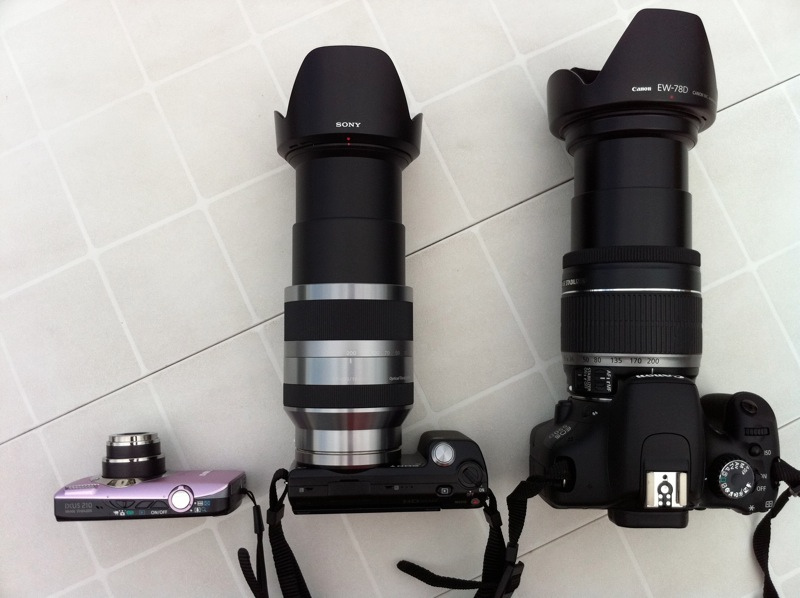
    That Sony 18-200mm superzoom in your photo is rather ridiculous though. Manufactures need to put stabilization in their bodies instead of the lenses. Anything that can make the lenses smaller should be done. Thanks to the smaller sensor both the Panasonic 14-140mm and Olympus 14-150mm are quite a bit smaller than that Sony 18-200mm, but the Olympus is noticeably smaller than the even the Panasonic. I have to believe part of that size reduction comes down to the fact that Olympus doesn’t have to include VR/IS/SR into their lenses.

    • http://thephoblographer.wordpress.com Chris Gampat

      Point taken about the IS lenses. Being a Canon shooter though, you’ll take my IS lenses from my cold dead hands ;)

      Then again, I just got a 35mm F1.4 L.

      Thoughts on good primes?

      • Eric

        Primes are really all I care about myself. I have no real need for a zoom. Something like the Panasonic 14-45mm would be nice to have for snap shots and if I’m on a hurry and dont have time for a lens change. I’d much rather have three small, fast pancake primes then one f/2.8 zoom. Which is one of the reasons I prefer in-body stabilization. As of right now there’s no such thing as a pancake prime with IS built-in, but if it’s in the body then even a 50 year old m-mount lens that you decide to play with for the heck of it will be stabilized.

  • http://stereoroid.wordpress.com/ brian t

    Something I want to see, at some time in the future, is an electronic viewfinder in the form of a head-mounted eyepiece. It will allow me to see what the camera sees without having my eye to the eyepiece on camera, or requiring me to have a view of the back of the camera. I’ve been in situations where a bright rear display is unacceptable because it’s an an odd angle, or it’s bad for night vision. It would need to be wireless, of course.

    • http://thephoblographer.wordpress.com Chris Gampat

      Interesting idea

    • Collin

      If you have a 5d MKII you could probably hack something together with existing head mounted displays and some kind of adapter (hdmi to vga?) if you didn’t mind it being wired. It would look goofy as hell though.

  • joel J

    Look at the history of the market as an indicator. Will they replace a DSLR? No. They never did when film was in. I think there is a huge market for a Leica-like rangefinder. Even the medium format form factors.

    I think history, and form factors, will repeat itself.

  • http://blog.taiwan-guide.org David on Formosa

    I don’t think DSLR cameras will disappear. I think the mirrorless cameras compete for two types of buyers. First is the premium compact market against cameras like the Canon G11 and Panasonic LX3 and the second is the entry level DSLR market. Both these markets may shrink as a result of more and better developed mirrorless cameras being developed. As a result DSLRs may become a more premium product for professionals and serious enthusiasts.

    • http://thephoblographer.wordpress.com Chris Gampat

      I think part of it is also the fact that Americans in general are slow to catch onto new technology. In NYC, everyone has a DSLR vs micro four thirds camera. And by everyone I mean normal folk that don’t shoot for money.

  • TheresaZphotography

    I’m just reading up on mirrorless cameras, but I agree with Eric, it depends on AF and quality. I just read an article that said if you are willing to sacrifice some automations then it’s great. I’m not willing to give up fast AF = )

    Now, if this pushes dslr’s prices down then I will still get my dream camera, the 7D much quicker.

    I will be back to read more comments. Thanks!

  • josé

    I was at the closing day party for the J-Pop Summit Festival, whatever that means. It’s a big event in San Francisco’s Japantown neighborhood. Lots of young people in really creative costumes. Almost everyone had a camera out and was taking pictures.

    And a lot of those were mirrorless cameras.

    Most people had big CaNikon DSLRs, of course, or else just pocketcams and even cameraphones. But I saw close to a dozen µ4/3 (mine is usually the only one around) and even a NEX 5, sported by a beautiful and beautifully-dressed young woman.

    I was clearly the oldest guy with a mirrorless, but ignoring me, the rest skewed really young. Makes you wonder.

  • http://www.facebook.com/profile.php?id=100000920108043 Carl Friend
  • Tirish Manoury

    Not for me. I still like my reflex camera. To have the no parallax/see the actual image you are having, you have to get the electronic viewfinder which i am not a big fan of. Even it’s getting more and more better. I perfer optical viewfinders.
    Not the future but it will defenitely be nice to see a digital Nikon, Canon Voightlander/Zeiss rangefinder c:

  • Storagezilla

    Cameraphones were going to kill off point & shoot cameras but sales of
    point and shoot cameras are up. Why? Because people got tired of bad pictures
    from their cameraphones.

    I think mirrorless systems will act as a feeder for more people stepping up to DSLRs.
    It’s a confidence thing, if you’ve taken your mirrorless system off of Full Auto
    you’re not going to be that intimidated by the dials, buttons and menus on a
    DSLR which say things like ‘ISO’ or ‘AI Focus’ or ‘White Balance’.

    People look at DSLRs and on top of the price there’s this complexity barrier which just freaks
    them out. If mirrorless cameras smooth that by coming in cheaper but offering the ability to dip their toe in then that’s a good thing.

    Panasonic are making rumblings about a high end mico 4/3′s, probably to fight off the NEX-7 and Canon have yet to make a mirrorless move so we’ll see how the ground shifts this year.

    • Felix Lájos Esser

      You wouldn’t believe how many people were using their phones as cameras in the zoo last week. About 90% of visitors taking pictures. That was quite a shocking experience for me. Makes you wonder where the market for “real” cameras is at all … must be somewhere, that’s for sure, but I didn’t see it there.

  • http://profiles.google.com/markkalan Mark Kalan

    Now that we’ve relegated film to artistic-only pursuits and agreed digital will be the standard photographic medium there is no need for a mirror or SLR. Mirrors only have negative effects; they use a lot of  mechanical parts to accomplish the job which also add weight and they shake the camera even on a tripod. In the as the megapixel wars die down the future professional camera will be discerned by the quality of the electronic viewfinder.

    • http://twitter.com/JohnOlinda John Olinda

      Mark, I definitely have to agree. I own both a DSLR and a mirror-less camera, and I love both. However, I can see EVFs advancing to the point where they are practically indistinguishable from optical. Especially with the confluence of still and video capabilities, the mirror is more of a hindrance than an asset these days because it slows you down.

      However, I don’t think that we’ll see “big” cameras disappear anytime soon, just the internal configurations will change. What I’m personally looking forward to is Nikon taking the basic features of the 1 series and “promoting” them to it’s enthusiast and pro level cameras. APS-C and full-frame cameras with blazing – as in 20-60 per second – frame-rates, excellent video, and no mirror. I think the D4 definitely upped the ante in the video department, but we’re still waiting on the other two.

Previous post:

Next post: