


The debate around artificial intelligence has never been more profound than it is today. Creatives around the world have been consistently rallying to create meaningful guardrails around AI’s inclusion in everyday workflow. While there are many concerns that companies are not yet addressing, it appears that those conversations will have to wait. There is no denying that AI has woven itself into our daily lives, and people have been finding ways to use the technology to excel in their work. Photographers are no exception, with a new VSCO report showcasing exactly how many image-makers are now embracing the change.
What Were the Findngs?
According to VSCO’s report, the debate on whether photographers should use AI or not has changed drastically, with the platform noting that about 83% of photographers are using AI in their workflow. Moreover, about 68% use AI daily or weekly, compared to the 34% of enthusiasts. While photographers have been thinking about the concerns of creative control, ethics, and professionalism while depending on AI, less than 5% feel threatened by it.
The deeper issue this research surfaces is the competition for their time. Nearly half of photographers spend between a quarter and half of their working hours on tasks that bring little creative satisfaction—file organization, planning, communication, promotion. For working photographers, time spent in this drudgery is even higher. These findings point to a future where AI plays a supportive, human-centered role.
Eric Wittman, CEO of VSCO
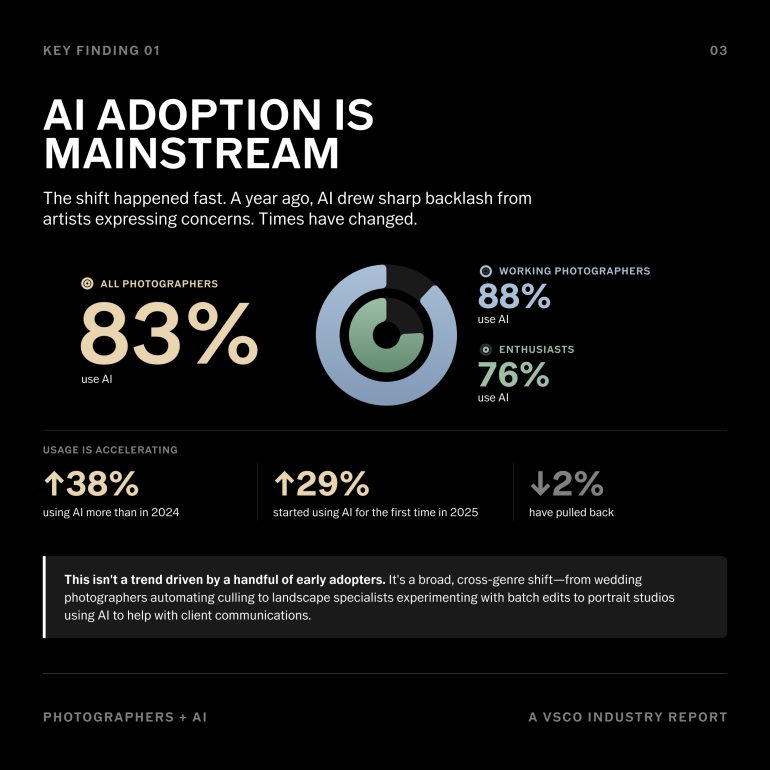
With more and more photographers wanting to find ways to streamline their workflow, AI, per the report, is able to achieve that without thwarting their creativity. In addition to 68%of photographers using AI daily or weekly, about 44% have increased their usage over the last year, and only about 4%of professionals are not relying on AI tools. The number only showcases the shift that has already occurred, and many of us have been turning our backs against reality. With more photographers competing with the adoption of AI, they will, at some point, give into the pressure, especially if their livelihood depends on it.
I always remind other photographers that AI isn’t here to replace you. If anything, it gives you more room to imagine, expand, and finally create the work you’ve always seen in your head.
Sherman Trotz, Photographer
Why Do Photographers Want to Use AI?
One of the things that the VSCO report highlights is how photographers spend their days showcasing the bane of the challenge. About 49% of all photographers spend about a quater or half their time on mundane tasks, while 52% of professionals do the same. According to Kenna Hartman, this includes tasks such as organizing files and parts of the editing process. “Using AI helps streamline those steps so I can focus more on the creative side of the work,” she adds.
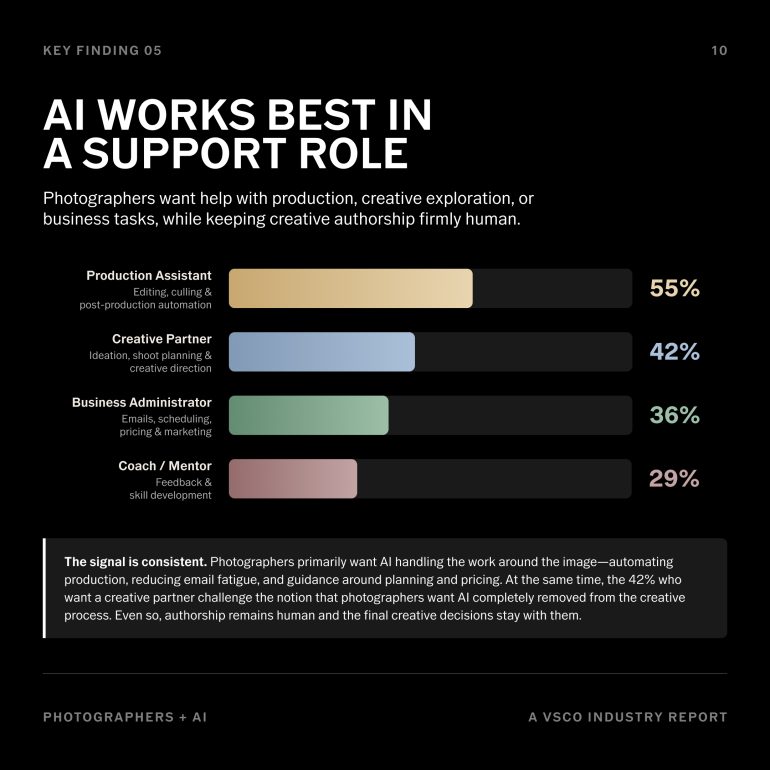
As seen above, AI is helping creatives in planning and ideation, but about 42% said that they want AI to further help with business administration. The latter is significant, given how it can lead to more business or recurring clients. 42% want AI to organize their files, 37% want help with contracts and invoicing, 30% want to work with communication and 28% need help with marketing. While AI can help with ideation, it certainly can’t fix the backend issues yet.
However, the only option that photographers have is generic AI like Claude or ChatGPT, which can’t help with tasks such as organization. There are 26 to 39%of photographers who use design-centric apps like Canva, Adobe, or Google Gemini, while less than 20% use AI tools designed for photographers.
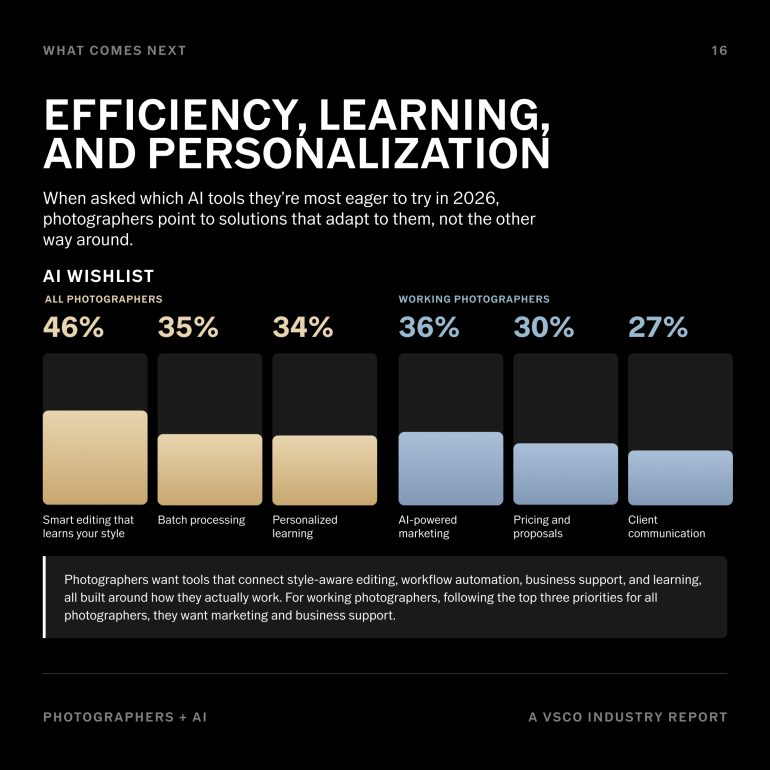
If technology could help these photographers to save 10 hours a week, about 23%of working photographers said they would work to get more clients or earn more. About 32% will get a work-life balance, and 23% will learn a new skill. The report notes that the next wave of AI needs to address these concerns and thus, those who still fear its use are likely to be left behind.
Who Were Samples For the Data Report?
To do this study, VSCO reached out to 401 photographers for the quantitative study. These image-makers were “independent of VSCO’s user base.” The research was conducted with the aim of examining how AI is perceived in the industry, the addition rate, and how it has been used in creative and business flow.
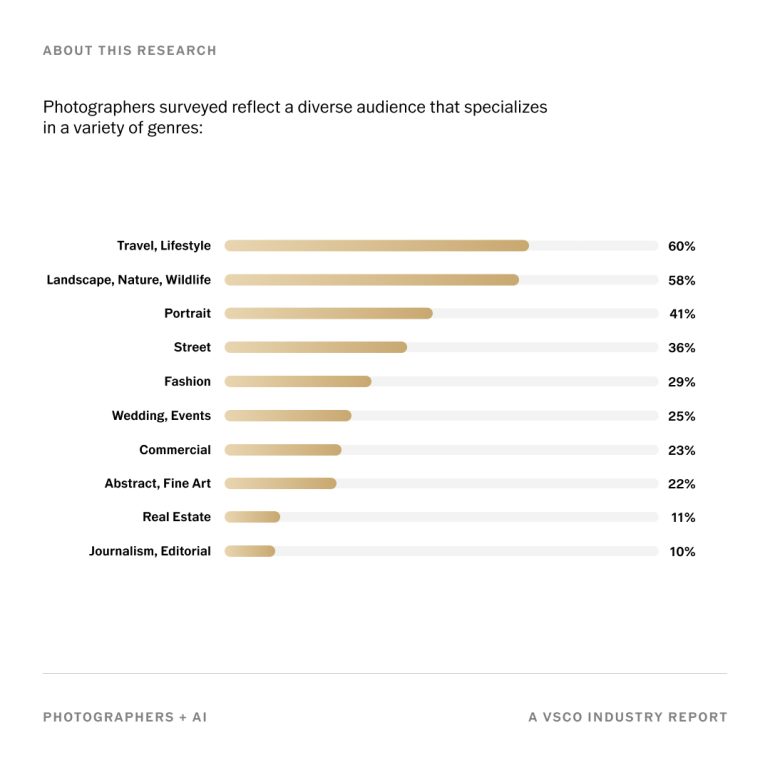
About 56% of the group consisted of working photographers, who have been using photography to generate some or all of their income. These are photographers who rely on the medium for their livelihood.
About 44% of the people were enthusiasts in the group, those who are not yet earning from photography but are interested in generating an income.
Why Did VSCO Do This Study?
VSCO’s motivation here is straightforward: They want to prove to photographers how its ecosystem simplifies image-maker’s workflows. The company has introduced various platforms, such as VSCO Canvas, VSCO Sites, VSCO Spaces, VSCO Capture, and VSCO Hub, each of which are designed to help to grow your business as well as your creativity. There is also VSCO Workplace, which is designed to manage their clients, and if their successful, they can use the platform to run a multi-person studio.
While VSCO has made moves in generative AI tools for editing, the company is now better known for its broader suite of things. This report, then, is as much a business statement as it is a data revelation. It is a signal to photographers that VSCO is building means to make their lives easy. And so, it seems like the right time to switch to their platform.
Get rid of the ads!
Did you enjoy reading this article as much as we enjoyed writing it? There's a way to support us and our reporting, getting ad-free navigation and more as a bonus. Subscribe to us for less than a coffee per month —just $3.99— or take advantage of our yearly subscription with a hefty discount for only $25.- An ad-free experience
- A free mystery box for Lightroom or Capture One
- All the books in our store
- 20% discount on Capture One
- 30% discount on Imalume Photo Theft Protection
- 20% off Herbs and Kettle Tea Company.
- 20% off your order from MPIX printing services.
- 5% off Viltrox Products via their eCommerce store.
- 10% off all film developing, printing and scanning services from Blue Moon Camera and Machine