

Last Updated on 02/04/2026 by Chris Gampat
Here at the Phoblographer, we’ve been the biggest champions of putting humans first before AI. We’ve got disclaimers and all to back that up — plus, we’re the only photography-speciality publication we know of that is part of Adobe’s Content Authenticity Initiative. That’s why what Profoto recently did on Facebook is just so incredibly jarring. And if you consider yourself a real photographer instead of some content creator, then you’ll be really angry at what Profoto has recently done.
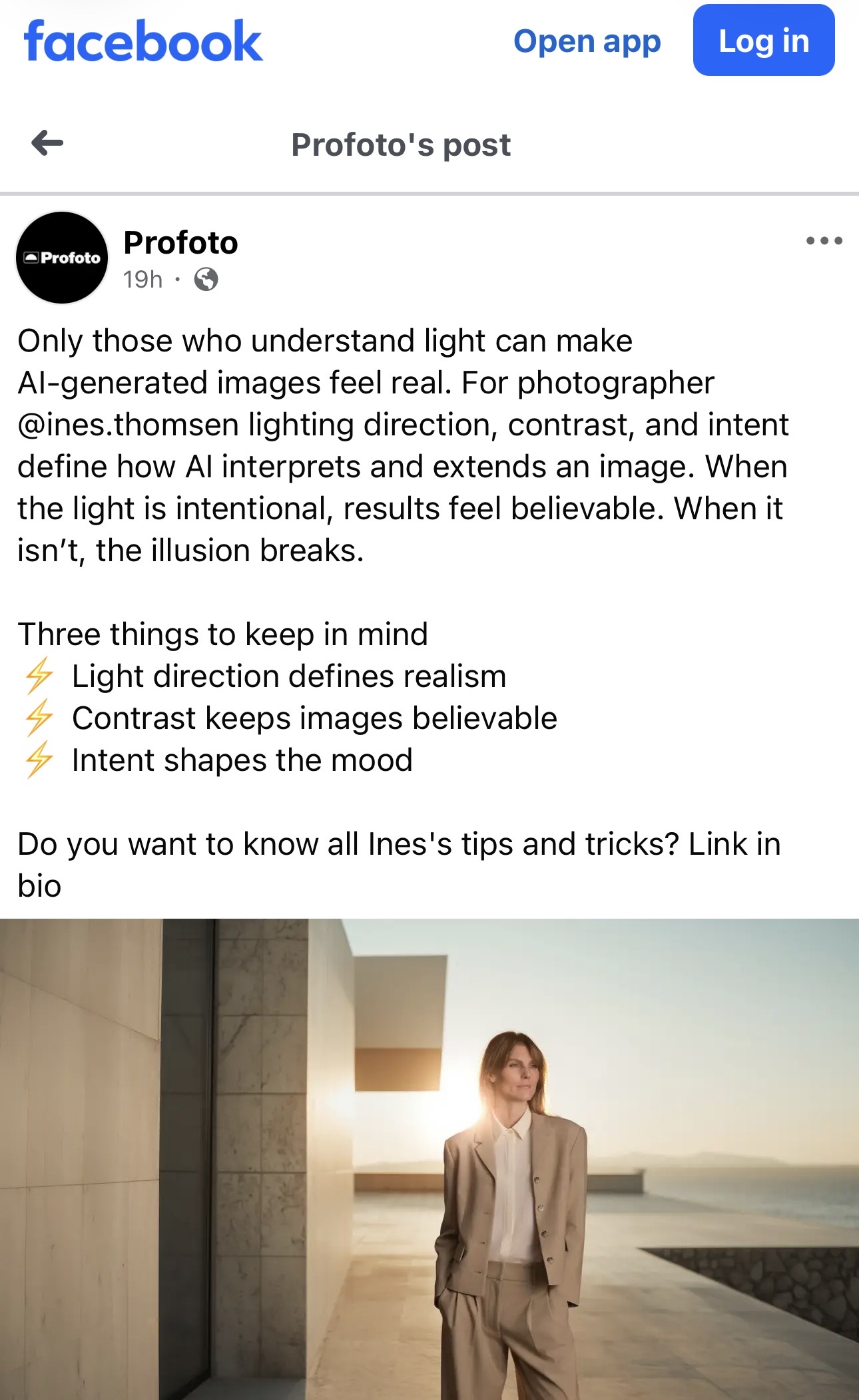
On both their Facebook and Instagram pages, Profoto shared this message:
Only those who understand light can make AI-generated images feel real. For photographer @ines.thomsen lighting direction, contrast, and intent define how AI interprets and extends an image. When the light is intentional, results feel believable. When it isn’t, the illusion breaks.
Three things to keep in mind
Light direction defines realism
Do you want to know all Ines’s tips and tricks?
It’s easy to see just how incredibly messed up this is. First, Profoto is a lighting company, and for many years, it was the industry standard in many photography studios. Second, photographers are very big on using assistive AI instead of AI tools that replace us. Here, in this example from Ines, they’re clearly sharing an instance of a tool that’s meant to replace what photographers should actually be doing. In the past and even today, photographers/brands/creative directors often use lots of post-production to add things into images that weren’t done before. However, that movement has been going away more and more.
Big CEOs are pushing the use of AI tools on everyone, but photographers are also choosing to stand up and not use it when possible.

It goes even beyond this, however. The use of Photoshop, Lightroom, Capture One or other tools involves the intentional addition of blending, masking, etc. Using AI, however, doesn’t do that. It’s more about prompting and telling someone else to do it. The difference is a product that’s produced abroad for cheap, outsourced, and unskilled labor as opposed to a local craftsman doing something. This is indeed the reason why people would choose a Japanese camera over a Chinese one — even if that myth has been debunked as years went on.
We haven’t even begun to speak about all the ethical problems associated with companies like OpenAI and their money trails.
Now here’s the big thing: if I can create that light with AI and Photoshop, why would I need to use Profoto lights? And to that end, why would I follow Profoto on social media? Shouldn’t I be following an AI lighting company instead?
If a lighting company promoted AI over the use of your actual lighting skills, how would you feel? That’s what Profoto did.
This is one of the biggest reasons why I’ve started to believe and think that digital post-production isn’t part of the photography process. Unlike the darkroom, you’re not painting with light at all.
For long-time, professional, and working photographers, this can really hurt even more. Profoto products are known to be the industry standard for reliability and quality, even if they have declined in the past few years. Now, it’s easy to a photographer to feel betrayed by a brand that they supported and touted through everything. While the customers were loyal to Profoto, the company feels as if it wasn’t loyal back to them when a move like this was made.
It’s a strange move for a European company like Profoto to promote. The move isn’t assistive to photographers in the same way that AI and scene-based autofocus is to many of us. Instead, it replaces us.
Is it time to replace the Profoto gear in your bag? Godox lighting has become much better over the years, and the reports on reliability failures have dropped immensely.
Get rid of the ads!
Did you enjoy reading this article as much as we enjoyed writing it? There's a way to support us and our reporting, getting ad-free navigation and more as a bonus. Subscribe to us for less than a coffee per month —just $3.99— or take advantage of our yearly subscription with a hefty discount for only $25.- An ad-free experience
- A free mystery box for Lightroom or Capture One
- All the books in our store
- 20% discount on Capture One
- 30% discount on Imalume Photo Theft Protection
- 20% off Herbs and Kettle Tea Company.
- 20% off your order from MPIX printing services.
- 5% off Viltrox Products via their eCommerce store.
- 10% off all film developing, printing and scanning services from Blue Moon Camera and Machine
- 15% off 7Artisans products: The lens and accessory maker is offering a sweet discount for Phoblographer's readers.
- 15% off a VSCO One subscription: Get a bunch of great tools with their all-in-one package.