


“After my friend’s death, I honestly didn’t want to continue anymore,” says Andrea Pizzini, the photographer behind one of the most organic photography projects that I’ve seen in a very long time. “But over the past three years, several friends, artists, and photographers encouraged me to rebuild the Cube and start again with new ideas. One of them was Lucas Zanotto — a world-renowned designer who will place some of his iconic creations on top of the Dolomite peaks. He asked me if I would capture his art by creating a 1×1 meter (about 40×40 inches) direct-positive photograph.” Andrea got to work.
In a world where digital photography is so insanely afraid of what AI is going to do and how it’s coming for us, I love anything that stands in the face of it like a little girl standing up to the bull of Wall Street.
Both of us feel that it’s time to move toward a form of art that cannot be replicated by AI or digital manipulation. The result of our collaboration will be 100% analog photographs — unique, unrepeatable pieces of art, immune to the constant and accelerating waves of AI innovation.
Andrea Pizzini
2
The project, which no longer lives on a dedicated website but on an Instagram page and a section of Andrea’s website, is a true work of love for photography. Several years ago, Andrea tried putting together a giant cube that exposed massive positive sheets. Then, every shot was developed inside of the cube itself. It’s grueling work, but rewarded the photographers with incredible photographs with depth that truly can’t be expressed digitally. More importantly, it’s a pretty original project that Japanese brands wouldn’t necessarily be able to make very profitable. That’s a longer way of saying that this absolutely cannot be done digitally without an insane amount of work.
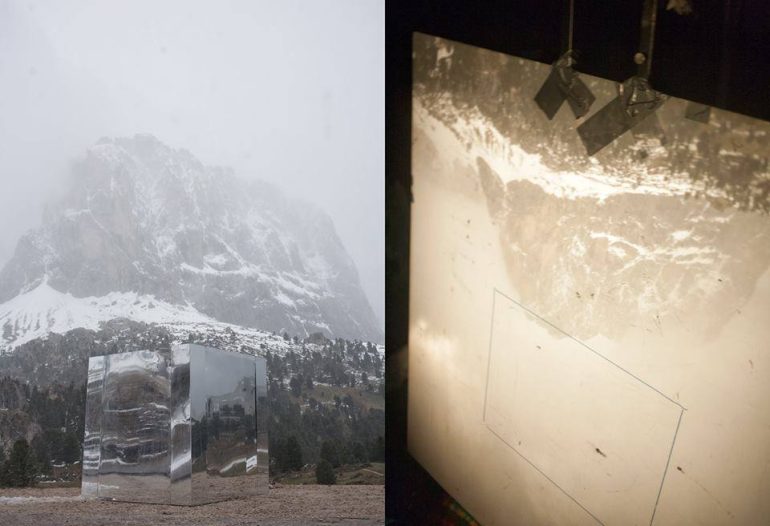
The Cube, as it’s called, is a giant 2x2x2 meter mirror cube. According to Andrea, it serves a dual purpose as a monumental camera obscura and as an art installation reflecting its surroundings. A massive Nikon Apo-Nikkor 890mm f11 lens is being used. When it’s stopped down, it projects an imaging circle that’s around 1.3 meters.
Inside the cube, they’re mounting a 50 inch square sheet of photographic paper that will be directly exposed by the light of the scene. Then they develop it. Andrea says that the detail is around 7,000 Sony A7r V cameras.
“In the past, I worked with Ilfochrome paper, but that material and its chemistry are no longer available,” Andrea explains to the Phoblographer. “Today we use a reversed RA-4 process. It’s more challenging, but we’ve managed to come remarkably close to Ilfochrome’s quality. In many ways, I’m returning to the roots of photography — relearning the fundamentals of color theory, exposure, dynamic range, and film development.” He continues to state that there is no digital shortcut here.
The final result is a finely done Italian-made photography product spanning 40 inches by 40 inches. The images for the project are going to feature locations in the Dolomites and Venice. To many of us, this sounds like a wonderful, fun excursion or workshop of some sort. But the project is very important to Andrea. They’re not doing it alone though as the duo is recruiting a dozen friends to carry all the equipment up a 7,200 foot mountain.
Upon knowing that Andrea wishes to photograph Venice, I’m immediately in awe of this project. It’s a disappearing city due to the effects of global warming. So naturally, I’m curious about why he specifically chose this city. Andrea was born near Venice and falls in love with it all over again every time he’s there. The project is all about capturing the good things in life that we so often forget still exist in the face of all the chaos around us.
Truly, I wish more people shot like this instead of shooting in the search for external validation from social media.
5
Get rid of the ads!
Did you enjoy reading this article as much as we enjoyed writing it? There's a way to support us and our reporting, getting ad-free navigation and more as a bonus. Subscribe to us for less than a coffee per month —just $3.99— or take advantage of our yearly subscription with a hefty discount for only $25.- An ad-free experience
- A free mystery box for Lightroom or Capture One
- All the books in our store
- 20% discount on Capture One
- 30% discount on Imalume Photo Theft Protection
- 20% off Herbs and Kettle Tea Company.
- 20% off your order from MPIX printing services.
- 5% off Viltrox Products via their eCommerce store.
- 10% off all film developing, printing and scanning services from Blue Moon Camera and Machine
- 15% off 7Artisans products: The lens and accessory maker is offering a sweet discount for Phoblographer's readers.