

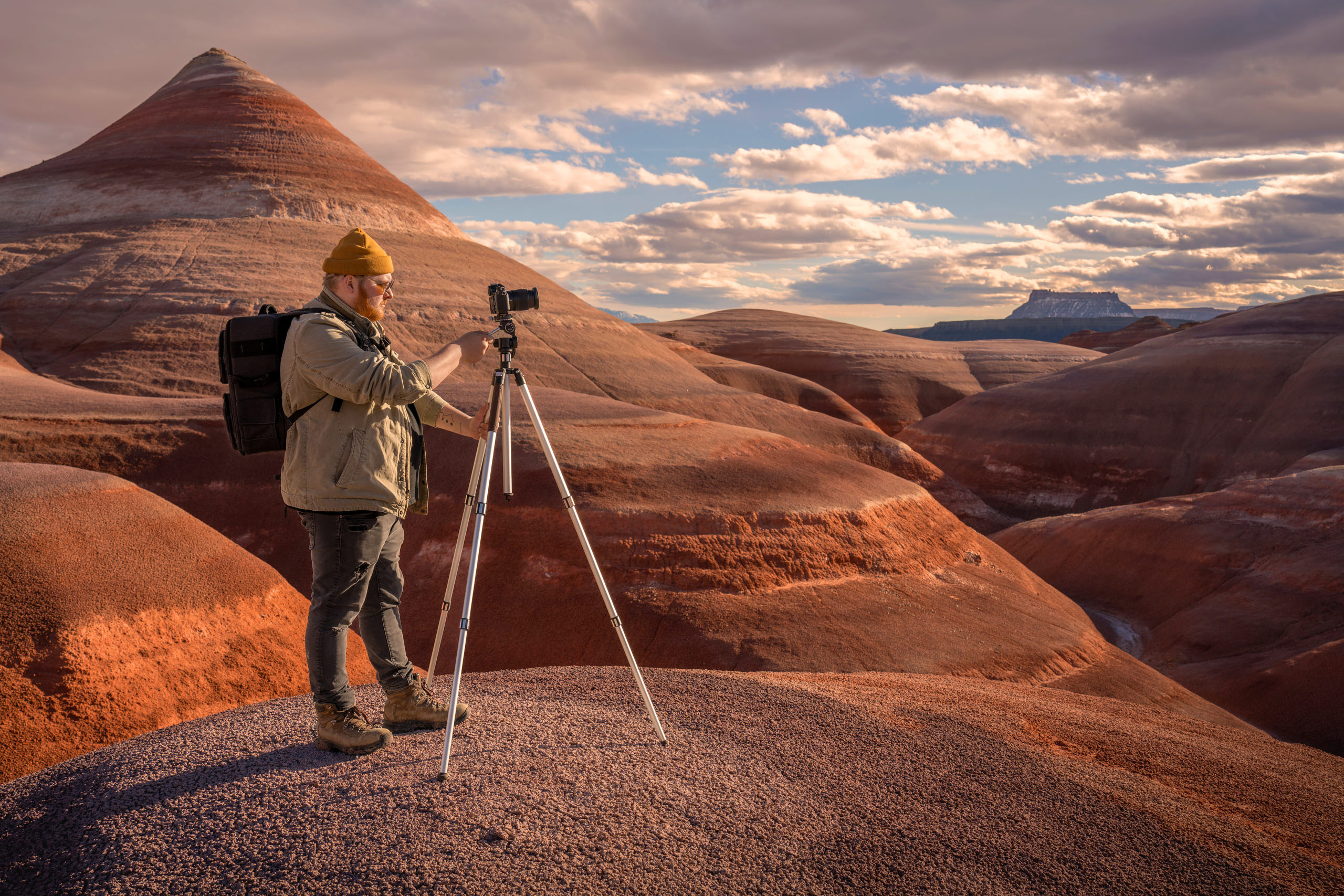
Whether one likes to believe it or not, a good tripod is one of the most essential tools in a photographer’s arsenal. But today, to discover a tripod with a great design, sturdy build, and vintage appeal is almost unheard of. Well, that was the case until ProMoster launched its ProMaster Epoch series, a unique blend of contemporary technologies and retro aesthetics. As one applauds a tripod that meets your demands, much of its credit must also extend to its designer, Paul Orzel, and his ingenuity. “The real joy for me is in the making of the photo, outside, in nature. Working with gear that is precise and beautifully designed complements that. The Epoch is my way of sharing that joy with everyone else,” he tells The Phoblographer in an exclusive interview.
The lead image and images within the article are product shots courtesy of ProMaster. Input for this article was also provided by Chris Gampat.
From Photography to Designing, An Ascending Journey
For Orzel, it all started with his love for photography in high school. As a freshman, Orzel took a 101 photography class, which led him to admire the blend of creativity and technicality of the medium. “For me, it tickles both the left and right sides of the brain. I ‘discovered’ Ansel Adams when I found his biography in the school library a year later, and I was hooked after that,” he tells us.
It was here that he also began to use his father’s Pentax ME Super, which went on to become one of his treasured equipment. “When he passed away, I found it in a shoebox. It’s busted, but I don’t care. It reminds me of him and the time we spent together when he drove me all over to get photos for that class. I proudly display it in my office,” he adds. The next gear was a Zone VI 4×5 view camera, which he purchased in the early 1990s and which helped him learn compositions. “I also got hooked on what a technical camera, with tilts, swings, and shifts, can do for creativity in composition.”


However, when the college didn’t go as planned, Orzel began work in the photography business, albeit on the retail side of things. He got a job in a local company, where he worked for 19 years, learning the ropes and working up the corporate ladder. Just a decade ago, his life’s trajectory changed when he saw an opening ProMaster. “At that same time, I was looking to make a move and do something new. I didn’t know if I would be any good at product design, nor did the folks that hired me. But we gave it a shot, and it seems to be working out well,” he states.
ProMaster Epoch: Bringing Back Simplicity
With ProMaster having over 1,800 products, Ozrel’s main objective was “to improve product quality,” and the designer took “years to improve and innovate our tripod lines.” In 2023, after developing the ProMaster Chronicle lineup, Ozrel had time to ponder over his progress. “I thought to myself, ‘Maybe now I can take a little time to design a tripod that I would use personally. Something that appeals to me and my style of photography,'” he explains, speaking about the genesis of the ProMaster Epoch series. “As a product developer, I often have to think of various customer groups, feature sets, and price points that appeal to them. So, to finally be in a place where I could make something with a personal appeal was a real treat for me,” he adds.
After a few weeks, Orzel received the first Epoch prototype prior to his three-week family trip. To put the tripod through its paces, he used Cambo Actus, a camera with a bellow, which was then paired with a Fuji GFX50S. “The Actus is heavy, and the bellows act like a sail when it’s windy. Therefore, it is a great outfit for testing the stability of a tripod,” Orzel explains. The designer also carried a Pentax 645, a Mamiya 645, a Mamiya 6, a Fuji large format (CM-W), and a Rodenstock enlarging lens. This brings us to another important inspiration behind the design of Epoch’s leg locks… “They are modeled after the scalloped focusing ring found on many older lenses (Leica, Nikon, Canon, etc.…),” he adds. “I made some hand drawings for the factory to understand the aesthetic.” After the trip, Orzel also used the Bronica EC and Nikon F4 cameras with the tripod.


Following his weeks of usage, his original tripod had a small issue with the leg angle locks. However, he was able to resolve the issue easily. “I also made a design change to the head, which gave it a more balanced feel and appearance,” he states. “It was only after using the tripod for a while that I thought of this modification and felt it would be beneficial for the end user.”
In a time when tripods come with 6-section legs and multiple complex features, including AI, Orzel’s ProMaster Epoch takes us back to simpler times. After speaking to younger photographers, Orzel observed: “They don’t understand the joy of using a simple, stable 3-section tripod or the incredible creative value of composing an image with a 3-way head. And that is not just the tripods; even cameras today are undergoing a similar transition, which is a theft of joy. “Maybe many of us who have been around a bit longer have also forgotten these things. Perhaps the Epoch is a reminder,” he adds. And we couldn’t agree more.
Get rid of the ads!
Did you enjoy reading this article as much as we enjoyed writing it? There's a way to support us and our reporting, getting ad-free navigation and more as a bonus. Subscribe to us for less than a coffee per month —just $3.99— or take advantage of our yearly subscription with a hefty discount for only $25.- An ad-free experience
- A free mystery box for Lightroom or Capture One
- All the books in our store
- 20% discount on Capture One
- 30% discount on Imalume Photo Theft Protection
- 20% off Herbs and Kettle Tea Company.