


Canon often pushes out its best optics, priced at the much higher range, and then works on providing a more affordable version of it to its users. So, when they recently announced their Canon RF 28-70mm f2.8 IS STM lens, we couldn’t help but think about its excellent optic in the L series, the Canon RF 28-70mm f2 L USM, which was released in 2019. The 28-70mm is a workhorse focal length, offering the best of wide and zoom lengths, and is useful to various photographers. In addition, Canon has also unveiled a new printer, the SELPHY QX20, for smartphone users. So, how good are the new devices? Let’s find out.
The New Canon RF 28-70mm Is Hybrid Focused
Canon is slowly pivoting to cater to the needs of content creators, especially those in the video segment. They are not the only ones to do so; it is something all camera makers are focusing on, perhaps due to the rise of social media platforms like TikTok and Instagram reels. So, who is the Canon RF 28-70mm f2.8 IS STM lens dedicated to? According to the company, it is for everyday use and for genres such as portraits, events, landscapes, travel, and low-light occasions.

Specs of the Canon RF 28-70mm f2.8 IS STM:
- 15 elements in 12 groups, 2 UD lenses, 2 Aspherical lenses
- 9 aperture blades
- Minimum focusing of 0.27m (10.6in) at 28mm with AF
- Maximum magnification of 0.24x at 70mm with AF or MF
- SSC (Super Spectra Coating)
- Up to 5.5 stops of OIS
- Up to 7.5 stops of IBIS + OIS
- 67mm filter threat
- Measures 3in x 3.6in (76.5mm x 92.2mm), weighs 17.5 oz (495g)
- Dust and weather-resistant
- Price $1,099
There are some obvious updates from the Canon RF 28-70mm f2 L USM. The price point, for instance, is the most obvious one here. The L series lens costs $2,799 despite being a little close to six years old. Since it is a luxury lens, it also had more elements, offering 19 elements in 13 groups, Two UD Elements, and One Super UD Element. However, it was also equally heavy and bulky (weighing 1430g), lacking IS.
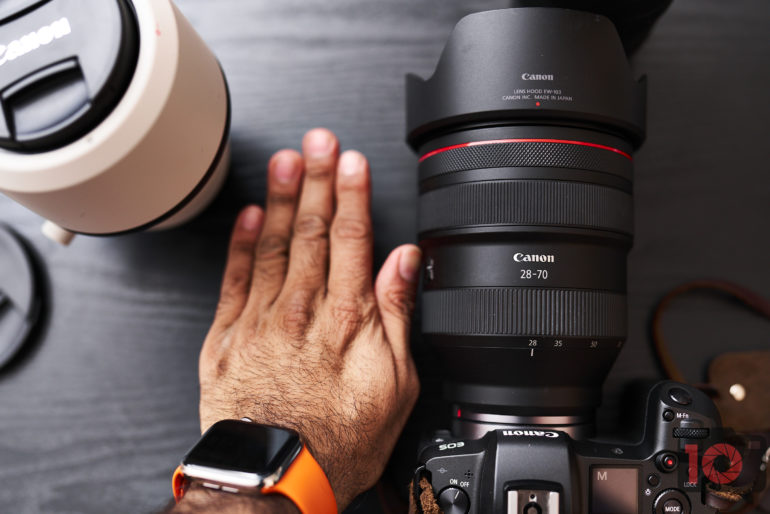
But, despite some of its flaws, we absolutely adored the lens. Editor Chris Gampat wrote in our review: “Although the Canon RF 28-70mm f2 L USM is a massive lens, it’s also understandably so. The photographer who will spring for this lens really needs the extra stop of light and genuinely wants super high-quality images. That’s what you’re going to get with the Canon RF 28-70mm f2 L USM.”
Considering the image quality of the L series, it seems that Canon may try to achieve something similar with the Canon RF 28-70mm f2.8 IS STM. It may not be designed to beat it, but clearly, the philosophy is to offer a more affordable solution for hybrid shooters. While Sigma and Tamron both have 28-70mm and 28-75mm lenses, they are for Sony and Nikon mounts only. Why? Because Canon is very particular about not allowing photographers to use a third-party lens. That’s the rule of the game. Furthermore, while the Sigma 28-70mm costs about $799, our review states one also loses out on corner sharpness, full weather sealing, and some distortion control. However, the Tamron 28-75mm, which costs $899, we found it to be a better buy.
Is the SELPHY QX20 Better Than Fujifilm Instax?
SELPHY, which Canon launched in 2004, is celebrating its 20th anniversary this year. According to the company, the printer was created to meet the need for digital photography, much like Fujifilm’s Instax. Derived from the words “self” and “photography,” SELPHY offers square prints. It prints a new card-size sticker paper format (2.1in x 3.4in) alongside the regular one (2.7in x 2.7in).

Specs of Selphy QX20:
- A Dye-sublimation thermal transfer printing method
- 287×287 dpi print resolution
- Cyan, magenta, and yellow film 256 shades/color (16.8 million colors)
- 100 years of print longevity
- USB Type C Port (for charging alone)
- WiFi3, built-in batteries
- Measures 4.0in x 1.3in, weighs 1.0 lb
- $149.99
We can’t comment on the quality since we have not used the device. However, Fujifilm’s Instax printer series has been a favorite amongst Gen Z and many millennials who are running after the film simulation look. In that regard, we aren’t sure where SELPHY stands. However, it will be great to see if Canon can rival Fujifilm in this domain, especially considering that Fujifilm is the go-to choice for an affordable instant camera or printer.
For more information, visit Canon U.S.A., Inc.’s website.
Get rid of the ads!
Did you enjoy reading this article as much as we enjoyed writing it? There's a way to support us and our reporting, getting ad-free navigation and more as a bonus. Subscribe to us for less than a coffee per month —just $3.99— or take advantage of our yearly subscription with a hefty discount for only $25.- An ad-free experience
- A free mystery box for Lightroom or Capture One
- All the books in our store
- 20% discount on Capture One
- 30% discount on Imalume Photo Theft Protection
- 20% off Herbs and Kettle Tea Company.
- 20% off your order from MPIX printing services.
- 5% off Viltrox Products via their eCommerce store.
- 10% off all film developing, printing and scanning services from Blue Moon Camera and Machine
- 15% off 7Artisans products: The lens and accessory maker is offering a sweet discount for Phoblographer's readers.
- 15% off a VSCO One subscription: Get a bunch of great tools with their all-in-one package.