

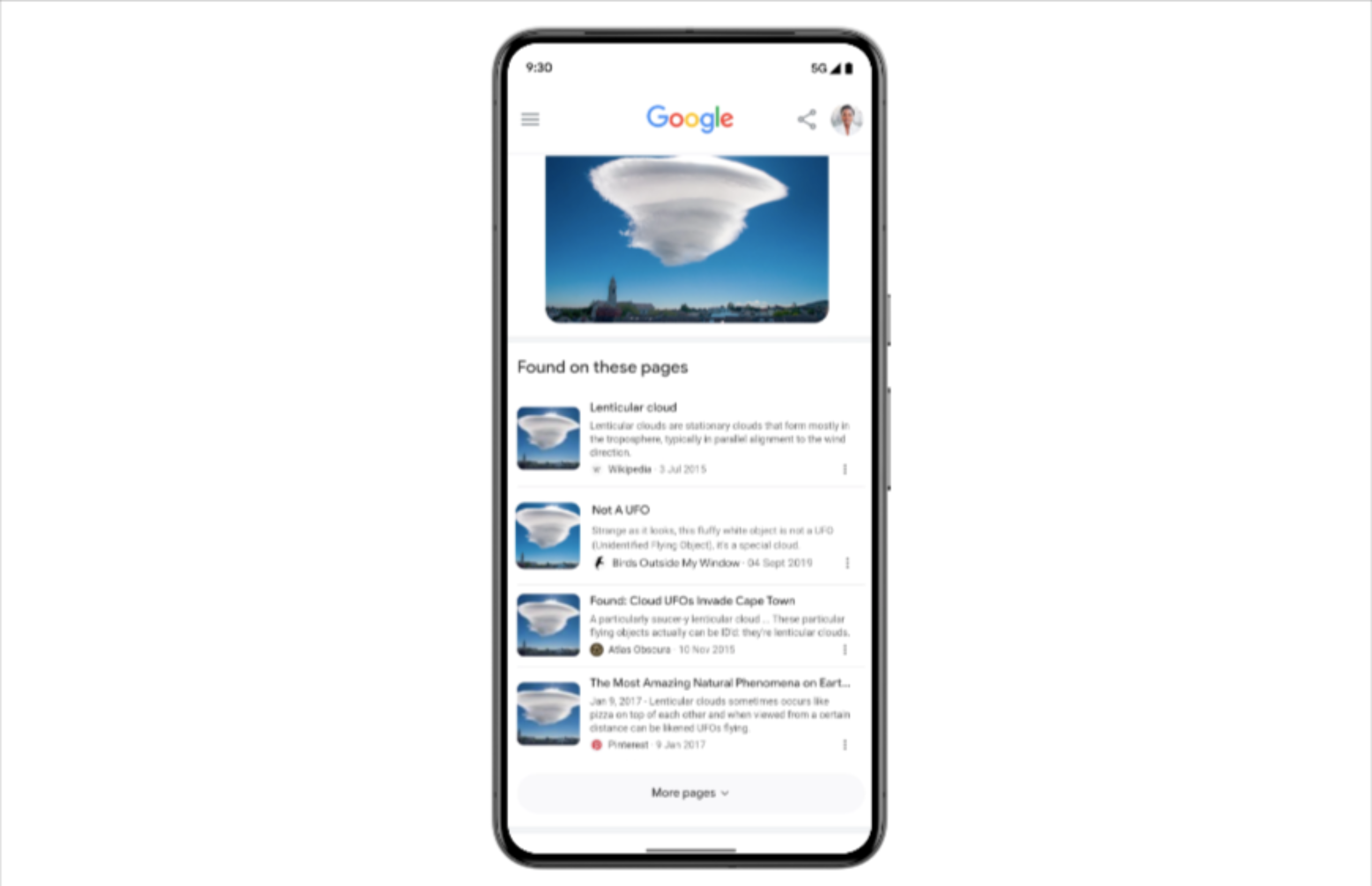
Do you know the feeling when someone sends you a photograph, and you can’t decipher whether it’s authentic? The image, either too picturesque or sensational, makes you halt or interrupt your errands. Today, anyone can be deceived easily, even a professional photographer! Keeping such instances in mind, Google has now concocted a new feature called ‘About this Image,’ which could help you navigate the treacherous water of AI.
How Does it Function?
According to the company’s blog, the feature is included in Google’s Circle to Search and Google Lens, allowing users to quickly access the context in which they were shared.
Google’s ‘About this Image’ reveals the information on three different fronts:
It displays other websites and descriptions: Users will easily access news and fact-checkers sites to see how the photograph was used and what narrative it features. The evidence from reputable pages can ease your mind.
Metadata: This data is attached to the image and includes information such as the photographer’s name, the place where it was shot, and the camera settings. However, one must note that the author can change the metadata. Despite this, it can assist you in learning whether the image was created using generative AI.
Digital watermark: Google’s ‘About this Image’ can help reveal generative AI images only when created using Google DeepMind’s SynthID watermark.
Is Google’s ‘About this Image’ Really Helpful?
It must be noted that Google’s ‘About this Image’ timing is nothing short of surprising. The company is set to unveil its flagship series, the Google Pixel 9 lineup, in the subsequent few days, and one of the central USPs is the Gemini AI assistant. The company has been promoting its AI on every front, drawing people’s ire on the internet. In their latest campaign for Gemini, Google portrays a father who asks for the AI assistant’s help to write a letter for his daughter. (Lazy parenting, we know).
However, Google is not the only company that has invested heavily in AI. Apple, too, is working on Apple Intelligence, its own AI that is set to be realized with iOS 18 and MacOS Sequoia. One of the pivotal features is using prompts to construct images on the go.
As every tech giant is marketing AI as the dynamic future, the question of whose hands it will fall into also looms on the horizon. While some websites have guardrails, including The Phoblographer, a member of the Content Authenticity Initiative, they are still limited in number. As smartphones are becoming increasingly common, so is the use of AI. For instance, deep fakes of politicians or the explicit content of women influencers are abundant. AI is not only plagiarizing content but is also quickly becoming a tool to spew hate, right-wing agenda, and propaganda. You see how quickly the software has become the devil’s advocate.
While Google’s ‘About this Image’ is in its nascent stage, it is one of the instruments that can slow down, if not halt, the bombardment of generative AI. As the saying goes, “If you are creating the poison, then you might as well carry the antidote.” Google is accomplishing just that. While they give the weapon of destruction, they also provide (a very bare minimum) resolution. Only time will reveal how this turns out, but we hope Apple leaps on this bandwagon for the greater good.
Get rid of the ads!
Did you enjoy reading this article as much as we enjoyed writing it? There's a way to support us and our reporting, getting ad-free navigation and more as a bonus. Subscribe to us for less than a coffee per month —just $3.99— or take advantage of our yearly subscription with a hefty discount for only $25.- An ad-free experience
- A free mystery box for Lightroom or Capture One
- All the books in our store
- 20% discount on Capture One
- 30% discount on Imalume Photo Theft Protection
- 20% off Herbs and Kettle Tea Company.
- 20% off your order from MPIX printing services.
- 5% off Viltrox Products via their eCommerce store.
- 10% off all film developing, printing and scanning services from Blue Moon Camera and Machine
- 15% off 7Artisans products: The lens and accessory maker is offering a sweet discount for Phoblographer's readers.
- 15% off a VSCO One subscription: Get a bunch of great tools with their all-in-one package.