

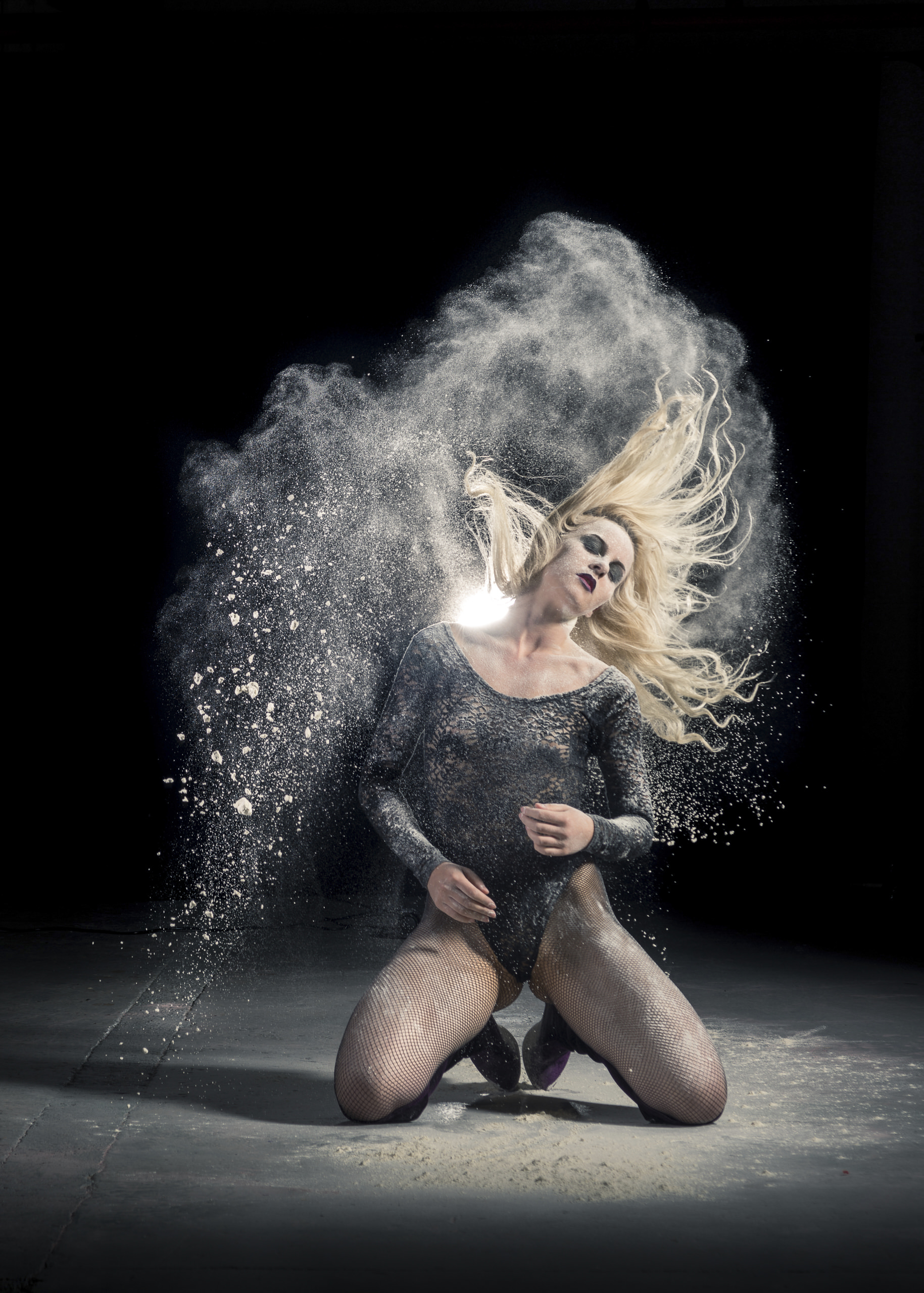
Like so many other photographers today, Owne Lloyd took inspiration from Joe McNally. But of course, he interpreted Joe’s use of off-camera flash in his own way. At around 40 years old, he got into photography and realized that he needed to dive further into it. “I was hooked on this idea of augmenting the light with a flash or two or just creating my own light from scratch,” Owen tells the Phoblographer in an interview, referring to inspiration from Joe’s book, The Hot Shoe Diaries. “Joe shot with a lot of dancers, and that seemed like a great place to start for motion-inspired images.” And since then, he’s been huge on photographing movement.
All images by Owen Lloyd. Used with permission. Check out his website for more.
These days, Owen shoots with Nikon D850s. However, most of what’s important to him is lighting gear. So he turns to Godox AD600 lights and AD200s. “They’ve served as a fake sun many times on my shoots and will sit happily in the rain inside a clear plastic freezer bag for hours,” Owen tells us. “Using the shutter and continuous light for this means a lot less light hitting the sensor, and so noisier files. Removing the ambient light and using a really low duration flashlight is a much more effective way to freeze motion.” And so, Owen sees his scenes, but doesn’t look at them because they don’t exist to the human eye. This is the gift that so many photographers give: making a moment that can’t be seen otherwise.
He also uses fog machines, waterproofing bags, etc. It all makes sense, considering the production that he’s going through.
Owen works to represent motion within a single still image. And he explains his creative vision best:
For these shots, the primary goal is to represent motion in a still image, and I’ve found 3 ways of achieving this. First you can freeze the action with your subject in a position that would be impossible to hold as a static pose. They may be mid-jump, or mid-fall from a position of imbalance, but it should be evident that they are moving as its the only way they could be frozen in that position. A variant on this approach is to include another element in the scene which could not possibly be static, such as a piece of fabric thrown in the air, or flour, water drops etc.
Second you can show blur trails using a continuous light in the scene. This means locking the camera down on a tripod, so the only movement is from your subject. Generally, I’m using a light “upstage” from the subject for this – i.e. an edge-light or backlight, as using a continuous light from the front, would result in, well – a mess. I’ll usually have a flash fire at the end of the exposure to stamp the subject in place.
Third, we can go for multiple flashes in the same exposure to stamp the subject onto the image in multiple positions. With flash light firing say 5 times per second, we can produce a lovely progression of a dancer moving across the floor.
We can mix and match all of these together and I’ve usually added a bit of continuous light to the multiple flash technique to provide a bit of motion blur to connect the flash images of the subject as they move through the scene. Conversely, if blur trails are the main indicator of motion in a shot, I will usually add a flash at the end, or light different zones of the scene with continuous light or flash to control which elements make blur trails and which are sharp.
Owen Lloyd
Owen typically works to express drama in his images. He describes them as images that should end in an exclamation point. “…I aim to produce something on-set that would be non-trivial to add in Photoshop,” he explains. “I want to see the subject immersed in the motion.” Owen typically fluctuates with how much post-production is done. Sometimes it’s just color work in Lightroom while using Photoshop is usually just involving cleanups.
To that end, he has some intriguing thoughts about AI. In fact, he goes as far as saying we need to treat it like a human being. To Owen, if you ask ask another artist or hired them to produce an image, then you don’t own it; but you still asked something to produce it for you.


While Owen sometimes even makes fantasy-style images that are meant to be made in post-production with 3D renders and all, he acknowledges that there is a misunderstanding about it. “…with the advent of text-prompt driven AI image factories, it’s likely a lot of people look at this work and just assume the whole thing is the work of 30 seconds typing in a text box, and this has caused a shift in my photographic work away from these composite images to the more natural, classic styles,” he explains. “Of course, these can also be generated by AI, but they don’t take 3 days for me to produce!” Owen uses AI in Photoshop that’s typically around the content-aware fill,
In the end, he’s aiming to make art that lasts a while, instead of content that is temporary and dated.
AUTHENTICITY STATEMENT
The Phoblographer works with human photographers to verify that they’ve actually created their work through shoots. These are done by providing us assets such as BTS captures, screenshots of post-production, extra photos from the shoot, etc. We do this to help our readers realize that this is authentically human work. Here’s what this photographer provided for us.


Get rid of the ads!
Did you enjoy reading this article as much as we enjoyed writing it? There's a way to support us and our reporting, getting ad-free navigation and more as a bonus. Subscribe to us for less than a coffee per month —just $3.99— or take advantage of our yearly subscription with a hefty discount for only $25.- An ad-free experience
- A free mystery box for Lightroom or Capture One
- All the books in our store
- 20% discount on Capture One
- 30% discount on Imalume Photo Theft Protection
- 20% off Herbs and Kettle Tea Company.
- 20% off your order from MPIX printing services.