


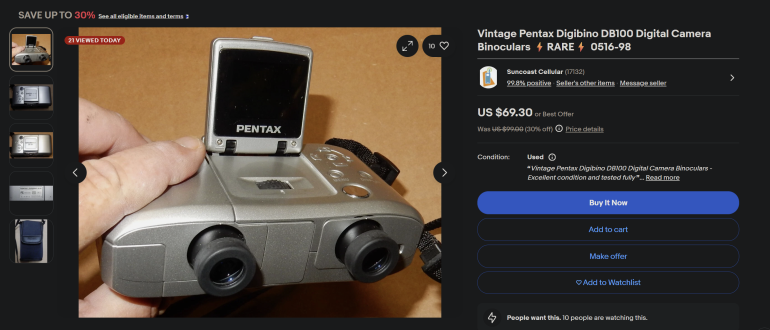
Camera technology has seen immense change over the years. While there are devices that push the medium forward, there are some that tend to find solutions in the most unique ways. Pentax managed to achieve the two in one go with a specific camera that was designed for outdoor shooters: the Pentax Digibino DB-100. While it remains the most genuinely original piece of camera to be created, it still remains largely forgotten.
The original Digibino DB-100 was announced in 2002, and it was the world’s first binoculars that also functioned as a camera. One could photograph what they saw with ease. It also featured an LCD monitor, which further helped those who wanted to combine two hobbies as one—watching and photographing. The focusing mechanism of the binoculars and the focusing system of the camera were physically linked as well, which made photography an easy act. The latter was quite a novel act, as nobody had thought of this innovation before.
The next year, Pentax announced the DB-200, which is an overhaul of its predecessor with a higher resolution sensor, newly added SD card, and much more. In fact, it’s this model that continues to fetch a better price in the vintage camera market. Here’s a look at DB-200’s specs:
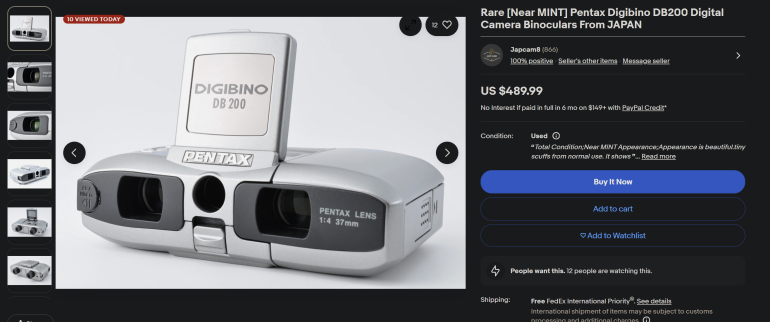
- 1.3 megapixel CCD, 1/3-inch progressive scan
- 1280 x 960 pixels (1.3MP) and 640 x 480 VGA
- 250mm equivalent (35mm format), F4.0 fixed aperture
- 4x zoom
- 1/30 to 1/8000 of a second
- Binocular-linked focusing, 200 cm to infinity
- Center-weight metering
- Automatic white balance
- 1.6-inch LCD
- SD card storage
- Runs on 2x AA batteries
- 127 x 69 x 44mm
- 270g
- Continuous shooting of five frames per second for two seconds
- Voice memo of an eight-second audio clip attachable to each image
- Binocular magnification of 7x
The lens was what the Digibino was known for. The 7x magnification was 280mm equivalent, which means wildlife photographers, birdwatchers, and sports spectators will adore the device. And all that packed in a small design. Overall, the Pentax camera was designed to appeal to amateur digital photographers. One could say it worked as a bridge camera, just like the Nikon P1100. And with the voice memo, naturalists and birdwatchers could record a behavioral observation or a location note.
So, did it fail? It is quite hard to say since there is little literature about its success or failure. The camera was truly ahead of its time, and it certainly can be helpful to many. However, the resolution at that time could be one of the constraints, since other models, including the Olympus E-1, had a 5MP sensor. Similarly, while it offered a 280 mm zoom range, the roof prism binoculars may not compete with optics manufacturers like Leica or Zeiss. So there could be a gap between serious binocular buyers and serious camera buyers without the satisfaction of either group.
Interestingly, the camera never had a successor after 2003, which proves that Pentax was unable to get higher demand. Despite everything, the DB series remains a collector’s curiosity. Perhaps, if Pentax launches something similar today, it may find the base it was looking for then.
Get rid of the ads!
Did you enjoy reading this article as much as we enjoyed writing it? There's a way to support us and our reporting, getting ad-free navigation and more as a bonus. Subscribe to us for less than a coffee per month —just $3.99— or take advantage of our yearly subscription with a hefty discount for only $25.- An ad-free experience
- A free mystery box for Lightroom or Capture One
- All the books in our store
- 20% discount on Capture One
- 30% discount on Imalume Photo Theft Protection
- 20% off Herbs and Kettle Tea Company.