

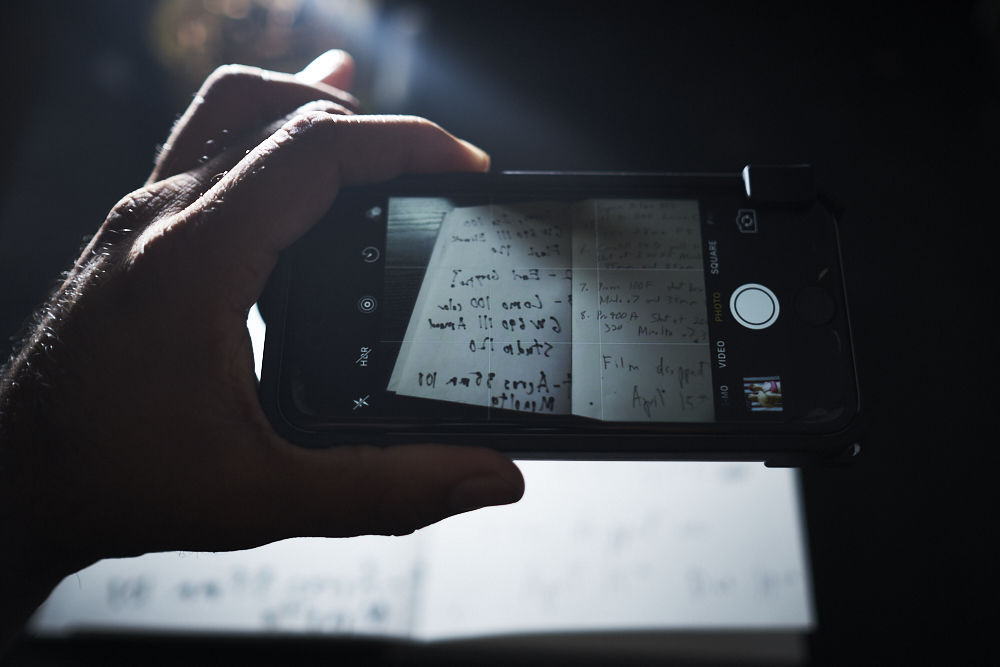
Today, we can capture thousands of images on our cell phones with just a click of a button and even share them with a few taps on the screen. This advancement has made our lives easier (and, at times, more complicated), allowing us to share the moments with our loved ones. While we appreciate how far technology has come, we should also recognize the visionaries who pushed the boundaries of invention. For instance, reports indicate that the first “phone with a camera” was not released until around 1999 or 2000. However, there was one individual who achieved the extraordinary feat of paving the way for cell phones as we know them today. Here’s a captivating story about the first photograph ever taken with a cellphone and shared on the internet set in a time when the camera phones did not yet exist.
The lead image is by Chris Gampat. Other images within the article are screenshots.
Yes, you read that right. As we stated, phone cameras did not evolve until the turn of the 21st century. The story goes, in fact, all the way back to 1997, about three to four years before the official launch of phone cameras. Philippe Kahn, an entrepreneur and engineer, was eagerly awaiting the birth of his daughter. However, at a time when the internet was in its infancy, there was not exactly a way to capture a digital picture to share it with his friends and family. But Kahn would not back down. Instead, he began to work on Picture Mail, a Web-based infrastructure that allows you to share pictures with your family via mail. This was a huge achievement at a time when people could only send prints to one another.

While he took a year to build Picture Mail, states IEEE Spectrum, he realized he would also need a device to capture a photograph of his daughter. As it turns out, his wife’s labor would last about 18 hours at the Sutter Maternity Center in Santa Cruz, California, giving Kahn enough time to build the first camera phone. How did he do it? With a Motorola StarTAC flip phone, a Toshiba 430CDT laptop computer, and a Casio QV digital camera. The camera phone was then used to capture a 320×240-pixel photo, which was then connected to the web, where it was uploaded and sent as an email to his relatives and friends.

Kahn states what he achieved was not exactly the birth of camera phones. He believes that others before him have achieved the milestone. However, it was the first time a photograph was instantly shared with a group, such as his family and friends. In fact, he went on to create a second prototype using a microcontroller, CMOS sensor, and phone. A year later, he patented the technology under his company, LightSurf. While he did not succeed in the US with his achievement, Japan’s J-Phone helped him launch the first camera phone in the US in 2002. Today, the visionary keeps an eye on how photo sharing and citizen journalism empower and change the world.
Kahn’s story is no short of exceptional. His ideas finally found their place in the world while it showcased the power of photography to us. In 2016, TIME named his image one of the 100 most influential photographs ever. This proves how significant Kahn’s contribution is, considering that he shared the honor with Joseph Nicéphore Niépce, the inventor of the world’s first camera. Stories like these must be shared to remind us how far we have come and which direction we want to go.
Get rid of the ads!
Did you enjoy reading this article as much as we enjoyed writing it? There's a way to support us and our reporting, getting ad-free navigation and more as a bonus. Subscribe to us for less than a coffee per month —just $3.99— or take advantage of our yearly subscription with a hefty discount for only $25.- An ad-free experience
- A free mystery box for Lightroom or Capture One
- All the books in our store
- 20% discount on Capture One
- 30% discount on Imalume Photo Theft Protection
- 20% off Herbs and Kettle Tea Company.
- 20% off your order from MPIX printing services.
- 5% off Viltrox Products via their eCommerce store.
- 10% off all film developing, printing and scanning services from Blue Moon Camera and Machine
- 15% off 7Artisans products: The lens and accessory maker is offering a sweet discount for Phoblographer's readers.
- 15% off a VSCO One subscription: Get a bunch of great tools with their all-in-one package.