


Flash photography can be pretty challenging to master. But it is an excellent way to add more drama or try more creative shots. Whether it is street or portraits or even lighting up still objects, flash photography helps you achieve distinct results. After all, a little light can only add to your composition and bring out your vision. For this reason, we have listed a few flash photographers whose work will inspire you and urge you to pick up your flash.
The first three images in the article are used with permission from the photographers. The remaining are screenshots.
Table of Contents
Audrey Woulard
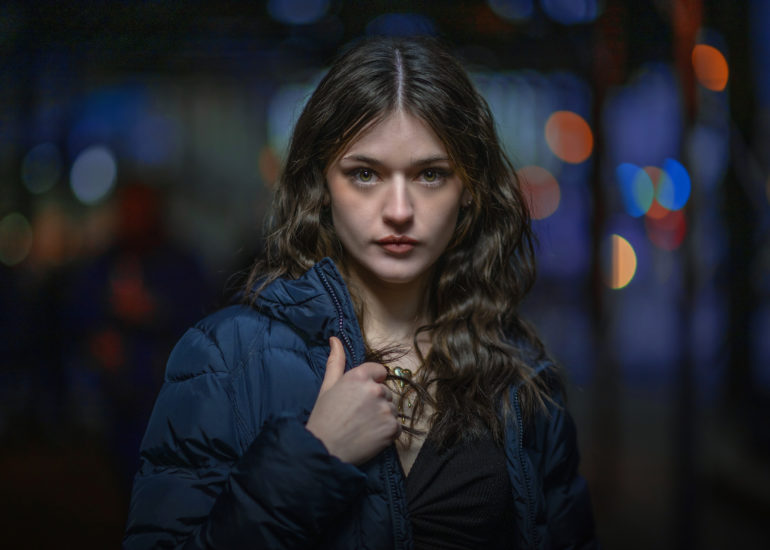
What you appreciate about Audrey Woulard’s flash photography is that the use of external lights is soft and creates an exceptional separation between the subject and the backdrop. To me, the first thing that stood out here is the catch light in the model’s eyes, which adds so much depth to the portrait. The soft white glow makes her look lively and even mysterious. At the same time, it gives her hair some texture, which otherwise would not have been visible with a harsh light.
Talking about her clothes, the dark colors help her face stand out and make her the picture’s protagonist. The subtle shine of the coat is also on point with the aura and the background. Now, talking about the background, the overall blue tone is welcoming. The lights in the background further add to a ‘mystical’ feel of the image. If the image were shot later than twilight, it would be as powerful. The colors are soothing and make the image even more inviting.
In her interview with us, Audrey Woulard tells us:
I used the strobe to overpower a bit of the ambient lighting so that the background appeared darker than it actually was outside. We were photographing within the heart of Downtown Chicago. I was in areas where I photograph regularly. Because these are my “locations,” I usually know exactly what I am going for. I typically look for areas that aesthetically look unattractive to most people. I do this because I do not like anyone to envision my image before I take it. If someone can easily visualize what you might capture, I find it doesn’t really wow a client. So I look for light, and I look for ways to layer my planes of focus so that my clients appear a bit 3D.
Adam Miller
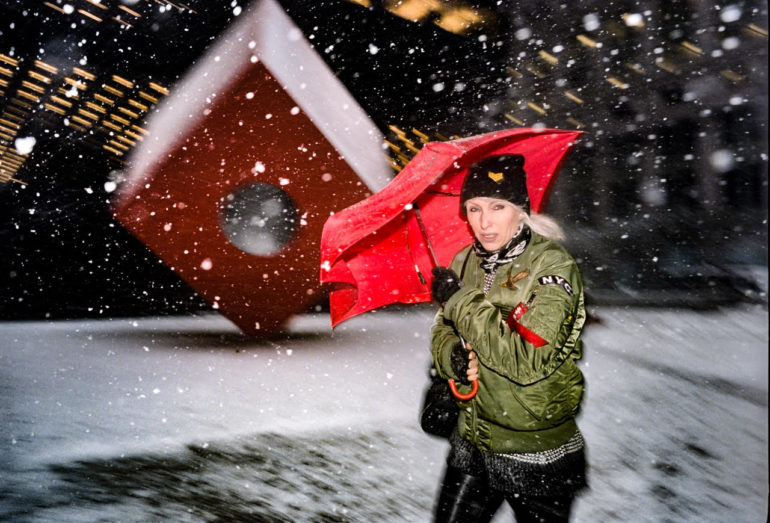
Adam Miller’s photographs reveal precisely why taking your flash out during a blizzard is essential. Not only does the snow appear like diamonds falling from the sky, but it also adds more depth to the photograph. Without the flash, this image would have given you the same impact as it does now. For instance, you would not be able to see the separation you see now between the woman and the background. Plus, with the help of the slow shutter and such a distinction between the backdrop, it makes you question whether it is photoshopped or real.
However, the most stand out part is the expression on the woman’s face. Without a flash, seeing every little line on her face would not have been possible. She looks like a deer caught between the headlights, and that’s why this image stands out so much. The color pops up more and adds another layer to the photograph. It is precisely the opposite of what Saul Leiter would do when faced with snow. And that is why the image speaks to the viewers so much.
Speaking about his work, Adam Miller told us:
My general technique is to seek out people who look interesting to me, getting as close as I can while still maintaining some context. I shoot them in a total candid fashion with a pulsating flash. I seek out interesting expressions, the behavior of struggling through the extreme wind and annoying snow pellets, a particular fashion statement (or lack thereof!) or anything else that embodies New York City.
Ivan Tsupka
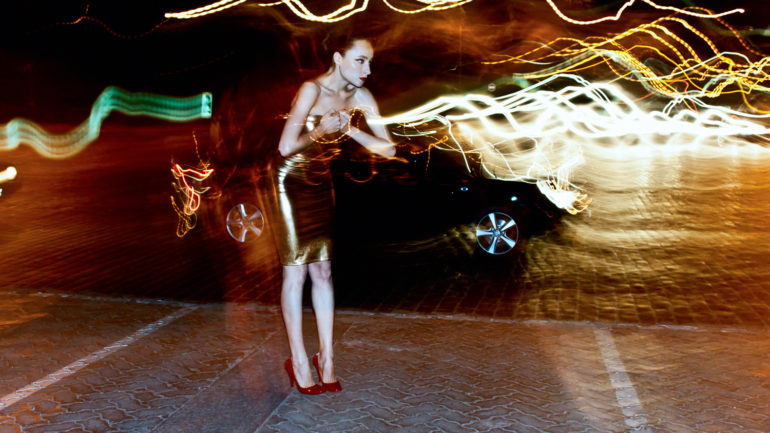
This is one of my favorite uses of flash photography. Let’s talk about how the long exposure with flash works wonderfully well. The moving street lights appear as if they’re coming right out of the model’s chest, which makes the image so enchanting. The lights at the top and then on the side also appear like magical threads, making this image appear like a modern fairytale.
The model’s hands and expression are serious, which adds to the whole aura. In fact, the shine of her golden dress is where the eye draws the viewers, too. The color of her heels is very well matched with her lipstick, creating a beautiful palette of red and gold. It would have been better not to have the car in the back, but I think we can distinguish between the golden road and the model due to its color.
In his words, Ivan Tsupka told us:
It took me more than one hundred clicks to understand where cars should be at the when pressing the shutter and how to move a camera to get the light patterns I imagined for these pictures. Next hour or two I shot about three hundred extra frames to choose ten final images later. I called that series “Flashing Lights”.
Weegee

Born as Usher Fellig, then changed his name to Arthur Felling at 10, Weegee earned this nickname as he always arrived early at crime scenes. A photojournalist who captured gruesome black-and-white images of New York, Weegee was a master of flash photography. In the 1930s, flashes were not as compact as today but worked like a torch. By that, we mean you need to light up the magnesium metal, for which Weegee used flash powder on an alcohol-soaked rag.
Weegee documented murder and turmoil, but what stood out was his use of geometry, such as shapes and lines, as well as unconventional angles and varied vantage points. The flash further added to his stark images, showcasing a gritty side of the city amidst the grandeur people knew it for. One can learn so much from him even today, as the city continues to have a rhythm of its own as it grapples with various challenges.
When I really see the picture is when I’ve developed the film. Then I really see what I’ve done. I really seem to be in a trance when I am taking the picture because there is so much drama taking place or will take place. I mean, you just can’t hide it—go around wearing rose-colored glasses. In other words we have beauty and we have ugliness. Everybody likes beauty, but there’s ugliness too.
Weegee
Gjon Mili

A LIFE magazine photographer, Gjon Mili was renowned for capturing movement in his images. Instead of a usual flash, the Albanian-American photographer created stroboscopic photography, where he would use electronic flash and long exposures to study movements and gestures. The technique was pioneered at the Massachusetts Institute of Technology, where he also learned engineering.
Unlike Eadweard Muybridge’s images, which were different shots of movement, Mili captured everything in one frame. People who have never tried long exposure should look at his pictures and try something different. While this style of photography may not seem unique today, you can use the method to explore new avenues.
My generation came at a time when photography was advancing by leaps and bounds, creating the impulse to experiment and to seek new approaches. After a decade I became fed up with the strobe because I had done most everything once and I didn’t want to repeat myself.
Gjon Mili
Ren Hang

As a Chinese photographer, Ren Hang’s legacy inspires many even today. Hang photographed his friends nude, but the images were often playful and provocative, usually highlighting the themes of expression and liberation. Many view his work as performance art and certainly call him a nonconformist. His photographs reveal a new meaning and where the nude form is celebrated instead of being shunned.
It was his style that earned him an excellent reputation in the West. He showed people a side of China many in the West are unaware of. In fact, one could see the influence of Guy Bourdin and Araki, a controversial Japanese photographer, in his work. Furthermore, he uses a powerful flash, which removes details in highlights and creates a retro aesthetic. One can use a similar form to create interesting self-portraits, which can help show the world how one feels.
It is very difficult to shoot nudes in China. People are more bound by traditional and conservative attitudes toward the body. They think it’s a degradation, even a demoralization, to show what they think should be private. They generally abhor nudity here. We hide the body in our culture.
Ren Hang
David LaChapelle

David LaChapelle is best known for his colorful portraits of celebrities. However, what you see is an interplay of humor, sensuality, and a touch of surrealism and pop culture. His photographs challenge the norm of how one captures a portrait, and his maximalist style leaves you wanting more. His work is so distinct that Helmut Newton, an iconic fashion photographer, said about LaChappelle: “A lot of the nudity is just gratuitous. But someone who makes me laugh is David LaChapelle. I think he’s very bright, very funny, and good.”
Although his portraits are largely indoors, LaChapelle does not limit himself to just one light. You look at any photograph, and you see multiple sources of light. The flash will light up his subjects, but his main strength is in the expansive backdrops and stylized images. Of course, this kind of work takes a whole crew to set up and shoot, but we thought it would be the best to include him in our list of flash photography inspirations as his style can help you create something truly unique.
I was working in this very bombastic style. I didn’t really know about style. I didn’t think about it: I did what I was interested in, what I was attracted to, what I was drawn to. I was drawn to color, and I was drawn to humor, and I was drawn to sexuality and spontaneity. It was all really intuitive. I never really thought, ‘Well this is the style…’
David LaChapelle
Get rid of the ads!
Did you enjoy reading this article as much as we enjoyed writing it? There's a way to support us and our reporting, getting ad-free navigation and more as a bonus. Subscribe to us for less than a coffee per month —just $3.99— or take advantage of our yearly subscription with a hefty discount for only $25.- An ad-free experience
- A free mystery box for Lightroom or Capture One
- All the books in our store
- 20% discount on Capture One
- 30% discount on Imalume Photo Theft Protection
- 20% off Herbs and Kettle Tea Company.
- 20% off your order from MPIX printing services.
- 5% off Viltrox Products via their eCommerce store.
- 10% off all film developing, printing and scanning services from Blue Moon Camera and Machine
- 15% off 7Artisans products: The lens and accessory maker is offering a sweet discount for Phoblographer's readers.
- 15% off a VSCO One subscription: Get a bunch of great tools with their all-in-one package.


