


Have you been curious about the kind of cameras that trend due to search results? While full frame cameras have been quite popular amongst many, there is also growing demand for small sensors, with much of it due to social media and rising prices. In the past year, Fujifilm has been a company that consistently dominated search bars, in fact, even beating Canon to some extent. Have a look.
If you look at the past year on Google Trends data, you see how one camera dominated the charts: the Fujifilm X100VI. It was not just in the United States but across other regions, such as the United Kingdom, Germany, Japan, and India as well. When compared to the Sony a6700, the Ricoh GR IIIx, the Canon R50, and the Nikon Z50II, the Fujifilm X100VI showcases positive results, with only Canon being the closest to match it.
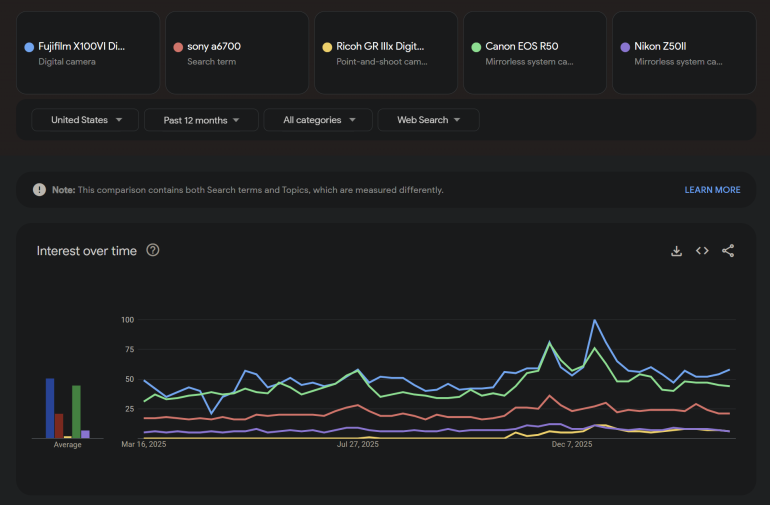
The data showcases results from March 2025 to March 2026. Across the United States, the X100VI is at the top, followed by the Canon R50. The latter managed to reach the top for a bit, but that eventually declined in recent weeks. Similarly, in the UK and Germany, the gap between the two is more pronounced.


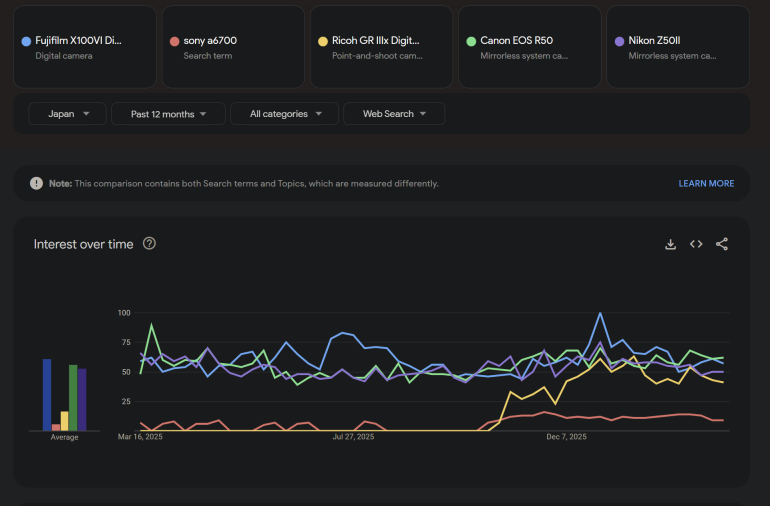
On the other hand, Japan seems to have the most interesting trend. The Fujifilm X100VI, Canon EOS R50, and Nikon Z50II are all quite close to one another in the search department. This makes sense since Japanese users are diverse, and their needs also change based on what they want to shoot.
However, the only market that showcases a sharp divergence is India. The Canon R50 dominates the charts, followed by the Sony 6700 closely. The X100VI sits really low, perhaps due to the fixed focus lens. This also proves how India is a price-sensitive market, and many young photographers will choose a more basic entry-level camera over what is trending on social media.
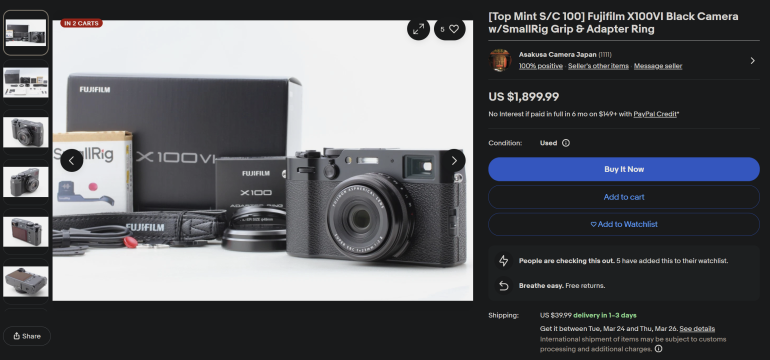
So, what is driving Fujifilm sales even now? A quick look on eBay will showcase how the X100VI is still priced close to $2000, which is close to the price listed on Amazon. This showcases a $400 increase, since the original price was $1,600. While the camera offers a 40MP sensor, the biggest drawback is that the device offers more features for video use than for actual photographers. If you have read our Fujifilm X100VI review, you are aware of how low the camera scored in our tests. As we have said in our review:
The Fujifilm X100VI exhibits the happiness of a forgotten plant in a bachelor pad. Fujifilm’s smallest division could’ve strove for excellence, but they settled for mediocrity and algorithmic staleness. The dream isn’t only gone here, it’s been wiped from your memory and sold to you at a discount worthy of the pity one has for starving college students.
While the X100 has always been a cultural object, the X100VI purely went to cater to a much younger, social media-active crowd, and that still works for them. In the US, specifically, the numbers showcase how Americans are not making decisions primarily on price point. There are other driving factors, which may include the need for a film simulation, more megapixels, and a smaller setup. Similarly, the sharp spike towards the end of 2025 also showcased how people opted for Fujifilm during the holiday season as well.
The biggest lesson here is that camera purchases are increasingly driven by social media identity and aesthetic aspiration for many young photographers. These are usually people who need a camera to make images for the web, and they do not look for technical greatness in the photos. In that regard, the X100VI is a camera that people are keen to be seen holding. And other than Fujifilm, nobody is listening to these photographers.
Get rid of the ads!
Did you enjoy reading this article as much as we enjoyed writing it? There's a way to support us and our reporting, getting ad-free navigation and more as a bonus. Subscribe to us for less than a coffee per month —just $3.99— or take advantage of our yearly subscription with a hefty discount for only $25.- An ad-free experience
- A free mystery box for Lightroom or Capture One
- All the books in our store
- 20% discount on Capture One
- 30% discount on Imalume Photo Theft Protection
- 20% off Herbs and Kettle Tea Company.
- 20% off your order from MPIX printing services.