

Last Updated on 07/24/2013 by Chris Gampat

After an exhaustive amount of time, we’ve finished reviewing the Olympus OMD EM5, Sony NEX 7 and Fujifilm X Pro 1. Each camera has their own strengths and weaknesses and represents the pinnacle of what each company has tried to achieve so far in the mirrorless camera market. With all of them being targeted at the high end enthusiast/semi-professional, they all bring a unique set of features to the table that makes them all appealing to various types of shooters. But in the end, only one can actually be called the current king of the crop.
This post is a result of the findings of various exhaustive tests, the least amount of pixel-peeping possible, and based on how someone may actually use the cameras.
Now, let’s dive right in.
Editor’s Note: All of these cameras have had significant time to have firmware updates, and so we are updating our findings in bold and italics.
Tech Specs
X Pro 1
Specs borrowed from the B&H Photo Video listing
| AV Recording | |
|---|---|
| Video Recording | Yes |
| Audio Recording | With Video, Stereo |
| Focus Control | |
|---|---|
| Focus Type | Auto |
| Focus Mode | Single-servo AF (S), Continuous-servo AF (C) 1 |
| Autofocus Points | 49 |
| Viewfinder/Display | |
|---|---|
| Viewfinder Type | Optical, Electronic |
| Display Screen | 3.0″ Rear Screen LCD (1230000) |
| Screen Coverage | 100% |
| Exposure Control | |
|---|---|
| ISO Sensitivity | 200-6400 (Extended Mode: 100-25600) |
| Shutter | Type: Mechanical Speed: 30 – 1/4000 sec |
| Metering Method | Spot metering, Average metering, Multi-zone metering 2 |
| Exposure Modes | Modes: Aperture Priority, Manual, Program, Shutter Priority Compensation: -2 EV to +2 EV (in 1/3 EV steps) |
| White Balance Modes | Auto, Fluorescent (Day White), Fluorescent (Natural White), Fluorescent (White), Incandescent, Kelvin, Underwater 3 |
| Flash | |
|---|---|
| Continuous Shooting | Up to 6 fps |
| Dedicated Flash System | iTTL |
| External Flash Connection | Hot Shoe |
| Performance | |
|---|---|
| Self Timer | 10 sec, 2 sec |
| Connectivity | HDMI C (Mini), USB 2.0 |
| Power | |
|---|---|
| Battery | 1x Built-in Rechargeable Lithium-ion Battery |
| Operating/Storage Temperature | 32 to 104 °F (0 to 40 °C) Humidity: 10 – 80% |
| Physical | |
|---|---|
| Dimensions (WxHxD) | 5.5 x 3.2 x 1.7″ / 139.70 x 81.28 x 43.18 mm |
| Weight | 15.9 oz / 451 g |
Sony NEX 7
Taken from B&H Photo’s listing of the lens
| AV Recording | |
|---|---|
| Video Recording | Yes, NTSC |
| Aspect Ratio | 4:3, 16:9 |
| Audio Recording | With Video, Stereo |
| Focus Control | |
|---|---|
| Focus Type | Auto & Manual |
| Focus Mode | Single-servo AF (S), Continuous-servo AF (C), Manual Focus (M) |
| Autofocus Points | 25 |
| Flash | |
|---|---|
| Continuous Shooting | Up to 10 fps |
| External Flash Connection | Proprietary |
| Power | |
|---|---|
| Battery | 1x NP-FW50 Rechargeable Lithium-Ion Battery Pack |
| Physical | |
|---|---|
| Dimensions (WxHxD) | 4.72 x 2.63 x 1.69″ / 11.99 x 6.69 x 4.28 cm |
| Weight | 10.3 oz / 292 g Camera body only |
Olympus OMD EM5
Specs taken from the B&H Photo listing of the camera
| Imaging | |
|---|---|
| Lens Mount | Micro Four Thirds |
| Camera Format | Micro Four Thirds (2x Crop Factor) |
| Resolution | Effective Pixels: 16.1 Megapixels |
| File Formats | Still Images: JPEG, RAW Movies: AVI, MPEG-4 AVC/H.264, MOV |
| Bit Depth | 12-bit |
| Dust Reduction System | Y |
| Noise Reduction | Yes |
| Memory Card Type | SD SDXC 1 |
| Image Stabilization | Mechanical |
| AV Recording | |
|---|---|
| Video Recording | Yes |
| Aspect Ratio | 4:3, 16:9 |
| Audio Recording | With Video, Stereo, Via Optional External Mic 2 |
| Focus Control | |
|---|---|
| Focus Type | Auto & Manual |
| Focus Mode | Single-servo AF (S), Continuous-servo AF (C), Manual Focus (M) |
| Autofocus Points | 35 |
| Exposure Control | |
|---|---|
| ISO Sensitivity | Auto, 200-25600 3 |
| Shutter | 1/4000 – 60 seconds |
| Remote Control | RM-UC1 (Optional) |
| Metering Method | Spot metering, Center-weighted average metering, Multi-zone metering |
| Exposure Modes | Modes: Aperture Priority, Auto, Manual, Program, Shutter Priority Compensation: -3 EV to +3 EV (in 1/3 EV steps) 4 |
| Flash | |
|---|---|
| Max Sync Speed | 1 / 250 sec |
| Dedicated Flash System | iTTL Groups: 4 Channels: 4 |
| External Flash Connection | Hot Shoe |
| Performance | |
|---|---|
| Connectivity | AV Output, DC Input, HDMI D (Micro), USB 2.0 5 |
| Power | |
|---|---|
| Battery | 1x BLN-1 Rechargeable Lithium-Ion Battery Pack |
| AC Power Adapter | AC-3 (Optional) |
| Operating/Storage Temperature | 32 to 104 °F (0 to 40 °C) Humidity: 10 – 90% |
| Physical | |
|---|---|
| Dimensions (WxHxD) | 4.8 x 3.5 x 1.7″ / 12.19 x 8.89 x 4.32 cm |
| Weight | 15 oz / 0.43 kg |
Ergonomics
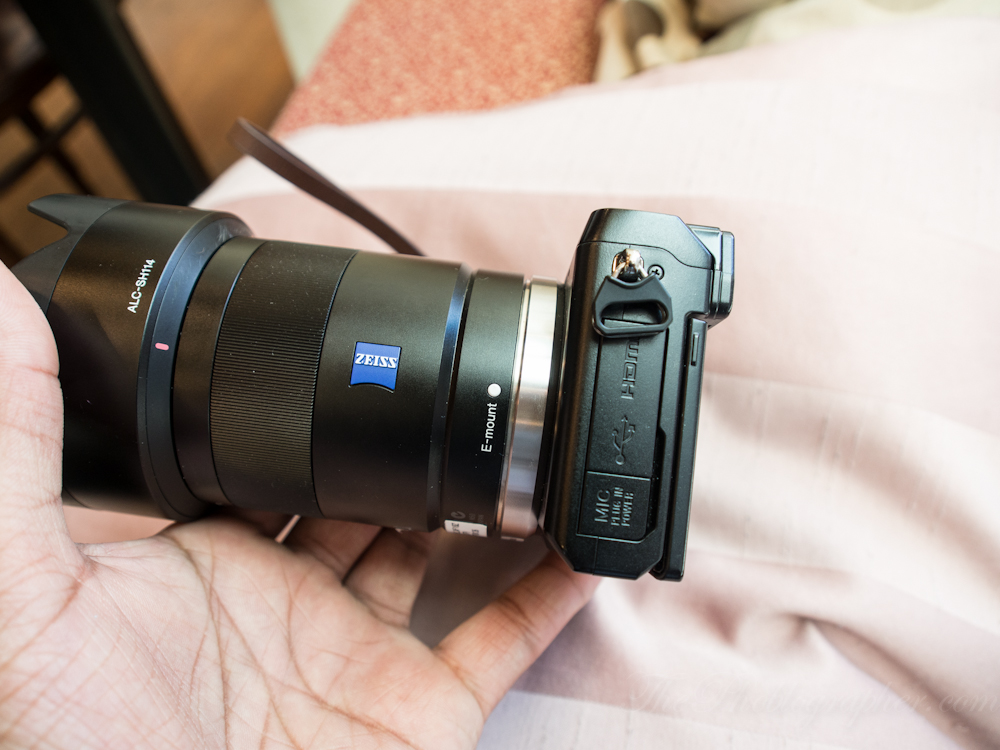
Sony NEX 7: The NEX 7 is characterized by three main dials that control various things depending on what mode you’re in. In full manual they control ISO, shutter speed and aperture. Otherwise, there is a nice hand grip to it, an excellent viewfinder, and overall layout that makes you feel like Sony/Minolta took a rangefinder, updated it for modern needs and fused it a bit with a cyborg.
Just be ready to memorize buttons: many of which are programmable. Also major props to the full tilt screen.
Fujifilm X Pro 1: For users that yearn for the old school feel of a good Contax G2 and Leica rangefinders, this is the camera for you. The dials and aperture ring around the native lenses will give users the full rangefinder experience for the most part. Even the viewfinder is very nice. There are also very few buttons on the camera.
Olympus OMD EM5: With a design that is reminiscent of the old OM SLR cameras, the OMD is a bit different than the other two cameras in this battle. The dials are all in great places and it is also the only camera of the three with a full touchscreen. The screen is just as versatile as Sony’s. It is also the only weatherproof camera in this battle.
Winner: In real life use, and after consulting a couple of members on the staff, we feel like the Sony NEX 7 has this one won. Many of us went on a personal photowalk recently and got to hold and try the cameras. The NEX 7 was the most comfortable in the hand after prolonged use due to the size, weight and the grip design.
Focusing

Sony NEX 7: The Sony NEX 7 has the option of manual focusing (which is the best in class) focusing on a certain area, a specific point, or the entire range. By far, it is the smartest of the NEX line in terms of determining what you actually want to focus on based on your actual composition.
Not only that, but it is also super fast to focus.
Fujifilm X Pro 1: The X Pro 1 has the slowest focusing and oftentimes even misfocuses. However, it has a major advantage in making selection of a specific autofocus point very simple to do. Update: As of July 2013, the X Pro 1 has significantly improved, but still can’t touch the OMD and NEX 7.
Olympus OMD EM5: The EM5 the fastest focusing camera of all of them. When it comes to manually focusing, it does not have peaking like the NEX 7 but the viewfinder is so well define that you often don’t even need it. That’s coming from me: a guy that wears glasses. Plus selecting a focusing point can be done quickly through either the button interface or using the touchscreen.
Winner: The EM5 wins not only for fast focusing, but also the ability to get the focusing right the first time in a speedy fashion.
Ease of Use

Sony NEX 7: The Sony NEX 7 is extremely simple to use once you sit there and program all the buttons to do exactly what you want. Then it is just a bit of muscle memory and praying that you don’t need to go through the NEX menus, which can be a bit tedious.
Fujifilm X Pro 1: Aperture, shutter speed, ISO settings, drive, autofocus type, autofocusing points, and playback all with the touch of a button. What else could you ask for? The menu system is also very, very clear cut and perhaps the easiest of all the systems.
Olympus OMD EM5: The EM5 is interesting in that there isn’t necessarily one clear cut way to do anything but instead multiple ways. In terms of menu navigation and getting something done quickly, that is actually pretty darn cool. For example, one can use the touch screen to set the flash intensity or use the button navigation system. Versatility is key here, and Olympus delivers that very well. To boot, there are tons of programmable buttons and you’ll just need to develop the muscle memory.
Winner: This is a tie. The OMD and X Pro 1 both win for the Fujifilm’s ability to put what you need right where you want it but Olympus’s ability to give you the flexibility you want without needing to dig through menus in search of El Dorado.
Lens Selection
Sony NEX 7: Sony’s NEX 7 has a ton of adapters available. They even have an adapter to allow phase detection focusing with Alpha lenses. Plus, Sigma and other manufacturers produce lenses for them already.
Fujifilm X Pro 1: Being the late comer to the game, they still have yet to develop their system but do have third party additions already.
Olympus OMD EM5: Due to having the smallest sensor of the three here, the camera also has the ability to mount nearly anything you could possibly think of. They also embraced the third party community right out of the door.
Winner: The Olympus OMD EM5 wins with no problems.
Image Quality

Sony NEX 7: The NEX 7 put out some of the most impressive image quality I’ve seen to date with a Sony camera. In the right lighting conditions, the 24MP sensor shines quite a bit.
Fujifilm X Pro 1: The X Pro 1’s image quality stayed true to all of the different film emulsions that the company put out before. For those that adhere to the old school way of things, this will help you to predict what your images will look like and a little bit about how to treat the sensor when shooting.
Olympus OMD EM5: The EM5 reminds me of Kodak Portra so much, and I’m absolutely smitten with this fact.
Winner: This is a very, very tough one. Each camera has a ton of color depth and dynamic range versatility. From a technical standpoint, the NEX 7 and Fujifilm X Pro 1 kill the Olympus EM5 OMD. However, I know that in real life use, that none of that means anything. Instead, Olympus’s sensor renders images that look just like film. Personally, I love that. If I really, really had to give this decision to one company though, then the Olympus OMD EM5 would win if paired with the right glass like the Voigtlander 17.5mm f0.95 lens. With any lens attached though, I really do have to admit that I’ve fallen head over heels from the Sony NEX 7.
Update: As of July 2013, we changed our minds to the X Pro 1. With the improvements to Lightroom and Capture One, the image quality has become even more versatile and more potential has been unleashed.
High ISO Results

Sony NEX 7: The NEX 7 controls noise fairly well and gives a tight grain structure.
Fujifilm X Pro 1: The X Pro 1 smudges the details a bit, but overall does a great job on noise control.
Olympus OMD EM5: The EM5 is finally the Micro Four thirds camera that does well at high ISO settings and that one can use with no problems for professional reasons.
Winner: Despite the fact that there is a bit of smudging, I can often recover the details in Adobe Lightroom 4. With all this said, I thoroughly enjoy the X Pro 1’s rendition.
RAW File Versatility

Sony NEX 7: The NEX 7 raw files are very, very versatile and in real life use only require a tiny bit of massaging to get the look that you really want.
Fujifilm X Pro 1: The X Pro 1 is capable of some outstanding things when it comes to colors.
Olympus OMD EM5: The EM5, while very versatile, will create lots of problems when it comes to drastic amount of color changes and balancing. However, the colors straight out of the camera are often very good and don’t require a ton of editing though much can be brought out of them.
Winner: Again, Fujifilm takes the cake here with the fact that the RAW files are pretty much just as versatile as my Canon 5D Mk II’s.
Universal Support of Third Party Accessories

Sony NEX 7: Sony has partnered with a couple of companies so far, but they honestly need to be pushed a lot more in this respect. Their hot shoe also really limits them.
Fujifilm X Pro 1: At the moment of publishing this piece, Fujifilm has a lot of work to do.
Olympus OMD EM5: When the Micro Four thirds standard was announced, they partnered with a ton of companies to create accessories and support for the system. And overall, they done a damned good job.
Winner: The Olympus OMD EM5 wins my heart in this case.
Conclusions
In truth, any one of these cameras will get you the image results that you want and need. But the major push to get one over the other are the extra features like:
– Fujifilm’s optical viewfinder
– Olympus and Sony’s excellent electronic viewfinders
– Sony’s peaking mode for third party lenses
– Olympus’s weathersealing and ultra fast auto focus
– Sony’s top notch ergonomics
– Olympus’s universal support
– Fujifilm’s bar none image quality
– And…the price.
In terms of standpoints, the OMD is the most affordable with the Sony NEX 7 coming in second and the Fujifilm X Pro 1 taking the cake as the most expensive. This also depends on current lens investments. As it stands, Olympus seems to be able to keep up with the demand the most at the moment, so that may be the one to spring for.
But at the end of the day: I’ve personally bought the X Pro 1 with the NEX 7 and OMD coming in the near future. But if money were no object, I’d spring for the NEX 7 for the resolution. However, I would have to get adapters and also perhaps switch over my entire current lighting kit. That’s just my opinion though.
Update: As of July 2013, we’re changing our minds to the X Pro 1 due to the fact that the lens system is continually growing at a fast pace and the image quality and focusing have vastly improved. Indeed, we consider it the best long term buy that you can possibly go for at this point.
Please Support The Phoblographer
We love to bring you guys the latest and greatest news and gear related stuff. However, we can’t keep doing that unless we have your continued support. If you would like to purchase any of the items mentioned, please do so by clicking our links first and then purchasing the items as we then get a small portion of the sale to help run the website.