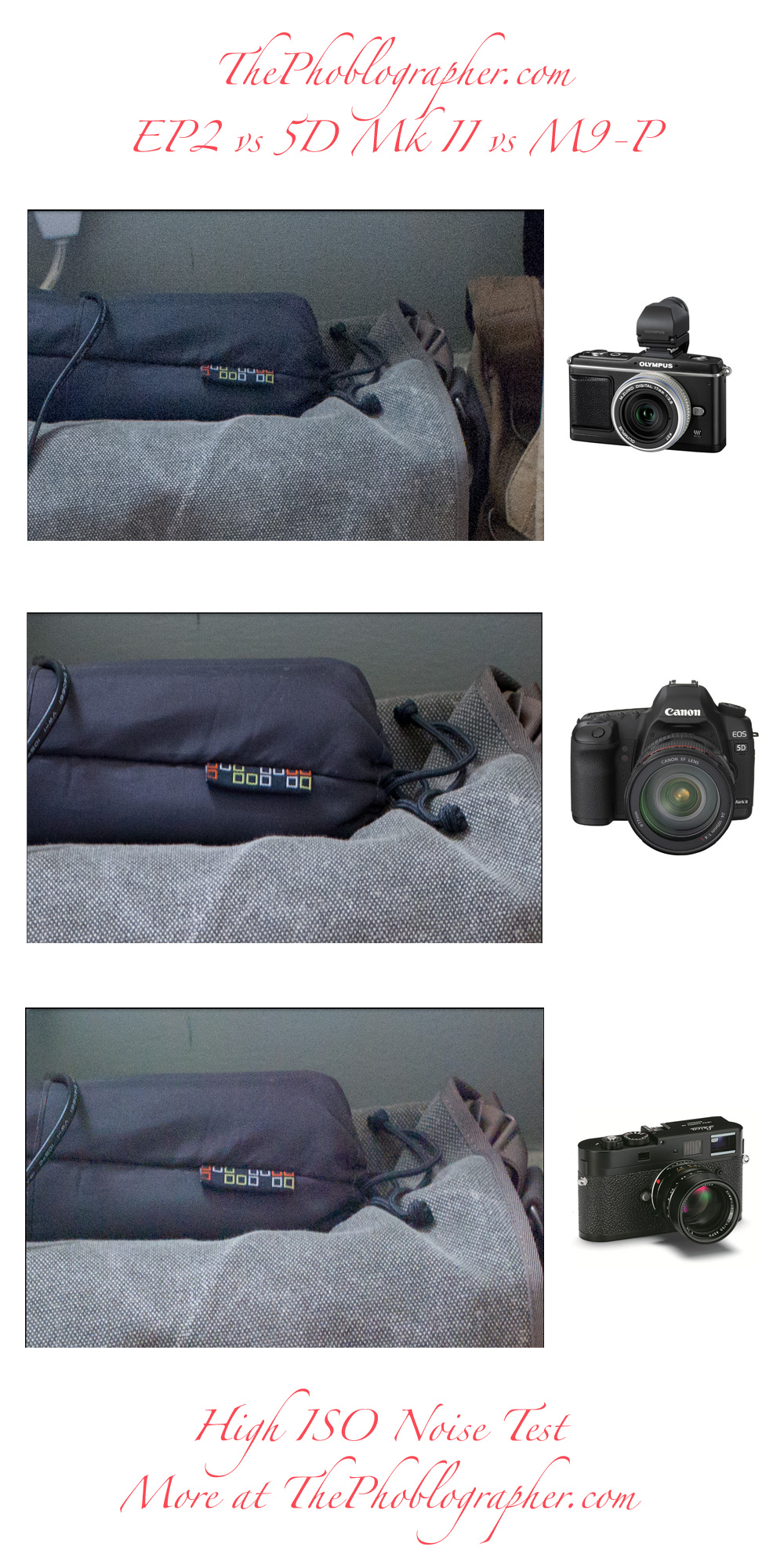
High ISO Noise Test: Olympus EP2 vs Canon 5D Mk II vs Leica M9-P

by Chris Gampat on 07/30/2011

With the Leica M9P(or M-9P and M9P) around for a little while, I decided to put it up against my trust Canon 5D Mk IIand the Olympus EP2(or E-P2 and EP-2)  to see how the high ISO noise levels are. Granted, all three of these are different cameras: one is an EVIL camera, one is a DSLR and the other is a rangefinder. They are all used in different ways, but one of the complaints that many people state on street photography, photojournalism, and wedding forums is that the 5D Mk II is the only one with good enough high ISO capabilities.

Well, is it? Take a look at our non-scientific test and judge for yourself.

Conditions

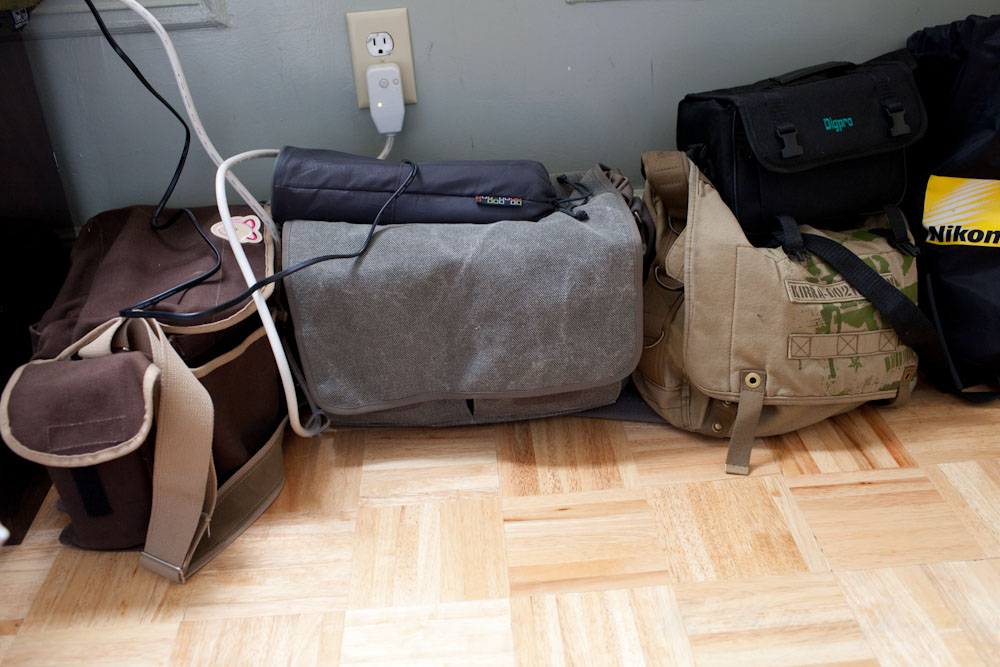
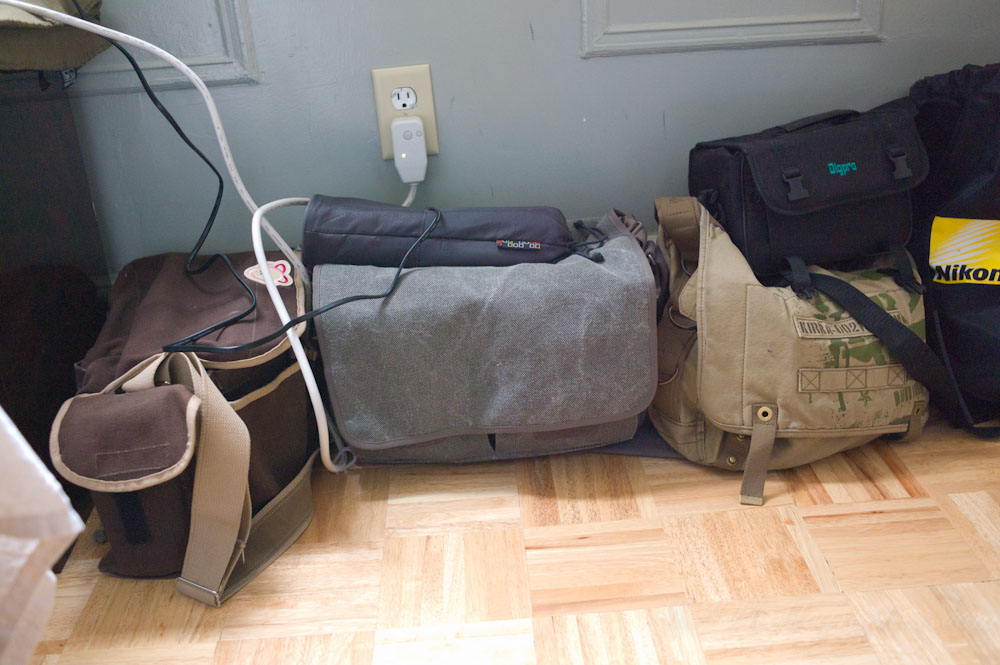
Each camera was set to around the certain levels at ISO 2500 and with the attached lens being set to F/4. The Leica and the Olympus both stated that 1/25 would be the correct shutter speed with the Canon stating that it would be 1/20th. The reason for the differences in the metering was because I metered each scene to what the camera thought was balanced. Either way, they were all set on a tripod and took approximately the same photo.

In post-production, the 5D Mk II was set to match the exposure levels of the other cameras while the M-9P and EP2 were set to match the 5D Mk II’s white balance.

The Canon 5D Mk II had the 35mm f1.4 L (reviewed here) attached. The Leica M9P had the 35mm f2.5 Summarit attached. Finally, the Olympus EP2 had the 17mm f2.8 attached.

Each camera was set to capture photos at the 3:2 aspect ratio.

No other processing was done except for resizing the photos down below for the web.

Purpose of the Test

The purpose of the test is to hopefully answer the questions of users on forum after forum that ask whether they should get a DSLR, rangefinder or Micro Four Thirds camera for their photography. Indeed, they all do different jobs and have different characteristics. However, in a world where everyone has rangefinder lust, loves retro looking cameras, and where everyone is trying to predict the end of the DSLR, hopefully this test will go to show the capabilities of each.

The Results
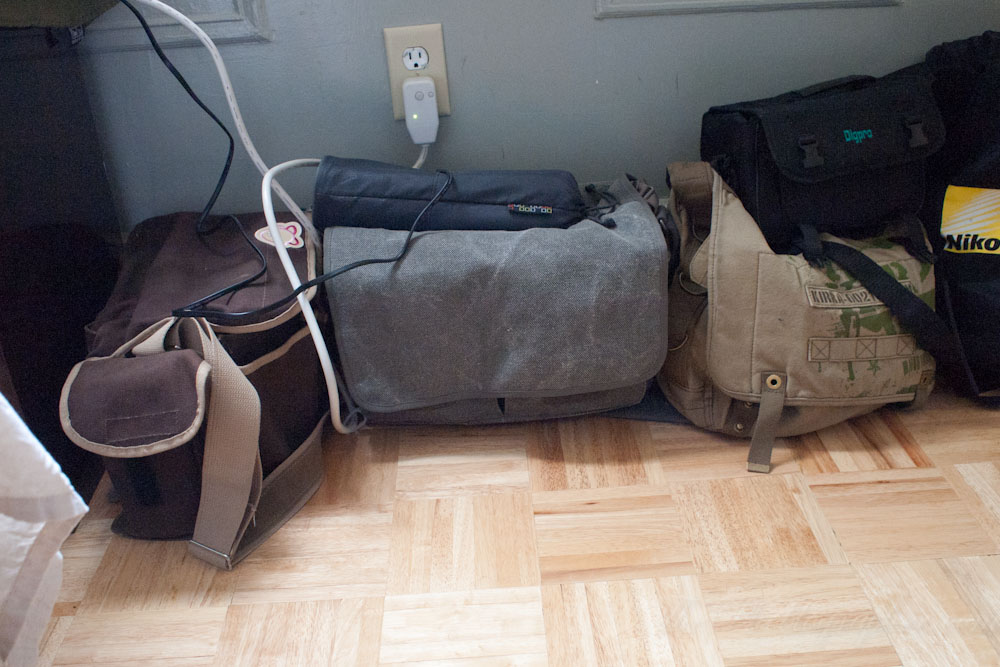
Olympus EP2 1/25 f4 iso 2500

Canon 5D Mk II 1/20 f4 iso 2500

Leica M9-p at 1/25 f4 ISO 2500

Findings

As you can see from the test, the Canon 5D Mk II is the clear winner with the cleanest ISO readings at 2500. Canon 21MP sensor and DIGIC IV processor does an excellent job—which only harkens back to the fact that even three years after it was announced it is still a force to be reckoned with.

Interestingly, the EP2 and M9-P are almost neck in neck. The M9-P wins as far as showing less overall noise but there is some really nasty color noise especially in the blacks. In contrast, the EP2 is a bit noisier but with less color noise. Both cameras use CCD sensors from Kodak, so this is a very interesting test to see (edit, just to clarify: we’ve been told by Olympus technical reps before that the LiveMOS sensor is a CCD with lower power consumption.)

2nd edit: Olympus Australia contacted me via twitter and stated that the sensor is a MOS sensor and not a CCD. This goes against what an Olympus America rep had told me before. I did some more research into it, and still am working on that. Then I saw a forum on DPReview linking to this post and debating it themselves. At the moment, I’m not exactly sure what to think but I will go with the statement that Panasonic produces the sensor and that it is a MOS sensor.

With this said, I think we need to consider some extra evidence. The fact that there is little to no jello effect with the EP2′s sensor and the Panasonic GH2′s while recording video is quite interesting. In contrast, the EP3′s sensor shows quite a bit of jello while recording video: at least it did when I was working with it. So with this said, I believe that the sensor is not CMOS as everyone else has been saying. CMOS sensors show much more pronounced jello.

Either way, whomever manufactures the sensor or what type of sensor it is should not lead you astray from the results of this quick test. Oh, and don’t act like you don’t ever not sit there and just take photos of random things around your room ;)

Translation into Real Life (As far as ISO results are Concerned)

Wedding Photographers- You are less likely to actually need to convert to black and white with the 5D Mk II. Additionally, you’ll be happy that saving the exposure of the files will be easier due to the larger dynamic range.

Photojournalists- Same as wedding photographers.

Concert photographers- focusing a rangefinder in dim light can be extremely tough to do. Stick with hyperfocal length focusing or use the DSLR instead.

Sports photographers- the DSLR is king. End of story

Landscape photographers- the DSLR will give you the image quality you’ll need. If Ansel Adams can take glass plates into the Arctic, you can do this.

If you’d like to read more, check out how the 5D Mk II vs 7D vs EP3.

Please Support The Phoblographer

We love to bring you guys the latest and greatest news and gear related stuff. However, we can’t keep doing that unless we have your continued support. If you would like to purchase any of the items mentioned, please do so by clicking our links first and then purchasing the items as we then get a small portion of the sale to help run the website.

  • Corwin Black

    EP2 .. sensor from Kodak? Where youve been last ehm.. 6 years? Its Panasonic sensor, hybrid between CCD and CMOS (have worst of both, low light performace of CCD and colors of CMOS :D ).

    Leica is actually better, easier to clean up 18 mpix than 12. And at base ISO it just wipes floor with any m4/3s. Though it does with pretty much everything except medium format.

    Btw. sure 5DMK2 has decent noise performace at this ISO.. if you dont look at 100% view. 21 mpix is what does that trick. But truth is that it cleans really easy via PP. More mpix = easier to clean (unless its A900 on some high ISO).

    • Anonymous

      The sensor itself is made by Kodak, the design is by Panasonic. Two different things. Same with Nikon and Sony with certain cameras. The point of a LiveMOS sensor was to use CMOS sensor levels of energy consumption while maintaining CCD levels of image quality. CCDs can still do a very good job, just look at the medium format cameras of today.

      The Leica M9P isn’t easier to clean up due to the color banding and other color noise issues that it suffers from. The X1 on the other is not like that, and it is 12MP.

      Even if you look at the images at 100% it still has great high ISO performance. Take a look in the opening image for this story. It does clean up easily via post production, but so do other cameras like the Nikon D700 and the Sony NEX C3 that I’m testing now.

      -Chris Gampat
      Editor in Chief, ThePhoBlographer.com
      Twitter.com/ChrisGampat

      • Eamonhickey

        I think Olympus’s original marketing of the “Live MOS” sensor is potentially a bit confusing. What Olympus has given the trade name of “LiveMOS” is simply NMOS — Negative-channel Metal Oxide Semiconductor. It’s a form of MOSFET circuitry logic, like CMOS (Complementary Metal Oxide Semiconductor) and PMOS (Positive channel MOS). A CCD is a much different animal.

        Olympus was promoting the idea that NMOS allowed them to give each pixel a larger light-sensitive area than CMOS architecture allows (i.e. close to what is typical for CCD pixels), and that should theoretically improve noise, dynamic range and other qualities. 

        But not all CMOS sensors are the same (i.e. some are much better for imaging than others), and these things can be tested without relying on theory. And when tested, CMOS sensors from Canon and Sony have, so far, been able to compete quite well, of course.

        Also, I’m very dubious that Live MOS sensors are manufactured by Kodak. Everything points to Panasonic, so I suspect maybe the person(s) who told you that was under the wrong impression. 

        • Anonymous

          I’ll check again, but that came straight from an Olympus technical rep’s mouth. It’s Sunday, so it will take some time for them to get back to me.
          As for who manufactures the sensor, I’m very positive that’s it. Kodak is also part of the Four Thirds and Micro Four Thirds alliance. And that’s their role.

          -Chris Gampat
          Editor in Chief, ThePhoBlographer.com
          Twitter.com/ChrisGampat

          • Thom Hogan

            As far as I know, Kodak doesn’t make CMOS sensors that large any more (technically they did once when they bought Cypress/FillFactory), and NMOS is definitely in the CMOS family. Beyond that, it would be unusual for one company (Panasonic) to give another company (Olympus) the right manufacture proprietary IP (NMOS) at a third company (Kodak).

            But more to the point, the technologies in the m4/3 sensors and Leica sensors aren’t even remotely close. Your technical rep needs some retraining if they believe that the E-P2 and M9 sensors are related. One is a CMOS-type direct addressing architecture,  the other is a CCD frame architecture. It’s one of the reasons why the M9 doesn’t have Live View: Kodak has not built sensors that do that at video rates because they can’t subsample the pixels as CMOS designs do. Worse still, according to the primary news outlet for sensor technology, Kodak closed their CMOS line in 2009. At present, Kodak lists exactly one CMOS sensor being available: everything else is CCD inline, frame, or linear.

            Moreover, to believe this would also force us to believe that Panasonic farmed out sensors to Kodak for Panasonic products, which makes absolutely no sense. Panasonic has used the same sensor as is in the E-P2. Given that they have a large sensor fab of their own, it seems very unlikely they would contract out the fab to another company, let alone one they compete with for design wins.

            Kodak has indeed been part of the 4/3 alliance. I know they’ve sampled sensors as large as 18mp to Olympus for consideration. But AFAIK they have not had a design win in any camera to date. At the moment, the only Kodak-sensored cameras are medium format and Leica.

          • Eamonhickey

            Cool. Ask him/her to go on the record with that statement — i.e. you’ll publish their name when you report what they said. You may find that suddenly the information is less certain, but if you can get an on-the-record statement, that’ll be great.

            In my own many contacts with Olympus personnel from the U.S. and Japan (I’ve been briefed twice by Mr. Terada in the last two years, for publication), there has been no information whatsoever given about who actually fabricates Live MOS sensors, although, again, everything points to Panasonic.

            In the end, none of it matters. All that matters is how the cameras perform and what the pictures look like — which, as I said, is testable. And the more good sensors we have to choose from, the better, and Olympus, Panasonic, and Kodak are all formidable technology companies, so I expect good things to continue coming from them.

            • Anonymous

              In these hard economic times, I pray that you’re right.

              Chris Gampat,
              Editor in Chief
              The Phoblographer

        • Anonymous

          I’ll check again, but that came straight from an Olympus technical rep’s mouth. It’s Sunday, so it will take some time for them to get back to me.
          As for who manufactures the sensor, I’m very positive that’s it. Kodak is also part of the Four Thirds and Micro Four Thirds alliance. And that’s their role.

          -Chris Gampat
          Editor in Chief, ThePhoBlographer.com
          Twitter.com/ChrisGampat

  • Ranger 9

    There are SO many weird things about this “non-scientific test,” but I’ll act as if the results are meaningful and just observe two things:

    – The Leica and 5D are both 36×24 sensors, and the Leica has a lower pixel count, so its photosites should be even larger than the 5D’s. And yet it struggles to match the Micro 4/3 camera in terms of noise! This matches up with what shooters immune to Leica-idolatry have been saying all along: considering what you pay, the M9′s low-light performance is unbelievably lousy.

    I guess that’s why anybody who’s serious about low-light shooting, and has money to spend, uses a 5D or (better yet) a Nikon D3s, and why Leica — once known for superlative available-light documentary instruments — now pitches the M9 to landscape photographers looking for a compact “full-frame” body.

    – Actually, an optical-rangefinder camera is easier to focus *accurately* in poor light than almost anything else… IF you know how. That’s the real reason people still use them — that and the fact that there’s no viewfinder blackout during or after exposure, so you never lose sight of the subject. Some of us really need that. That’s why in tough situations I still pull out my creaky old Epson R-D 1, and why SOMEbody needs to make an optical-rangefinder camera with a state-of-the-art sensor in it (come on, Nikon, you KNOW you want to build an “SP-d”…)

    • Anonymous

      Hi Ranger,

      It is a weird test. I agree, but it’s absolutely accurate!

      The Leica’s photosites should indeed be larger than the 5D’s, but part of this has to do with the processing engine and algorithms as well which I’m positive you know. Getting back to your point though, I agree with the M9′s performance. However, I don’t think that that will hinder you enough from creating spectacular images.

      I’ve never heard of Leica pitching the M9 to landscape photographers but I’d be interested in hearing about what they say. Can you point me to a resource? Landscape photographers love their full frame and medium format sensors.

      Agreed on rangefinder focusing. But the thing is that most modern DSLRs focus very well in low light. You know what focuses better though? The Polaroid cameras with Sonar built in: providing you’re not shooting a subject that’s behind glass.

  • http://www.facebook.com/andy.piper1 Andy Piper

    I have a Canon 5D mk1 and Leica M9.  The 5d is way ahead in low light – no question.  That’s a little disappointing considering the price of the Leica.  I don’t even bother taking pictures with the M9 above 800 ISO.  The Leica goes with me a lot more places than the 5D does because of the size, and, most important, people just ignore you when you are taking photos with the M9 but tend to freak out when you whip out the 5D.

    Is there a better way to process photos from the M9 to remove noise?  I am using Lightroom.

    • Anonymous

      I’m using Lightroom 3 too.

      Notice all the purple noise? What I’m doing is using a combination of both noise reduction and desaturating the purple levels providing there is no purple in the scene. If I find that it’s taking away too much detail, I raise the sharpness and then artificially add film grain to make it look more like actual film and therefore more pleasing.

      No question the M9 is still good for covert shooting, providing you can use it correctly.

      Hope that helps. See my full review of the M9-P though.

      -Chris Gampat
      Editor in Chief, ThePhoBlographer.com
      Twitter.com/ChrisGampat

  • http://www.facebook.com/klarno Andrew Meilstrup

    Panasonic is one of the biggest semiconductor companies in Japan. If anything they’d be making sensors for Kodak, not the other way around.

  • Anonymous

    Amazing, the full and definite answer to what type of camera on should get, based on the single test of the high ISO capability…
    The forum people that find their answer here… they get what they deserve. No offence to the tester, you’re only providing the info based on the requests probably, I hope… ;-)

    • Anonymous

      You’re quite right. As stated though, this is a high ISO noise test.

      -Chris Gampat
      Editor in Chief, ThePhoBlographer.com
      Twitter.com/ChrisGampat

  • http://pulse.yahoo.com/_ZCIEMNATL63QNIQSQ4UWZMZYFI Kartik Mani

    Are you on crack???? The dynamic range on the M9P is really much better than the EP2. The gradations are much nicer with clearly better microcontrast. Luminance noise is more but from the appearance point of view, the third image clearly has a more natural appearance than the other 2. I am a microfourthirds enthusiast but this is delusional. This is pixel peeping without looking at the larger picture. 

    • Anonymous

      Who said that the dynamic range wasn’t better? The 5D Mk II’s dynamic range is what I say is better than the M9′s.

      Microcontrast comes from the lens good sir. It’s something Zeiss says. This test was only to test the high ISOs.

      Also, if you use the art filters, the image quality of the EP2 looks amazing as well unless you can edit to mimic those looks.

      -Chris Gampat
      Editor in Chief, ThePhoBlographer.com
      Twitter.com/ChrisGampat

    • Anonymous

      Who said that the dynamic range wasn’t better? The 5D Mk II’s dynamic range is what I say is better than the M9′s.

      Microcontrast comes from the lens good sir. It’s something Zeiss says. This test was only to test the high ISOs.

      Also, if you use the art filters, the image quality of the EP2 looks amazing as well unless you can edit to mimic those looks.

      -Chris Gampat
      Editor in Chief, ThePhoBlographer.com
      Twitter.com/ChrisGampat

  • Brightcolours

    Hmmm.,… Ever heard of lens equivalence? Your test is a bit nonsensical.

    You did try to use equivalent focal lengths.. (35mm on the FF cameras,  17mm on the Olympus (a 2x crop camera compared to the full frame 135 format from the Canon 5D mk II)).
    Equivalent focal lengths are nice, you get the same field of view.

    But.. what about equivalent f-values? The same aperture (opening) gives similar DOF. For that, you need to use equivalent f-values… so, if you use f4 on the FF cameras, use f2 for the MFT camera.  Or, if you use f4 on the MFT, use f8 on the FF 135 format cameras.

    This or course means that you have a shorter exposure time on the MFT. So, then also use an equivalent ISO setting for the MFT camera. I suggest you set the FF cameras to ISO 3200 and ISO 800 for MFT.
    if you wonder about equivalent ISO settings…. With similar apertures (equivalent f-values)  an equal amount of light falls through “the hole” of the lens. The sensor of the MFT camera is about 1/4th of the size, though, so the sensor will only capture 1/4th of the light. To counter that, the signal is amplified more to reach a similar “ISO setting”. ISO on digital cameras has nothing to do with sensor sensitivity.. only with equalizing different sensor sensitivities for the user.
    Anyway… this all means that ISO 800 on MFT is equivalent to ISO 3200 on FF 135 format. And ISO 100 on MFT equivalent to ISO 400 on FF.

    Now you will have equivalent focal lengths (similar field of view), equivalent f-values (similar aperture and DOF), equivalent ISO settings (and similar exposure times).

    And you will find that the Olympus you tested will perform better, noise wise, that you already found. Much better than the Leica, and probably close to what the 5D mk II shows.

  • Pingback: Olympus, Leica and Canon – noise comparision Sensitive Pixel – Photography, News, Digital Cameras Sensitive Pixel - Photography, News, Digital Cameras

  • Pingback: Which One? Sony NEX C3 vs Olympus EP3 at The Phoblographer

Previous post:

Next post: